Taxpayers Union: Teaparty wingnuts or rational economists?

Today saw the launch of the strangely named Taxpayer’s Union, a lobby group aimed at “giving taxpayers a voice in the corridors of power.”

Given the taxpayers, that’s all of us, already have a voice each three years and through various processes, the Taxpayer’s Union deserves a bit more scrutiny. Are they rational economists looking to help make government more efficient, or is it a right wing shop looking to promote the selfish interests of wealthy people?

From their Q&A page:

Our objectives and aims include:

To give taxpayers a voice in the corridors of power;
To educate New Zealanders against excessive and wasteful government spending;
To scrutinise government spending;
To publicise government waste;
To promote an efficient tax system; and
To increase transparency and accountability of government spending.

None of that sounds too bad at first read, but “excessive and wasteful government spending” could mean being smart about the details, or it could be code for “no more welfare but yes more roads”. Similarly “promote an efficient tax system” could mean reduce all taxes to rich people, or it could mean reduce the administrative burden of collecting tax. Or, as @farmgeek mentioned, it could be making sure that we are collecting our fair tax from offshore based corporations indulging in tax jurisdiction dancing.

The first initiatives of Taxpayers’ Union may give some clues:

Promote an ‘Armchair Auditors Act’, modelled on legislation enacted in some U.S. states, where all transactions over a de minimis amount are searchable on an online database;

Promote legislation strengthening the Official Information Act.

These are great. They may lead to petty chasing of ministerial expenses, but overall the more government data we can get into the public domain the better. (It seems they already have ours.)

Identify and expose the most flagrant examples of government waste;
End taxpayer funded corporate and union welfare;

The language here is problematic with “flagrant examples” and “corporate and union welfare” smelling a little inflammatory and feel-good stuff for the right, but not really adding to the overarching goal of evidence-based lawmaking. This is potentially very selfish stuff, but a lot depends on the cases they bring forward.

Expose and halt the significant public funding that lobby groups receive to campaign and lobby government for pet policy and law changes;
Promote legislation requiring local referenda for any increase in real per capita rates

These feel more selfish. I’m guessing that the money funding campaign and lobby groups is generally primarily for NZ’s social benefit, and that the TaxPayers Union has some specific targets in mind. The details matter, but just as we provide defence lawyers, so should we also give those without a voice the ability to be articulate in the halls of power. Lose the voices, and sooner or later the laws will swing in the direction of the hard right.

And local referenda are simply dumb dumb economics, as a cursory glance at the USA’s State of California will show. We elect politicians to make tough decisions on tax, and our system works as it removes the personal incentive to pay less tax in favour of ensuring that the long term benefits and public goods are delivered. This is short sighted selfish wingnuttery and is deal killer for me as it implies a lack of rigour.

A quick search found this record of requests received under the Official Information Act, from the Clutha District Council Agenda for August 2013.

What’s interesting (and credit open data from the council for this) are the other names surrounding David Farrar, Stephanie Morrison and Jordan Williams, all of whom are part of the Taxpayers Union crew. But also on that page are Matthew Beveridge, the ex VicNats Deputy Chair and executive member for Lower North Young Nationals and Aaron Letcher, a National Party aligned member of the University of Waikato Council and Waikato Student Union president. I suspect Aaron, asking about travel costs for an area well away from his purview and Matthew, who is fishing for spend on fireworks displays and flower arrangements amongst other things, are part of the wider team. Also on the page were Jamie Morton of the NZHerald, who is based in Tauranga looking for rates changes and Vanessa Forrest, a producer from Campbell live, was asking about churches. we will give them a pass, and wait for their articles to emerge. On the next page was a Rebecca Green, asking about post 1940 buildings on the heritage list, so we will see where that ends up.

I will note that the burden placed on that little council by the team is quite high, and hope they are aware of their impact. I wholeheartedly agree with the approach that all government data should be online (including our housing data that is currently sold) so that government bodies are saved from the burden of OIA data collection.

Overall I’m willing to wait and see what the Taxpayers Union comes up with, but with a core aim to “lower the tax burden on New Zealanders” and a focus on uncovering scandals it feels like a economically lightweight single cause group. It seems to lack people from parties other than National, accepts anonymous donations (giving instructions as to how) but has a $5 joining fee – which smells potentially of rich people paying for astroturfing. I really hope this is not be the case, but that’s what I’m seeing at the moment. Sorry David Farrar.

However compared to the craziness in the USA this very mild (not that it makes it right). For comparison here are the Tea Party’s 15 Non-Negotiable Beliefs. Imagine having this lot in control of parliament, and remember that they started out as an astroturf organisation that sounded almost rational.

1. Illegal aliens are here illegally.
2. Pro-domestic employment is indispensable.
3. A strong military is essential.
4. Special interests must be eliminated.
5. Gun ownership is sacred.
6. Government must be downsized.
7. The national budget must be balanced.
8. Deficit spending must end.
9. Bailout and stimulus plans are illegal.
10. Reducing personal income taxes is a must.
11. Reducing business income taxes is mandatory.
12. Political offices must be available to average citizens.
13. Intrusive government must be stopped.
14. English as our core language is required.
15. Traditional family values are encouraged.

Doing Business well, but we still do it better

The World Bank Group’s Doing Business report for 2013 is out, and New Zealand is again ranked at number 3.

I’ve highlighted on our report, below, the areas where we are clearly behind. However even in the areas where we do well, such as opening a business, we can do a lot better. It’s not just the government that needs to improve either – try opening a bank account for a new business – a process that seems to have become worse, not better.

This year introduces a new measure, connecting a 3 phase electrical circuit to a new warehouse, and New Zealand ranks an appalling 45th. That’s an indictment on several players no doubt, and I hope this is sorted quickly.

Another area to improve is paying taxes, which is measured as a combination of the number of business taxes to pay, the administrative burden to pay them and the rate. Let’s not touch the rate just to climb global ranks, but the administrative burden can certainly fall for businesses, especially employers. Private enterprise has a place here as well, with Xero and bank integration with IRD (potentially) making things a lot easier.

Overall our Doing Business ranking continues to be a great story that reflects some of the strengths about living in New Zealand. Long may we continue to improve.


<Update>

I see now that we were stung by the ACC component of tax. I wonder whether the accident management and costs were included for other countries – I doubt it. The time burden, set the same as GST, seems high to me, but I’m not sure what the burden is like for all.

I’d also wonder what tools that are used – with Xero and online filing and payment the burden drops a lot.

The not so free coffee

For now I have to focus on activities that will earn back some of the lost earnings and investment in trying to get Punakaiki Fund off the ground. 

One intent of Punakaiki Fund was to fund my time spent helping companies to grow, an activity which I really enjoy. Meanwhile a byproduct of the fund raising process was a sharp increase in the number of companies wanting help, and so now I find myself overwhelmed by potential free work and in debt.

So unfortunately for now I’ll be taking a tougher line on helping companies for free, and I apologise for that. My commercial rates are similar to those of a senior law firm partner, although I will consider discounted rates or equity for selected companies.

Innovation and Failure – IITP speech

On Friday afternoon, just as Punakaiki Fund was closing well short of the $5 million minimum, I gave a speech (video) to close out the IITP annual conference. I was asked to talk about innovation and to be inspiring as the conference ended.

It was a tough call as the spectre of a public failure hovered over me, and as I felt even more disappointed that we would not be able to fund any of the many great companies who need smart money to accelerate growth.

But then I realised, as I put the speech together, that despite the failure of Punakaiki Fund, and of Pacific Fibre before that, that I’m proud to have been involved in both endeavours, that they both proved a market need and that I’ve learned a vast amount while staying true to my own standards.

I asked the audience members to consider whether or not they are working for an organisation that is seeking to change the world, and almost nobody could say that. Only a third could say they were working for an organisation seeking to improve the lives of their end users, which I find quite sad. I challenged everyone there to lift their standards, and to work within their business to change the world, the country and their end users lives – or to get out. The future economy of New Zealand will be driven in large part by the ICT sector, and we all need to stand up and take risks.

The worst thing that can result  from trying innovation is failure. It’s happened to me twice in a row now, and look – I’m still here.

http://vimeo.com/78002783

The product lifecycle – as explained by Apple

Tomorrow is the latest Apple event, apparently focussed on iPads. It’s time to dredge out my predictor from 2011. Black are the original predictions, red the results to date and I’ve put green boxes around potential releases this year. Missing is the rumoured iPad mini retina display.

The predictions are showing their age now. In general the product lifecycle, which Sony exemplified with the Walkman, is to:

  1. Release an early product in an early category, one that does the job but very expensive and primitive.
  2. Refine the product to be better faster cheaper, easily staying well ahead of competitors who are scrambling to introduce their first versions.
  3. Create upmarket (same price) and downmarket (cheaper) versions of the product to combat competitor products, that are competing largely on price and have low margins.
  4. Introduce a wide range of product choices (Colours, walkman sports) as the product moves to being fashion-led rather than technology-led. Competition is tough, so try to avoid fighting a feature war, but engage as you have to, and fight to maintain margin by locking consumers in somehow.
  5. Keep cutting costs and look to exit gracefully as the category is now very very low margin and declining volume. Look for the new category killers to take over or another category to disrupt.

In Apple terms, I see the classic iPod and iPod nanos are between categories 4 and 5 (Cheap, disrupted by iPhone and iPad), while the iPod touch and iPhone are moving from category 3 to 4 and the iPad from 2 to 3.

Apple have superb lock-in with the App-store, but sadly apps themselves are subject to a rapidly accelerated version of the product lifecycle process, and so Apple’s hold on the ecosystem could be a lot more fragile than it appears. In any event the content providers of music, movies are agnostic about which platform their work appears on, and the same is happening with apps.

Hiding The Harbour

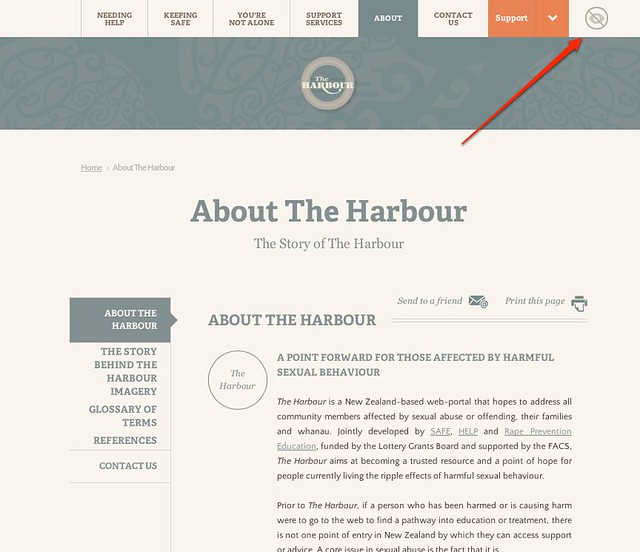
Just launched by Curative and 96Black funded by gambling money from Lotto is The Harbour, a site for those affected by harmful sexual behaviour. It’s very well done (aside from some initial paragraph spacing issues and missing links.)

The content does not take long to read, and it’s good for all of us to get a reminder or lesson in what harmful sexual abuse is, and is not, and how both offenders and victims can be helped. For example only 2% of adolescents and 5% of adults re-offend after completing treatment.  The list of support agencies feels short – and that’s sad.

One neat feature is the hide this page button:

Hovering over it gets this message:

In my (contrived) case hiding the page goes to a nice “safe” misogynistic opinion piece from Bob Jones. Why the Herald publishes this crap I don’t know, but regardless, kudos for the team behind The Harbour at least for advancing society.

Better By Design CEO Summit 2013

I’m really quite sad to be missing this year’s CEO Summit, but Punakaiki Fund has to take preference. The summits are aimed at CEOs of medium- and larger-sized NZ companies, and combine an audience from the design profession with the CEOS, management teams and a host of high quality local and international speakers.

They are one of the hidden gems in NZ business, and while I’m not there, two CEOs from companies I’m associated with are.

If you are on Twitter then you can follow along with the #BBDSummit hashtag. I do hope that someone else will take up the mantle of blogging the event this year. Otherwise, here is some reading from the past events.

Insure the weather

Monsanto just purchased Climate Corp for US$960 million.

Climate Corp is a company that is really good at predicting weather in a small area (like a farming region) and provides insurance against poor weather conditions like drought to farmers. It was started by two ex Googlers.

Do we have anything like this here? We certainly have he building blocks, with MetService, who are very good forecasters, and a host of companies and people who are experts in sensors, farming and so forth. The insurance part is not that hard, and we have plenty of people here to help.

This article from March 2013 by Dr Michael Naylor in the NZ Herald states that insurance companies in NZ are not covering drought. If so then there is really an opportunity here.

All of this is occurring in a world of changing climate – so there’s a huge advantage to a firm that can understand everything that is going on and earn margin for doing so.

Could someone could put this together? I suspect that not only do we have some structural advantages, but that ownership of Climate Corp under Monsanto may cause issues over time. Alternatively a NZ company could take this in another direction.


Hire good people and pay them well

Wal*Mart thought it could save money by shifting towards a higher percentage of part time temporary staff, who had to reapply every 180 days. They also increased the number of hours required to qualify for healthcare from 24 to 30. These to me were signs that senior management was lowering its commitment to putting customers first in order to chase short term profits.

The results were obvious, especially in retrospect – poor service resulting in poor sales.  Wal*Mart products were not getting stocked in stores, queues were long and sales suffered. Meanwhile their staff, as part timers, would not get the health care benefits that are so necessary in the USA.

Their competitor Costco paid staff 40% more and their profits lifted by 19% in Q2.

So the recent announcement that Wa*Mart will be moving 35,000 staff to full time status (with health-care benefits) is going to be well received by both staff and,  eventually shareholders.

The lesson is that doing the basics well, something that Wal*Mart used to do, is what makes for great businesses and great returns to shareholders. It also reinforces that shareholders maximise their return by making sure that all stakeholders are winning.

It reminded me that in New Zealand we have our own version of Wal*Mart – The Warehouse. And it also reminded me that the team there received little kudos for the introduction of a higher pay for a higher trained workforce. As investors and shoppers, if not staff, we should all be thanking The Warehouse and demanding more of the same.

What not to invest in?

Two things not to invest in:

1: Nobel prize winner Robert Shiller says housing is a lousy investment.

2: FMP Medical Services Limited, who just made history by being the first company to have a prospectus cancelled by the FMA.

The point with the first is that all of your cash is tied up in one illiquid over-levered investment, and you are not diversified. That means you can lose money quickly.

The point with the second is that not all investments are created equal – look very hard at everything and be a smart investor. Starting with an FMA registered prospectus gives you a basic level of protection, but does not, of course, mean it’s otherwise a good investment unless you have actually read the prospectus and taken advice if required.

The Economics Nobel – asset pricing

A simple summary of today’s “Sveriges Riksbank Prize in Economic Sciences in Memory of Alfred Nobel for 2013”, or the Economic Nobel Prize as everyone incorrectly calls it:

Eugene Fama: You cannot really predict the price of a stock in the short run.

Robert Shiller: The ratio of stock prices to dividends (P/E) trends to be the same over time, so stock prices are also relatively predictable over time.

Lars Peter Hansen: You demand higher returns to compensate for riskier assets, especially in riskier times.

All of this points to investing based on how good an asset is, rather than the high speed trading or statistical arbitrage that drives most of the trades today. It’s a shot across the bows of the financial shenanigans that drove the insane valuations which created the global financial crisis. It’s a message of sanity.

Fama did a series of papers with Ken French from 1988 on asset pricing. Ken,who taught me finance at Yale and is a simply outstanding lecturer, really misses out here as no less than 11 of his papers are cited in the Nobel Prize Scientific Background.

One more step towards Xero as a mainstream US stock

With another $180 million raised and $230 million on hand, Xero has proved once again that’s it’s smart to raise money well before you need it.

But what’s interesting is that the type of investors that Xero is attracting are changing. Don’t focus on Peter Thiel’s Valar Ventures, but instead on Matrix Capital Management and “some of the most enduring and well-capitalised asset management firms in the world.

Matrix Capital Management (MCM) is not Matrix Partners, a venture capital fund with one common owner that TechCrunch managed to get somewhat confused about. Instead it’s a classic Boston fund, without even a website and the only public information I could easily find is this SEC filing along with principal David Goel‘s Wikipedia page. MCM has just 104 investors and just over US$1 billion under management. The minimum investment for their on investors is $5 million, though they also have a smaller fund with a lower investment quantum of $100,000.

David Goel is classically trained and experienced in funds management from the big end of town, and is apparently “known for fundamentals-focussed value investing“. He thinks “in 10 year terms“, and is known for his depth of research. The fund’s brochure says that it follows a classic hedge fund strategy and takes on a little debt as it places long and short positions. Of interest to Xero investors is that:

Each portfolio position taken for such a Fund is based on the Investment Adviser’s assessment of any significant discrepancies existing between a company’s current market value and the company’s intrinsic business value.

All of this means that a well-respected fundamental investor performed a considerable amount of time in research and analysis and believes that Xero is significantly under-valued. That’s one reason that Xero’s share price rose this morning. 

MCM is investing for the second time, and the new is that another series of US funds have joined the investor party. The names of these funds are not disclosed in the press release, nor yet visible on the companies register. But funds watch funds, and as more of these large funds invest it will make Xero more popular amongst the US investing scene. That means that we can expect to see increased pressure on the share price as Xero becomes a stock that just needs to be owned.

But let’s not get ahead of ourselves. The NBR article quotes Rod Drury as saying the investors had looked very hard at Intuit, who themselves seem fully aware of the Xero threat. From looking at the press releases and reports, Intuit is running fast to keep their market share, but some very smart investors have determined that Xero has a great chance of winning share from Intuit. My overall take is that both companies will split the US spoils, and that MYOB and Sage will fall well behind Xero offshore.

What’s happening Trade Me?

I was shocked to see first that Trade Me had appointed an advertising agency, and secondly at their TV campaign. I really can’t bear to watch it so I’ll not embed it.

Trade Me has always won by being more end-user centric and easy to use than any alternative, and it has become beloved by New Zealand. The issue is that they have run out of customers, and can only grow by increasing activity for existing customers, increasing prices for sellers or entering new categories and businesses.

Increasing customer activation through advertising may be an interesting experiment to run, but let’s not forget that Trade Me’s superior profitability versus eBay is not only through better usability, but also because they do not throw money away into advertising.

Meanwhile we all have our individual understanding of what Trade Me stands for. Like a poor movie following an excellent book, my understanding of what Trade Me is not at all reflected in that advertisement. I suspect many of the other members, staff and ex-staff feel similarly.

The advertisement makes me feel discombobulated, a little disconnected from what Trade Me stands for. The question is whether Trade Me is losing long term customer love at the expense of short term activation with this annoying ad.

The kicker, and catalyst for this post, is that it’s compounded by an event that I have not seen for years. Trade Me is currently down.

Update: Trade Me is back online and all auctions will be extended by 5 hours.

Being a smart investor

I’ve previously discussed how 1200 people lost $6.8 million by investing into an opportunity that was dubious at best. It was the madness, not wisdom, of crowds.

But sadly investors are still investing in dubious opportunities, and their experiences will continue to give the whole field of private investing a bad name.

Raising Money

In most countries there are strong rules about approaching members of the public with investment opportunities, and for good reason. However founders can approach sophisticated investors for money, as it’s assumed that they have the ability to make an informed considered decision.

In New Zealand these investors are called “eligible investors or eligible persons” under the Securities Act. You can be eligible either by being Experienced or by being Wealthy.

Experienced is defined as “experienced in the industry or business the security relates to or experienced in investing or the business category.” That means the investor is able to assess:

• the offer’s merits;
• the value of the security;
• the risks if the offer is accepted;
• their own information needs; and
• the adequacy of information provided about the offer.

Wealthy means “Net assets of $2million or more or annual gross income of $200k or more for each of last two financial years.”

You can see the issue, right? Wealthy but not Experienced investors have the legal ability to invest and lose a lot of money. And they do.

What type of investor are you?

The beautiful thing about poker is that everybody thinks they can play.
Chris Moneymaker

Just what sort of investor you are depends on the circumstances. For some investments, such as mortgage backed security derivatives,  there turned out to be almost no smart investors. For other investments, such as property and bank debt, the barrier to entry and understanding is much lower – a reason why they are such popular investments in New Zealand.

But let’s focus on the roles investors, individuals or funds, can play when investing in private companies, and in particular in the the earlier phases of growth.

1: Professional Money

There’s no way that spending a few hours a week looking at individual securities is going to equip an investor to compete with the incredibly talented, highly qualified, extremely educated individuals who spend their entire professional careers trying to pick stocks. It’s just not a fair fight. You know who’s going to win before the bell rings.
David Swensen, Yale Investment Office

Funds with teams of investment professionals will always have more time and energy to apply to the field, whether that is picking stocks or investing in early stage companies. Their challenge is fund raising, the time and expertise taken to do deals and the need to exit within a certain timeframe. I’ve written about this elsewhere.

In New Zealand we have far too few entities in this category. It’s a real challenge.

2: Smart Money

Founders ideally want investors who are smart and have access to funds that are very substantial versus the need. These experienced investors understand and can really help with the business.

Smart money investors are generally part of the ecosystem where they have chosen to operate, seeing the very best opportunities very early. They often get involved well before any investment pitch documents are created, and have the time to make well-informed and considered decisions.

The ideal investors in this space are ex-founders who are still active in a community in a very hands-on way. There are just a handful of people that occupy this space in New Zealand, and we need more. These investors can be very selective and tend to make very few deals. The smartest ones are very strict about sticking to the narrow niche or sector that they know. Other smart investors tie themselves to certain lead investors.

Arguably their deal flow, access to funds, low costs and ability to provide 1-1 help delivers superior returns with lower risk of complete loss. However they are generally not full-time investors, and there may be many other things happening in their lives that are more material than making a particular investment.

3: Smart but small money

Next are the experienced but less well off, who may be able to quickly understand the business and investment opportunity, but who cannot make much difference with the funds they have. Every little bit helps, especially in early rounds, which is where these investors must participate.

There are an increasing number of people who can play this role in NZ, but not many who consistently do it well. That’s because it’s a definitional problem, as gaining investing experience needs the ability to commit funds to a number of companies, but that in turn requires wealth.

For founders my advice is to be sure of cultural fit, and to be careful on evaluating skills and experience. Advising early stage companies is very different from being part of the corporate world, and similarly early stage investors need to follow the written and unwritten investor rules. Those include being ready to lose the money, having a very long term perspective and not being a pain for each round.

Investors in this space get only selected access to deals – they simply don’t have the wallets for more. However if they retain their heads, choose wisely and are patient then investors can get very good returns for their small investment.

4: Dumb Money: Investors who don’t know the sector

Finally there are wealthy investors who do not know the sector, but who perhaps know investing or business. They became wealthy somehow, and so are clearly smart at what they do. However while being smart in one area can help, it is generally insufficient for understanding early stage investment and rapidly changing technology.

There are two strategies here. The first is to place the money alongside or with funds or people in category 1 or 2. Choose the people well, make sure they really do understand the sector, and otherwise maintain discipline around investing in what you know.

The second is to go it alone, and that’s when the risk of being “dumb money” is high. That risk is especially high when investing into companies where there is no FMA registered prospectus.

The gap in investor knowledge and the lack of a proper prospectus provides an opening for hype and over-selling of lousy opportunities. It’s a slippery slide from promoting investments that have poor fundamentals to being poorly legally restrained, or even unscrupulous in the quest to land investors under less than favourable terms.

The promotors of an investment may not even understand themselves that what they are promoting is a poor deal. And once investors start to pile on, and a rush to invest occurs, then may can be seen that as validation by other investors. I’ve seen some shockers locally, but the all time classic for me is Pets.com, a famous US story of US$300 million raised and squandered within 2 years.

Are you smart or dumb money?

“Risk comes from not knowing what you’re doing”
Warren Buffet

Obviously nobody wants to be dumb money, but sadly most of us in the investing game, whether in public or private securities, have been in that position. We need both the self-awareness to know when we don’t have enough information and analysis and the discipline to only invest after ding the homework. Anything else is akin to gambling, and with over $2 billion lost in gambling in New Zealand each year I don’t recommend it as an investment strategy. 

It’s very frustrating to see investments made into sectors and companies based on insufficient information and assessment work. The investors may be investing based on a pitch seen with a group, or based on a recommendation from someone who is not a real industry insider, or even from conversations with the founder.

But surely you are different? With human nature being what it is – I doubt it very much. In Tauranga over 1200 investors treated with a clearly un-investable founder who somehow attracted and vaporised  $6.8 million. That’s the risk you take every time you invest, and it’s a particular risk if you are investing without a registered prospectus.

What to look for 

I recommend that investors create a simple checklist of the things that they look for before investing. It’s a good way to ensure that the emotional drive to invest is somewhat contained. Some starter questions are:

Is the end user experience great? Have you tried the products (and those of the competitors)? Have you seen the customer experience yourself, or solid evidence that it is great?  

Do they have a clear route to the paying customers? Have you seen evidence that thy can steadily ramp up sales? Be very careful (better avoid entirely) companies that want to spend the majority of the investment on advertising, especially with the long sales cycles that business to business selling involves. It’s a good way to lose money quickly.  Look for gradual ramp-up of sales team and effective, targeted advertising that is results oriented.

Do they own their competitive niche? Have you really looked hard at the competitive positioning? Are you sure that the company you may invest into has a dominant position in their niche? Play with the competitor’s products, or get on the phone and call or visit them – you may be very surprised.

Is the team full of A players? Are you confident that the management team and board can build a great company with a high performance collaborative culture?

Is the investment good value? Have you verified that the amount being raised and the valuation for the company are consistent with other deals and with the fundamentals? Be very careful about placing large amounts of money with companies with no or very little revenue – they need to grow into investability. 

Seek help

“Be Fearful When Others Are Greedy and Greedy When Others Are Fearful”
Warren Buffet

Whether an offer is public or private, and especially where it is private, the golden rule for investors always applies: invest in what you know. So here are some more questions to ask:

Are you being subject to FOMO?  The fear of missing out is not a reason to invest. Make sure that investment decisions are based on facts and considered sector-informed assessment.

Do you really understand the company? Can you explain to others the products, the route to the customer, the competitive landscape and the approach to growth? Do you have a clear idea of how and why this company will win?

Are real industry insiders investing? Are others investing from the industry involved? Can the deal attract coders and designers as well as more senior figures?

Are the basics making sense? Is the product selling for more than cost price? Is the cost of selling low enough to make money from paying customers? Does the revenue per employee match that of other similar companies? (e.g. this post suggests US$230-310k/employee  is average for software, advertising and media companies.) Are there any triggering warning signs in the language used by founders?

Have you talked to someone in the sector?  Have you tested the investment by sounding out people from inside the early stage industry or the sector? Often the more junior people can provide the greatest insights. They know the duds.

Have you sought investment advice? Are you working with an investment professional who really does understand the sector?  This may mean reaching beyond the bubble that you are in and talking to people who bring very different perspectives. Don’t worry – you won’t miss out on the deal.

Is there security in diversity?

“You have to diversify against the collective ignorance,”
David Swensen, Yale Investment Office

Some may seek diversity through increasing the number of deals they are involved with, but that risks compounding the systematic errors behind selecting lousy investments. It’s better to select diversity through the overall investment strategy. That means investing in different sectors, using different advisors and investing in contrarians. I liked this quote from David Swenson, who leads Yale’s Investment Office and who taught me in Institutional Funds Management at Yale School of Management:  

Small independent firms with excellent people focused on a well-defined market segment provide the highest likelihood of identifying the intelligent contrarian path necessary to achieving excellent investment results.
David Swensen, Yale Investment Office

I worked in one of those firms, courtesy of David, in my summer job while at Yale. New Zealand has come a long way over the last ten years, and we are seeing some players carve out a solid niche. But we do need a lot more of these firms, and investors to back them.

Summary

It’s not hard to avoid behaving as “dumb money” if we have the discipline to invest in only what we know. However we also need to make sure we have a diverse investment strategy, which means stretching beyond what we know. You can choose, for diversification, to apply discipline and work to learning a new sector, becoming an investment professional along the way, as many family offices have done. Alternatively, or more often, as well, you can place funds and trust with a diverse selection of small expert teams.

If it sounds too good to be true – it is

I’ve received a series of comments from Ken Pedlar on some recent posts, and decided in the end to approve them for publication, removing any personal details such as phone numbers.

I’m excerpting from the latest comment below, which was in response to the the post on Xero valuation. I’m doing this and commenting on it to show how to avoid making the very poorest investment decisions. There is much in the note which should cause any reasonable person to never reply, but it is worth going through why it triggers investor instincts to run a mile.

The comment

“How would you go about estimating a value for a new Wingless Vertical Takeoff & Landing Pico–come Microlight/Ultralight Craft scalable to immense size. Craft will use latest lightweight high tech permanent magnet electric motors controller energy storage cells etc plus miniaturized avionics autopilot, infrared night terrain scanning equipment etc. Two craft one capable of carrying 50kg and a manned unit carrying 200+ kg craft. , Both to be constructed over 6 to 9 months and the whole process videoed in documentary style and fed direct via a pay per view site to the net to raise money to repay initial funder. Upon maiden launch and info being sent to certain long interested parties I am absolutely confident of raising several billion for forward order. As inventor of the globally patented Inertialess Drive Rotor and multiple green tech developed from it and having done a successful launch worldwide of my previous company with a handful of people while engaged in a convoluted war with racist idiots in the corrupt SEC. They becoming engaged after nasty pathetic niggling shareholders made four anonymous complaints to them of which the ensuing public warning notices literally destroyed the company. Thus I do have the necessary experience to go global real quick if I can find a couple of guys like yourself who are smart enough to come to the party part fund an expert engineer/physicist/entrepreneur to the tune of $100K to get the two prototypes built over the next few months in the run up to April first whereupon it becomes legal to raise funding without a prospectus using the crowdfunding format. I could certainly teach you guys a thing or two and also am willing to learn for your ample expertise. Know also I am well know throughout the fortune 500′s and upper echelons of scientist, engineers, and royals the world over and have powerful above top tier people. I require one or two person who can be trusted to front me my name having been tarnished by the SEC and a few of the nasty petty shareholders who have been blocking my access to funding. All I ask it you come and help me an I can assure you I can and will make you a very very wealthy man in return. My interest is the craft as I don’t need money once I have these for my family. I have 12 kids and a heck of a lot of grandchildren. Should you decide to help please come talk to me or at least call me, I only bite on Friday’s. LOL. Ph..”

The Issues

Let’s walk through the issues:

1: a new Wingless Vertical Takeoff & Landing Pico–come Microlight/Ultralight Craft scalable to immense size”

This sounds similar to Martin Jet Pack, and their company is 9 years old and they have yet to make a commercial sale. So from an investor perspective this points to years of funding over multiple rounds, a lot of work with the company and the founder personally. So the idea and founding team had better be credible.

The “scalable to immense size” triggers less than credible physics warnings.

2: Two craft one capable of carrying 50kg and a manned unit carrying 200+ kg craft. , Both to be constructed over 6 to 9 months

The timing to construct two aircraft seems very unrealistic given the Martin Jetpack experience. Moreover it is now clear that this investing into an idea only, and not into a company with a tangible prototype or paying customers.  That’s a good way to sink a lot of money over multiple rounds.

Meanwhile there are at least three aerospace companies in New Zealand that have advanced prototypes, including a Composite Helicopters, a fixed wing player who I am not sure I can name and Martin Jet Pack itself. All of these are perhaps seeking investment.

3: the whole process videoed in documentary style and fed direct via a pay per view site to the net to raise money to repay initial funder.

This raises the question of what the investment is for – a documentary or an aircraft? Very few people could point to a successful track record in either, and certainly not both.

4:  I am absolutely confident of raising several billion for forward order. 

This raises the concern that the writer is not realistic in his expectations. If it were remotely true then funding would not be an issue. If the founder had a track record of attracting such orders then this could read differently, but we would expect to see evidence for the same.

5: globally patented Inertialess Drive Rotor

This raises the question of patent validity. I searched and found this.

However that search raised lots of questions. There is the failed delivery of any products from the company that owned the patent, which calls into question the usefulness of the patent. If everything else checked out (it does not) I would unleash a professional, such as Kristian Slack, on this field to determine just how interesting the patent is before going any further.

I also searched on the term “patented Inertialess Drive Rotor and the results are not good. The third result is from Crank.net, the second is titled “Is this possible” and the first says someone did a search and turned up nothing. The fourth result is a Youtube video with surprisingly readable, and negative, comments about the former business.

The phrase itself screams “fake physics”, in the same category as “frictionless” or “perpetual motion.”

6: having done a successful launch…. while engaged in a convoluted war with racist idiots in the corrupt SEC. They becoming engaged after nasty pathetic niggling shareholders made four anonymous complaints to them of which the ensuing public warning notices literally destroyed the company

This raises the first question of why the previous company failed if the launch was successful, and secondly on what actually happened to the investors in that company from their perspective, and thirdly on just how hard the founder was to work with.

However the real issue is that the way the investors and regulator are referred to in the comment, as even if their actions were poor (and I doubt it very much), the rant reflects very poorly on the founder’s ability to work with anyone in the future.

7: Thus I do have the necessary experience to go global real quick if I can find a couple of guys like yourself who are smart enough to come to the party part fund an expert engineer/physicist/entrepreneur to the tune of $100K to get the two prototypes built over the next few months in the run up to April first whereupon it becomes legal to raise funding without a prospectus using the crowdfunding format. 

This raises the question of whether the founder understands and has learned from the lessons of the catastrophic failure of the previous company. It also raises the question about the expectations of the founder for being able to build two prototypes so quickly, with such limited funding. I would expect to see prototypes that are built using more time and less money before investors are approached at all. Given the challenging physics above it seems that an actual product would never get off the ground, as it were.

However this raises the very deep and problematic question of the prospect of this  proposition being offered to the public through a potential law change. How will we prevent major losses of funds for investors if crowd-funding becomes law in New Zealand? It also calls into question whether we should even allow the law in the first place, which is sad as it could deliver substantial benefits.

8:  I could certainly teach you guys a thing or two

This raises the question of whether the founder is a collaborator, and can learn from advisors and experience and can write in a way that does not make people angry.

9: and also am willing to learn for your ample expertise

This raises the question of whether the founder actually could learn from others.

10: Know also I am well know throughout the fortune 500′s and upper echelons of scientist, engineers, and royals the world over and have powerful above top tier people.

This raises the question of why they and others are not investing.

11:  I require one or two person who can be trusted to front me my name having been tarnished by the SEC and a few of the nasty petty shareholders who have been blocking my access to funding

This raises the question whether the founder is looking for people who to convince to give him money based on a process or evidence that the SEC and former shareholders would be very uncomfortable with.

It also raises the question of what actually happened, and a quick search reveals that the SEC (now FMA) had a warning in 2001 about an illegal share offering. The notice also states that there is a long history of treating with public investors without the necessary legal processes and documents :

“The Commission had previously, in 1998, banned advertising for shares by Inertialess Drive Technologies (1995) Limited (now liquidated) because there was no registered prospectus. In 2000 the Commission also banned advertising for shares in Inertialess Drive Corporation Limited for the same reason. Mr Pedlar was involved in both these companies. The advertisements in the Bay of Plenty Times are targeted at former shareholders of these companies.”

It raises the question of whether the founder has good legal advice, whether he would take good legal advice or whether any good legal advisors would work with him after this track record.

12: All I ask it you come and help me an I can assure you I can and will make you a very very wealthy man in return. 

This raises the question of inflated investor expectations, leading one to believe that the founder is targeting unsophisticated investors, a real issue in early stage businesses in NZ. Investors in this space should know exactly what they are getting into, and sadly many do not. Angel clubs can help educate investors, but there is no substitute for full time professionals on the job.

13: My interest is the craft as I don’t need money 

This raises the question of credibility, especially as a search finds this Bay of Plenty times article about Pedlar raising $6.8 million from local investors and then disappearing. The key quote:

“Mr Pedlar moved to Switzerland following a shareholders’ meeting in Tauranga on February 24, 2000. By the time the company was put into liquidation, he had left behind more than 1200 shareholders, most of who lived in the Western Bay of Plenty.”

Again this raises the question of his own motivation and ability to deliver value to investors. It also raises the question of what he told the investors, 1200 of them, in the 2000 fund raising process.

In Summary

Some people prey on our vulnerabilities to take advantage of us, using things like greed and dishonesty to capture us into an elaborate confidence trick. It may not be planned or even deliberate, but the general rule when confronted with something new is worth putting in lights:

If it sounds to good to be true, it is

There is plenty in the above pitch that makes it obvious to any reasonable person that the investment is best stayed well away from.

Which makes it even more upsetting that so many people were caught up as “investors” in Pedlar’s prior company, Inertialess Drive ZPE. More than 1200 shareholders gave a total of over $6.8 million to a business that was flimsy at best and arguably fraudulent at worst. Let’s quote from the Bay of Plenty Times again:

Mr Richards said he was struck by how the factory looked like the set of a B-grade movie, with people in white overalls milling around like extras, with nothing really happening.
He asked Mr Pedlar how business was going and was told that the company was working with General Motors on a deal worth billions of dollars.

Astonishing. Those investors were targets of a scam at worst and victims of an illegal investment (no public prospectus) at best. It would appear that they did not make their decision based on well-informed robust analysis, they did not do proper due-diligence on the company and they did not “invest in what they know”. They broke the basic rules of investing in early stage companies, and as a result all early stage companies will look risky to them.

But I don’t believe that early stage investing is necessarily risky, but like all investing it should be done on the basis of good information and understanding. The first step is to avoid any stories that are too good to be true.