Picking stocks and housing bubbles

Professor Robert J Shiller won the Nobel prize this year (with Eugene Fama and Lars Peter Hansen) for his work on the analysis of prices of various assets. He repeated his Nobel lecture at the Yale School of Management today, and I grabbed a couple of screenshots from the livecast.

His early work tested whether the value of shares is equal to their future dividend streams, and it did. Later he observed that the volatility of share prices (against his model) was mainly due to “innovation” from the companies and the market.

Picking Stocks

For me this means investors should hold stocks in companies which have secure dividend streams for regular portfolio growth (e.g. Meridian), pick stocks in companies that will deliver disruptive innovation to get outsize returns (e.g. Xero), and avoid stocks where the companies are subject to being disrupted by innovators and are unable to respond (e.g. Yellow).

Later in his career Shiller came up with the definitive house price index for the USA, which tracks prices for repeat sales:

I raise this because he then put up a slide of Los Angeles house prices versus personal income, relating a story about how extreme ratios a few years ago made it hard for people to choose move there.

So how are we doing in New Zealand? Even I, a housing price cynic, was shocked by the result when I crudely replicated the analysis.

Our latest median house price, states REINZ, was $425,000 in November last year. The latest statistic for median income in New Zealand from NZ Statistics is $29,900, from the June Quarter last year. That gives a ratio of $425,000/ $29,900 = 14.21.

That wouldn’t even fit on the chart above, so here’s how it would need to be amended to show New Zealand.

A bit more searching and I found the 2004 paper where Case and Shiller asked “Is there are bubble in the housing market?“, and showed that while for most US States the housing prices were directly related to income, but a few (about eight) states were well out of whack, showing more volatility along with higher average ratios.

Picking Bubbles

The chart that Shiller showed above shows that the LA prices dropped by over 50% versus income from 2006 until now. My own take is that there is clearly also room in New Zealand for a very very steep plunge in house prices. It would need a catalyst, but let’s remember to not blame whatever that catalyst is, but the system of incentives that has delivered us this ridiculous and very dangerous situation.

And remember – if you are selling your house, then its smart to do so using the latest tools, real estate agent experience and low commissions at 200Square.


Update:

I forgot to add into housing index that Shiller put together. How I would love to invest (short) on this for NZ.

What if you knew how to stop cycling deaths. Would you do anything?

Last April Auckland Transport received a report they had commissioned on Why do Cyclists run red lights?

A decommissioning the report was an excellent move by Auckland Transport.

Sadly the report is only available as a powerpoint presentation, but what we can see is excellent. They observed over 22,000 vehicle, pedestrian and cyclist movements across five key Auckland intersections and also interviewed cyclists.

What they found is that cyclists run red lights largely due to safety reasons, and most infractions are during the pedestrian phase of the lights (they call this the Barnes dance).

The yellow part of the charts below are cyclists crossing with pedestrians – an activity which I classify as safe if done with consideration and at the speed of the pedestrians. I, like it seems the cyclists surveyed, see this as often a lot safer than crossing with the cars, and it also helps motorists as it gets the people on bicycles out of the way.

Unfortunately this is not legal under current NZ law, and nor is it legal to ride on the footpath. The only legal thing to do is to walk the bike across.

The cyclists’ comments shown in the report are all about safety.

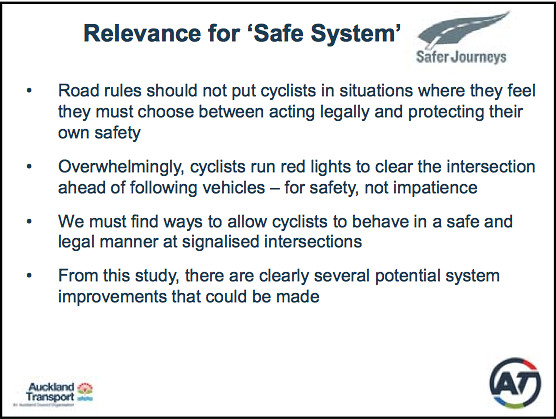
The report concluded that road conditions were such that cyclists have to choose between safety and being legal, and often (and correctly) chose safety. They authors suggested that we must fix this, and came up with four simple, cheap and effective recommendations.

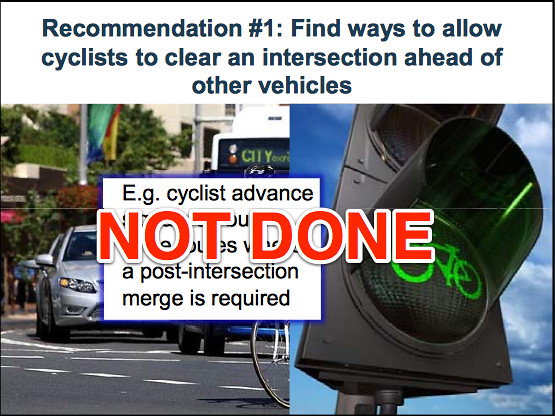
So how have we done with those recommendations in the 9 months since the report was received? Sadly from what I can see – very little or nothing has changed. I stand to be corrected on this, and would welcome any evidence to the contrary. Let’s not be too hasty in pointing the finger at Auckland Transport either, as they have done some great work here, but most likely need more political clout and resolve to make this happen quickly.

Number 1: Sadly I don’t know of any cyclist-first intersections in downtown Auckland.

Number 2: The law still prevents safely turning left on a red light for cyclists.

Number 3: The law still prevents cyclists from legally crossing with pedestrians.

Number 4: I know of no changes to sensor locations or sensitivity. This is the hardest to evaluate and may well have happened, to be fair. It’s under Auckland Transport’s direct control and is the most likely to have changed. But I’m not seeing it so:

Two of the four, lights to clear cyclists and improve cyclist detection, are under the control of Auckland Transport (as far as I can tell).

The other two will likely require changes to national road rules, to allow cyclists to turn left, and to allow cyclists to cross with pedestrians at lights.  That’s up to the Ministry of Transport and NZTA and the national Government.

The proposed solutions are clear, cheap and high impact. Let’s do what we can to help Auckland Council, Auckland Transport and the government to prioritise these.

A typically deadly commute – let’s fix it

My partner rides a bicycle to and from work. Her town bike has a basket on the front and back, and she is small, wears normal street clothes and obeys traffic rules. This is what a ride home looks like. (She takes the long way home to get exercise).

She’s fast right?

You might have caught two or three scary moments — let’s look at the worst one, on what is essentially a random day — today.

Here she is nearing the top of College Hill Road. She is not very big and goes pretty quickly up hills — and enjoys passing the occasional middle aged man in lycra. She sometimes does that when those baskets are full of groceries.

She is approaching a carpark – and as there are no cars today she had a clear run. This is great as normally the parked cars force her into the often fast moving traffic that is chaotic due to a complex intersection ahead. This, by the way, is on the safest route she has found to get some exercise while riding home.

The cars at the front by the light are stopped, and the closest car, the red one in the car lane to the right, is slowing to a stop. There is lots of traffic so it’s pretty noisy.

With the empty carpark she has a clear run to the head of the intersection and can stay well out of the way of motorised traffic. She could alternatively choose to cross to her right to get behind the red car, but that decision would have killed her, as you will see shortly. When cycling or motorcycling making decisions about not dying are fairly constant, with the key rule to stay the away from high speed differentials with large vehicles.

From nowhere comes a bus at high speed:

The bus is trying to cut between my partner, who is riding quickly, and the parked red car, and then take the left hand turn at the end of the street. The green bus has a large amount of momentum and very little room for error on either side. My partner is still riding in the designated car park.

A few seconds later the bus and the bike have braked almost to a stop – but look how far it took the bus to do so. The bus driver chose not to hit the red car from behind, and instead cut in front of the person on a bicycle, potentially fatally. Perhaps it would have been safer to graze or hit the car than to risk squashing an unprotected rider – a potential judgement call that should be discussed in an incident investigation, but clearly won’t be because this incident is a sadly regular occurrence for both buses and cyclists, and they are never investigated as far as I can tell.

Luckily my partner, riding the bicycle, braked very hard, and a tragedy was averted. However once again I get to greet a distraught partner when she arrived home.

There really was no room for error if she had continued.

But the bus made it through, the car was untouched and the my partner got to come home physically unscathed tonight — and I am grateful for that. But for the sake of about 3 seconds of time, the bus driver’s dangerous driving was exposing the driver of the red car to an accident and injury, and the cyclist to a potentially fatal accident. That’s not worth it, and the driver should instead have slowed down to follow the bicycle.

Let’s look at it all in real time speed. What would you have done? Are you confident enough to stop safely? How about if your bike was full of groceries?

This sort of incident is, tragically, quite usual for Auckland roads. While every cycling day is packed with the normal dangers to avoid, most days also see specific dangerous driving actions like this one, and that’s what we have to stop.

Our worst story

One reason my partner gets distraught at these sorts of near misses is that she was knocked off her bike in late 2012 by a woman who works for an insurance company. That person dangerously crossed a busy road by driving her car illegally through a stop sign from one side street to another. My partner was descending and the car hit her, knocking her off her bike and she slid for quite some time, luckily avoiding hitting anything. Even more luckily she had just avoided a perhaps fatal T-bone accident, and escaped “only” with lacerations, bruising, swelling and a couple of trips to the doctor. She was also very shaken up.

Strangely, for someone I discovered to be a communications professional, the driver, provided only her first name (Michelle) and phone number. As a victim my partner wanted as little as possible to do with the driver or her insurer company, but I was glad to  help. Even then, while my Google foo was strong enough to find the driver, I had to ask her quite firmly to formally identify herself so that we could settle accounts. I also actually enjoyed jousting with her insurance company (which was not her employer), who as always are not exactly there to meet your full costs unless you fight. Incidentally — if something like this happens to you there are people out there who really enjoy negotiating with insurance companies — so don’t be afraid to ask around.

We did report the incident to the police, who were wonderful. However we were later disgusted to find that  the end result was not a loss of license or worse for what was clearly careless or dangerous driving, but essentially a traffic ticket. My partner had had enough, and didn’t feel she could handle a court case, and so we let it slide, as victims often do. I’m certain that this is very common, and it’s just sad that dangerous driving against cyclists seems to be treated as irrelevant.

What we did

The first thing we did afterwards was to purchase Go Pro cameras for riding. They provide great evidence of dangerous driving, and I highly recommend riding or driving with a camera to everyone. If in doubt, search for “Russian driving video” or similar.

I did not write about the incident at the time, also because my partner did not feel she could cope with it. Overall I do not feel that there was natural justice, and feel that at the very least the driver should be compelled to go through some sort of remedial course.

However as with all accidents, it was not all the fault of one person. The real fault is the design of the road where vehicles have to cross a large road with cars traveling at high speeds. The side roads should either be closed, for example, or some sort of traffic control put in place. There should be no surprise to learn that nothing has happened yet, but we did go to the Ponsonby Road Masterplan public hearing.

What can we do?

Do buy a camera and use it to name and shame, but most of all to show other road users that their behaviour will not go unobserved.

Please do respond, and drown out, the vocal minority of selfish commenters on a variety of forums who seem to think it’s okay to mow down people with their car.

Please consider riding a bike yourself – as the more people on bicycles commuting to work, the faster we will change behaviour.

Please ask your local and national politicians what they are doing to stop the killing of cyclists and to make Auckland, Wellington, Christchurch and all of New Zealand have vibrant life-filled streets and the best urban and rural cycleways in the world.

Let’s make it happen.

How simple it can be to create protected bike lanes

This is a piece received via email from Gloria Williams (@caniwiwilliams) that she has given me permission to post.

 
I read your thoughtful column on cycling safety this morning and I thought I’d send along this photo which shows just how simple it can be to create protected bike lanes. This is Vancouver, a city similar in size to Auckland and this photo is on a main street within the CBD.

Yesterday I walked to St Heliers on the footpath and made these observations about the so called cycle path ( the one on the footpath, not the road)

  1. There are signposts cemented into the middle of the bike path in places ( bus stop signs, crossing signs etc etc)
  2. When parked cars open their passenger doors it blocks the entire bike oath ( witnessed a near accident because of this) Car passengers don’t look of course.
  3. Of course we know how bumpy and uneven it is (tree roots etc)
  4. It’s very narrow, not wide enough for bike travelling both directions.
  5. It’s poorly marked. The little painted bicycle sign is not used near enough and they are quite faded anyway.
  6. People and their leashed dogs, strollers, scooters, skateboards, joggers etc all stray into the lane, or use it intentionally.

So no wonder cyclists take their chances on the road, where the haphazard attempt at bike lanes are just as bad, too narrow, used by cars, intermittent, car door hazards, etc etc.

What all this shows me is that bike lanes are just an afterthought, we are trying to fit them in around very other usage without dedicating any real space to it.


Confronting death

Today I arrived very early on the scene of a cycle versus truck fatality in Auckland today. The sight of a person lying motionless in the street with mangled bicycle in the background is chilling enough. The sounds of grief-stricken people comforting each other, the shock on the face of the woman in the car stuck in full view of the scene, the general feeling of despair – these things are not easy to portray. All of us were changed today.

For the family and friends of the deceased – utter devastation. For the witnesses who saw the event happen, that event will replay for years. For the police, ambulance and other emergency staff – another brutally tough day. I don’t know how they cope.

What can we do?

Today’s accident was, like all accidents, preventable. Like all accidents the root and contributing causes of the accident will be varied and troublesome, but are also able to be eliminated. However like all cycle accidents in NZ they likely won’t be, and we should all be very angry and upset about this.

Most of the causes of this and other accidents are fairly obvious, and have been observed time and again by cycling and safety advocates. They come down to one core goal, to seek to limit human-vehicle interactions:

  • That means physically separating trucks and cars from cyclists, and cyclists from pedestrians, through a system of bike and pedestrian paths that criss-cross cities and form commuter routes. This increases bike use, boosts the retail economy and reduces motorised traffic, reducing associated infrastructure costs as well.
  • It means investing serious dollars into this human-scale infrastructure, and rather happily this also creates a lot more jobs per dollar than truck-scale infrastructure.
  • It means putting in place short term solutions immediately, such as smart use of painted lanes to widen cycle lanes, removing lanes of car traffic from Parnell Rise, removing car parks from Tamaki Drive (where a person was injured today) and laws which increase the incentive to give cyclists their space.
  • It means accelerating and building from the liveable city changes that have already happened in Auckland, removing car parks in favour of wide boulevard footpaths, bike lanes and multi-use zones. If it works for New York’s economy and people, it can work better here with our weather.
  • It needs a Mayor and Council and transport authorities and ministers to lead, and to take responsibility for just making changes happen.
  • And it also means asking seriously why we needed the truck there in the first place – and that goes back to whether we even want a working port in downtown Auckland. 

It’s an election year, and this is a great time for all parties and candidates to take a tough stand. Cycling and work safety are not Green, Red, Blue or other party-affiliated issues, but ones that offer benefits across the board. Improving cycling safety and work safety generates more retail and manufacturing revenue, saves on medical expenses, prolongs lives, saves money for individuals and families and delivers better environmental outcomes. It’s cheaper than building roads and rail, and will make it far safer for our children to walk and cycle to school. It seems obvious, and will attract a decent number of voters looking for a better life.

It’s a great time for us voters to ask the candidates and existing MPs what they are doing about safety on the streets and work, but we also need to ask and apply pressure to the recently elected mayors and councillors to follow through on their promises. I am particularly concerned with Auckland and Wellington mayors and councils, who have delivered little for cyclists on a mandate of change. Too many people are dead and I think we would all like to see a genuine sense of urgency before more people die.

When will the next fatality happen at Lyttelton, Port of Christchurch?


I don’t know when, but this is a dreadful picture. The incident happened at Lyttelton Port of Christchurch on Saturday 4th January, 2014. It was a near miss to a fatal injury – the driver is lucky to be alive and was reported to be taken to hospital. Let’s hope that their injuries are minor.

The near miss is more evidence, on top of the two recent fatalities, that the port is not providing a safe work environment. It’s a situation that needs serious intervention before the next tragedy, which can clearly happen at any time.

Something needs to change, and now. Two fatalities and this incident are well beyond any normal signalling required for a site to recognise it is in crisis and for major change to occur.


As a postscript – the person just visible in the bottom right of the picture is not wearing gloves, nor hardhat and has their sunglasses (protective perhaps) on their hat, but not covering their eyes. They also look to be quite close to the incident, and if there is anything flammable being emitted then they are using a device (iPhone) that is not intrinsically safe and could cause a spark. I would argue that none of this would be acceptable on a true Zero Harm oriented site.

When people die at work it’s always a safety issue

Another tragic fatal injury from a work accident in New Zealand, this time on board a fertiliser ship berthed at Lyttelton, Port of Christchurch.

My heart goes out to the family, friends and colleagues of the deceased man.

What went wrong?

Every accident is preventable, and there is never an acceptable excuse for placing any worker into harm’s way, let alone repeatedly exposing workers to fatal risks. These tragedies were preventable – and so why weren’t they?

For one, the Maritime Union Maritime New Zealand (a government agency) spokesman who said:

“There doesn’t appear to be any safety issues or equipment failures that have lead up to this. It seems to be a wrong place wrong time sort of thing”

clearly does not, to me, understand that the site and its safety management systems have failed this deceased man and his family. It’s good that the Maritime Union is supporting the family and colleagues, and calling for a meeting, but I am not convinced that they anyone understands the magnitude change in culture required.

<Update – I incorrectly attributed the quote above to the Maritime Union, rather than to Maritime New Zealand. My apologies to all concerned. Updates are in italics.>

Even more sadly this is the second fatality at the Lyttelton, Port of Christchurch facility within a month, showing with arguable certainty that this worksite has broken safety systems and processes, leadership and culture.

Is safety even a priority for the Port?

One crude indicator which we can all see, aside from these twin tragedies, is that the Lyttelton Port of Christchurch website carries no reference I can find to either fatality, not even in their media releases. Sure, the fatalities may (or may not) have happened by workers not employed by or contracted directly to the Port, but they occurred on their site.

Another indicator is that finding out about safety on the website is hard – it’s buried within the menu structure, and the result when there is underwhelming.

What should happen?

The Port has faced tremendous challenges following the earthquake, and no doubt the challenges will continue as the rebuild evolves. But challenges to operations should never be a priority over safety.

LPC is a listed company, but 80% is held by Christchurch City Holdings (CCH), who are generally very smart. CCH and the board should be entering crisis management mode, and ensuring that the company responds with appropriate seriousness. At the very least I hope they all understand that this is arguably a lapse in duty of care that could elsewhere remove the site’s “license to operate.”

The board and management team should not rest until they can state unequivocally that the safety systems and culture have changed, and changed for good, and that people on their site can go home unharmed each day.

What would I do?

If this were under my control the port (and any other facility) would be shut down immediately after any fatality, and not reopened until control of fatal risks was regained. I would conduct an all-hands meeting (as suggested by the union) and ask everyone to commit to a tougher set of site safety rules – and enforce them. The rules would include the obligation to stop any observed unsafe work, and I’d hire in external experts to stick around for months to coach everyone through the process. Not everyone will get the new Zero Harm approach, and a small percentage may need to be prohibited from accessing the site.

As an uninformed outsider in any case like this I would stand the CEO down. I would replace him with a new leader with a mandate to place Zero Harm back at the top of the site priorities. I am sure the CEO in this instance is going through hell, and I appreciate that me saying this will not make that better. He may well be superb at his job, but the priorities the board and he agreed to were not correct and an epiphany is required.  So while the CEO may be able to change his approach, he is also somewhat caught in the crossfire here, and in my experience removing the CEO (and at times the management team and/or board as well) is the strongest signal that owners can send to a site that things simply have to change. 

Finding a new CEO who will drive change will not be an easy job, and neither will that person have an easy time of it. He or she will need to work top down and bottom up, and get the support of the Union, employers and all the other players on site to make sure that safety outcomes improve. It’s a challenging job, but one that has been successfully done across a wide range of industries – I’d start by calling recruiters for senior staff in the Australian mining sector.  

The standard is quite simple really – we should all fight to ensure that everyone gets to go home safely at the end of each day. 

Chorus: Turn around and go.

The short and light on detail Ernst Young Australia (EY) report on Chorus [thanks NBR] shows that while Chorus’s top line “$1 billion shortfall” statement was correct, it was also disingenuous.

First of all, we already knew that the $1 billion gap is until 2020, which is 7 years away, which is an average of just $143 million per year. This may still seem like a lot, but this is for a business with current revenue of over $1 billion and EBITDA of a staggering $663 million.

Secondly, the $1 billion to 2020 assumed that Chorus would make no changes to their current approach business, an inexcusable approach.

Thirdly the EY report, rather embarrassingly for Chorus, identified some simple ways to reduce the gap to $200-250m ($28-36m per year).

  • Chorus had a dividend yield of 10.3% to June 2013, unsustainably higher than the 4.3% NZ and 6.7% Australian peer averages. Their FY13 return on equity was a staggering 29.7% versus peer averages of 12.5% in NZ and 11.2% in Australia. So EY is comfortable recommending that Chorus remove or reduce dividends.
  • EY also point out that Chorus has been operating well away from the danger zone for their debt covenants, and so they can raise more money through debt
  • They also show that there are ample opportunities to save costs and increase revenues.

I’ve seen teams successfully deal with turnaround situations that are a lot worse than this. While the report does not itemise the cost and revenue opportunities, my own experience is that these numbers are easily achievable, especially when we look at the current situation. I say easily achievable, but that’s only if the right approach is taken, which is to create departmental teams with CEO line of sight and authority to prioritise and systematically identify and fix the biggest and easiest revenue and cost opportunities. With the right approach Chorus should be able to eliminate entirely the remaining $200-250m gap, mainly by focussing on increasing fibre revenue per premise.

The huge opportunity

Chorus was formed with one primary goal – to install fibre on the roads past 70% of the premises in the country. The are behind their peers in this, but the industry is lousy at the real primary goal – of converting those premises to being lit fibre customers. Chorus may argue that it’s the RSP’s (ISPs) mandate to convert retail customers, but I hold them firmly to account for not making it easy for those businesses. This, I believe, is the real turnaround opportunity for Chorus.

Internet access is a strange business, where demand rises exponentially at a staggering annual rate. That demand though is largely influenced by the available supply, following an “if you build it they will come” model. The slow conversion of premises (rather than the roads in front of them) to fibre means that Chorus misses out on the essentially free incremental revenue above the fixed price base plans.

Fibre is intrinsically easier to upgrade than any other technology, and will always maintain a physical advantage over alternatives. While the GPON technology used for UFB is a poor choice, once fibre is in the ground then it is eminently upgradeable with newer equipment on each end. The more quickly the industry connects premises to fibre, the more quickly we they will be appreciated and upgraded, and the more money Chorus will make.

Some examples of the current industry pain that need to be fixed are: 

  • Chorus has 24 candidate areas for UFB, and has fibre in roads past 153,000 premises so far. The three other UFB players have just 9 areas, but have passed 94,262 premises, 64% more than Chorus has per area.
  • Multi-family dwellings and offices are placed on hold during months-long waits for pieces of equipment (MDUs) that really should be in stock, or may not even be required in the first place.
  • ISPs dealing with Chorus have to invoke black arts to get their systems to work properly, making installations slower and more expensive.
  • The industry collectively presents poor quality plans and a confusing picture to buyers, which the new broadband product disclosure will help.
  • The Chorus Gigatown promotion-spam debacle is a lottery-like distraction for individuals and towns that all just want Chorus to do their job of delivering gigabit internet to all premises.
  • The international cable bottleneck is still unsolved – and Chorus would be an ideal partner in one or both of the two proposed ventures. They could also work to build or buy backhaul infrastructure, and offer a wholesale internet in a box transit service to RSPs large and small. 

What should Chorus do? 

The UBA decision and the EY report clarify the future for Chorus, and nicely align the public and shareholder incentives to replace copper with lit fibre. It’s time that Chorus embraces their true role of being the champion of this future.

  1. It’s time for Chorus to introduce a culture of continuous improvement, systematically prioritising and removing the barriers to increasing revenue and the wasteful costs.
  2. It’s time for Chorus to move on from playing politics and to place overwhelming board and management focus on delivering lit fibre at ever-increasing data rates. Bring us our UFB future. 
  3. It’s time for this giant start-up to stop on paying out its short term earnings as dividends and instead invest for the future beyond 2020. That future will see ridiculously lower capital requirements, monopoly profits and dividend streams to please any investor.

I suspect that the current board and management felt that they had to give this politicking a go, but they now they have a clear chance to inspire and transform the company, and the country, rather than fight for the copper past.    


If the Chorus board and management cannot manage their way out of this, then the logical long term controlling investor to step in is our government. They should then invest with an accompanying mandate to the new board to focus on accelerating the lit fibre rollout to deliver long term value, rather than on the Telecom of old strategy of underinvesting and high dividend streams to shareholders.

I see tremendous long term value in owning a controlling stake in this monopoly player. There are, however, government limits which prevent any shareholder from asserting control – and repeating the Telecom of old mistakes. That’s good, but perhaps the right long term investor is out there (Milford is a start), and if the government is unwilling to step in then this may be a way forward.

NZ Customs Seizes Electronics – a full enquiry please

In the first week of January I’m leaving a Software Engineering gig for a US defense contractor to move to New Zealand.

It’s great that New Zealand attracts high talented people from across the world, and we certainly need more software engineers from local and offshore sources.

Due to the expense of shipping, my wife and I are only bringing what we can carry, and we’ve taken special care to fit as much of our lives as possible into our electronic devices.

It’s wonderful that we can digitise our possessions, carry a track record of our life online and digitally hold our digital music, book and movie collections.

However NZ Herald reported on Thursday this week that New Zealand citizen Samuel Blackman, had “all of his personal electronic items seized by NZ Customs.” Blackman believes this occurred because he attended a London meeting on mass surveillance. NZ Customs subsequently said that they had seized the equipment (returned on Friday afternoon) because of a “website accessed from a shared internet connection at a student flat in 2007“. That’s a long time ago, and if the website in question really was that disturbing then we have to ask why authorities (which authorities?) tolerated the ensuring 6 years of not following up.

The quotes come from one benjamincburns on Hacker News, and while one person commenting on a news site is not a trend, he went on to say:

the only solution would be either to not go, or to not carry any devices at all…

We need to handle this with great caution as the values that bind us together and attract offshore visitors and business are at stake. I have three concerns and a suggestion.

  1. “Theft” of the devices: Once a computer, phone or hard drive is out of our hands, we have no control of the disposition of the contents, are unable to use the devices while they are gone and can never trust the devices again. I do trust our guys, but this is, for the affected party, roughly equivalent to theft and destruction of property.  Seizure of devices is a valid action by authorities, but should only be invoked with considerable cause, and with full investigation as follow-up if there is nothing found .
  2. Damage to New Zealand’s reputation: This is bad bad press for New Zealand, and detracts significantly from New Zealand’s reputation as a place that treats people fairly, where considerate rule of law prevails and where MPI and Customs officials focus on finding things like rooster testicles. While this incident (devices not roosters) should  only marginally affect our $24 billion tourism industry, I would argue that the resulting publicity will give pause to some considering tourist and business visits. Those rethinking visits will most likely be from the sector of people who read technology news and who coincidentally are often the investors in and drivers of the start-up economy. NZ Customs have a job to protect our borders, but their primary role is to provide a safe and efficient service to everyone while doing so. This action will make it harder for them to be trusted by visitors in the future.
  3. Lack of process: Borders are, by their nature, the places where we have the least rights, and border officials have essentially arbitrary powers to detain, remove or tax possessions, assert criminal charges and/or reject entry to a country. This incident has exposed that New Zealand may be asserting these powers beyond what is reasonably expected, and while one incident does not make a pattern, we need to make sure that the system remains fair and reasonable. I’m not convinced by the explanation offered by NZ Customs. Perhaps an investigation would find that every device owned by every person residing at the 2007 address has been checked each time they have gone through Customs, but it’s doubtful and even if so it’s a strange way to go about the business.

What Next?

New Zealand needs to confidently say to all approaching our borders, visitors and citizens alike, that they will be treated fairly and reasonably.

The lesson so far from the aftermath of the Kim Dotcom raid is that while we can make mistakes, but we can also learn from them, and that our political and judicial systems are strong and we can fix underlying issues.

So I’d like to see this incident followed up at a senior level, with Government oversight. We need an enquiry.

I’d like to make sure that any structural issues are identified and addressed, that people in these positions have the right training and procedures to fit the circumstances, and that taking electronic possessions away remains an extraordinarily rare event, at a level, say, where the person involved is also placed in custody.

The worst case would be for this to be ignored and then it happens again and again in the future. We can expect any future events to be reported internationally again, and each event will have an exponential effect on our inbound visits and economy.

Our New Zealand values are what bind us together. Let’s defend them.

Novopay: credit due for the progress

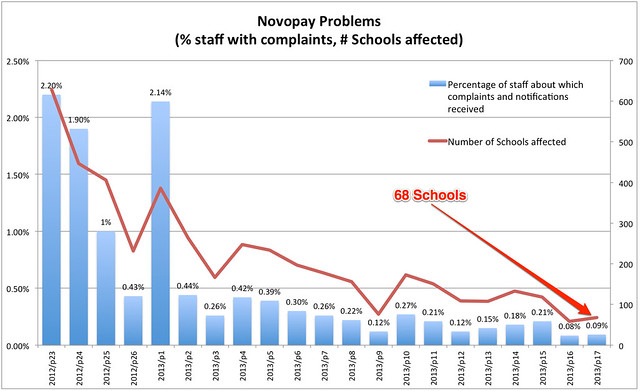
Not many people wanted responsibility for fixing the Novopay school employee payment system, but credit is due for the results as we approach schools’ year end for 2013. Here’s a chart of progress by pay-run from a year ago. 

68 Schools with issues is still too many, but it seems the vast bulk of the problem is solved. So well done.

The government were smart enough to place this in the hands of their fix-it minister, Steven Joyce, and I think the entire house breathed a sigh of relief when he took over.

I’ve said before that Labour and the Greens have to be sure that they have someone of similar abilities on their lists if they hope to be able to govern effectively.

Why are you accepting fatal risks Heart of Auckland City?

<update: I’ve changed the headline and edited this post as Auckland Council deny that this is under their purview. The Whitcoulls building and the Santa are both private.

I’ve done some digging around, and it appears to be the responsibility of the Heart of the City campaign, who have a 3-day time-lapsed video of the Santa and Reindeer build (perhaps from last year?) The organisation behind the campaign is Heart of Auckland City, a downtown business association. They mention the Whitcoulls’ Santa as part of their Christmas theming of Queen street on this webpage from 2012. From their 2012 annual report we can see that the entire Christmas budget was $460,000 in 2011/12, and the Santa is mentioned again.

Contractor names that I see in the photos include Waikato Cranes/Auckland Cranes, North Shore Scaffolding, Gulf Projects>

The annual raising of the somewhat dubious Santa on the Queen St Whitcoulls was completed this weekend. I passed by and was shocked at the unsafe work practices that I saw. The most concerning fact, aside from up to five fatal risks  was the reaction by the site safety officer who yelled at me and told me to fuck off. But at least he stopped the most unsafe acts before doing so.

The blame for this rests not with the obnoxiously behaved site safety officer, who was clearly out of his depth, and nor the lead contractor, the sub contractors or the workers themselves.

No – the blame resides with the people who hired this crowd to do the work. The folks on site said this was paid for by Auckland Council, and so Auckland Council gets the blame. (I only have the word of the workers for this, so apologies if the blame lies elsewhere. However regardless it’s on Auckland Council’s patch and they should have no tolerance for this.) <update: not Auckland Council as above, but Heart of Auckland City>

Quite simply they should insist that any work performed for them is performed to a high safety standard. Placing five (at least) workers at risk of fatal harm is simply unacceptable, and the Council Heart of Auckland City should give clear direction to all contractors that they should build complete safety into all of their tender responses and work. Yes this costs more, requires more planning and thought on-site and perhaps the work will take longer. But that’s far easier than telling families that daddy isn’t coming home anymore.

I witnessed the raising of the antlers. In general I’ve circled and written about the people working. This is the first photo I took.

Assuming the men on the top are attached to something secure with their harnesses then there is nothing that isn’t safe under NZ law. It’s good, for example, to se the scaffold railing that the person in the middle of the picture is holding on to, and the two gentlemen at the top barely moved the entire time I was there, leading me to believe they were securely attached to the building.

However the work was clearly about to be very unsafe, and on a site I (or anyone else) would have stopped the job.

Now we see the fatal risk occur, above and below.

It’s important when doing a lift that everybody is aware of what’s going on, as if the load slips then people can easily die. So this was disappointing:

As was, a little later, this:

Here’s a close-up:

Meanwhile on of the workers on the lift had clambered up to the top. The work he performed was often under the lift, and it was hard to tell whether he was secured.

x

He was certainly very mobile.

I suspect the harness was off, but it could be argued that this photo shows evidence otherwise. Doubtful, but ideally one would ask the question.

Meanwhile the scaffolders and builders using the long ladder generally, but not always used the ladder with someone holding it. Here’s one case where someone is at least 3m above ground and the ladder unsupported.

That’s a fatal risk. In fact a ladder that high is a fatality waiting to happen, as a fatality from a fall can happen at just 2 meters. There is not much the chap at the bottom cold do if the man in the blue shirt slips. Ideally workers would clip in as they climb, or have scaffolding to make the climb safe. Quite a lot of workers climbed up and down that ladder, arguably all at fatal risk.

But things were about to get a lot worse, ultimately leading me to say something.

The chap in the presents was not only 4-5 meters above the railing, but from my angle it seemed he was at risk of falling over that railing all the way to the ground. Above he seems to be treating the risk with respect, but then he started to work.

Notice that harness is not attached to anything, and with the primary focus on the work there is serious risk of falling, especially if he is distracted by something else happening.

He was joined by a mate.

A defensive argument would be that the person on the left was inside some sort of platform, but it’s clear that the height of the barricade is well beneath is waist, and besides he is leaning over it. I suspect though that the top of the box is either flat or close to it.

Here’s the really disturbing part.

Twenty three (that I counted) workers were on the site, and none saw fit to stop any of the dangerous practices that I saw. That means that they either didn’t have the eye for the hazards, or they did but were too intimidated to say anything. As it turns out I obtained evidence that it was both.

First, with five people that I could see potentially at fatal risk, I called out across a ute to several white-hatted people observing the work. I was not as consultative as I would like to have been, but I simply pointed out that the workers were at fatal risk as they were not wearing harnesses. (Normally one would ask to stop the work, ask about the risks that people see and lead them to the answer. That was clearly not going to fly here.)

To their credit they did agree essentially instantly and stopped the work on the presents, but not the reindeer where they said the men were wearing harnesses. I have no evidence whether they were or were not.

That was good. However a minute or two later the site safety manager came over and started yelling at me.

His bullying behaviour was wildly at odds with the sort of calm authority I would expect from someone responsible for people’s safety. It seemed to me that he accepted no challenge to his authority, and that this would cast a chilling effect on anyone else on site stopping work when they observed risks. It also occurred to me that it was shocking that there was a site safety manager who had been observing the “particularly hazardous work” and yet allowing the fatal risks to occur. I politely stood my ground (on the footpath) even after being told to fuck off more than once. I did like my response to “don’t you have anything better to do?” which was “not when I see five fatal risks at once”. He tried to intimidate me to move away from the area, to stop me taking photos (too late) and to not send the photos to OSH (Occupational Health and Safety). All that of course just made me determined to write this piece and to figure out how to escalate this to “OSH”.

With fatal risks for the two people under the lift, at least two if not five workers working from heights without connected harnesses and countless trips up and down the very high ladder I feel that this was well beyond reasonableness.

But OSH, it seems, no longer actually exists. The Health and Safety Group is part of the Ministry of Business, Innovation and Employment, and the responsible minister is Hon Simon Bridges in his capacity as Minister of Labour. It’s all moving to Worksafe NZ on December 16th this year.

Sadly I could not find a way to easily submit this unsafe act observation on the Health and Safety website. That’s something which the new Worksafe NZ could consider, along with a simple discussion of what the public and fellow workers can look for. We all carry cameras on our phones, and if worksites know that there is a trivial way for people to submit suspected unsafe working practices then overall standards will certainly lift.

I’d like to see active @WorkplaceNZ Twitter, Facebook and email accounts, along with a simple website and form to upload photos and text from computers and mobile phones. I’d like to see those accounts fully staffed by people who proactively and positively reach out to find and fix unsafe work practices, to encourage people to send photos of both good and bad, and to write a blog on the good, the bad and positive case studies.

We need a national conversation about this, and it needs to be focussed on improving safety rather than catching people out. We need to work to remove any defensive and belligerent bullying from the system, and to help workers help each other to be safe. We need to help people commissioning work that safety is not optional, and that jobs will take longer and be more expensive so that people don’t die.

Not fair trading

Several of New Zealand’s largest retail businesses have been convicted of breaches of the Fair Trading act within the last five years. Some were smart enough to settle with the Commerce Commission before being convicted, but most admitted a breach of the act.

  • Telecom was convicted and fined $500,000 in 2009, pleading guilty to 17 charges from the nasty 2006 era. They also admitted breaching the act in 2011, refunding over $2.7m to 47,445 affected customers. It’s nice that they found and reported this breach themselves.
  • Vodafone was convicted and fined $960,000  last year for 21 charges, with Judge David Harvey describing calling the campaign “clearly false and misleading” and the conduct “gross carelessness“. This followed 6 other charges successfully prosecuted in 2011.
  • Carter Holt Harvey settled in 2011 and made a voluntary payment of $1.5m to a Christchurch project. The charges were from activity in 1998-2003 where the ComCom alleged that some timber CHH had sold was not up to advertised specification, but CHH did not admit a breach of the act.
  • BNZ settled in 201o with the Commerce Commission after agreeing that its credit card brochures had breached the Fair Trading Act, and acknowledged that they had breached the act.
  • ANZ and ING settled with the Commerce Commission in 2010, and got $45 million repaid to investors in two funds. (It’s nice when the Commerce Commission works this well). In 2008 ANZ was fined $80,000 for a misleading bonus bonds campaign.
  • Air NZ settled with the Commerce Commission this year over price fixing from 2002 to 2006, paying $7.5 million in fines.
  • The Warehouse was convicted and fined $209,600 in 2009 for ‘multiple breaches relating to 2005-2007.

I’ve always been proud of New Zealand’s Fair Trading Act, and the presence of the Commerce Commission.

However Tom Pullar-Strecker writing in Stuff today brings up an interesting point from the delightfully named Licensing Authority of Secondhand Dealers and Pawnbrokers annual report. (I can only find the 2012 version). It seems that companies with convictions in the last five years under the Fair Trading Act are automatically refused a license to buy, sell or otherwise deal in second-hand goods, and in 2013 both Telecom and Vodafone were refused licenses for that reason.

However despite lacking a secondhand dealing license both Vodafone and Telecom are operating a trade-in scheme for mobile phones.

Sure the law might be ridiculously antiquated, but both companies should be aware that they are pushing it here, and it seems they are breaking the law. They should both should stop dealing in second hand phones immediately, but also apply their clearly considerable lobbying power to work to fix the law.

Those Fair Trading convictions are are very serious matter, and while those fines might seem high, they are trivial in relation to the sizes of the companies. It’s especially galling for companies that are so pervasive in New Zealand commerce to mislead us, and I am not unhappy that this somewhat unintended consequence of those breaches has come to light.

Let’s start paying GST on everything

I paid no GST when I purchased Lorde’s Pure Heroine album from Apple’s NZ iTunes store in September, but I did pay GST when I purchased a MacBook Air from Apple’s NZ online store. And while I do pay tax when I rent or purchase movies from the US iTunes store, but that’s a US state’s sales tax, not GST.

I don’t get charged GST when I subscribe to offshore web-based products like MailChimp, SurveyMonkey or WSJ, but these monthly fees could easily creep up over the GST minimum of $400 per shipment or transaction.

Is this fair?

At the moment when we purchase any item in New Zealand we pay GST of 15%. It’s been lauded as one of the most efficient taxes around, and we are lucky to have it and to have kept it simple. But GST does not apply for purchases from offshore valued at under $400, and with the move to sale of virtual goods online that’s becoming a fairness and revenue problem for NZ. 

So it’s time for a review of how it all works, and Revenue minister Todd McClay is kicking it off with the launch of a discussion paper – soon.

The aim of any taxation system is to achieve the two very difficult goals of fairness and efficiency while collecting sufficient revenue for the government to do their job.

Fairness is making sure that everyone pays their fair share, as dictated by the policies of the day.  I don’t want to get into the argument on whether it is right or wrong to tax the rich or poor, but I do think it is important to make tax avoidance very difficult to do and expensive when caught. Efficiency is more important in many respects, and is the measure of the cost and time burden that results from paying and collecting tax. An efficiently collected tax is generally a simple tax.

My own ambition is that New Zealand sets the global standard for both the fairness (e.g. apply GST to Amazon ebook purchases from the USA) and the efficiency (make it trivially easy to pay GST) of our tax system. GST is one of the most efficient taxes around, and I’d hate to see it become complicated or to see onerous requirements or privacy issues result from poor implementation. 

Proposal 

One proposal is to simply remove the $400 minimum per shipment from the current system, so that GST will apply to every item, physical or virtual, that is purchased by someone in NZ. And then make it trivially easy to pay that GST. 

This could be supported by an annual “GST not charged” allowance for individuals (but not businesses) who purchase goods from offshore, and it may as well be $400 again. Thus if individuals purchase over $400 of non-GST-paid goods from offshore in any one year then they are liable for the GST. 

But how do we collect the tax efficiently? Currently Customs hold physical goods with a value over $400 until tax is paid. This is woefully inefficient in time and dollars, and it slows commerce, adds real expense on top of the tax and doesn’t work for virtual goods. Let’s not do this any more.

Instead let’s just capture the information about the physical goods as they arrive, send a bill to the customer, with system to accept payment. Let’s release the goods before the GST is paid so that we remove double handling and storage costs. I’ve written before about the Customs website for calculating duty as Step 1 of 10 for paying our tax more simply, and it would be nice to see them push this sort of change.

Once the law is changed to remove the threshold then we have the ability to chase the big sellers, and ask Amazon, Apple et al. to collect GST at the source for all transactions delivered here (based on IP address ideally). Like anything there will be some sort of 80/20 rule that applies, and the lions share of the tax will be collected this way. 

We can also place the burden on individuals to collate and pay tax on items they have purchased from offshore, provided the total is above the limit. The focus would at first be on making it easy for people who want to pay the tax to actually comply. Ideally the initial minimum would be quite high and it would drop over time as automation improves. Sure people could avoid the tax by using fake addresses or VPNs or whatever, but the burden is still on them to pay it and the conversation at audit time will be between them and the IRD.

What it means

The big change here will creating the burden for individuals of collating receipts and paying GST where it is not collected by the seller. (Businesses already do this). However the nice thing is that electronic purchases do create a lovely electronic track record, and tools such as bank online systems and Pocketsmith will help.  

But the easy parts are for businesses to start paying GST on everything, for Customs to release all goods before GST invoices are paid and for big foreign sellers to collect GST at source. Those simple moves will capture the lions share of the tax, and the IRD can take a soft line on individual compliance for lessor cases.

Punakaiki Fund – The end for now

We sent the below to investors on Friday. Thanks are due not just to investors, but also to everyone who supported us.

In particular though are our suppliers. We were amazed at the excellent support in particular we received from Buddle Findlay (Sacha Judd), Lee Ter Wal Design (Baruch Ter Wal), Pursuit PR (Paul O’Leary) and COrr Communications (Catherine Orr). 

The website, prospectus documents, events and communications were superb thanks to these folks, who all understand early stage companies as well as the bigger end of town. You would do very well to send work their way.  

Dear investors

Wayne, Sandy, Chris and myself are grateful for your support.

However we regret to advise that we will not be proceeding with the capital raising and allotment of shares in the Punakaiki Fund Limited as we have not raised the minimum amount of $5 million.

As a result of the fund not going ahead, we will return all application monies to investors. A payment advice for the refund is enclosed.

We received, in the end, 368 subscriptions for a total of just over $3.33 million, well short of our $5 million minimum, let alone the $20 million target. I am still confident in the demand from emerging companies for smart funding, and very disappointed that we are unable to help any of the very long list of high quality companies who were attracted to our fund.

We crafted a company and management team to be expert at doing the job of finding, investing in and helping early stage and growth companies.

We were raising money strictly in accordance with the FMA’s public offering rules, so we could not identify any targeted investments, as doing so would mean providing full financials, often well before a deal was done.

We also could and did not say that I estimate my own, largely unrealised, returns in the sector at over 900% since 2007, at a rate of over 70% per annum. Nor could we say that under 5% of that capital invested resulted in absolute loss. These figures are dramatically different from venture capital and angel club norms, and would have helped show just how different Punakaiki Fund might have been.

In a public offer like this it’s critically important to only say things that are verifiable, as it means things are clearer and fairer to investors. But that makes it hard to get our message across.

Our thanks again. Perhaps we can continue this journey in another form at another time.

Lance Wiggs
Punakaiki Fund Limited

Taxpayers Union: Teaparty wingnuts or rational economists?

Today saw the launch of the strangely named Taxpayer’s Union, a lobby group aimed at “giving taxpayers a voice in the corridors of power.”

Given the taxpayers, that’s all of us, already have a voice each three years and through various processes, the Taxpayer’s Union deserves a bit more scrutiny. Are they rational economists looking to help make government more efficient, or is it a right wing shop looking to promote the selfish interests of wealthy people?

From their Q&A page:

Our objectives and aims include:

To give taxpayers a voice in the corridors of power;
To educate New Zealanders against excessive and wasteful government spending;
To scrutinise government spending;
To publicise government waste;
To promote an efficient tax system; and
To increase transparency and accountability of government spending.

None of that sounds too bad at first read, but “excessive and wasteful government spending” could mean being smart about the details, or it could be code for “no more welfare but yes more roads”. Similarly “promote an efficient tax system” could mean reduce all taxes to rich people, or it could mean reduce the administrative burden of collecting tax. Or, as @farmgeek mentioned, it could be making sure that we are collecting our fair tax from offshore based corporations indulging in tax jurisdiction dancing.

The first initiatives of Taxpayers’ Union may give some clues:

Promote an ‘Armchair Auditors Act’, modelled on legislation enacted in some U.S. states, where all transactions over a de minimis amount are searchable on an online database;

Promote legislation strengthening the Official Information Act.

These are great. They may lead to petty chasing of ministerial expenses, but overall the more government data we can get into the public domain the better. (It seems they already have ours.)

Identify and expose the most flagrant examples of government waste;
End taxpayer funded corporate and union welfare;

The language here is problematic with “flagrant examples” and “corporate and union welfare” smelling a little inflammatory and feel-good stuff for the right, but not really adding to the overarching goal of evidence-based lawmaking. This is potentially very selfish stuff, but a lot depends on the cases they bring forward.

Expose and halt the significant public funding that lobby groups receive to campaign and lobby government for pet policy and law changes;
Promote legislation requiring local referenda for any increase in real per capita rates

These feel more selfish. I’m guessing that the money funding campaign and lobby groups is generally primarily for NZ’s social benefit, and that the TaxPayers Union has some specific targets in mind. The details matter, but just as we provide defence lawyers, so should we also give those without a voice the ability to be articulate in the halls of power. Lose the voices, and sooner or later the laws will swing in the direction of the hard right.

And local referenda are simply dumb dumb economics, as a cursory glance at the USA’s State of California will show. We elect politicians to make tough decisions on tax, and our system works as it removes the personal incentive to pay less tax in favour of ensuring that the long term benefits and public goods are delivered. This is short sighted selfish wingnuttery and is deal killer for me as it implies a lack of rigour.

A quick search found this record of requests received under the Official Information Act, from the Clutha District Council Agenda for August 2013.

What’s interesting (and credit open data from the council for this) are the other names surrounding David Farrar, Stephanie Morrison and Jordan Williams, all of whom are part of the Taxpayers Union crew. But also on that page are Matthew Beveridge, the ex VicNats Deputy Chair and executive member for Lower North Young Nationals and Aaron Letcher, a National Party aligned member of the University of Waikato Council and Waikato Student Union president. I suspect Aaron, asking about travel costs for an area well away from his purview and Matthew, who is fishing for spend on fireworks displays and flower arrangements amongst other things, are part of the wider team. Also on the page were Jamie Morton of the NZHerald, who is based in Tauranga looking for rates changes and Vanessa Forrest, a producer from Campbell live, was asking about churches. we will give them a pass, and wait for their articles to emerge. On the next page was a Rebecca Green, asking about post 1940 buildings on the heritage list, so we will see where that ends up.

I will note that the burden placed on that little council by the team is quite high, and hope they are aware of their impact. I wholeheartedly agree with the approach that all government data should be online (including our housing data that is currently sold) so that government bodies are saved from the burden of OIA data collection.

Overall I’m willing to wait and see what the Taxpayers Union comes up with, but with a core aim to “lower the tax burden on New Zealanders” and a focus on uncovering scandals it feels like a economically lightweight single cause group. It seems to lack people from parties other than National, accepts anonymous donations (giving instructions as to how) but has a $5 joining fee – which smells potentially of rich people paying for astroturfing. I really hope this is not be the case, but that’s what I’m seeing at the moment. Sorry David Farrar.

However compared to the craziness in the USA this very mild (not that it makes it right). For comparison here are the Tea Party’s 15 Non-Negotiable Beliefs. Imagine having this lot in control of parliament, and remember that they started out as an astroturf organisation that sounded almost rational.

1. Illegal aliens are here illegally.
2. Pro-domestic employment is indispensable.
3. A strong military is essential.
4. Special interests must be eliminated.
5. Gun ownership is sacred.
6. Government must be downsized.
7. The national budget must be balanced.
8. Deficit spending must end.
9. Bailout and stimulus plans are illegal.
10. Reducing personal income taxes is a must.
11. Reducing business income taxes is mandatory.
12. Political offices must be available to average citizens.
13. Intrusive government must be stopped.
14. English as our core language is required.
15. Traditional family values are encouraged.