BBD CEO Tour: SYPartners

SY Partners helps companies facing major transformation. The session was aimed at helping the group push the thinking a little, and we very privileged that Chairman Keith Yamashita flew west to run the session.

SYPartners see themselves as consistently choosing to be great, for themselves and for their clients.

Keith questioned whether we risk what is required? Do we venture before it’s clear there is something to be gained?

As we know ‘start-ups’ often have little to lose, and everything to gain, by risking everything. The venture capital model drives either quick failure or outrageous success.

However as revenues and expenses and staff numbers grow we can get stuck on stock market driven annual planning and budgeting processes. It becomes increasingly difficult for larger organisations to unleash staff to simply do the right thing, to go with what feels right, to experiment and to move quickly. Allocating staff and money to new areas can get stagnated in bureaucracy and process, despite almost all leadership efforts trying to accelerate change.

Keith then asked what were you put on this planet to do, what will your organisation achieve unlike any other, what must you transform to get there?

Individuals

SYPartners sees that greatness starts with individuals – being aware, alive and engaged and aspiring. (I would say well educated and inquiring also.) We should seek to create a positive environment that appeals to individuals’ sense of meaning and purpose, and motivate participation.  We need to feel good about ourselves first before we can healthily engage with others. The greatest gift to give each other be fully aware and fully alive.

How do you show up when you are at your best, what conditions are at play to help you be your best, and where and when do you get stuck? The seemingly simple questions with difficult answers continued. The answers will vary by person, but center on being in a situation where you have the ability to change things, have meaningful results to achieve and where you are stretched but not extended too far. For some it means being around other people, and becoming smarter by being in a group. For others it may be toiling away solo and getting into flow while pondering a difficult problem. We can seek to understand what we are good and not so good at, and focussing on both increasing our strengths and buttressing our weakness, perhaps with the help of others. We can game this also by changing the environment to promote the conditions necessary to be at our best. This can be as simple as moving location, or changing the office environment by ripping out the walls.

Duos

Keith sees that building trust in the system starts with building trust-based 1-1 relationships. He sees little literature about duos, a lot more about leadership (1 to many) and apparently has started to fill the gap. This is a great look at Keith in action, and has some lovely commentery on duos at about 13 minutes.

A good duo starts with one person extending trust to the other, an act of giving before it is warranted. We can be smart about this when looking at companies – searching for the duos within the business.

Duo abound in business (think founding duos) and life. The individuals don’t have to necessarily get along, but trust and respect for each other is the key. We should be aware of the top few duos in our own lives (our speed-dial list, a somewhat dated term), and work to nurture them. One exercise is to consider the duos that you have categorised by the strength of the relationship.

 Teams

This duos work resonated with many of us, it’s a wonderful concept that great teams build from a series of great duos. Teams are where most work happens. Bringing the trust of the duos into a team brings the goodwill of those relationships, and makes the team easier to get going.

SYPartners see that there are nine actions that make a great team.

-Knowing the team strengths and playing to them
-Rallying people around a shared purpose and living by it every day
-See the forces working for and against your team and capitalise on them
-Choose bold moves to make and align your resources with them
-Identify the outcomes you’re after and measure your progress
-Get creative in reframing obstacles and resiliently adapt to change
-Evaluate the duos on your team and work to build trust
-Cultivate belief and motivate people to authentically act on it
-Make smart decisions and evaluate their impact over time

This is from a forthcoming toolkit called teamworks, which is a lovely site even pre-launch.

Organisations

Organisations, the next step up, are driven by a series of teams that innovate. The organisation should be certain about their unique corporate character and be vigilant in showing up in the spirit of that character in everything they do.

Greater society, Shared Agenda

If you are best in the world at what you do then you earn the right to help drive the national agenda.

SYPartners have helped companies build a shared agenda, which is understanding what you are fighting for, then aligning & rallying, everyone around that goal. The agendas work only when they are authentic, born of a real underlying need. Great agendas are bold, activated and also drive smart business. They should be measurable and widely shared. Poor agendas which fail are too obviously artificial and self-serving, mere marketing or positioning. Setting the agenda is the easy part – the harder part is to keep it going, backing it up with consistent and high levels of effort.

Three examples of shared agenda.

IBM with their Smarter Planet campaign – which was a ‘new agenda for IBM to offer the world.’ The IBM leaders saw the emerging opportunities from the rapid acceleration of collection and analysing of vast amounts of data. They saw that they needed to be a lot smarter about dealing with the data stream. IBM, with SYPartners it seems, convened their top 300 leaders to validate the ideas and get input on what IBM should do. They came up with three premises – that the world is becoming more instrumented (the internet of things), that is was becoming more interconnected and that it was becoming more intelligent. They summed this up with the tagline “A smarter planet.”

The kick off to the campaign happened during the GFC, with IBM seeing that they wanted to be a reasonable and optimistic voice in the middle of a crisis, stepping up to their full responsibility. Keith compared the GFC impact on Greece, Ireland, Italy and others with New Zealand’s successful negotiation of the storm, and has a hypothesis that NZ is in the midst of choosing to be the next form of great.

IBM rallied a wide range of people, starting with clients, and playing to higher aspirations around a shared agenda. They even changed the way they sell, focussing client conversations first on the larger picture of what matters. They reframed the way they communicated with Wall St, which also helped them see the ‘power of the portfolio’ and the wider addressable market, in turn increasing their stock price. They also reframed the focus of the IBM research group, and engaged staff, stakeholders and even general public with the smarter planet campaign.

Ikea’s Strand East urban development project in London, which we heard about at the CEO summit, is an effort by Ikea to model how intelligent design of an urban area can deliver sustainability and a sense of community.

Kaiser Permanente, an insurer and HMO (health care provider) in the US, has a much harder problem to attack – US Healthcare.  They intend to shift their conversation from treatment to wellness – it’s been seven years so far, ad they are only now able to start pushing this out into the company. The intent is to reorient their product portfolio and how they serve their members. Early programs are electronic ways to engage with doctors, sponsoring a farmers market movement and local exercise programs with client companies.

BBD CEO Tour: Klutz

Turns out Kiwis buy more Klutz items per capita than anywhere else. They are a toy company that specialises in helping 8-10 year olds build things. Klutz was started by two graduating students with a book on how to juggle attached to juggling balls, and after some wider publicity the sales exploded. After a few years they branched out into other products – all combination book and toys. The philosophy is “if people as inept as us can do this – you can too”, and they created a new product category.

They don’t like the ‘dummy’ books – ‘klutz’ means you are wonderful capable smart and…. clumsy. The second book was called Harmonica for the Musically Hopeless. The intent for al of their work is to get the kid or adult to simply try, to talk to them like they are capable of doing it and to accept failure as a natural part of the process.

They touted ’Damn Good Advice for Talented People’ by George Lois, quoting from there “Creativity is…there for us to find.”

Klutz want to be funny, but do not to advertise that fact as in “we are funny”. The expect that the humour should be obvious to the end user.

The people at Klutz all seemed to enjoy play – at work and in life. They seem to have a self-deprecating sense of humour, which perhaps why their products are so popular in NZ. They see that a collaborative culture is hard with big egos and bad moods – and that we all need to accept that our ideas can be silly and that we should be bring positivity.

Product development is very hands on, tactile. The staff are unafraid to act like kids, to bring their kids in or to give each other gifts. They, like many other companies, are completely set up to quickly prototype new products with an awesome array of ‘spare parts’.

The company was sold to Scholastic last decade, with sales and distribution now centralised there.

A Klutz staff of just 28 sits in a large shed creates the awesomeness that is the Klutz books. It’s a space that they seem to own themselves, but it is also a tiny team for such a large revenue base. It’s hard with the quarterly reports and the corporate overhead (one staff member mentioned that she had never had so many passwords.) However Scholastic in turn are respectful of the effect of the culture and generally stay away.

Learnings:

1: Do stuff that makes you giggle
2: Don’t be afraid to let your own sense of humour or other values pervade your products
3: Unleash the space and give permission to all staff to craft their own way

BBD CEO Tour: Hyatt Santa Clara Lab Hotel

Hyatt have about 500 hotels worldwide. A year ago the CEO saw that they needed an innovation drive, so hired a Chief Innovation Officer who started holding think tank sessions around the world. These brought in a diverse group of people from within Hyatt, their customers and others such as architects. They talked about wide topics like health and wellness, and generated, as these things do, thousands of ideas. They boiled these down to a book (that’s not exactly boiling down).

After they selected 8 hotels to be Lab Hotels, and our presenter Dania Duke was transferred to Santa Clara Hyatt to be a Hotel Lab Leader – as General Manager. She engaged Stanford D School to help – a smart move. Dania focused on gathering customer insights through empathy and trying lots of things.
Early learnings are that people want to be comfortable, feel in control, eat on their schedule, and do what they do when when they are at home.

(All of this session was conducted in a brown windowless room with a soulless text based powerpoint show interspersed with some neat photos. However while free unencumbered wifi was apparently one of the earliest changes made, it didn’t reach to my corner, and 3G telephone data access was cut off.)

Early results are good.
One example is how they reacted to feedback from customers that the furniture in the lobby was too heavy to move. Dania gave staff $500 to go and buy some cheap stuff from Ikea. The new furniture was immediately used by guests, moved around and used in different ways. They then asked guests the reasons for their behaviour and learned a lot. Some guests, for example, placed their computers on high tables, preferring to stand after a long flight.

Another change was to stop the bellman trying to shift business people’s luggage and instead gave him an iPad to do checkouts – a great ida both ways.

The most visible change is apparently the way employees interact although we didn’t see that from our brown room.

The widest change is an Asian preference program that has gone global, where Asian people can choose to get a package including a newspaper in their language, miso soup for breakfast, a lightweight smaller robe, a tea brewing station, “brown” and green tea and so forth. The Asian preference program was kicked off at the Santa Clara Lab hotel in March, was successful in dollar terms (driving bookings) and then rolled out in July to 24 other Hyatt hotels. I can’t wait for the Lance preference program, but apparently another preference program is rolling out soon, which I suspect the next one is targeting single females.

Other emerging programs could be VC suites, small free meeting rooms and even flexible check-out times.

They have a vey small development budget ($250k) and limited air cover from corporate interference. The limited budget is perhaps good, as it means change is focussed on small projects delivering fast results rather than large capital works. The general managers provide the aircover, protecting the staff and are fairly senior. That combined with early results has allowed them some degree of autonomy.

The Lab Hotels as a group are delivering results in customer satisfaction scores and to the bottom line.

Overall this is fertile ground. Hotels are miles away from giving us what we really want, and it is gratifying to see Hyatt launch not just the Lab Hotel program but also to quickly roll out the successes through the Hyatt chain.

This was a difficult presentation for me – struggling to match the uncomfortable chair, brown windowless room and bullet points with the idea of design led change. However it slowly emerged that Dania and her team had delivered a large amount of changes over the last 6 months, some of which was very high impact. Give it time.

Meanwhile I would suggest trying out the Santa Clara Hyatt next time you are in the region.

Top 10 things I want from a hotel that I seldom get
1: Online room selection at booking
2: 1 minute check in with no personal information exchanged or room unlocking with my iOS device
3: Clean bedding – no schmancy yet filthy bedspreads & pillows that are not laundered.
4: An ergonomic desk chair (a Life Chair) and a sofa I can stretch on
5: Toothpaste (as well as soap and shampoo) in the bathroom
6: Quiet but efficient air conditioning yet also fresh air in the room
7: Free high speed wireless internet with zero signups and unlimited devices
8: Plugs by the desk and bed I can use without bending or stretching
9: Check out 24 hours after I check in, regardless of the time of either
10: Pleasant can do anything staff who never want to be tipped

BBD CEO tour: Cisco II

Next up from Cisco was Joanne Bethlahmy Director Cisco Internet Business Solutions Group, which is an internal strategy consulting group charged with coming up with provocative ideas challenging business models and approach to customer engagement. They work with customers to do this, combining new strategy approaches with technology. Joanne comes from a FMCG and background.

Joanne spoke about customer engagement trends – a bit of a survey.

Today people expect to get both in-store and internet experiences.  Video is pervasive, eCommerce is 8% of US retail, 25% use smart phones in store and Facebook is dominant across most of the world. As a result retailers can often be show-rooms online stores, as bookshops are for Amazon (absolutely for me). In the US already 50% of consumer electronics are sold online, and we are used to interacting with talking heads on a screen. (That makes for some obvious next steps – delivering commerce through talking heads on screens, both in store and online).

Customer review and professional review sites are rising in importance of making buying decisions versus personal recommendations and especially versus in-store staff.

Joanne combines these trends into a word – calling it the Mashop – mashing up the physical and online commerce experiences. The goals of mashops is to improve the consumer experience, finding, experiencing and buying the product over any channel, and helping employees get really smart when dealing with customers. This can lower costs, improve sales per square foot, reduce staff costs and increase effectiveness through better measurement and loop closing.

Some examples.

More online experiences are being delivered in and around the store, which increases sell rates and up and cross sells. At least one Singtel store in Singapore has smart external glass, acting as a touch screen and allowing customers to purchase products 24/7 as well as showing interactive advertisements.

Creating “branded seamless spaces.” The Burberry store in Regent street has a huge video wall, each staff member has a tablet, each product has an RFID tag which displays information when held in front of a mirror. (I’m not sure about the “branded space” part, but the overall idea of getting customers to want to go the the store through making it awesome is good.)

Providing personalised information and products is something that casinos have been doing for a while, and they are now stepping up to personalising signage. (This is creepy, but part of the overall trend towards personalisation of advertising and products.)

Nike, and Adidas allow you to design your own shoes, and a place called Chocomize apparently lets you design your own chocolates. These personalised products are more than just a front end of course, and need a fulfillment process that can efficiently deliver the individual product. Obviously companies can build this capability as demand ramps up.

Mobile devices are helping staff become smarter, perhaps as smart as their customers. JCPenny is using tablets for fine jewelry selection, Mercedes Benz (and Ducati) have a tablet app for designing and selling their vehicles. (Nordstrom staff have phones and can do rapid check outs, and Apple stores have been doing this for a long time).

Cisco kit monitors mobile phone RF emissions in Copenhagen airport to track movement of people, and even to provide offers (boo) to consumers. Casinos, such as Harrahs, use Cisco kit to do video tracking and analytics, as do many supermarket chains and other stores.

Mobile phones are also handy for bypassing hotel check in and use NFC (or a bar code) to go straight to the room to unlock the door.

Sainsbury’s (rather disturbingly) have tried tablets on the shopping cart which interacts with the location to provide “personalised experiences” to shoppers. (I read that as annoying ads, and the tablet itself seemed to be in the way of seeing the cart contents.)

Remote expertise: interacting with experts can be done either in store or over the network and delivered on a variety of devices. An in-store setup can be VC or telepresence quality to match up call-center (or video-center) staff with customers across a chain of stores. That same video center could field voice and video calls from customers on home or the road, or the person could be an avatar. (Which seems like a frustrating idea)

Immersive experiences: fun things in store that use digital technology. Shisedo has set up the ground floor of a Tokyo store with virtual make-up stations, others are trying virtual trying on of clothes or placing virtual furniture in a room.

New technology can help deliver different or temporary physical store formats, including shipping containers. Of course I’d hope that stores would use Vend for those pop up and shipping container stores.

Amazon lockers and virtual storefronts such as Tesco’s Homeplus are, apparently, changing the idea of what a store is. Vending machines are becoming interactive, and the overall expectation is that we are doing more virtually.

Overall this was a fairly quick survey of what is out there. The main point is to put ourselves into the shoes of the internet generation, and understand their expectations of what the new normal will be.

BBD CEO Tour: Cisco

Surprisingly Cisco does not offer free wifi to all-comers at their executive sales center. To get on the guest wifi network one needs a ‘Cisco Sponsor’ and have to agree to not ‘create any liability for us or cause use to lose (in whole or in part) the services of our suppliers’, amongst a host of other clauses. The center itself is very impressive, but I get the feeling that visiting it comes with similar strings, and that it would be very difficult to leave without signing a multi-million dollar contract. In short these folks are aiming at the big end of the market, and  do so very very well. The room we were in was the best set up so far, with dual projection screens, large chairs and power at each table place.

We were here to hear about innovation at Cisco. Entertainingly speaker Stan Baginskis, the leader of their internal Innovation Group, used to work at both Intuitive Surgical and SurveyMonkey, our last two visits. He gave an superb presentation, hence the lengthy notes.

Cisco uses a variety of approaches, including acquisitions, incubating new technologies, partnering with others, designing and developing new products, spinning in (reabsorbing a spin out) and generating new business models.

Cisco’s Innovation Group superficially has a fairly standard approach to incubation – finding and filtering the best ideas, then initiating, accelerating and delivering the product. The difference is that the idea is not passed between teams, but kept within a separate development group until it has several hundred million in revenue. The teams are full time on each idea, generally 10 people in each. Overall they have a 50% success rate for getting to maturity and handing to the Cisco group, general five to seven years from idea. Cisco can of course more rapidly scale these efforts than a pure start-up, but that 5-7 years resonates with other evidence of how long it takes to develop a real business.

Cisco’s Telepresence business is a graduate from the group, while Smart Grid and Digital Security are current incubating companies. The Innovation team is well funded, but still has to go through an annual budget cycle to get money allocated. This can be a real problem for corporate innovation in general, but from the few words I heard it seems Cisco does it pretty well, and the team is protected from most corporate interference.

Three books touted by Stan were Clay Christensen’s Innovators Dilemma, James Surowiecki’ Wisdom of Crowds and an new one for me, Dealing with Darwin (2005) – by Geoffrey Moore, who also wrote Crossing the Chasm.

For new switches and routers that Cisco launches within the main group they can go global with immediate margin and revenue expectations. For new products and businesses from the Innovation they have a leaner approach, restricting the number of customers initially and learning as they go. They start pitching the idea to customers with a with a Powerpoint deck 18 months before launch, generally targeting 3 verticals, across selected geographies and looking at certain pain points. The do a road show with the development team to meet 10 customers in each vertical, bringing the business case to them and seeking feedback. This tends to narrow down to one vertical and one set of customers – say 5 or 6 charter accounts, who they build the solution with. The innovation teams get introductions to target customers through the existing sales force, looking for fit to the product and a very good relationship.

The first year after launch the focus in on expanding the first vertical, with 30 target accounts and an expected sell through rate of 50% with 5-8 referenceable sites. They don’t measure performance based on revenue in that first year, waiting for the next year and then waiting longer again for margins to be a concern.

Funding milestones are embedded in the process, but the first real milestone is not until the decision to launch the business. After that there are semi annual or annual reviews, where three year plans are presented and tracked. Continued non performance means attempts to change and then eventual deletion, though everything sold has the Cisco brand and so they seek an exit that makes sense for Cisco and customers.

Apparently Ed Roberts from MIT Sloan school says it’s twice as difficult to enter new markets than to deliver new technologies, and Stan says it’s even harder for Cisco who are technology led. Cisco do not see themselves as good at self-disruption, at changing the way they do business, and the Innovation Group prefers ideas that disrupt business models as well as technologies.

Stan put up a slide asking why large companies struggle with innovation, which is an excellent question. The answers were too much money, too much time, too many people, too much love, too much hate and black sheep.

Solving for these means, for Cisco, limiting the size of the team and budget, protecting them by running them in stealth mode* within Cisco, and having a very aggressive schedule. Too much hate means the presence of highly opinionated driven entrepreneurial types who would conflict with Cisco approaches, so they keep all the new and old incubating companies together. I’m not sure what the black sheep one was, but the answer, apparently, is to have the department only focus on innovation and get away from the Cisco margin and revenue pressures.

*They even keep the CEO out of the loop.

I would emphasize making sure that teams are full time, housed in a separate location and completely protected from corporate interference. This includes getting them off the standard big company systems and management practices.

Cisco ran a crowd sourcing idea generation iPrize process, soliciting ideas with a $250k prize. This delivered the smart grid idea, which is in incubation.

Cisco’s criteria for evaluating those and other ideas are

1: Opportunity for disruption
2: Adjacency to corporate priorities
3: Ability to have enduring differentiation
4: Ability to capture significant value
5: A plausible route to market.

Which are a solid set of standard criteria. Stan sees that a target market needs to be worth at least $3 billion for them to be interested, so that Cisco’s share (they assume there will be decent competitors) will exceed $1 billion. This size of the opportunity knocks out most ideas. His team is full of people with very broad experiences – combining tech experience and education with MBA and business experience. Sounds familiar.

Market trends. 

Stan sees that the mobile phone is still hugely more important globally than smart phones and computers. That describes a huge opportunity for change.

Cisco sees an approaching wave of market inflections, but the innovation team is not that interested in the relatively short term. The next wave, hitting 5 years out, is more interesting for them, and they see it including sensor networks, education, augmented reality, healthcare and BYO device into the enterprise.  After that wave (beyond 5 years) they see media metrics insights, networked transportation, next generation manufacturing, robotics/AI and rich media access.

Their overall approach to hiring is to find passionate people who like to think big and look for the large disruptions, but who can solve the small pain points first. They want people who are unafraid to drive to be leaders in the market, evolving and iterating quickly.

Learnings

1: Separate your new business team (innovation group) from your new product in existing businesses teams. Give them the space, budget and time to create and grow their businesses.

2: Provide access to your major resources, but don’t impose your own systems, management processes and overhead on the group. Let them choose what they will adopt, and what they will do themselves.

3: Review progress of the innovation team slowly, allowing the team to rapidly develop outside of the standard business planning processes.

BBD CEO tour: Intuitive Surgical

Intuitive Surgical makes giant surgical robots (surgeon assistance devices), and is publicly listed, delivering $1.76b of revenue last year. The have 2341 of their systems installed globally, mostly in the US and with 5 in NZ. Their revenue model is clever, with $700m of the total revenue from instruments and accessories, between $1000-2000 per surgery and $272m in service agreements. The disposable parts last for 10 operations, and are fully autoclavable, expiring due to stretch and wear on the wires controlling the pincers and other tools.

Using the robots does not save money on surgeons, as they are present, but does reduce length of stay, increase throughput per surgeon and reduces errors. There is a bit of literature out recently on making hospital procedures more consistent and I wonder whether the survival rates reflect not just the less invasive approach (the arms go in through small incisions) but also through an imposed procedure.

Clearly they are very good at selling in to hospitals, but Intuitive sees itself first as a product-led company, focussing on making the machines intuitive. Evidence for this is that surgeons  require just two days of training and the first few procedures supervised to be proficient. I struggle to reconcile this with the massive display wall of patents inside the building, which points to them being technology led. I also struggled with the giant cube farm and overall blandness of the office – which feels straight out of Dilbert and creativity free.

Intuitive seems like a classic start with technology and flip to product or sales led company. The IP to make the first product came out of DARPA, MIT AI lab and Bell labs, and was pulled together by the early team. A president was hired later on who flipped the company to be product (or as I believe, sales) led. The transformation was led by the second generation of product, which was aimed at prostate cancer surgery first.  This is an important flip which many MSI funded companies need to go through, one example of which is Christchurch’s Syft, led by sales guy and fellow Yalie Doug Hastie.

Most of the presentation touted the benefits of the robots (which are driven by surgeons operating locally, rather than telemedicine or true robotic. This reiterated the feel that Intuitive has a sales DNA rather than a technology one.

The sales team was built originally by people who already had experience in health care marketing. The large  sales force goes to ‘university’ twice each year, and they all go through a 6 week boot camp when they start, which has a very high drop out rate.  This is clearly a core competency in the business – and something that many NZ companies fail to build.

We spent the rest of the time playing with the robots, which are more like waldos to me – they help surgeons do what they do. Simply amazing products.

Learnings

1: Flip your technology driven company to a product (or solution/sales) based company as soon as you have a viable product. The best way to do this is through a new CEO, who should build a management team with a different style. Allocate a good amount of money to do this.

2: Hire people who are already selling into your market, and build a large high talent team. Train them rigorously in your product, as well as basic sales techniques and how to sell to your market.

3: Sell the benefits, not the product. The presentation we received was strong on the health care benefits, creating a compelling case for buyers. Everyone in the company should know the benefits the product delivers, playing from a single song-sheet.

BBD CEO tour: Survey Monkey

People use the SurveyMonkey tool for a large number of purposes with performance reviews, training and parent feedback my favorite non-traditional uses that CEO David Goldberg mentioned.
The product is easy to use, simple to set up and marketed essentially through word of mouth, mainly through people answering surveys. Easy to use was designed in from the start by the founder – who wanted to reduce support emails.
Their customers growth curve is wonderful organic, from a start in 1999, 8000 paid customers in 2003 and 340,000 customers now. More recently they have become acquisitive, purchasing Wufoo, Zoomerang and Zoompanel, whatever they are.

SurveyMonkey has a fremium model, and they believe in making the free product useful. However a surprising to me 50% or so of surveys that go out are from paid customers – I would have estimated a lot less. I checked out their pricing plan and pondered their average revenue. That pondering was unnecessary as David later said that the average price was about $25 a month, which when multiplied by 340,000 gives a run rate of $8.5m a month, or $102m a year. They are still growing, and at a good rate, so historical numbers would be lower, and future ones higher. ]
I suspect that they are leaving money on the table from customers who would be willing to pay a lot more. The highest rate of $65 a month feels like a lot above the next highest, but the plenty of clients would be able to cope with much greater monthly payments, and SurveyMonkey should help them do so. Overall it’s a nice little earner.
It’s a great investment for Bain Capital, in the news a lot recently as Mitt Romney was the founding CEO, who bought into the company in 2009, along with the current CEO David Goldberg and others. The founder Ryan Finley is still on the board, though it seems not very engaged aside from that.

We don’t know the sale price, but I wonder whether Survey Monkey founder lost a lot by selling “most of his shares” to the private equity companies. All they have done is reinvest in the product, changed the pricing model (I assume) and grow capability across the board. The same result could have occurred without selling out, by appointing a CEO, getting a consultant to help with pricing and strategy (pick me) and letting go of the reins a bit. They found, for example, that price ‘does not move the dial’ for their business. As mentioned above they could raise prices, but have deliberately chosen to keep prices low to mop up all customers and prevent the emergence of a new large competitor.

I can’t help comparing this to Trade Me – a wonderful organic curve, and yet rather than selling out completely the founder sold down and stepped up, appointing someone else as a CEO. This could have worked for Trade Me, and they didn’t have to bring in outside money. However in a way Trade Me, post IPO, is back to where they could have been with new found freedom from Fairfax to carve their own path.

The CEO presentation we watched felt like a pitch deck – are SurveyMonkey looking for an IPO or a new investor? Or was this a deck designed for Bain and their limited partner investors?

Next up were the product designers and owners. SurveyMonkey are redesigning their venerable interface – you can see the redesign it here. They are using an agile process, with the front end developers were unleashed first, and the back end database developers chasing behind. The test site is not connected to a database, and so the front end team can iterate much more quickly, while the back end team can observe the progress and see the obvious trends and direction. The front end team focussed on the negative feedback and ran web based user testing to see where the dissatisfied customers were being under-served. When launched it will run in parallel with the current create tool, but overall I guess that people will switch.

Their analysis tool was always weak, and they have another project to improve it. That’s a much longer project, with a quite long for the industry end user observation and interview process before they started to code.

Overall SurveyMonkey looked like any one of several NZ SAAS companies, including Trade Me, Vend or Xero. The key differences were the front end-only testing, the longer time spent observing and interacting with end users and the very high paid share of customers.

Top three tips for surveys from Survey Monkey staff

      Survey often
      Don’t sent a survey out that is more than 12 minutes long. Aim for it to be much shorter – and I would counsel 3-10 questions is much more likely to leave a great feeling.
      Don’t use the matrix question type, where you have to fill in a grid of answers.


BBD CEO Tour: Google

“We really are in the people business” said David Lawee today to the BBD CEO Study Tour Group at Google.

Our study tour group got the standard walk around Google, which starts with free food, and shows the volleyball court, the dinosaur and so on. This wasn’t the real Google though.

The real Google is about giving engineers a dream environment to create. That starts with the systems and tools that they have in front of them. I heard, for example, that every engineer gets access to all source code, with the exception of the core search code. What a vast resource. I’ve also heard elsewhere that all engineers get access to the massive data processing capability delivered by the vast data centers worldwide. And finally I’ve heard that there is no problem getting the tools that you personally like. This combines to form a great working environment for the engineers.

Google hires for great engineers, and great engineers vastly out-perform the good or ok engineers. Giving them the ideal development environment is good basics.

What can you do?

1: Ask your creatives, including developers what they want, listen to them and work with them to understand the biggest priorities and pain points.

2: Fulfill their dreams. Start with the tools – it’s inexcusable not to have two screens these days for a developer, but also give them complete flexibility on what computer and other tools they have, the desk and chair and the software. Productivity and creativity may be difficult to measure, but for the sake of a few hundred dollars you’ll see a massive difference in attitude and output. You can’t expect the system of the future to be designed with yesterday’s tools.

Get the bigger stuff right as well – make sure you step back now and then to look at the development platforms, the size of the databases and so on to make sure that none of these is ever a constraint. Let the professionals pick the right tool for the right job.

3: Get the physical environment right. That means everything from what sort of office everyone is in, to the presence or not of healthy food, the noise levels, access to a team’s  own whiteboards and meeting rooms, and ability to customise everything. An easy way to do this is to allocate each person or team a quarterly budget, and let them create their environment how they like it. Expect and encourage it to change over time – the office of today should be nothing like the office of last year.

There was plenty more to learn from Google – especially how they improve recruitment, performance reviews and compensation using analytics. They are probably the world experts at this, and while I got to hear a little bit about it from a friend prior to this week, I would dearly like to sit with him for a week or so to see how it actually works.

BBD CEO tour: IDEO

I’m on the Better by Design CEO Study Tour, visiting a host of companies in the SF Bay area. I’ll try to post notes as I go.

IDEO is held up by many of the exemplar of user centered design, and certainly some of their output has shown that. I was a huge fan of the silver Palm V, and it turns out they were the folks behind it.

However their magic juice is simple, in my opinion.

Firstly they simply spend a lot more time and energy on gathering end user requirements. That’s in language they wouldn’t like, as they prefer to use words like empathy and observation, but regardless their clients are all happy to spend months of time on IDEO looking at the underlying needs of their clients. They used a nice example several teams that  IDEO formed to develop a new baby incubator for Nepal, but only one team realised (through observation and questioning) that the baby incubators were not the solution to the core problem. The core problem was actually high infant mortality, and it was happening way back in remote villages rather than in hospitals in main centers. The group went to the villages and after returning designed a simple sleeping bag inspired baby warmer. The other IDEO groups designed baby incubators, which would, like the existing ones, sit unused in the central hospitals.

I would argue that we can get the the same effect simply by asking why. Why are babies dying, why are the incubators not used, and so on until you get the root cause. This, 5 Whys, technique, is a classic Lean tool, but it’s also a classic consulting tool, design tool and learning tool for 3 year olds.

So ask why, observe end users and spend time uncovering the real root problem.

Which brings me to the second of IDEO’s secrets – to encourage play. As children we natively understand that we must pick things up and arrange them in different ways for fun. This is progressively beaten out of us, as we cede creativity to Designers (with a capital D) and Writers and so on. That’s rubbish, and we all need to back ourselves to give it a go. We also need to keep learning, and to use Designers and Writers when it really matters.

So – give it a go, and encourage everyone else to prototype, design and write.

Thirdly and finally IDEO teams remain focussed on one task until it is finished. This means firstly having a team, comprised of multi-skilled people who are very good in at least one area. Then it means ensuring that the team has its own space, the budget to travel to see end users and, the time to complete the work and most of all, no other legacy tasks or overhead. That’s difficult for most companies to manage, and this is just the product or service design stage. It’s also tricky to take the greatest people away from their current tasks and put them on a team. However my own experience is similar – breakthroughs happen with high performing teams working full time on specific tasks. These could be new products, but also performance improvement for large plants. The team works on the business, not in the business.

So – if you have a big problem or opportunity – consider forming a team and unleashing them full time for a few months.

Mapping your Social network

Wolfram Alpha just released a nice statistics pack for analysing your Facebook activity. Simply type “Facebook report” into the search bar, connect to Facebook, register for Wolfram Alpha, wait for minutes between each interaction as Wolfram Alpha is getting hammered at the moment.

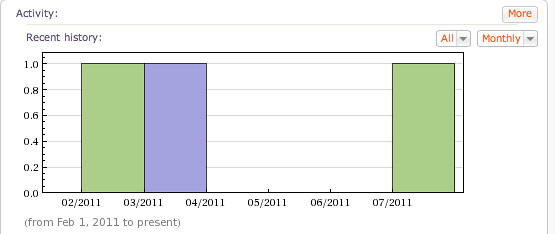
I’m essentially inactive on Facebook, but did get a couple of nice charts. Here’s one showing my lack of activity:

That’s 3 updates since February 2011, less than one every 6 months. However I do send my tweets to Facebook.

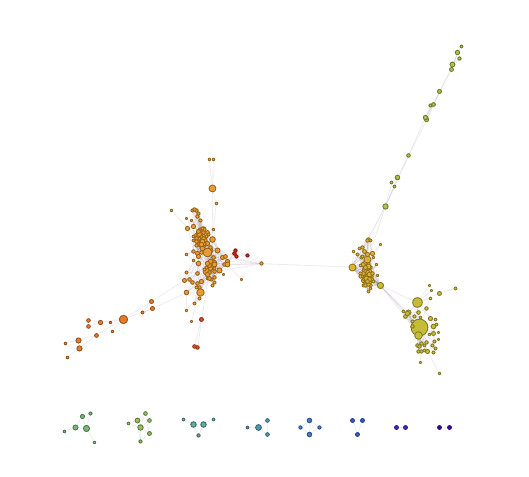
You’ll get more interesting information if you are active. Below is a cluster of my friends by who is connected with who. It’s a little more disconnected than my Linked In map of connections.

There are 15 or so groups, and generally very little connection between them beyond me. On mousing over it becomes clear that these are people who I’ve met in distinct places and times.

The large grouping on the top right are Yale alumni, while the green group below and to the right of it are Washington DC and McKinsey connected. On the left in orange are the bulk of New Zealand connections. Vikas Jain, from Yale days is on the right, and Ollie Clark, from Wellington (we work together on myTours) is on the left. They work together at Wildfire in San Francisco and provide the sole connection between the groups.

The groups at the bottom represent people from South Africa, South American travels and so on. Rather amusingly one of those small groups are friends I know on Facebook from Massey University, which was after all the original reason for Facebook.

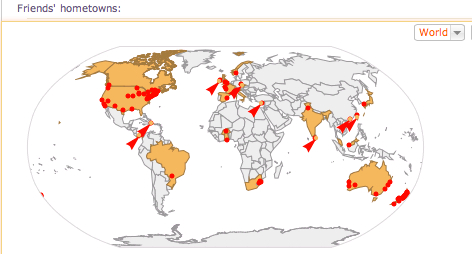
The map of friend locations shows the clustering in another way.

I could get a lot more links if I used Facebook for anything other than sending my tweets there, or accepted some of the friend requests in my queue. Nothing personal – but Facebook is too personal (and data hungry) for my tastes.

Where it gets too personal is that it seems I can now run these reports for any of my friends. I won’t blog the results.

Domain squatting is an asshat thing to do

FamilyFirst.org.nz is anti-gay marriage group with views regarded as despicable by a decent part of New Zealand society. Their website used to be hosted at familyfirst.co.nz, and until recently was redirected from that address.

A Hamish Spencer (@hamfritta) purchased the familyfirst.co.nz domain after it expired, and redirected it to pro-gay marriage site marriagequality.co.nz.

I regard this as an asshat move, especially as 200 people an hour apparently were being redirected, although many of them no doubt were simply confirming the story. I strongly condemn the message of the Family First group, but also strongly support their right to say whatever it is they want to (provided it is not inciting violence or hate-speech).

So in the spirit of fairness I just purchased marriageequality.org.nz and redirected it to familyfirst.org.nz. It hasn’t come though yet (and probably won’t for about a day), and I’m only doing this as a cheap way to show that this sort of thing is asinine. I will re-direct the domain to this post eventually, or redirect or hand it to Marriage Equality if they ask nicely, and let it expire otherwise.

<Update: Marriage Equality asked nicely, and I redirected the url to marriageequality.co.nz. In all the redirection to FF lasted an hour or two at most. The point was made. >

This stuff can go on infinitely, and I suggest that Hamish does the right thing – and offers the domain back to Family First.

Hamish should also look to his own affairs before entering into this sort of battle. It’s actually amazing that as I write both the .co.nz and .com versions of his own name are available – he should snap them up. I use IWantMyName.co.nz, and highly recommend them for very simple and straightforward domain purchasing and management.
IWantMyName

NZ Government on Investing in shares – some more questions

The NZ government now has a page up with all you need to know about investing in shares.

There is not a lot on the page, and certainly not investment advice. It even avoids answering its own question of “How many New Zealanders own shares?”

They do point out that Kiwisaver and term deposits as well as Iwi funds total $100 billion, but a quick search shows that Kiwisaver funds under management was just $11.26 billion at the end of March 2012, according to Morningstar.

However it’s what’s missing from the page is very important. I’ve proposed some more questions which could be answered on the page:

  • How do I sign up to a share broker? Provide links to them, all of them, and show which ones you can sign up to online (That would be none).
  • What are the costs are to buy and sell shares? Show, for each of the brokers, the costs to buy and sell shares.
  • How long should I hold the shares? Discuss the different approaches to investment and investment horizons, defining the traders, long term buy and holders and discussing successful investment strategies.
  • What is selling shares short? Discuss shorting, and its application in the NZ context. Show why a healthy shorting and options market is good and that the NZX is liquid enough to cope with it. (This may be difficult)
  • How do find out about companies to invest in? Discuss disclosure rules, and show where each of the companies is required to disclose information. Show whether the unsophisticated investors are on a level playing ground with the professionals. (This may be difficult)
  • How do I know it is fair? Discuss the rules in place that ensure agents and large shareholders and their friends cannot get any advantage over other investors. Show how the watchdogs are relentless in their pursuit of any irregularities. (This may be difficult)
  • What are tax imputation credits? Show how you don’t, unlike pretty much anywhere else, have to pay tax on dividends from New Zealand companies, unless you are Australian of course in which case you do. Confused? So are offshore investors.
  • Where can I do more research? Point to the large range of analysts that provide free and very cheap reports on the top NZX companies, allowing sophisticated and unsophisticated investors to really dig behind the company rhetoric and numbers to see the real long term value of the business. (This may be difficult)
  • Should I stop my Kiwisaver? Gently show that most Kiwisaver finds will be investing in the top NZX firms already, and that placing more of your funds in a Kiwisaver fund gives the portfolio diversity effect as well as tax benefits, giving  increased returns at lower risk over time. Point out that betting on individual companies is something that is fraught with danger for uninformed people, especially with a short term time horizon. (This may have a negative effect on SOE sales)
  • Should I buy more NZ stocks? Show that New Zealand is a trivial part of the international investment scene, but also point out that we know the most about our own businesses and foreign ownership by short term financial investors, as with Telecom in the day, is a very very dangerous thing. Discuss how a well constructed portfolio will balance offshore and domestic investments, while trying to avoid talking about the asinine tax regime for assessing offshore holdings. (This may create tension)
  • Any others?