

Antarctica – albatross

Antarctica – random picture
We are back from the icy south, still on the boat but about to disembark. Here’s a friend:

Going Offline and South
I’m off to Antarctica from 10th of February to 9th March. During the trip there will be essentially no internet access, though the occasional email or blog post may get through.
While I am away I will turn the comments on the blog off, to stop potential growth of the several spam comments that I have to manually remove each week. My apologies for that.
In emergencies, or for calls where you don’t mind paying international roaming rates, there are two numbers to try. The bridge is manned 24 hours a day by Russians who may or may not speak great English. Ask for me in cabin 510, and then call back after 5 minutes or so. 0088 167 7705 483
The other option is the public phone in the communications area, which I suspect will be manned a lot of the time anyway. You’ll get a fellow Our Far South traveller and can ask for me, in room 510 again. 0088 167 7705 485.
Apparently we will be assigned an email address specific to the ship and voyage. Email is data, and data is $10,000 per GB or so. I’m not expecting to send or receive many, if any at all.
I have not been offline for 30 days since the mid 90s, when I travelled around Europe for a few months in a world before internet cafes. It will be an interesting experience.
It’s a bad time to be away, and will miss seeing everyone at great events like Foo, Webstock, 0to60, the Broadband Summit and InternetNZ Council. Have fun all!
It’s great to be part of the Our Far South crew, and I expect to come back a lot better informed and energised about the region. The aim is, says Gareth Morgan, to have all of New Zealand sick of Our Far South by the end of the year. To make that happen there will be four books published and two documentaries screened by mid year, while plenty of schools have picked up on the trip and offers of visits.
To the South!
The End. AllAboutTheStory closes down
We are sad to announce that AllAboutTheStory is closing down. We had a talented team, a great idea and did a lot right – but in the end it failed.
Founder Julie Starr put in the lions share of the commitment into the business, but in the end, as she wrote to members:
We’ve enjoyed running the site, being able to connect writers with editors, and being involved with so many great stories and cartoons. But we said at the beginning that the site would be an experiment and here’s what we’ve concluded: Yes, there is some demand for this kind of marketplace for content and we have provided a useful service for some of our members, but overall the opportunity just isn’t compelling enough for us to take it any further.
So that’s it. Perhaps we were too early, perhaps the idea is just lousy, or perhaps we needed to insert a lot more money and time. Ultimately I believe we did well enough where we had to in order to be able to identify that there was no market at this stage. While did not ever expect that New Zealand alone would be a sufficiently large market, it was a test market, and the test failed.
Everyone involved is working on something else. Rowan, Koz and Amnon are involved with Vend, Go Vocab and some secret stuff no doubt; Enspiral are working with Siobhan Bulfin on Goalpost and with Natalie and I on SafePlus; Natalie is also with MyTours and Julie is pondering her next attempt, which I know she will do well.
We all learned through the process, and are chalking this one up to experience. It’s important to push an idea hard, but it’s equally important to know when to stop. That’s a lot easier to identify when there are several other businesses to work on, but it is much harder for and on the founder. Julie – congratulations on this business, and I look forward to seeing your next endeavour.
What else is important to the NZ Government?
Having had our fun with Antarctica, let’s look at some other areas of concern. How often do the Briefings to Ministers mention certain other words?
Let’s start with “internet”.
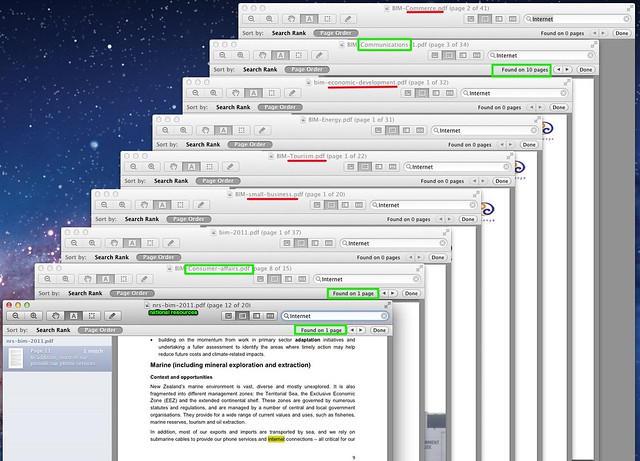
I would content that the internet is an important feature for Commerce, Economic Development, Tourism and Small Business, so it’s a surprise that it isn’t covered at all.
On to “Maori”, critical to be involved across all aspects of policy making.
Consumer Affairs and Small Business make no mention of Maori. That’s very strange. Good to see the coverage elsewhere though.
Somewhere that almost all of us go to is “Trade Me”, so what is the government position on this dominant eCommerce force?

Nobody cares about Trade Me it seems, and the notable absence is Consumer Affairs.
Nor do they care about Facebook, where our teens and adults are spending their time online:

Surely the “economy” will deliver the results? Who wouldn’t be concerned with that?
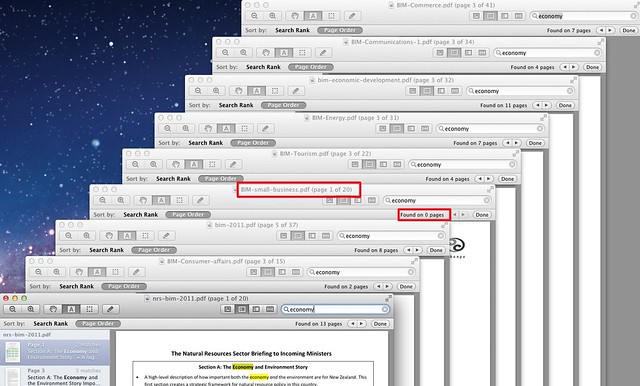
Consumer Affairs agan. They didn’t talk about Maori, the economy, internet, Trade Me or Facebook, let alone Antarctica. It must be a shocker of a paper.
Indeed it is. The paper, as it turns out, is a scan of a paper rather than a genuine PDF, which I should have noted when every other file was under 600k, and this one was 4.3MB. I would encourage the folks there to turn it into a proper searchable PDF, because on reading it there seems to be an excellent paper. I would like, for example, to copy and paste “New Zealand currently ranks third for ease of doing business in the World Bank’s Doping Business Survey” instead of retyping. The next paragraph says that we cannot stand still, and the one after that talks about firms being more productive when they have lower compliance costs. It’s all gold, and deserves a wider audience.
How important is Antarctica to the New Zealand Government?
The MED’s Briefings to Incoming Ministers are a wonderful institution, and a must read for anyone interested in NZ Government policy. They were released today, and survey all of the major issues that ministers need to know for their portfolio.
A group of us are of on a boat from Friday next week to promote the importance of our far south – the area south of Stewart Island – to New Zealand. There are a lot of reasons this area is important, including economic, from our claim to an enormous economic zone based on our possessions (islands) and geography, climate change with the area playing a critical role and environmental with a stunning and also critical ecosystem.
I thought to search for “Antarctica” amongst the BIM papers, and found – nothing.

I’m not pointing the finger at anyone here – the BIMs cover the top issues only. But I am using this as a key measure of how successful the group will be at getting the message out there. Will we be able to create a policy conversation about Antarctica?
Only time will tell, but in the meantime I’m counting down the days and packing warmly for Ourfarsouth.
The Facebook IPO: comments
I’ll update this as I read the S1 prospectus.
Facebook’s daily user growth is slowing. While 6-10% growth per quarter feels like a lot when annualized, it is getting close to being a normal company. Facebook is running out of target market, and especially target market with pockets deep enough to be monetised.
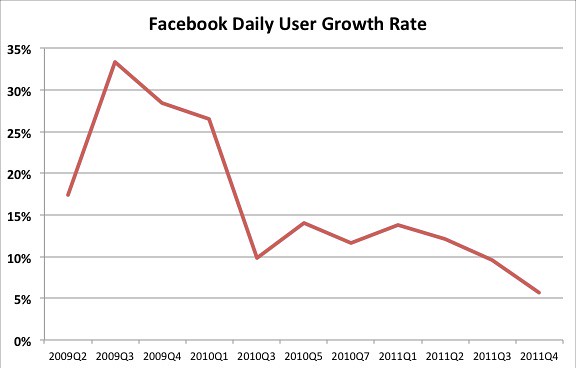
The monthly active user chart is falling harder, and explains why I keep getting those annoying “Lance, you have notifications pending” emails. They are trying hard to keep these numbers afloat.

The Summary Risk Factors deserves reading and thought. Be warned.
If we fail to retain existing users or add new users, or if our users decrease their level of engagement with Facebook, our revenue, financial results, and business may be significantly harmed;
Related to this is the boilerplate: Our business is highly competitive, and competition presents an ongoing threat to the success of our business;
This is the principal risk. If users migrate to Twitter and other platforms as Facebook follows in the footsteps of MySpace, Friendster and Bebo into uncool obscurity then the house of cards falls apart. Nobody can say what users will do, but the charts above should be hte most closely watched, as well as the amont of time users are engaging.
We generate a substantial majority of our revenue from advertising. The loss of advertisers, or reduction in spending by advertisers with Facebook, could seriously harm our business;
This is the second biggest risk, though I would characterize it as a loss of ability to grow first, and the loss of current income levels second. Facebook is free, and so advertising is the primary way to make money. There is a strong tension between getting revenue from ads and the quality of the user experience. A lousier user experience means people will migrate to other platforms. As Facebook is going public the pressure will be on to ever-increase revenue, wich in turn means more advertisements and in turn means a lousier user experience. It’s a tough circle to play in.
Growth in use of Facebook through our mobile products, where we do not currently display ads, as a substitute for use on personal computers may negatively affect our revenue and financial results;
Quite fixable
Facebook user growth and engagement on mobile devices depend upon effective operation with mobile operating systems, networks, and standards that we do not control;
Apple and Google could make things hard for Facebook on iOS and Android if they so choose, and they may do so.
We may not be successful in our efforts to grow and further monetize the Facebook Platform;
Facebook makes 17% of revenue from clipping the ticket on payments for virtual games. How sustainable is that?
Improper access to or disclosure of our users’ information could harm our reputation and adversely affect our business;
Privacy is still a major concern for FB.
Our CEO has control over key decision making as a result of his control of a majority of our voting stock;
I’m actually ok with this, as it hopefully means decisions will be made with respect to usability and long term sustainability rather than quarterly reporting. We shall see.
The loss of Mark Zuckerberg, Sheryl K. Sandberg, or other key personnel could harm our business;
Quite.
Our business is subject to complex and evolving U.S. and foreign laws and regulations regarding privacy, data protection, and other matters. Many of these laws and regulations are subject to change and uncertain interpretation, and could harm our business;
SOPA and other draconian legislation ideas could have a real impact on Facebook. However having Facebook as a large listed company will increase their voice on the Hill.The question is how they will lobby.
We anticipate that we will expend substantial funds in connection with tax withholding and remittance obligations related to the initial settlement of our restricted stock units (RSUs) approximately six months following our initial public offering;
Put that in the valuation models.
The market price of our Class A common stock may be volatile or may decline, and you may not be able to resell your shares at or above the initial public offering price; and
Substantial blocks of our total outstanding shares may be sold into the market as “lock-up” periods end, as further described in “Shares Eligible for Future Sale.” If there are substantial sales of shares of our common stock, the price of our Class A common stock could decline.
This is going to be a rocky ride.
(update 4)
The standard revenue and expenses numbers look like this:
What’s interesting is looking at these on a per user basis. This is difficult to do as I don’t have the quarterly revenue figures to match with the monthly users, and even then we need to really get down to smaller periods so that the number of users is relatively static over the averaging period. In an attempt to get the weighted average I’m going with the end of 3rd quarter numbers of active daily users for this chart. Those users are worth about $8.12 each per annum right now.

Let’s try the active monthly users chart:

Most users are not active each day, and the average value of each of the people that checks Facebook at least once a month is just $2.12 per year.
Let’s thinking about those numbers in practical terms. As a user Facebook makes money from you if you are exposed (weak) or click (strong) on advertisements and buy things (very strong), or if you partake in the many social games and pay money to the provider through Facebook’s payment system. The question to ask is how often people are clicking on advertisements, and hw effective they are. Facebook will be working hard to increase the effectiveness of advertising targeting, and on selling to adland, but ultimately the results are in our hands.
The question to ask as you make a decision to invest or not is simple – how many regular customers will Facebook have, how long will they have them for, and how much money per year will each customer deliver.
At the end of 2011 there were 483 million daily active users, and if we assume 6% growth for each of the next two quarters then 4% growth for the quarters after that then the Dec 31 2012 active daily users will be 587 million. The third quarter number would be 564 million.
At the moment the gross revenue per active user (at the end of the third quarter) is $8.12, a 20% lift on 2010, which was almost 25% up on 2009. Let’s assume growth of 17%, whihc gives a nice round $9.50 per active end 3rd quarter user per year.
That would mean total revenue of 564 million x $9.50 = $5.358 billion for 2012, 44% up on 2011. After that it gets interesting. Will Facebook users actually keep climbing? Will the average revenue per user do the same? How good will Facebook be at controlling expenses, which climbed over 100% from 2010 to 2011?
When it comes to valuing the company, think about the total amount of money that each active user will ever be worth Facebook. If active users were worth $10 each per year, then Facebook would need to keep 1 billion users for 10 years just to earn $100 billion in revenue. Subtract from that the expenses and the considerable time value of money, and we can see a large gulf when looking at hte $100 billion valuation.
However if the average revenue per active user crept up to $25, then 1 billion of them would deliver $25 <edited typo> billion in revenue per year, and an easy $15 billion or so in net. That will take a few year to get to, but justifies a $100 billion value.
So the questions to answer are simple: Can Facebook over double the number of daily active users, and Facebook over triple the dollars that each active user is worth to them each year.
From my own experiences, dropping out of active Facebook participation and using blogging and Twitter only, I see this is very difficult. It seems hard to imagine higher penetration of Facebook in most Western markets, and there are portends of an early adopter migration to elsewhere, including Google +, Twitter or nowhere in particular. The expansion into new markets is also problematic as the average revenue per user will be lower in those lower income per capita areas.
I wish Facebook luck with the IPO, it will be a good one, but I will not be investing.
Don’t do big deals
McKinsey Quarterly reports on a study of 1,000 companies and their approach to mergers and acquisitions. This builds on work we did in the Evergreen project in 2001.
The answer is simple, just don’t do big deals as they will likely lose money. A big deal is defined in the study as one that is greater than 30% of the larger company’s value.

It’s far smarter to become very good at finding, negotiating, buying and absorbing a series of companies that are a lot smaller than the buyer. Even so, buying other companies is a no a panacea – there is plenty of variability in the results, with poor returns and the risk of failure high.

Some industries fare worse than others, and high tech and Telecom are in the mix. We found in 2001 that you simply cannot purchase your way out of a bad situation, and the markets are littered with companies that tried and failed.

In 2001 our sample size of M&A deals was a lot smaller, as it was only part of a larger study. We did see that some firms who had well oiled fundamental business practices, did well buy being programmatic purchasers of smaller companies. It was quite rare, and I stress again that the companies that succeeded in this approach were already superb operators.
In summary my overall perspective has not changed. Purchasing other companies is a good way to grow only if your own company is doing well, if the companies you buy are relatively small versus your own and if you have a well rehearsed plan for what happens after the deal is finalised.
Don’t blog like a pro
I strongly believe that any activity that is “good for business” but bad for customers, is, in the long run, bad for business.
One example is from ProBlogger, who say this about their attitude to linking to other websites from professional blogger sites:
“Instead of being a helpful way to share relevant content with our readers, we’ve come to view them as a way to increase our SEO. We’ve become stingy with links because we want to keep our readers on our own pages, viewing our AdSense ads and buying through our affiliate links.
It seems obvious to me that making the product (the article) worse by not providing the right links will drive long term traffic down, and not up. It will (and did) certainly put me off this sort of site, which exists to drive traffic rather than for some higher purpose.
It feels obvious that short term gaming of Google results through the “right” use of SEO results in a reader experience that is flawed, and that Google will eventually figure this out.
It seems to me that some so-called professional sites have increasingly lost the plot.
As readers what we want is quite simple:
- Quality edited content that informs, makes us think and reflects the sources and facts which are linked to;
- The ability to comment and reflect on that content in a polite and informed community;
- The ability to up or downvote on the content and the comments to help give feedback to that community.
The benchmark for this today is Hacker News, which manages to link to mostly the source content and has a nerdy community that is intolerant of anything off topic.
However while ProBlogger is beginning to get it, their proposed solution indicates that they actually do not:
We all need to adopt a mindset that includes outbound links in our articles—not necessarily every article, but I think it should be 25% at a minimum.
That’s a very prescriptive way to write, and readers will see that.
Instead they and other professional bloggers should focs on writing quality and relevant content in the first place, not writing at all if there is nothing to say, and linking appropriately using the standard internet ethic that the non “pro blogger” community just seems to understand.
It’s not safe working in America
The Atlantic’s photo survey of America at Work (or not) is doing the rounds. It’s a compelling set of pictures that showcases all that is right and wrong about the world and the US today, and I highly recommend having a look.
The survey is amazing, and sad.
My own impressions of the work being performed are coloured not only by my experiences as a business consultant, but primarily by working in sites with a safety first philosophy. At BHP Billiton, where I was a consultant on several sites, they have the concept of striving forever to have a safe and healthy work environment. They call it Zero Harm, and the way to get there in essence is a matter of looking at each task and asking what could go wrong?
It’s simply good business to ask that question, and to also ask “how can we do this task better?” Better in this context means not just safer, but more effectively and to produce a better product.
Let’s survey the first few photos from the America at Work collection.
The very first one shows someone doing a task, but the task itself is ineffective. The worker is trying to steam a huge flag, and he is in a cherry picker and with a suport person (which is good). I would ask whether he needs secondary fall restraint (clipping on to the platform), whether they can find a bigger steamer and steamer head to improve the effectiveness and quality of the task, or whether the flag should just be taken down to be steamed.

The picture below shows a worker assembling a Ford Focus engine. She is wearing a large glove on her left hand, but does not appear to be wearing an appropriate glove on her right hand. No glove means a much higher chance of a hand injury (one of the more common injuries in many places), as well as lower ability to grip and apply force. I would ask her to stop the job and talk about this, amongst other things.
I would mention that is is god to see her wearing eye protection, and ask whether she has hearing protection.
I would ask her, and others, when they intend to make the move to high visibility clothing, as so many in industry have done. I would also ask whether there are any hazards (anything mechanical that is moving) that would require her hair to be tied back so it is not caught.
Finally I would ask about the comfort of doing the task itself. She is standing in a strange way, with part of the jig in the way, and the task itself far enough away so that she has to lean in. Any embedded approach to continuous process improvement (TQM, TPM, ISO 9000 etc) should see this changed fairly quickly.

Next up is a clock worker is carrying a part. I would ask how heavy it is, and whether wearing gloves would improve things. He’d certainly find that this sort of work a lot easier and safer if he does so.
He is also wearing low visibility clothing, but without seeing the rest of the plant it is difficult to know how unsafe this is, beyond the basic idea that being seen is smart.

This worker has picked up a crocodile without gloves. I would ask her what could go wrong, for her and the crocodile.
The neat thing about this picture is that the worker is monitoring a growing crocodile populations which emerged from a nest originally found in a plant’s cooling system.

The sight of over 100 police officers laid off is sad. I notice not just a variable level of fitness amongst these former officers, but also the variance in the types on police boot that they have lined up in front of them.
A fit police fore seems like an obvious step, and many have regular fitness testing, so I would ask about this.
I would also ask about their boot procurement process, using it as an example of how a little bit of control and deal making can save substantial money, and thus perhaps jobs. It’s a pretty easy thing to settle on a standard couple of types of boots, make volume deals with suppliers and eliminate sweet-heart top of the range boots for those that game the system.

Moving on to food, I would encourage readers not to eat this white and startling yellow grated cheese – it contains 26% of your recommended daily saturated fat allowance in 1/4 of a cup.
It’s good to see the worker wearing eye protection, a hair net and white coat. I would ask whether she has hearing protection, but more importantly whether there is any sanitary protection between her and the cheese. If she coughs and splutters then that will get on the cheese – and what happens then?
I would also ask about the tidiness of the work area, which just seems a bit too messy for my liking for the food industry, although I am not at all an expert in the area.

The Occupy Wall St movement has sounded a chord across the US and the world. I would suggest to this protester that could do himself and the movement favors if he removed the nail polish from ‘that’ finger. He also seems to be wired like security guards, which is intimidating, while a little bit of hair grooming would make him more approachable.

The Boeing 787 is the first fibreglass airliner, and apparently offers a much more comfortable passenger experience. However this peak inside the fuselage of one is shocking to me. While there does seem to be some sort of overall design, the result is a complex spaghetti of plastic, pipes and connectors. No wonder the worker looks perplexed. I’d ask a lot of questions around maintainability.
I would also ask, in the very safety conscious aviation industry, whether and when they are moving to use high visibility clothing. I would ask this gentleman whether he needs a hard hat (those pipes above are very close), and whether there are any controls on objects like the torch and ladder. I would not like to think about spare torches or screws hanging around in that fuselage.

This next awful scene speaks for itself, and for a society that seems to be functioning in a compassionless manner. No doubt all of the people involved in this process feel like they are doing the right thing, but well before it comes to the stage of placing a baby on the lawn and locking the house up behind you something is seriously wrong.
I would ask from a health and safety perspective why the deputy taking the child and not the parents? I would also ask where is the family going to stay tonight, whether the owner of the mortgge, if known, would do a deal and how they ever got the loan in the first place. I would ask the city how they are dealing with these situations, and I would ask politicians and voters whether they find this at all acceptable, and how to change it.

Next is the picture that motivated me to write this post. It’s an awful scene, worthy of the industrial revolution era, not of today.
There is no barrier between the worker and molten metal, exposing the worker to fatal harm. While the worker is wearing two visors, they are both raised so that (s)he can see where they are walking. Dual protection is normal in smelter work, but seeing it compromised like this is shocking.
I would stop the work immediately and ask about these points.
I would also ask about the face mask, which looks like a dust mask only, and would therefore not provide any protection against nasty fumes. A proper respirator is a lot more bulky and hot to wear, but will provide the necessary protection from toxic fumes.
I would escalate this as a great example of a task that should be redesigned so that it is safe, ideally placing the worker well out of harms way. There should be a short term fix, perhaps involving more cost and staff, and a longer term fix which solves the underlying problem.

And so on and on the photos went. Almost all of them raise serious questions beyond the obvious ones that the Atlantic wanted to show. There’s the person sewing boots but not wearing gloves or hearing protection, the woman serving food without wearing gloves, a man, and photographer, working in a confined space (raising many questions), and an unrestrained man working at heights building a solar panel farm.
Overall there is plenty of room for improvement in health and safety, and that, in my experience, is a clear sign that there is also huge scope for improvement in processes. Improve them both and costs go down, production goes up and, above all, everyone gets to go back to their family and friends in the same state that they went to work.
Stuffed pictures

For some reason Stuff have chosen to “protect” their photos by disabling right-clicking. This is a giant leap backwards.
Firstly it makes for an awful browsing experience. I tend to randomly right-click on things as I browse, and the pop-up dialog box is unexpected behavior. It’s behavior that feels like it breaks the internet.
Secondly the pop-up box is modal – it grabs all of the browser attention, and will not go away until it is clicked. If you click a link from another program, say, email, then the page will not load (at least on Safari) until the dialog box is clicked. Try it – it really feels broken.
Thirdly this approach is fundamentally a waste of time for the intended purpose. As the picture above demonstrates it is still trivially easy to copy a photo from a website.
I would strongly question the overall intention of copy protecting the image. I would advocate to the senior Stuffies that they should want Stuff images to be spread around, with a link back of course. People should be able to tweet, email, or share on Facebook links any awesome images they see.
It’s the internet, and so the solution now is to take a screen grab of the photo, place it in another photo repository and share it that way. Stuff will now have no idea or control over the image.
I was motivated to write this post after genuinely hesitating before clicking on the Stuff bookmark just now, recalling this issue. I suspect I am not alone, and also suspect Stuff will soon see an impact in page views versus the NZHerald site.
Fairfax – please reverse this decision.
Share portfolio 2011
US portfolio results for 2011.

A relatively simple trading year for my US share portfolio, which was up pleasingly versus the benchmark of 0%.
All I did was buy some Call options on Amazon (betting that would go higher). I later sold some of them, bought some Puts to hedge against the price dropping too much and then managed to time the sale of both to get a decent percentage return. All of this is small beer in dollar terms.
I also bought some Puts on Linked In, figuring the price would go down for that vastly over-inflated company. The price did fall, but not, I thought, by enough and so I did not sell the options soon enough. Those options are now almost valueless as they expire next month.
I’ve just bought some Call options on Apple. The company is huge, the shares relentless rise, but the share price versus earnings still seems very low. I expect to see some more magical products this year, despite the absence of Steve Jobs. At the very least it will take a year or three for that magic to fade, but there is a very god chance that it will also stay.
Xero blog: Focus on the customer, and do so with your strengths
Xero’s blog has drifted off course recently, as they commissioned external writers to come up with such marvels as Choosing the right smartphone for your business, How to avoid holiday computer disasters, Social networking policy: what’s in yours?, How to exit a business and win and How to make sure your emails aren’t marked as spam.
The quality of the commissioned writing is poor. It’s not poor because the writers cannot write, but because their assigned topics are too broad, the content isn’t new or especially insightful and they are not writing from Xero’s perspective. There are far better sources for the article content on the internet and in books, but the authors generally attempt to summarize the topic Demand Media style instead of linking to the authorities.
You can tell that the posts are poor by the number and nature of comments that these posts generally attract. The Computer Disasters post, as I read it today, has just two comments, and one of them is a link back from the author who posted the text to his own blog on the same day. The other comment looks like spam. The author’s own blog attracted no comments.
This gradual build up of commissioned content came to a head with the Choosing the right smartphone for your business post from Dec 30th, where commenter Kelvin nailed it with “adding generic content to this blog about social media, smart-phone choices, e-books, etc… dilutes the value of the blog.”
What to do
I was disappointed and surprised that the Xero team chose to go this way, though perhaps just as an experiment. The external content is obviously poor and the reading the Xero blog is no longer so fun.
Perhaps this was part of a SEO strategy to attract more page views to the blog, but even if so SEO should never substitute for great and relevant content, and certainly not by straying into vaguely relevant and generic commissioned articles.
I would primarily nudge the Xero team to remember the wonderful customer-first approach to business that is part of Xero’s culture.
In the latest phone review instance, if Xero really thinks the topic is important then internal writers can instead point customers to great reviews found elsewhere, and then discuss how Xero works on each of the platforms. Blackberry and Xero – what should one do? Selecting a new phone? Xero works best on X and Y.
Xero has a large number of strengths, and should continue to use these to deliver the news and views to the growing Xero community, keeping the genuine Xero voice.
To that end Xero does demonstrate to customers how to do phones, social networking and everything else right by walking the talk, producing awesome products that shine on each platform and being leaders in genuine engagement with customers through different media. Posts on Xero Touch, the sniper team, How web hosting benefits from an open API, Double Entry Bookkeeping, and Lunch with Meg are written by Xero insiders for Xero customers and community.
More of the same please.
<update. Xero agree, and have, naturally, blogged about it. Kudos>
2011 in review (auto-post)
Below is an automatically generated post by WordPress.com. While I don’t agree entirely with the direction of WordPress (the last thing we need is yet another social network), I do enjoy their essentially free service that continuously gets better.
The WordPress.com stats helper monkeys prepared a 2011 annual report for this blog.
Here’s an excerpt:
The Louvre Museum has 8.5 million visitors per year. This blog was viewed about 170,000 times in 2011. If it were an exhibit at the Louvre Museum, it would take about 7 days for that many people to see it.
Click here to see the complete report.
 Lance Wiggs