Why Mastercard’s RWC decision is stupid

Mastercard are banning other credit cards from Rugby World Cup venues, and insisting on only a pre-pay Mastercard or cash as acceptable forms of payments. The prepay card costs “$5-$10”, can have up to $1000 deposited into it and cannot be recharged. It uses ‘tap and go’ technology to accept payment of up to $80.

Paul Harper at NZHerald writes

“Fans at the Rugby World Cup will need either cash or a special new Mastercard ‘tap and go’ card to buy food and drinks at the tournament, organisers have revealed.”

<update – a representative from Mastercard called today, Thursday, and stated that the Herald article was incorrect, and that all Mastercards (but no other cards) will be accepted. Mastercard is not involved with ATMs and he knew of no plans to increase the number. He seemed upset when I asked why Mastercard were breaking the EFTPOS system in New Zealand, and didn’t seem to understand the negative impact this move has had on the perception of Mastercard here. He promised an email, which I promised to blog when I receive it. This post was replicated to The NBR and they have added a note as well.>

Commercial

Sales will be lower at RWC venues than before this move, particularly sales of expensive merchandise. No credit cards means that only people with cash or worse, with enough cash and foresight to load a pre-pay card will be able to buy. Impulse buying of a $150 rugby shirt will be essentially impossible to occur for many.

EFTPOS machines ARE in fact available at some venues – such as the Deloitte lounge in Westpac stadium. If this move means removing those terminals then arguably this is restraining Visa (and Mastercard’s own) trade, as well as debit card transactions. I’m sure Mastercard has done their homework and is on solid legal ground, but tell that to the punters.

The cards are not rechargeable and cost money tp buy, and unknown costs to charge. This means consumers are paying high transaction fees. Firstly that $5-10 represents over 1% (probably more like 2-4% with average balances) to obtain a one-shot card, and secondly the inability to recharge means that residual balances will be unspent. The opportunity to launch nationally a new credit card while also spearheading the product launch of the near field technology is beautifully avoided.

Brand

The instant reaction to this is near universal. Mastercard are making things expensive, more complicated and asserting their market power. EFTPOS, which is universal in New Zealand and has been since the early 90s, is being put aside for a technology that seems to be a dead end street. The terminals will not be EFTPOS terminals, but will only accept a prepay card, and worse yet they won’t even accept existing Mastercards.

We are unsure of the requirements when we buy the pre-pay cards, but there are some hooks here as well. What sort of information will Mastercard require from us if we buy a pre-paid card? Will this comply with know your customer law, or are these going to be a great way to launder money? (this one is difficult to win). If we do provide information then will we be forced to provide details that create a business relationship that ends in spam and so forth? Will this be a slimey way to obtain marketing information and pitch other deals to us?

This morning there is no perceived difference between Visa and Mastercard, but now in my mind there is. Visa works everywhere.  Mastercard works everywhere but is the company that made things harder for us with stupid restrictions at the Rugby World Cup.

Overall this feels like a dubious decision made from outside New Zealand and accepted by local staff who don’t have the political clout to change things. It’s perceived as a dumb decision locally and will make people angry at Mastercard – angry enough to write blog posts, complain to media, write articles and avoid using the product, buying merchandise or even going to the games. It needs to be rethought.

Three suggestions on how to rethink the offer

Firstly – get EFTPOS into every venue, and make it super-easy for customers to purchase merchandise and overpriced food and drink. That’s part of Mastercard’s overall Vision – to advance Commerce Globally, and should be the most basic part of their offering. Brand the terminals with Mastercard logos, but accept as many forms of payment as possible.

Secondly – Do offer the pre-pay cards, and do offer them with the near field capability. But make the cards free so that we will be tempted to actually use them, and make it easy for us to remove the cash at the end. If we fill in an online form, then make a particular card rechargeable, so you can instantly roll out a new credit card. This means associating the card with a particular bank, or maybe you can allow customers to choose that bank with the online form.

Thirdly – roll out the NFC/EFTPOS terminals across New Zealand so that tourists and locals alike can experience the technology.


Fiat’s deal to buy into Chrysler

Jeff Bennett at the WSJ writes that Fiat just increased its stake in Chrsler from 25% to 30%. The terms of that deal are fascinating, and very well crafted.

The original stake Fiat was given was 20%, as part of bankruptcy organisaiton and alliance.

Then they get given 5% more for each of the performance mandates that they reach. These mandates are cleverly focussed on ensuring that Chrysler grows through developing better products and increasing export-led sales, and are tangible and achievable.

  • Mandate 1: Help Chrysler build a new fuel-efficient engine in the USA <done>
  • Mandate 2: Increase Chrysler’s revenue outside North America by $1.5 billion AND  secure agreements to sell Chrsler vehicles through 90% of dealers in Brazil and the EU. <done>
  • Mandate 3: Produce in the USA a small car based on Fiat technology that can go 40 miles on one gallon <later this year>

After that Fiat can refinance the current loans and then they will be allowed to purchase another 16% – to make a total of 51% of the company. After that an IPO is on the cards.

All in all a nice way to align incentives. Fix the company and reap the rewards.

Even easier way to get around NBR’s copy protection

In the comments to the last post Mr. Annonymous said:

“The Biggest problem they’ll have is that this takes 29 characters of javascript to avoid completely

$(“span.copyright”).remove();

Or, available as a lovely simple bookmarklet:

http://xrl.us/NBRSuperHax&#8221;

To translate – all we have to do is to drag CopyNBRtxt to your toolbar to make this work, click it just before you want to copy text from an article or before you use an accessibility reader to read the text out loud or make it larger.

How to get around NBR’s copy protection

NBR today put in place copy protection for its articles. Basically the page injects hidden HTML into the text, so that

Princess Wharf developer David Henderson goes back to his creditors today to see if he can win support for plans to repay 4c in the dollar of a $105million debt and keep bankruptcy at bay.

becomes

Princess Wharf developer David Henderson goes b (© Copyright Protected – The National Business Review 81) ack to his creditors today to see if he can win sup (© Copyright Protected – The National Business Review 11) port for plans to repay 4c in the dollar of a $105 (© Copyright Protected – The National Business Review 33) million debt and keep bankruptcy at bay.”

when you copy and paste it. Technically have scrambled the HTML to insert hidden text that only appears when you copy and paste. This makes page loading slower, makes NBR look unprofessional and makes the site harder to share. All of this means NBR seems to want to strong-arm rather than encourage people to sign up.

I share articles with colleagues now and then, and have encouraged people to sign up. I see this as a step backwards, as despite simple workarounds the hassle of forwarding will mean that less people will be able to sample articles.

There are two ways for non geeks to get around this. The first way is to paste everything into a text editor, and search/replace the offending inserted text

In Word, for example, do an “advanced search and replace” – looking for the following text, and replacing it with nothing. Click the “Use wildcards” checkbox so the question marks work.

(© Copyright Protected – The National Business Review ??)

Now do another search and replace, looking for the following text and replacing it with nothing:

^p()^p

And there is your article. You’ve probably lost the NBR fonts and so forth, and so any link back to the NBR is gone. It’s also easy to record this as a macro and then put a button on your toolbar for one click article translation.

The other way is even easier – just take a screen shot:

I do not recommend that you subscribe to NBR while this nonsense is occurring. AFR.com.au uses a similar approach and as a result has just 0.03% of the Australian population subscribing. That’s an improvement over a year ago when they had 0.0182%.

Henri and FW – early management theory

Henri Fayol was an early management theorist. His Wikipedia entry shows a very simple approach which is largely unchanged today. (I just learned about him (again) today.)

His Functions of management are simple:

  • forecasting
  • planning
  • organizing
  • commanding
  • coordinating
  • monitoring (French: contrôler: in the sense that a manager must receive feedback about a process in order to make necessary adjustments).

His Principles of Management resonate through the ages – and some of them are not particularly nice.
Division of work. This principle is the same as Adam Smith’s ‘division of labour’. Specialisation increases output by making employees more efficient.
Authority. Managers must be able to give orders. Authority gives them this right. Note that responsibility arises wherever authority is exercised.
Discipline. Employees must obey and respect the rules that govern the organisation. Good discipline is the result of effective leadership, a clear understanding between management and workers regarding the organisation’s rules, and the judicious use of penalties for infractions of the rules.
Unity of command. Every employee should receive orders from only one superior.
Unity of direction. Each group of organisational activities that have the same objective should be directed by one manager using one plan.
Subordination of individual interests to the general interest. The interests of any one employee or group of employees should not take precedence over the interests of the organisation as a whole.
Remuneration. Workers must be paid a fair wage for their services.
Centralisation. Centralisation refers to the degree to which subordinates are involved in decision making. Whether decision making is centralised (to management) or decentralised (to subordinates) is a question of proper proportion. The task is to find the optimum degree of centralisation for each situation.
Scalar chain. The line of authority from top management to the lowest ranks represents the scalar chain. Communications should follow this chain. However, if following the chain creates delays, cross-communications can be allowed if agreed to by all parties and superiors are kept informed.
Order. People and materials should be in the right place at the right time.
Equity. Managers should be kind and fair to their subordinates.
Stability of tenure of personnel. High employee turnover is inefficient. Management should provide orderly personnel planning and ensure that replacements are available to fill vacancies.
Initiative. Employees who are allowed to originate and carry out plans will exert high levels of effort.
Esprit de corps. Promoting team spirit will build harmony and unity within the organisation.

He was influenced indirectly at least by Frederick Winslow Tayor, and I can heartily recommend “One Best Way“, which is a magnificent book about him.

Principles of Corporate Governance

I’m on a corporate governane course today and tomorrow – run by Massey University on behalf of COMU. COMU is the Crown Ownership Monitoring Unit, which “monitors the government’s investment in companies/entities owned by the Crown, assists with the appointment of directors, and provides performance and governance advice to Ministers.”

In the USA corporate governance is driven by rules, such as Sarbannes Oxley. In New Zealand (and the Commonweatlh) we have principles.

Here are the Securities Commission principles for Corporate Governance in New Zealand.

  1. Directors should observe and foster high ethical standards.
  2. There should be a balance of independence, skills, knowledge, experience, and perspectives among directors so that the board works effectively.
  3. The board should use committees where this would enhance its effectiveness in key areas while retaining board responsibility.
  4. The board should demand integrity both in financial reporting and in the timeliness and balance of disclosures on entity affairs.
  5. The remuneration of directors and executives should be transparent, fair, and reasonable.
  6. The board should regularly verify that the entity has appropriate processes that identify and manage potential and relevant risks.
  7. The board should ensure the quality and independence of the external audit process.
  8. The board should foster constructive relationships with shareholders that encourage them to engage with the entity.
  9. The board should respect the interests of stakeholders within the context of the entity’s ownership type and its fundamental purpose.

Also worth reading is the front section of the OECD Principles of Corporate Governance, which were originally written by a group chaired by Ira Millstein. They look suspiciously like the content we studied in Millstein and Prof. Paul MacAvoy’s Corporate Governance course at Yale.

iPhones generate over 350Mb per month

Cisco Visual Networking Index: Global Mobile Data Traffic Forecast Update, 2010–2015 [Visual Networking Index] – Cisco Systems

At least that’s what Cisco saw during a study on pricing tiers in their last mobile white paper, and in the USA. The Android growth rate is also interestingly high, though the end game is unknown. Also unknown is the tethering use versus device only .

Telsos will need to ensure that their data plans to match this demand.

The problem with Microsoft is in this office

Gary Rivlin, writing for Fortune, wrote a super article on Microsoft’s problem. As a hefty hint of the contents the editors placed a large photo of Steve Ballmer under the headline.

But more telling to me was this shot later in the article, of Steve in his office.

It’s an office stuck in the 90s, and the early 90s at that. The screen on his computer is tiny, and there is only one. The desk is ugly and small. The wall-board is ugly and large. The chair is ugly, probably not very ergonomically sound and also large.

(It’s not even as nice as my own office at home. I’m writing this while sitting on a Life Chair, looking at two screens, one of which is a 30 inch, and the other the 11 inch MacBook Air that is driving the big screen. The view behind the screens isn’t as nice, but only because I’m facing the wall rather than outside. Would Ballmer ever have this kind of set-up?)

Steve isn’t sitting with the troops, but is stuck away in a corner. That physical isolation makes it harder to really understand what’s going on. It may not feel as ‘important’ to be mixing it up outside to some, but open plan offices foster collaboration and fast moving decision making with lots of people involved.

What does Steve Jobs’ office look like?

AllAboutSteveJobs has some shots from 2004 of his home office. It’s a creative space, with a large screen, video camera for iChatting, on a desk stashed with papers in a bit of a man cave, and surrounded by an appropriate mix of books and creative objects.  It feels like a place where interesting work gets done, and it feels ahead of its time in 2004.

Steve Ballmer killed a promising competitor to the iPad, and killed it because it didn’t run Windows. That’s an appalling decision, and the latest of many.

His time has passed, and Microsoft needs to pass the mantle to someone who is a passionate advocate – but not for Microsoft, nor Windows, and nor even for the corporate customers. They need to be a passionate advocate and standard setter for all of us – the end users.

<Update – Bill Gates got it, as this Fortune article passed along from @slyall shows. He had 3 screens in 2006, and used a tablet computer, synced to his desktop, when he moved around.>

Tell teachers about Khan academy

I forget sometimes that the sites I read and the stories I follow are not entirely mainstream. Thus while there is a huge group of people that already know about The Khan Academy, there are even more people that don’t.

For those that don’t know about Khan, the best thing to do is to watch the video below – it’s a very good overview. I would strongly encourage you to do this is you are a student, parent and especially if you are a teacher. It’s revolutionary.

The video is of Salman Khan speaking at the most recent TED, and TED is a whole another realm of videos that are also worth exploring. Again – most readers of blogs know about TED.

For those that already know about Khan and have not yet watched the TED video, then it is really worth doing so. Salman Khan is now being seriously financially  supported, and he has over 2400 videos, with more and more coming. He aims to have everything from 1+1=2 to and through university. It’s inspiring. The academy is responding to requests from schools with some very cool testing and tracking software tools, which are already online.

For everyone: If you are not already, then please tell all the students, parents and teachers you know all about this . I showed the  video to a very smart 11 year old, a parent and a teacher today – and they both immediately saw the usefulness and implications.

While I have a small sense of regret that I didn’t have such tools when I was at school and university, I see great hope for the new generation being educated today and for the dramatic benefits this can have to the teaching industry and craft.

Some teachers may see this as a threat, but most will see that the videos allow them more freedom to focus on the right areas, and more 1-1 student time.

So here are the hundreds and hundreds of lessons and even better – sign up as a student of Coach (teacher, parent or, well, coach) and get moving on it all.

The trains don’t arrive

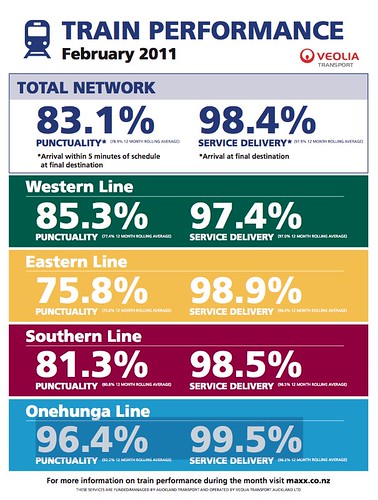
Auckland’s train operator Veolia provides their performance statistics – which is a good thing. The problem is that actual figures themselves, which show just how poor the service actually is:

The first column is how often trains are 5 minutes late or less. The second is how often trains arrive at all.

So if you take the Southern Line (wherever that is), you are likely to be more than 5 minutes late 24.2% of the time. If you commute 5 days a week, then that’s averaging one every two days*. Even the overall average of 83.1% implies one late train every three days.

Worse, if you commute 5 days a week on the Western line, then 2.6% of the time, or once every 4 week, your train doesn’t complete the journey. Perhaps it’s stuck somewhere, or perhaps it broke down with you one it. Either way you’ll have to take another one or find some other way to get to or from work.

So these performance statistics are clearly unacceptable for commuters, who need the security of knowing if they are at the station at a certain time then they will get to their destination on time, each and every time. It’s something that needs to be solved so that Auckland can extend beyond the traditional drive a car and then sit in the traffic jam approach.

So now let’s look at Wellington, where there’s been a relatively successful commuter train operating for years.

Oh dear. The comparable metric is that in the last month only 88% of the trains were on time – on average. That’s not as bad as Auckland, but it still means that the average commuter would be late about once every 4 days.

The worst line is the Wairarapa one:

While they dipped down to 73%, the 83% on time is still better than the Auckland average – expect to be late once every three days.

So Wellington also needs to improve their act.

I’ll continue to walk and motorbike to work in the meantime – particularity as I stay nowhere near a train line in either city.

*This assumes that trains at commuter times are just as likely as all trains to be late.  I suspect that trains during commuter periods are actually more likely to be late than trains in quiet times, as there’s more congestion then and more that can go wrong.

FlowerPower donates $5050 to Earthquake Fund

PowerKiwi’s FlowerPower has donated $5050 to the Government’s Christchurch Earthquake fund.

Like everyone we were shocked and dismayed at the devastation and loss, firstly to individuals and families and secondly to businesses and buildings in Canterbury.

We are also humbled and proud of Cantabrians, of New Zealanders, of those who were and are visiting here, and of people around the world who have all pitched in to help.

We wanted to do our bit, and while $5050 was a lot of money for us it just felt like the right thing to do.

The giving also reflects the reasons why we got into business – which were to help Powershop bring lower-priced, hassle-free power to Kiwis, and to do the right thing by New Zealanders and have fun while doing so. (That last bit may explain the strange amount – changed at the last moment from $5000 to $5050 for no reason in particular.)

Powershop themselves are contributing a lot as well. Powershop customers in the rest of the country had a price rise of about 1 cent on March 1st, as we entered the Autumn/Winter period, but Canterbury customers are still paying the old late summer price.  On Powershop prices go up and down through the year to reflect electricity energy cost changes, and Powershop are wearing the difference for Canterbury. Good for them. There are very real costs of generating, transmitting and administering power, so there isn’t much room to give without losing a lot of money.

Meanwhile clicking on the (now) red and black flower is a great way to join Powershop – as we will give you $50 of free power along the way.

Meeting the high resolution challenge

(Also posted on Pacific Fibre’s blog)
The iPhone retina display is awesome – not quite perfect, but incredibly high resolution that you can look at for a long time.

It has 326 pixels per inch, and 0.614 total megapixels. That’s not a lot of megapixels when we compare to the latest cameras with well over 10 megapixels.

But what if we scale the retina display up? If we make a 14.2 inch diagonal (12.6*6.6 inch) screen, then the number of megapixels becomes 8.8. What’s more important about that particular size is that it’s one of the standards for 4k video – 2160×4096.

The screen I’m typing on is Apple’s latest – 27 inches, 2560×1440 pixels and 3.68 megapixels. It’s a pretty high pixel density screen, but it pales besides the retina resolution.

If we make a 27 inch retina resolution display then we’d need about 4320 x 7680 pixels, to give 33.2 megapixels. This happens to be the specification for Ultra High Definition TV (UHDTV) which is still in its early stages, but the Wiki page says that target dates are 2016 to 2020. HDTV resolution is more than current consumer digital cameras can handle, and more than the latest MacBook Pro’s video card can handle as well – it’s limited to 2560 by 1600 pixels. So for this to work we’ll need new computers, new screens and new TVs – and none of these will be cheap at first. But we’ll all want them.

The fun begins when we start estimating how much bandwidth delivering full screen video will require at these resolutions.

The uncompressed UHDTV streams are 24 Gbits/sec, or 2400Mbits/sec – which is about 800 times more capacity than the average premise in Australasia and a significant percentage of New Zealand’s current total purchased international capacity.

Compressing the streams helps a lot – apparently the video (sound is extra) can go to 180-600 Mbps, which is still well out of out league for premises in Australasia.

The 4K (or 14 inch retina display’s full screen video) stream would be about 6.6 Gigibits/sec uncompressed, and 48-160 Mbits/sec compressed using the same compression ratio. That’s still way out of New Zealand or Australia’s reasonable ballpark speed to the premise.

Even the iPhone 4’s retina display would need 444Mbits/sec to drive uncompressed full screen video, and 3-11 mbps per second compressed. Our 3G networks and fixed networks are capable of delivering those compressed speeds, though the averages are quite a bit lower. This meshes in with real-world experience – sometimes video works well, other times it does not.

It seems that UHDTV, arriving hopefully in 2016-2020, will be delivered via the Internet. That means we’ll need 100Mbit or 1Gbit fibre to our homes to receive the service – and we are actually on track for that with the UFB and NBN initiatives. It doesn’t seem too remote that SkyTV or other operators can serve broadcast TV over fibre at theses speeds, but there is certainly plenty of end to end work to do to get there. I’d far rather have ultra-high resolution TV than the silly 3D TV that manufacturers are trying to push at the moment.

But what if the YouTube and Skype standard resolutions increase from the current HD to UHD? All of a sudden we will each be able to stream individual videos at say 250 Mbits/sec.  If more 50,000 devices (that’s about 1 in 20 premises in New Zealand, though each premise has multiple devices) did this at once, at say 250 Mbits/sec on average, then we’d need 12.5 Terabits/sec of data being streamed – and much of this would be from offshore.

That’s a huge number – the entire Pacific Fibre cable, servicing Australia and New Zealand, is planned to be about 5.12 Terabits/sec at launch, while the entire unlit market capacity right now is not much more than that.

So clearly there is enough demand for a new cable system.

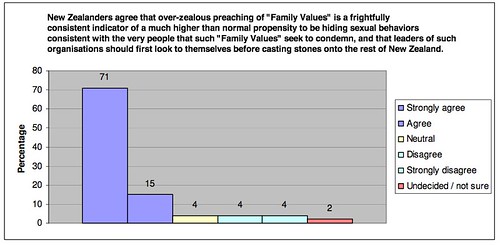
Family First Survey – the missing questions

You may or may not have seen the 2011 Family First survey (link borked) on Family Issues. It seems that not all of the answers were published, and I received the following from unnamed sources. If you come across any other missing questions then please post them into comments or send them through.

<update: It seems the original survey instrument has been removed – so just in case the answers disappear too here is a copy: Family First Survey (pdf)>

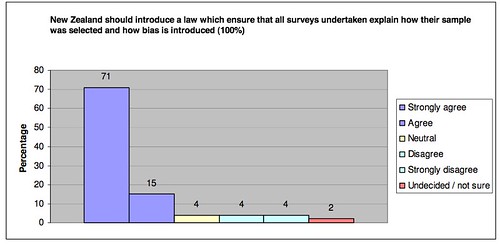
First -questions relating to survey sampling and the introduction of bias:

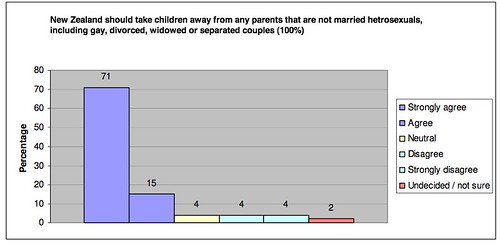
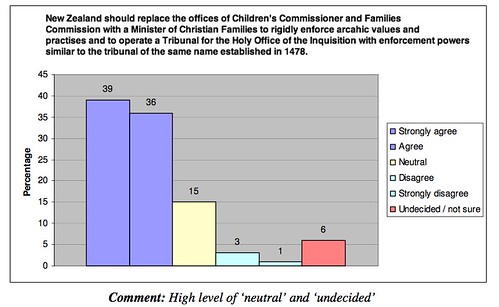
Next – the first draft, it seems, of some of the questions asked:

and also sent through were some questions about the questioners: