I’m a motorcyclist and a cyclist, but between the two is a market that is going to transform the way we thing about each – electric bikes.
The traditional electric bike is bulky, clumsy and looks like something you would be embarrassed to see your bulky grandmother on.
Times have changed.
This Trek bike is really just an updated version of history – it’s a beefed up bicycle with electric bits added on. Useful but ugly. 
I took the Pedago shown below for a test-ride. It’s beefy, heavy and has design features that make it and the rider look old and stodgy. However the utility is incredible. That motor makes cycling up hills ridiculously easy, so it would transform an excursion over a big hill from a workout to a pleasant stroll. It will also speed up any longer commuting journeys, so that you’d be more likely to leave the car or motorbike in the garage. I almost bought one on the spot, but I suppose it was lucky that we cycled there rather than took the car.

Offshore there are more of the same ilk, from the likes of Gepida, but also some new bikes which should make a lot more people reconsider electric cycling. This Bavarian Electric Touring Bicycle below has styling based on an old BMW R series motorcycle. It has a legally sized motor (under 300 Watts is an NZ requirement), carbon and aluminium bits and an impressively large 200 kilometre range. However the equally impressively large price of US$10,000 means that while I want one, I shall not be getting one. Imagine a version with decent panniers though, and then think about touring NZ.

Specialised have launched but not yet released this sport electric bike, the Specialised Turbo. Designed by their own engineers who are speed freaks to be the fastest legal electric bike, it brings new levels of design refinement to the category. I wouldn’t say it’s very practical, but a whole lot of fun on a longer commute on a dry day. If I make it to Europe this year one would certainly be on my shopping list. But the price was also prohibitively steep at €5,500 (let’s call it NZ$9,500). However give it time, and some competition, and that price will drop within reach of ordinary humans.

Across in the USA Optibike is doing similar design integration for the off-road bike sector. The bikes are fast, but at 1100W and 850W they are all too powerful to ride legally on the road in New Zealand, and that’s sad. If you have an offroad commute or want an easy way to exercise your downhill demons, then this (I’d take one) and the next bike are worth looking at.

The Stealth silent bomber s one of three bikes that a bunch of mad Australians are making. I’ve asked, but there is no word on New Zealand distribution. The bikes seem to have more motorcycle than bicycle DNA, and the design is not as refined as the US ones above. But the power, oh the power. The bikes are in 3000W and 4500W options, and the top speeds and suspension capabilities reflect that. Think of them as light enduro motorcycles, and wish that they were road legal and available here. I’d get one in a second if I lived near a bunch of dirt.

The rather unrefined looking design below is the Folding Lazerbike, listed at $2100 in New Zealand. It’s the importer’s favorite bike, and at 23Kg and with a 250W motor it is relatively light for an electric bike, but has legal power. The battery behind the seat design makes their standard bikes seem too long, but it seems to work for the folding model.

23 Kg is the limit for Air New Zealand domestic check-in, so one idea is to take the bike with 2 pannier bags. Take one pannier bag as carry on, put the battery into the other with more stuff and place the bike into a lightweight bike bag (carried on top of the rack.) The folded bike and panniers should be treated as ordinary luggage, and it would mean simple fuel efficient travel (aside from that flying bit). Aucklanders could take the bike on the bus on the long trip to and from the airport, and, Dunedin aside, be pretty set once they landed in the main centers. That commuting thing wouldn’t work for my last minute approach of course – far from it.
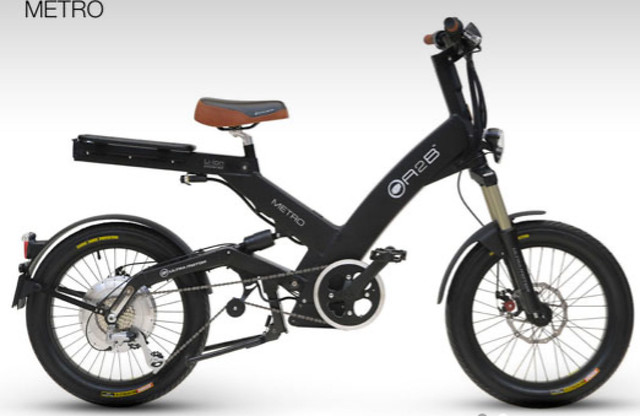
The A2B Metro below isn’t legal here, at 500W (750W peak) output. The range, 20 miles, seems short, and the maximum speed is also limited to 20mph, so it’s a bit silly that this sort of bike is not legal in New Zealand. That dual suspension isn’t really necessary in New Zealand metro situations, but in some US cities (like Washington DC) the road surfaces are shockingly maintained.
The Whisper bikes, available here, use a front drive approach, separating the pedalling from the drive. I would imagine that the temptation to forget about pedalling would take over for many. But electricbikes.co.nz also sell two kits to retrofit a front wheel drive system to your own bike. The Daahub in particular looks good, though even some pretty clever tweaking cannot remove the front wheel drive and tack-on nature of the solution. But there is an unused Surly bike in my collection that this could work well for.

Summary: Bikes for the rest of us
It’s still very early in the development cycle* for these. But already it’s clear to me that electric bikes will be revolutionary*, but that we also have a few problems to solve. (*sorry)
If you have decent hills or distance to traverse on your commute, then electric bikes transform exercising into an excursion, the equivalent of turning jogging into walking. This is particularly useful in Wellington and Auckland, where hills and distances play a big part in daily commutes. A great electric bike means that we would be far more likely to leave the car behind and take the bike, and taking the bike is an enjoyable thing to do.
The more practical bikes have capacity to carry plenty of things on panniers, including rain gear, a decent lock and work clothes and materials. The less practical ones are a great way to experience the outdoors, getting up and down hills with ease, and extending your playtime.
The battery life and range problems appear to be essentially solved. As battery density steadily rises and the bigger players start making in high volumes, we can expect to see prices drop and ranges increase further.
Meanwhile several new classes of vehicle are being introduced. There’s the electric mountain bike, the long range tourer (thats the $10,000 one), the electric racer, and the bicycle that is a motorbike. We can expect to see more vehicles in the range, as I suspect we are at the horseless carriage stage of development.
Sticking points
There are a few sticking points though. International laws are a mess of differences, and inadequate for the emerging future. In New Zealand we have a simple 300W limit, under which bikes are “not a motor vehicle”. But how do we cope with bikes of, say, 450W which are far closer to bicycles than motorbikes? Right now they are treated as mopeds, which are bikes with a maximum speed not exceeding 50 kph. Mopeds, however, need riders with heavy motorcycle helmets, and mirrors, a horn and brake lights. You have to have a car or motorcycle license to ride one, which is reasonable. They do not need a warrant of fitness, or to be registered, which is superb. But mopeds cannot use bike trails, which seems to push them into a very dangerous decision between high speed roads and slow speed bike lanes, on in particular is the one between Auckland’s North West motorway and parallel of the bike path.
So there is a gap in here between motorbikes and bicycles that we are not adequately addressing. For bikes that are designed to be or ridden at 20-35 kph, requiring a motorcycle helmet and other heavy paraphernalia, and forbidding the use of bike lanes means that they will never sell. That means more cars on the road.
And in general the requirement for helmets based on speed capability seems silly. Any of these bikes can exceed 50kph down a decent hill, as any half decent bicycle can. Should the elite groups of cyclists riding around Taupo be forced to wear motorcycle helmets then? That’s clearly absurd, but a middle ground is called for.
What I’d like
I’d like to see a nuanced system that accepts that a full motorcycle helmet is not necessary (or practical) on light bikes, where only electric bikes with certain more aggressive attributes are subject to the moped regulatory system. The learner motorcycle system was switched way from engine size limits to a more nuanced approach, and we can do the same for bikes I’d like to see intermediate helmet requirements, like ski or skater helmets for intermediate bikes.
I’d like to see a system where any electric bicycle bought into NZ can be easily adapted to legally ride on the road, under one of the three regimes.
And finally yet first, I’d like to see tens of thousands of these on the road using a network of separated bike lanes, and for all of those lanes to have speed limits, and some to have dual speed limits.
Next steps for New Zealand
Practically we cannot change everything at once. However here are three things we could do to speed the transition to electric:
1: Buy and use one – seriously. These are a lot of fun and will get you out of your car for errands and commutes that are much further away than you’d think. They are also serious fun.
How much fun would it be to sell your car, and buy two or three electric bikes, pocketing the difference? I’d live to walk downstairs and pick a bike each day – not that I commute.
2: Lobby to fix the laws for the gap in the middle, and if you are a politician, how about raising a private member’s bill? Be sure to add the electric bike effect to any cases for bike lane networks too.
3: Build your own. Between Sheppard Industries (Avanti) and Yike we have clearly demonstrated the capability to design an incredible range of electric vehicles for our terrain. Lets get going.













 Lance Wiggs