16% NBR?

According to Nielsen only 16.3% of NBR website readers are business managers or executives.

Meanwhile the advertising industry is clearly overloaded with these roles – as 28% of Stoppress readers are such.

Overall I believe this points to a poorly designed survey rather than any particular salient insights.

Fibre price drop

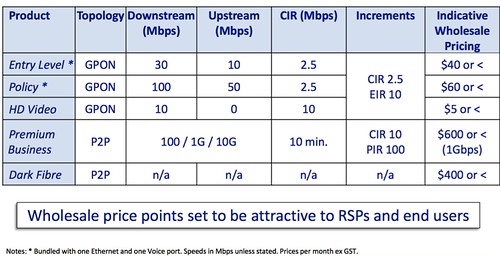
This was an early estimated wholesale price list for the Local Fibre Companies (LFCs) to charge the RSPs for access. RSPs are the Crown Fibre’s Retail Service Providers, who will be the companies that sell to us, the consumers. This is their wholesale price, to which they need to add backhaul,  international and margin.

Chorus itself will be a super-LFC – with CFH investing in Chrous as it does the LFCS. The balance of ownership will be quite different as Chorus brings substantial assets to the table.


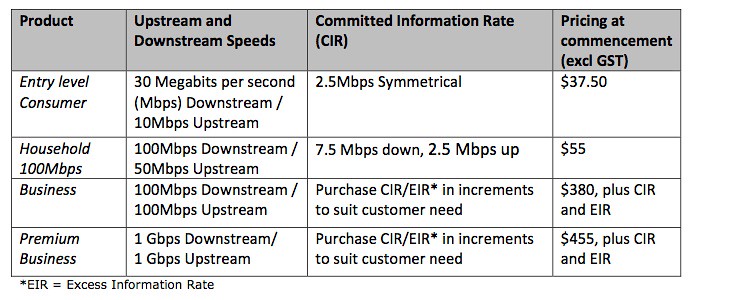
and this is the one just released from Telecom to the NZX. The prices have fallen, which is nice, and the committed information rate for the 100 Mbit/s plan has increased.

Xero cops the flak – but is doing things well

I really hope there is only one or two trolls behind the despicable comments on the recent NBR article on Xero results.

Healthy debate and skepticism can be good but, this series simply shows that tall poppy syndrome is alive and well in NZ. And that’s sad as Xero is poised to be a genuine breakout success.

The business model of Xero is pretty simple and being executed well:

1: Build a good enough product and launch. Xero did this by hiring well and focusing on usability.

2: Push to early adopters, learn from them and continuously improve the product to meet their needs. Early adopters were listened to and the product continued to change.

3: Try different ways to sell until you hit the most cost effective one. Turns out that’s through accounting firms, which was probably the most important Xero insight.

4: Double down by raising capital and investing heavily in the sales and development processes. There were a couple of major fund raising events – when MYOB founder Craig Winkler jumped in hard, and when Peter Thiel’s Valar Investments came over more recently.

5: Watch as sales become easier due to word of mouth and end-user expectations. The NBR article is part of that, but the real selling is done by accountants seeking to make their work with clients easier, and by end users wanting to wrest control of their finances.

6: Expand to other territories and learn how to sell there as well. New Zealand is on a great growth curve, and Xero started progressively pushing into other markets. Australia and the UK were first, but the USA is the big prize.

7: As you work out how to sell and grow inside each territory, then raise more funds and sell hard.

Monitoring success
This, like Amazon, is about the endgame, not the path. The endgame is that Xero has millions of customers, each paying a monthly subscription. The path to get there is one of spending as much money of effective selling and product development as possible so that the endgame is reached earlier. This means shareholders shouldn’t expect early profits, as there is much higher net present value to be found by continuing to reinvest.
Thus the numbers to watch are things like cost per customer acquired, growth rate in customer numbers by region, average monthly revenue per customer, sales made per year per sales staff member and and EBITDA before marketing spend.

It’s still very early days to pick winners – but Xero offers Kiwis a rare chance to have a shot at owning a piece of a huge software firm early in the land-grab phase. I’m not a direct shareholder as I don’t own any shares on the NZ or Australian stock markets and prefer to put my money into privately held start-ups.

Minister Joyce’s five benefits of UFB

Speaking at TUANZ Telcoday11 Stephen Joyce said the time nigh  to move from focusing on building the pipes to delivering the benefits. His top five areas, which will be captured in a action plan titled “Benefits of Broadband”  are:

1: eEducation. 99.7% of students will have UFB access within 5 years. The Ministry of Education is putting together a plan for a national education network. Joyce says that not many understand how this will revolutionise how we deliver education. Students anyhwere in country that want to study a particular subject will have access to best teachers in NZ or even the world.
2: eGovt: NZG about to invest billions? (surely millions?) in this, trying to deliver better services for less. That means more government services will be delivered online. Well overdue.

3: eHealth – The best specialist advice and knowledge will be available to all. He mentioned that a benefit for emergency management could be the ability to takeover handsets in emergencies to deliver messages. There is a Health IT plan, but I suspect there is plenty more to come

4: eBusiness. Not just new dot coms, but also helping  rural businesses
5: eDevelopment – removing the tyranny of distance for provincial and rural areas, especially for Maori economic development.

These are good – and it is even better to see the Minister say the focus is coming to articulate and deliver the benefits.

The US internet policy document for us

Who calls it Cyberspace anymore? Apparently the US Government does, and aside from the title their new International Strategy for Cyberspace paper is very well written.

Three quick take-aways for me:

1: A refreshing commitment to a right to access

Reliable Access: States should not arbitrarily deprive or disrupt individuals’ access to the Internet or other networked technologies

This is a departure from the three-strikes approach to copyright infringement, with the fine print reading:

Focus cybercrime laws on combating illegal activities, not restricting access to the Internet. Criminal behavior in cyberspace should be met with effective law enforcement, not policies that restrict legitimate access to or content on the Internet To advance this goal, the United States Government works on a bilateral and multilateral basis to ensure that countries recognize that online crimes should be approached by focusing on preventing crime and catch- ing and punishing offenders, rather than by broadly limiting access to the Internet, as a broad limitation of access would affect innocent Internet users as well As the United States and our partners engage in dialogue and help build capacity among law enforcement organizations worldwide, we will integrate this approach, uniting protection of privacy, fundamental freedoms, and innovation with collaboration to combat crimes in cyberspace

(I hope I didn’t breach copyright by reproducing that)

2: A continuing concern that Governments want to get involved in managing the DNS


Multi-stakeholder Governance:

Internet NZ is a not for profit organisation that receives a mandate from ICAAN to round the DNS and distribute the .nz domain. There is no Government involvement. This is one of many models from around the world, with some other country domains being managed by Governments. The US state is correct that the Governments should not be exclusive owners of a top level domain, but they are not necessarily necessary either.

3: Defense and attack


Cybersecurity Due Diligence: States should recognize and act on their responsibility to protect information infrastructures and secure national systems from damage or misuse

There is a strong tone of the US signalling that they will not tolerate data breaches, such as Wikileaks, and that they are reserving the right to go after the perpetrators, be they individuals or state backed.

When warranted, the United States will respond to hostile acts in cyberspace as we would to any other threat to our country All states possess an inherent right to self-defense, and we recognize that certain hostile acts conducted through cyberspace could compel actions under the commitments we have with our military treaty partners We reserve the right to use all necessary means—diplomatic, informational, military, and economic—as appropriate and consistent with applicable international law, in order to defend our Nation, our allies, our partners, and our interests In so doing, we will exhaust all options before military force whenever we can; will carefully weigh the costs and risks of action against the costs of inaction; and will act in a way that reflects our values and strengthens our legitimacy, seeking broad international support whenever possible

Overall the document is strong on collaboration and on an open internet. It feels like a significant improvement to me, though others will have much more informed opinions.

Not a Kiwi welcome

We Kiwis like to travel – a lot – and free camping is one of the weapons in our arsenal of cost reducing and trip extending techniques.

Now there is mooted legislation to ban free camping in our own country. I can understand fining campervan drivers for illegally discharging sewage – that’s disgusting. But fining people $200 for sleeping in their campervan or car in the wrong place is dangerously shortsighted.

I 100% agree with the sentiment expressed by the minister:

“Dr Smith said freedom camping was important to the tourism industry and the New Zealand lifestyle, but irresponsible campers were spoiling iconic areas with human waste and litter.”

And we should fine travellers for spoiling any areas with waste and litter. But fining travellers for free camping alone is not the right answer. Stuff’s article has better reporting – they actually talked to councils and campers. Councils need something like this as currently they have to take offenders to court, which is an expensive and time consuming process.

Independent travellers, whether free campers or not, are just the sort of people New Zealand is trying to attract. There apparently are 150000 freedom campers right now, and they will will seek to avoid the fines in the same three ways that we do when we travel and free camp overseas ourselves:

1: They’ll drive somewhere else to free camp

2: They’ll free camp but try to evade police

3: They’ll choose not to travel to NZ as it isn’t traveller friendly

1: They’ll drive somewhere else to free camp

The sad thing about this is that the free campers have probably chosen a beautiful spot to stop – it’s just that there is a stupid sign nearby. They may have just been to a Rugby World Cup game, or maybe just had dinner and a glass of wine. Now they will jump in their car and driver, perhaps drunk, somewhere else.

And where will that be? Outside your house perhaps, which in turn will lead to complaints and so a few more signs will go up. Before you know it the free campers will be condemned to Upper Hutt, Albany and other places where tourists will get a less than optimal experience.

2: They’ll free camp but try to evade police and council staff
Another lousy way to experience New Zealand is to spend the time looking out for Police and security guards rather than marvelling at the beautiful Wellington Harbour. It’s a common trick, and easier in an unmarked car, to sleep in the backseat in a place where perhaps you shouldn’t be. I’ve pitched a tent in the back of a service station, on a prayer lawn in Pakistan (I was given permission for that one – they were insistent), a farm off the Autobahn in Germany, a Blue Mountains’ picnic spot and am one of tens of thousands of Kiwis and Aussies that has free camped on Gallipoli Peninsula. Were any of these legal? Some were, some were not – but they are memories that I’ll keep and they are memories that we shouldn’t deny travellers to our shores.

Meanwhile our Police surely have greater fish to fry than scaring travellers as they otherwise seek to get a good night’s rest after a long day. Perhaps those travellers will keep an ear out for the cops, sleeping uneasily until they see the police car, and then driving away if they can. I’ve had a US cop bang on my window whilst I was asleep in the back of a driveaway car in the middle of nowhere, USA, and it’s a terrifying experience. That’s not the NZ we want tourists or locals to experience.

3: They’ll choose not to travel to NZ as it isn’t traveller friendly

Ultimately the sum of traveler experiences will result in one thing – less visitors. These days what happens on a trip is rapidly shared with friends, family and, in the case of good stories, the entire world. Having a good day on the Abel Tasman track might be the sort of good story we want to get out there, but on the internet a good story is more like the one where the polices woke you up at 2am in and took the last $200 from you, asked you to move your car and then arrested you for drunk driving. Thankfully our Police are not that stupid, but laws like this won’t make their job any easier.

The right answer
The right answer to to put the law in place, but to focus it on the actual harm – littering, blocking access to right of ways and so forth. Otherwise we should let campers park anywhere we the rest of us are allowed to park

One hour movie? No chance


One hour move? No chance, originally uploaded by LanceWiggs.


A 2GB HD movie from iTunes is about 1 hour long, but it takes over well over 4 hours to download.

There’s not much use getting angry, but this is typical of me on ADSL plans.

It’s a simple rule really – the movie should at least download at a faster rate tan you can watch it.

So I for one will be listening with great interest when the UFB plays out this week.

UPLoad 2011 – new business based on fibre

UPLoad 2011 is this Tuesday.

It’s going to be a great event.

Graham Mitchell from Crown Fibre and Vikram Kumar from Internet NZ will set the scene. They will offer up a challenge and an opportunity.

The challenge is to come up with viable ideas for businesses that take advantage of the emergent fibre economy. The business could be infrastructure, home technology, content, a B2B play – anything. The best idea on the night wins $300 worth of food and drink. All of the great ideas offer a lot more – the chance to actually start the business and receive support from the group.

The opportunity is an impressive offer to help with your fibre-driven business from one of the industry players, but I’ll leave it to Graham and Vikram to reveal who and what. It’s not what you expect.

After the speeches, I’ll facilitate a session. While the beer and wine flows, we’ll break into groups and each group will answer a few simple questions that will help the group generate ideas for new businesses. (or bring their existing ideas) The groups will then rate their ideas, and flesh out the best on or two.We’ll then ask groups to present their ideas back to the room, and select a winner. We’d also like to see people commit to taking ideas further.

We expect to have a good mix of entrepreneurs, developers and technical folks, to see at least one start-up created and to have some fun along the way.

Sign up while you can – It’s free.
5:30 pm to 7:30 pm, Tuesday 17 May, 2011.
Location: Deloitte NZ, Level 16, 10 Brandon Street, Wellington
Twitter hash tag: #UPLoad2011

Blog on iPad


I just found out that this blog (and no doubt most others hosted on WordPress.com) has a special iPad theme. This is what it looks like.

Cool. Thanks WordPress, and thanks @MichaelTurnerNZ for letting me know. WordPress’s post announcing the change was written on March 23. I’m so far behind the times it seems

However @rowsell points out that the format doesn’t quite work when browsing from within an application – like Twitter. Let’s see whether this becomes painful, and if so I’ll switch the feature off.

Osama and the KKR

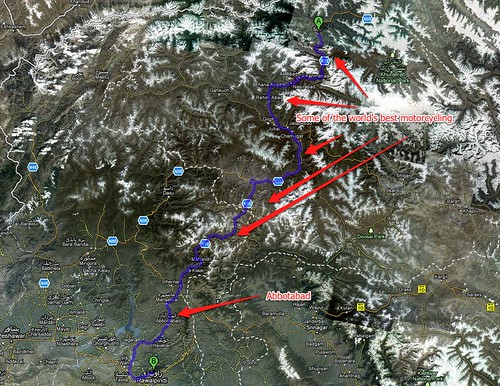
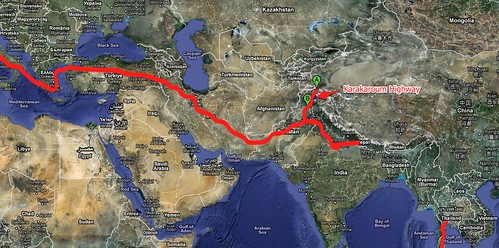
Osama Bin Laden’s last hiding place was within a block of one of the great motorcycling roads of the world.

The Karakaroum Highway goes from Pakistan’s capital Islamabad to beyond Sost, where it meets the border with China. The road passes a point where three great mountain ranges of the world meet – the Himalayas, Karakaroums and the Hindu Kush. You can even see Everest from the side of the road.

I rode the road back in 1998, making it up to Sost in two days and from Sost to the Border and back to Islamabad in one very long fast day.

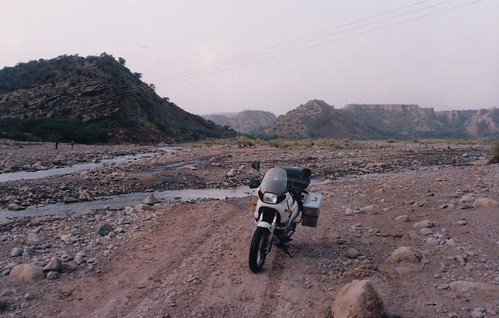
Here’s the bike on the back roads to Islamabad from the border with Iran. I got kinda lost (as in totally lost) and ended up in the wildlands.

There are checkpoints everywhere in Pakistan (as there are in many other countries). The drive, for example, from Attabad to Islamabad would certainly encounter several. 40km may not seem like a lot, but in reality it can take quite a while to navigate. This is one of the army guards at an internal border (I think to NWFP) who put me up for the night in the mountains.

I got to go up the KKR on a trip from Europe to Singapore. In retrospect the trip went by far too quickly, and by the time I got the India the bike was pretty much stuffed – with one working brake (only it didn’t work in the wet) and bald tires. But it was a brilliant journey, with plenty of highlights and the zoom down the KKR was way up there.

//

Borders’ Fail

I found myself in Borders’ Queen Street bookshop yesterday, and it was a sad world full of failure. Let’s have a wander through the store, and see not only how their business is failing, but how they fail at business.

First up – the magazine section. The latest Wired magazine, air freighted to be here in New Zealand quickly, was a February edition. In the USA, where Wired is published, magazines typically come out before the month on the cover. So this Wired magazine is from January – which is now 5 months ago. There were several copies, and with no discount they certainly were not being sold.
I suspect that the buyers for Borders are very busy cancelling as many orders as they can, while the stores are just trying to move inventory.

The price is outrageous. The $19.99 cover price is for one issue – while the price to subscribe to Wired in the USA is just $10 -and not per issue, but per year. We in NZ can subscribe to wired for US$70 a year, which is just over one third of the cost of buying older ones from Borders.

In New Zealand we can also buy Wired for the iPad for $5.29 per issue – provided you don’t mind downloading over 300mb of content or the average one star rating for the latest version. I’d avoid for now.

Next up – the display of books in Borders, which leaves much to be desired.

Here’s a picture from a tweet I sent – the Rugby World Cup book display. Kudos to the staff for making up a couple of signs, but the amateur nature of said signs doesn’t belong in a premier bookstore.

I also found it too hard not to tweet this picture – unfortunate juxtaposition which I admit was slightly aided by me moving the Harding book two titles to the left.

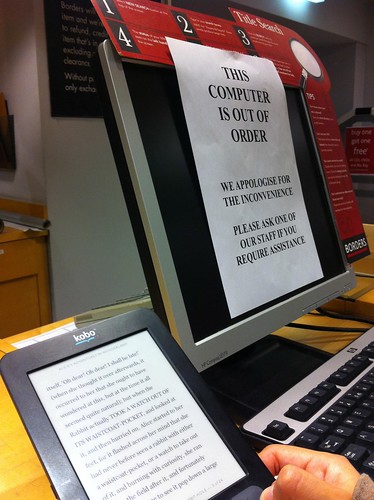
All of their catalog computers were out of order, so browsing was the only option. That’s ok, as if I wanted to search for a book I would have used Amazon, Fishpond or MightApe.

The Kobo on display was a poor advertisement for eBooks. It’s incredibly slow and essentially unusable. Go for Amazon’s Kindle, which is everything it needs to be – except for being waterproof, so use in the bath is out.

While many books were on special…

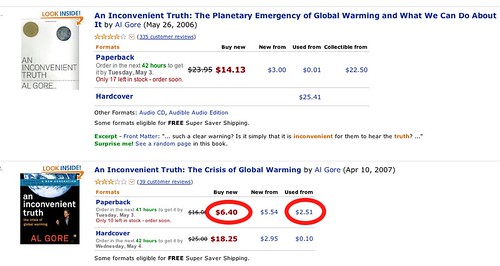
the prices were often not compelling. This NZ$25 one was available from Amazon for US$6.40, or just US$2.51 used. Book prices in general are exceedingly high here versus the USA, so it’s a wonder that we sell many books at all. The same book is on Fishpond.co.nz for $26.97, every day, not on special, but that’s still a lot.

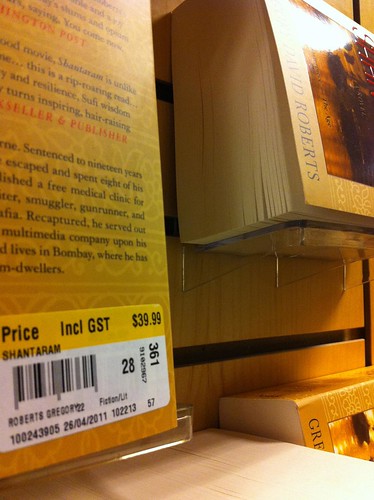
Another reason why Borders is ultimately a lousy business is explained by Shantaram, which is a decent book that I do recommend, but is physically enormous and enormously expensive. It’s heavy to carry around, heavy to hold as you read, and must be expensive to make and ship.

So instead of buying the physical book, why not buy the same book an Amazon for US$9.99 (about a third of the cost), and download it instantly to a Kindle? The Kindle itself is light, and holds a library of books which we can have with us at all times or download at will.

Amazon’s paperback version of Shantaram is actually cheaper than their eBook – recognising perhaps both that the eBook is a superior option and that Amazon needs to be rid of all of those heavy paper volumes.
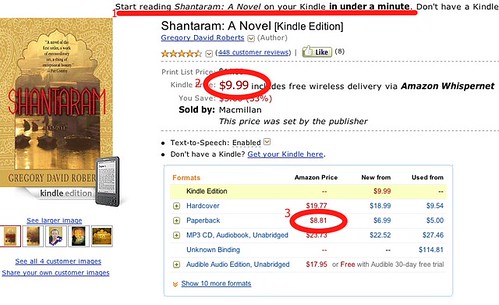
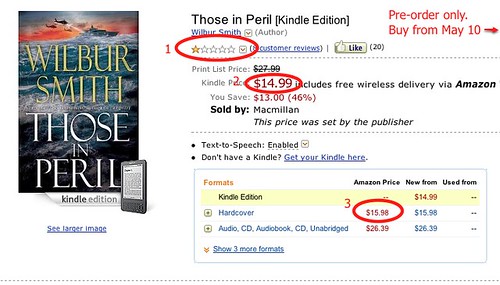
The next book is interesting, as Amazon fails and succeeds.

This latest Wilbur Smith novel is a staggering $50 to buy from Borders – which is not, however you label it, a great price.

However it’s not yet available on the Kindle in the USA, so perhaps Borders is on to something, making us pay more for the benefit of an earlier read?

Not so – as Amazon also allows us to read reviews – and for this book Wilbur Smith’s fans (and I was one as a young teenager back in 1923) are pretty angry, and the average rating is just one star.

Once again and of course the price is a lot cheaper on Amazon – the hardcover price is US$15.98, or about 2.5 times less than the one on display in Borders NZ.

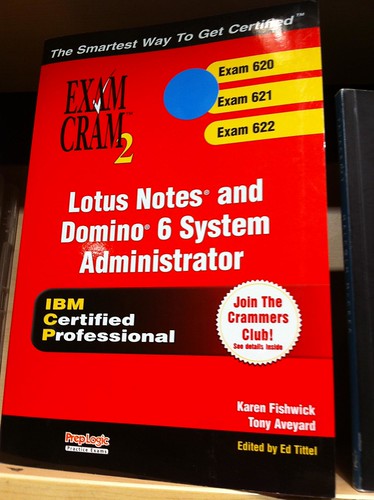
While Borders did actually have some books at very cheap prices, the books themselves were often amusingly out of date. This blue stickered book was just $2, and proudly displayed near the front door.
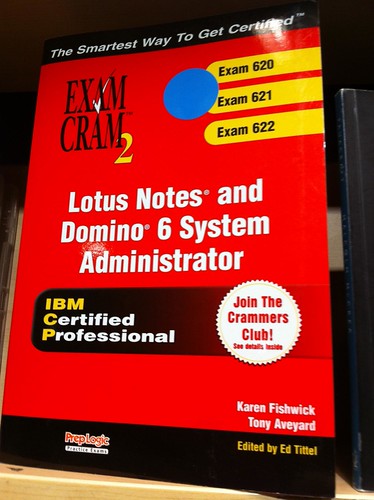
I suspect the market for it is small as Domino 6 was released in 2002 and superseded in 2005.

Borders is squeezed not just from online, which is increasingly the choice for people that read a lot, but also from discounters such as The Warehouse. The Warehouse doesn’t have to stock a wide range of books, and views them as just one product range in a portfolio.

Borders is pretty much stuck with selling only books, and will just see the slow demise of their core business as reader migrate to eBooks and beyond. Whitcoulls diversified away from being a decent books store years ago, but they are also squeezed by online and offline suppliers like Warehouse Stationary.

But what of the future?
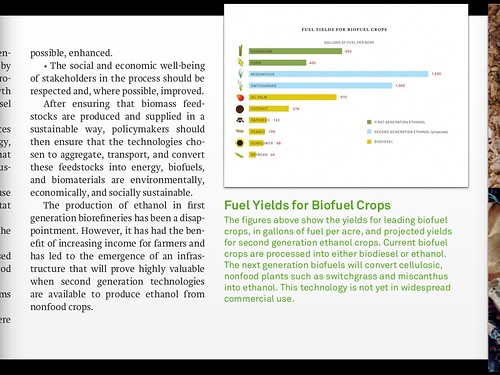
Behold another Al Gore example – his new publication is called “Our Choice”, and it’s available only on the iPad. It, what ever it is called, for it certainly is beyond a book, is a combination of text, diagrams and pictures, videos and speech. It features Al himself but also snips from other speakers, movies and articles, and is well worth a look for the format alone. It was $6.49 or so – far beneath the cost Gore’s An Inconvenient Truth, and with appropriately low distribution costs and environmental impact.

Someone has just purchased, or not, the NZ assets of RED. I really hope they have a long term perspective on the declining future of books.
The most avid readers and purchasers will increasingly purchase eBooks from mainly offshore, while the mass market can be served by discounters. Printing, distributing, stocking and displaying books is slow, expensive and environmentally irresponsible, and new technology is superior in essentially every way. It will take time for Amazon to really break through with their Kindle in New Zealand, but for me the game is already over.

It’s sad – I enjoyed browsing the Borders and Barnes & Noble stores in the USA, and I also enjoy Unity books and similar stores that are great at selecting quality content. But it’s now a lousy business to be in, and those stores will go the way of CD stores and will be fighting with the DVD chains for the best bankruptcy lawyers.

I live in Wellington

I’m spending a lot of time in Auckland, as we drive towards financing Pacific Fibre. However some have accused me of living in Auckland.
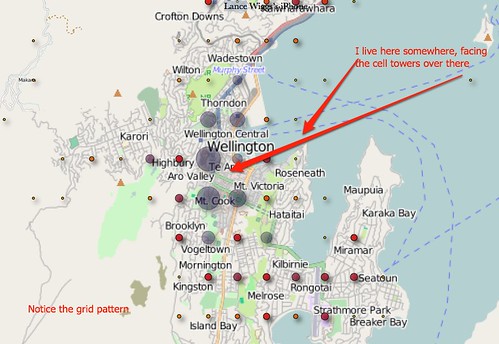
I present here evidence, straight from my iPhone, to the contrary. I clearly live in Wellington, spend time in Auckland and am quite disturbed about that purple Hamilton spot.

This is the map presented by the iPhoneTracker app for your mac, and it’s fantastic. It uploads from your iPhone data which has been stored, without us really realising it, and plots it on a map. While some will righteously complain about the privacy implications (and yes, this should be able to be switched off, and should be obvious that it is on), I see a lot of potential uses for this for individuals. How fun would it be to overlap maps of friends?

Interestingly though the dots are far apart. The dots scattered around the country are mostly from motorcycle trips, but much of the actual journeys is missing – due to lack of coverage perhaps, or due to low update frequency.

Here’s a zoomed in view of Wellington. My address is safe, as the data picks up the approxiamate cell tower location (I guess). That’s not very useful however, though it might allow folks concerned about the privacy issues, and people who are having affairs, express a  sigh of relief.

Here’s the Auckland map. It seems I get around a lot.

Mastercard responds

I just received this response from Mastercard.

– All Mastercards but only Mastercards will be accepted

– No plans to increase the number of ATMs – where there are already long queues

– The terminals are not locked to Mastercard – that is done at the acquiring bank’s end. Apparently the acquiring bank blocks out the other cards, so it would be good to know who is responsible for this breaking of our EFTPOS system.


Hi Lance

Thanks for taking my call earlier re your piece “Why MasterCard’s Rugby World Cup decision is stupid”…

The first thing I would say is that where there is card acceptance today, it will continue through RWC. That means that if a merchandise retailer accepts all forms of cards as payment now, they will continue to accept all forms of cards as payment through the RWC. We are certainly not expecting these retailers to lessen the choice they are giving to their customers. In fact, we are trying to offer more choice.

To that end, what we are doing is investing in building a network of card acceptance locations at major New Zealand stadiums where today, the stadiums do not accept cards. The only payment option accepted at these locations today is cash. This is part of our long term commitment to Rugby World Cup 2011. We intend to leave a legacy that delivers convenience and security for New Zealand long after the tournament has come to an end. Throughout RWC these locations – that today only take cash – will accept all forms of MasterCard cards (including Credit, Debit and Prepaid cards). After RWC, they will accept all forms of cards.

So, to reinforce what I have just said, no acceptance location at the stadiums should accept fewer forms of payment than they do today. All we are doing is strengthening acceptance to allow retailers in the public areas of these stadiums to accept MasterCard cards… ALL MasterCard cards (not just Prepaid).

MasterCard recently announced that, alongside the existing option to use cash, our cardholders will now also be able to use their MasterCard cards at Eden Park and Westpac Stadiums. For those people without a MasterCard card, ANZ have announced the launch of the RWC 2011 MasterCard ANZ Prepaid card, which will carry MasterCard’s PayPass technology.

We are absolutely providing MORE choice. Not less.

Hope that helps explain the situation. Happy to discuss further.

Regards

djm

David Masters
Vice President
Strategy and Corporate Affairs

MasterCard Worldwide | Asia Pacific, Middle East and Africa
Level 8, 100 Arthur Street | North Sydney  NSW  2060
Australia