Integrity: What to do if your academic paper is challenged

In the news recently is University of Massachusetts Amherst economics doctoral student Thomas Herndon, who reworked a very influential paper, and found some real calculation errors. He dug into the “Growth in a Time of Debt” paper by Harvard’s  Carmen Reinhart and Kenneth Rogoff as part of a class assignment, where students were asked to rework the numbers of an existing work.

Once the numbers were found to be wonky, Herndon wrote a paper with the assistance of the class’s Professors, Michael Ash and Robert Pollin. The paper, “Does High Public Debt Consistently Stifle Economic Growth? A Critique of Reinhart and Rogoff” caused a storm.  The Reinhart and Rogoff paper supported the theory that cutting borrowing (and spending) is the right thing to do in a recession. Right wing politicians have liked brandishing it as evidence over the last while for their Austerity programs. However reworking the numbers shows that it is clear the reverse is true. Turns out that borrowing and spending promotes growth, supporting the standard economic theory that getting out of a recession is about creating demand by helping people earn and spend. 

End result? Herndon and the two co-writer professors are heros, and Reinhart and Rogoff have a lot of egg on their face. They have subsequently admitted at least some of the errors but are still arguing for their point of view. In my opinion their refutation is very strong, and they are quite simply going against the facts.

I have had a similar experience to recount, but the ending was different.

In 1998 I took a class in Corporate Governance at Yale from Professors Paul MacAvoy and Adjunct Professor Ira Millstein. As part of that course a small group had to write a paper on one of a number of set topics, and present to the class. Our group got the topic of challenging the then just published paper: “The Active Board of Directors and Performance of the Large Publicly Traded Corporation“, written by none other than “Millstein, Ira M.; MacAvoy, Paul W“.

It was a tough challenge to take on.

Prof MacAvoy, who is now emeritus, is a leading academic in governance as well as telecommunication and electricity regulation. Millstein was the engine behind Weil Gotshal and Manges (an elite law firm), advisor to many top US boards and also an expert in regulation and anti-trust law. They were pros, and taught the course as a team and had done so for many years. Turns out that the course we took was the heavy basis for the first version of the OECD Principles of Corporate Governance, authored by Millstein.

Each of these gentlemen have ridiculous resumes, formed from a lifetime of achievement and integrity. So when we took on the challenge we knew we were up against it.

I read the paper, which compared the corporate performance measured in ‘economic profit’ against the quality of boards, measured by CalPERS, a huge fund, who provided ABC type ratings of boards of directors for top US companies.

I dug into the data, and then, with interest piqued, kept digging, acquiring the original spreadsheet, working through the formulae and the original macros and so on. The spreadsheet would suck in all of the financial data for a company, calculate the ‘economic profit’ between two periods, record it and then move to the next company. After that it was a simple regression against the CalPERS data. The Millstein/MacAvoy paper had found that there was a significant positive correlation between the quality of a board and the change in economic profit.

I could not get the economic profit model to work, so I ran the same regression using other measures, such as total return to shareholders and revenue growth over the same period. And I struck a problem. These numbers showed almost no correlation, and even negative correlation on some measures. We checked it, bundled it into a paper and presentation and presented that back to the Professors and class.

Now let’s pause. If you were the Professors, what would your reaction be?

MacAvoy and Millstein’s reaction was amazing. Not only did they accept that the findings could be valid, but Prof. Paul MacAvoy almost immediately afterwards asked whether I was interested in staying on after the academic year had finished, which it was about to, to dig into the issue some more to write a paper.

Instead I went on a lengthy motorcycle trip, but 8 months or so later called in from Singapore, asking whether the offer was still open. It was and I was offered a very generous deal. Incidentally I was funded by the rather right wing Olin Foundation, and paid by Yale under the same program that they use to pay elite academics and sports people doing very short appearances.

I worked first with the original research assistant and we got the model working again, and then I explored. Over time I realised that there were errors in the original model and how it was run. I fixed it and worked it through again, and using several metrics rather than just economic profit. From there I wrote a Yale Working Paper, “Corporate Performance and Corporate Governance”. The paper to my mind showed that the MacAvoy/Millstein paper was flawed, and that there really was no correlation proved. However they were willing to accept the that their own work was valid as my paper still showed a small, not really significant, positive correlation. There was no doubt in my mind that they would have withdrawn the paper (or whatever one does) if the results were shown to be wrong.

In the Reinhart and Rogoff case their paper was proven to be quite wrong, yet they stood behind their results regardless. In this case MacAvoy and Millstein encouraged and even paid for my challenge, and were able to make a well informed decision on how to proceed. 

To me the stories show three things. 

Firstly, the power of integrity. MacAvoy and Millstein knew that an error-filled paper was simply inexcusable, and were willing not only to ask people from their class to challenge it, but then to invest funding dollars and substantial time in helping to firm up that challenge. Tenure helps, but integrity was what drove this behaviour.

Secondly, the power of checking the numbers. MacAvoy and Millstein were completely reliant on the very smart but still solo operating research assistant. The RA, who turned out to be my next door neighbour, created the spreadsheet, ran the numbers and did all of the the statistical work – all of which I had to replicate. I would not expect the aging professors to drive a spreadsheet like that, but I would recommend that the person performing the analysis is checked by someone else, or works with a deeply analytical partner.

Thirdly, we should devalue or even ignore any research where we are not able to see the original data and the models used to run the numbers, and have the ability to re-run the exercise. These should be posted in open formats, be very easy to download and re-run and be accessible by the public without charge. Indeed why are papers not presented with the working model in electronic form embedded in the paper? The move to Open Research will help significantly here, and any funder should be mandating publishing not (just) in peer reviewed journals, but in an online and open way.

Electrickery – 10 alternative suggestions for changing NZ’s electricity industry

<update = 10:20, Friday morning I’ve edited this post since publishing last night.>

Let’s have a look at the Greens proposal to reduce electricity prices. I’m entering this as a sceptic, but also as founder of Powerkiwi [join!]. Powerkiwi sold a good amount of power on Powershop last year – 140 million units (KWh), or enough (at 8000 kWh/house/year) to supply over 17,600 houses.

I know a little bit about the industry, but am not at all an insider at all in the larger game. But here goes:

Our power bills are too high. While average power prices in the OECD have decreased in the past 20 years, in New Zealand they have gone up over 70%.  Greens

I don’t think that’s at issue here. Let’s dig into the industry.

Supply

Enter a nice chart I got from, err, some prospectus. (Ignore this if you are an investor from the USA.)

The red marks are mine. There are five major producers (and 8 smaller ones), 1 national lines company, 29 local lines companies and a bunch of power retailers, of which Powerkiwi is one (though we are probably counted as part of Powershop, which is part of Meridian, which is owned by taxpayers).

The national lines company, TransPower, and each of the local lines companies are monopolies, with the lines companies alone estimated to be worth $8.8 billion by the Commerce Commission in 2012.

TransPower is government owned, while the lines companies have diverse ownership, with some owned by consumers, others by local government, and seven have at least some investors involved. Those seven are collectively large – 56% of all customer connections are served by them. And those investors are motivated to have healthy prices and profits. Lines companies are a great business to be in – they regularly  put their prices up, and there is nothing the retailers or end customers can do about it, although there is ComCom involvement with investor-type lines companies.

Here’s the Commerce Commissions’ ruling on lines company price rises for 2013:

I guess Vector is making too much money right now. It’s nice for a business to have a price setting regime that ensures they make a profit each year, unlike regular businesses who have to face up to pricing risks and competition. Generally shareholders accept much lower returns on equity for these utility businesses.  However Vector, who I am admittedly picking on, had an EBIT to total income ratio of 37% in the 6 months to December last year, and made net profit of $118m on revenue of $669m. That’s amazing for a company without real price risk for its electricity business. Most of the recent revenue increase came, they say, from “unregulated technology operations, higher Transpower charges (passed to customers) and price increases on our energy networks”. Yes – a great business to be in, but to be fair they have gas and ‘technology’ as well as electricity.  They distributed 4,312 GWh of electricity in all of 2012, which is over 30 times more than passed through Powerkiwi’s accounts. Their 6 month to December revenue from electricity was $335 million, and EBITDA was $202 million, which is a incredible level of return of 60%. We should also add back the very real cost of depreciation and associated maintenance work on their infrastructure. The grew their smart meter numbers by 38.5% to 438,419 meters, for example, and this investment is not counted (I am guessing) as an expense. Any analyst looking at this sector should be ignoring the EBITDA numbers, but sadly the capital expenditure and depreciation numbers are not broken out by area spent.  Regardless, any reasonable assumption for those numbers leaves an absurdly high margin for their electricity distribution business.

Going back in time this Fairfax article states that the ComCom saw the distribution costs in NZ rise at 5% above inflation from 2008 to 2011, but apparently capital spend more than made up for that.

Transpower pricing is regulated by the transmission pricing methodology which is approved by the Electricity Authority – and that methodology is under review, and prices are likely to go up, perhaps significantly, beyond 2015, conveniently distant for Mighty River Power’s IPO.

All of these lines costs are passed to the retailers, who in turn pass it straight to us all, as consumers. It’s itemised on our bills as a daily or monthly rate (and Powershop’s and Powerkiwi’s pricing includes it). So when the Commerce Commission says raise your price to the lines companies, they do and we all pay. We can bet that the lines companies understand very very well what they need to do with their businesses and how to present themselves to the ComCom to make sure they are allowed the best price treatment each year. But competition is not coming anytime soon – as only one physical line per house makes sense – so something like this regulation needs to continue.

Let’s move to the wholesale electricity market, where energy is bought and sold and prices vary through the day, peaking in the evening when we all get home, and seasonally peaking in winter when it is cold.  Here’s a chart of demand for today until now, Friday 19th April, 2013.

The price varies according to the lake levels, and according to what power stations and lines are offline for planned or unplanned maintenance. There is a market for retailers and large businesses to buy financial instruments to lock in a price for a period, or they can expose themselves to the market. Here’s today’s chart so far for North region:

That’s a lot of volatility, and as a large buyer exposed to the market you’d like to be able to vary your demand according to price. Sadly for most we cannot do that, but therein lies an opportunity for later.

Retail Pricing

Most retailers, except for PowerKiwi and Powershop, set one price for consumers for the year, and it has to, by definition, be well above the average price set in the marketplace.  The biggest period of use, winter, coincides with the largest use, and so the price everyone pays reflects those winter prices. The retailers are, however, already buying in bulk and saving, using a combination of spot and longer term contracts. Retailers cannot afford to get this wrong, trading electricity with negative margins is a quick way to lose a lot of cash. So they give themselves a buffer, and so consumer prices are higher, but at least they are not subject to hourly change to potentially astronomic levels.

Meanwhile many customers are simply on a more expensive plan than they could get today at another provider, and while it does pay to shop around it’s a real pain in reality (unless you switch to Powershop of course). All of the retailers have a profit motive, despite some being government owned, and so all are seeking to maximise the return to shareholders through the right combination of buying, market share and pricing.

So the wholesale price of electricity varies all the time, often wildly so, the price to consumers is fixed, and the lines prices, which are passed on to consumers, are fixed and steadily rising.

And therein lies the rub. The real money is not made at retail, but in the lines and at the other end – generation. The business of electricity generation is a great one if you own certain types of costless assets. And in NZ companies do – there is a huge percentage of renewable power, where the inputs of sun, wind, rivers, lakes and geothermal energy are delivered essentially free.

The problem is that all generators are paid at the cost of running the most expensive power plants. Even though most of our power plants were built decades ago with public money and cost less than a cent a kilowatt hour to run, their owners pocket more than 10 times that amount. Russel Norman, Greens

This is true.

The price the owners of dams receive is nowhere near the marginal cost of producing that power. Instead that price is closer to the price required to build and run profitably the last power station that was built. By definition the last power station is the most expensive ever per unit of electricity, else someone would have built a cheaper one earlier. (It’s not that simple, but roughly so). That price has to take into account all of the pain and time and costs of building and then running the station. It’s it’s a solar plant, then the loans taken out to build the plant need to be paid back, maintenance paid and so on. Plus the solar plants are not on at peak times, so they will always receive lower spot prices. If it’s a thermal plant then the inputs of gas or coal need to be purchased forever, and the price will vary according to those input prices. In general they only switch on when demand is high – it’s expensive to run.

So the peak market price is set by the latest plant, and the price in energy unit terms per plant naturally rises over time. And companies that own renewable assets built in the past make lots of money. Turns out some of Muldoon’s Think Big did work after all.

Governments and private investors have used the electricity market as a stealth tax on our economy and have pocketed billions of dollars. Russel Norman, Greens

The problem here is that the income to government offsets other sources of income, like income tax, and related to that the money the government accounts will receive from the Mighty River Power float is a reflection of that profit. However that excess profit is also used to invest in new infrastructure, the free power generators of the future. It’s important to remember the lessons of Telecom’s underinvestment (with short term profit-seeking shareholders) and indeed the sustained underinvestment in electricity infrastructure that led to the price rises and the dreadful Auckland power cuts. We are in a much better situation now. I’m not saying that the 100% profit motive and rising prices was perfect for Might River Power and others under Government ownership, but if not then the entire market including competitors would have less incentive to invest in new plants. The current reality of a series of new, green, power stations and improving infrastructure is wonderful, but we got there through the profit motive and market pricing.

Some trends to consider

The technology part of the cost of generating solar and wind power is coming down, still high, but coming down over time. We are also getting smarter about extracting electricity with geothermal power. Dams are too hard though, as tolerance for the ecological change is very low. Overall, the next few power plants look to be renewable ones, which is great as their marginal cost to produce electricity is very low.

On the horizon is the gradual and then mass take-up of micro-energy generation at home, as solar panels (mainly) become cheap enough to place on every house. The electricity generated can be directed to the house, to a local community or back into the national grid. This alleviates day-time demand from the large power plants, and allows the dams, for example, to save their power until the more lucrative night-time rush. All these serve to lower the cost per unit of energy, as do the switch in lighting technology, better insulation programs and other energy efficiency measures.

Offsetting that cost pressure will be the gradual, and welcome, switch of the vehicle fleet to predominantly electric powered cars. They are not quite viable for most people, but it’s very clear where the trend is going. Some time within the next 10-20 years it will be silly to buy anything but an electric vehicle, as the cars will be faster and cheaper than those which internal combustion technology can deliver. Driverless cars will reduce consumption further. All those cars will need electrical power, and so that will increase overall demand. On the other hand all those cars will have batteries, and that storage is a great way to smooth out power consumption, taking power when it is cheaper perhaps from a household’s solar panels and returning it to the household or grid when it is more expensive at peak hour.

Peak hour is what our electricity generation and transmission system is built for – with a safety margin of course. Smooth the peak demand and the more expensive to operate power stations will get used less, and the average price will fall. So the cars in garages at home or work have a potentially interesting role to play. Imagine getting cheap power at work for your car, taking the car home and partially powering your house that night. Now that’s a nice perk.

But taking all of that into consideration, here’s what government projections for demand look like:

Electricity Authority: Electricity in NZ 2011

Yes – a steady rise in demand. You could argue that the curve will change, but I find it very difficult to justify changing a curve when I see a clear trend like that. It seems fairly clear that demand will continue to increase, and thus new plants will be built and pressure on prices will rise.

So let’s turn to the Greens’ recommendations:

Firstly, establish a single buyer that will negotiate cheaper power prices for all of us

Secondly, deliver cheaper power by giving each household a block of low cost electricity every month

And third, strengthen the role of energy efficiency and green energy within our electricity system.

It’s good to see them start the conversation, but I believe this breaks the market paradigm and moves us towards the lines company model of ever increasing profits without risk to the retailers.

The first recommendation ignores the fact that we already have three very large government owned buyers – the Government owned power companies. They can assert market power as it is, and can do so through long term contracts. So we should keep one or two energy companies owned by the government and encourage or mandate them to set the standard in cheap power and great service. However part of getting a long term cheap contract is often that you are using power in low-demand periods, and are able to shed load during peak hours when the retail price is high – as many aluminium smelters can do. That does not work with retail, not at the moment, as retail pricing is fixed throughout the year.

The second recommendation does not reflect the fact that electricity prices vary by time, and a block of power is currently priced at the weighted average demand x price for the month. If a large generator signed up to this deal that means they would not be able to turn their supply down or off when, for example, the lakes were low, as they would lose money by being forced to buy power on the spot market. The system as a whole could suffer if the lakes were drained for some customers, as we may not have extra generating capacity when we need it later. Customers meanwhile would meanwhile be exposed to much higher market prices for the bulk of their purchases (8000-3600=4400 units a year) as the money that disappeared from companies would need to come from somewhere else, to pay for their continued investment in infrastructure, and for their cost of capital. That means higher prices for all of the bigger users as well, especially businesses. I have a interest in an electronics manufacturer who would become a bit less viable as a result. It could all sort of work if enough demand was smoothed across the day, but that requires other things to happen, as discussed below.

And finally the money that disappeared from the industry with the first and second points is currently being used to pay to build the largely green power generation and lines infrastructure – so the third outcome could be worse than present. And then there is the business case for new builds –  why build a new geothermal plant when the market to sell that power at reasonable prices is gone, or may go in the future when it is deemed “paid off”?

The price of electricity to consumers is made up of generating costs, lines costs and retailing costs. The Greens’ own arithmetic shows a 9 cents/unit energy cost, and 18 cents/unit for everything else. But the Greens’ proposal will push costs to lines companies up as they upgrade their infrastructure to smart grid status – and those fixed daily costs hit lower use consumers proportionally higher than others. 

Now that energy cost, as I write this, at 11:45pm, is actually higher in the spot market than that 9 cents quoted, and likely to be much higher later in winter. ($94 per MWh = 9.4 cents/unit – from this handy site). Here’s a map. 

What’s going on? Well, the marginal cost of generating electricity is high because we have coal, gas and cogeneration plants all on the go at 11:45pm, as seen is this chart:
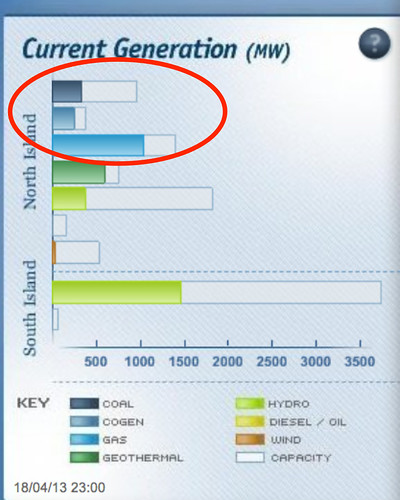
And here is is over the last 24 hours – remembering that blue is expensive:
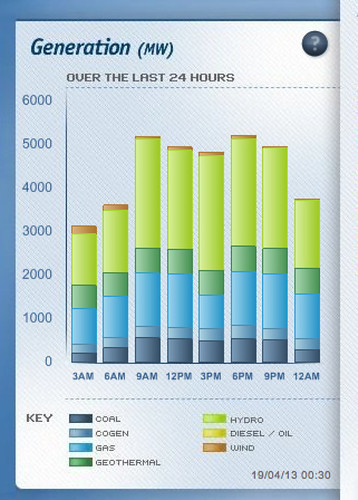
These thermal plants cost a lot to run, so the price is higher. If we want these more expensive plants to be there when we need them, like today, then we need to make sure they are used enough each year to be economical and that the price is fair.

If we want to build more geothermal, wind or solar plants, then we also need to pay them a decent price so that their investment gets a return. And that return should last forever, not for a limited time.

The green bars at the bottom are the ones that the Greens’ are probably most upset about – that’s South island hydro dams pouring energy into the grid at essentially zero marginal cost. I’m going to guess that a lot is going to Tiwai.

Overall

I did not support the prospect of the IPO of Mighty River Power, and nor did I place a vote for my National candidate in the last election with the expectation that it would be perceived as supporting that mandate. I also voted for the Green party as I see they temper National well, while Labour had too many dumb ideas and an old guard.

But now that the Mighty River Power prospectus is out it’s been invigorating the capital markets and is in turn hopefully going to make it easier for people in my space of web, technology and design-led businesses to raise money for the next generation of companies. Mighty River Power is a very investable proposition, and indeed last night I did just that – invested.

This bombshell policy threatens to derail the Mighty River Power IPO process, and arguably is in response to the National Party steamrolling this through without regard to the referendum and other obvious signs of public discontent. But it is rough politics, and I would expect more out of Greens at least, who should be demonstrating that they are ready to govern responsibly. It’s a move that if continued for too long will arguably threaten the possibility of a Labour-Green government at the next election.

But let’s not get carried away, and treat it as intended – as a way to start a conversation, and with that in mind here are ten alternative suggestions:

So – what would I recommend that Government should do with the electricity market?

Firstly, I’d fairly quickly open up the wholesale electricity market to everybody, not just the handful of operators and retailers. It’s very complicated now, and some work is required, but I’d like to see retailers like Powershop (and Powerkiwi) able to aggregate consumers and expose them to the hourly variations in pricing, so that they might adjust their demand to save money. A better market will also allow those retailers and consumers to sell back any power they generate at market rates.

Second, and related to the first, I would make sure that the lines companies and other local suppliers such as meter readers must deal with all retailers on the same basis and on the same easy terms. That means Powershop, for example, would be able to quickly roll out to all markets in New Zealand (like Nelson), and so would other retailers. The mission is to systematically break down barriers to entry, so that the price pressure can remain firm. Some retailers may even build enough customers to buy that dream amount of long term cheap capacity.

Third, invest heavily in the proverbial ‘smart grid’. Minimum requirements for this are to measure generation and consumption of power minute by minute at each location. The network will need to cope with those battery powered cars or home solar panels contributing power, provide for redundancy when major lines go out, figure out who is owed what in real time for consumption and generation and allow consumers to track it all with open data.

Fourth, why not put in place regulations that provide incentives for households, farms and other businesses to install solar panels and other micro generation plants. This could be a loan program, a feed in tariff program or even a mandate for any new property developments and renovations. Preferably it would be all three. The feed in tariff program would make sure that retailers and lines companies take back the power that the consumer generates at a fair price that is related to the price the consumer pays.

Fifth, why not push to make it much much easier for consumers and businesses to switch between companies, and expose the prices offered by companies for all households. Do this by migrating the government owned retailer’ customers to the Powershop marketplace, perhaps splitting Powershop to be independent from Meridian.  On the larger Powershop customers could be offered contracts that are annual, daily or anything in between, and the switching and selling costs would vaporise, saving the industry money and making it easier for consumers. (And no more paper bills). This means, for example, that households could choose to manage their consumption to reduce peak time demand and expenses – and that in aggregate lowers the costs for the industry.

Sixth, why not play hardball with our biggest CO2 emitter and electricity user – the Tiwai point smelter. Releasing that baseload electricity into the market will push the prices down for a while.

Seventh why not put that windfall money from the profit from the current government-owned dams into creating new green generating capacity, and to subsidising government so they can directly help poorer families through social welfare benefits and through efforts like the Greens’ housing insulation program. Make it a little more explicit than what happens now, including putting a mandate on Mighty River Power for investment in green power (it would likely change nothing in their plans), and including the lines companies. And yes, this is happening now, but can be even faster.

Eighth, never sell those other lines companies – keep them in the trusts and regional councils. They are a license to print money.

Ninth, let’s go ahead with the Mighty River Power sale, but make sure that NZ retains the majority shares, as the plan is. The sale is a done deal, but let’s not be hasty about Meridian, although the case for Solid Energy being in taxpayer hands is far less apparent.

And tenth, let’s think about splitting the generation and retailing arms of the remaining two government owned power companies, keeping the renewable generating assets and selling the rest. That will change forever the balance of power in the wholesale market.

New Zealand’s tourists are very very happy

Buried in this MBIE report on the tourism outcome from the 2011 Rugby World cup was this chart:

The little red pice of the left hand side of the bottom bar represents the percentage of people who gave their trip to New Zealand a 5 out of 10. That’s not a great trip for them – perhaps they were not rugby fans.

But just look at the numbers of people who loved their time here. Over 40% were extremely satisfied, 65% or so gave us a 9 or 10 out of 10 and almost 90% marked New Zealand as 8 or better out of 10. And that’s for the visitors who were not here for the rugby. Those who were, despite perhaps backing a losing team, were overwhelmingly gracious about their experiences here – with about 94% over saying 8 out of 10 or better.

It was a magical time to be in New Zealand.

It’s still magical now. So come on over to visit if you don’t live here, and perhaps think about starting a business here as well.

And for the record – here is the chart of visitors to New Zealand showing the impact of the World Cup:

The sharp increase and continued growth after the pop is an astonishing turnaround from the impact of Christchurch Quakes and Chilean ash cloud, let alone the global recession.

There’s a lot more going on in New Zealand than the RWC and tourism, and I’m a huge supporter of the emerging web, tech and design led companies here in particular. Stay tuned.

Can we replace the Tiwai smelter with a data center?

(I was going to save this for Nine To Noon tomorrow, where I’m doing the technology segment, but things are moving fast. But do listen in)

A few people have muttered, sometimes out loud, that one possibility for the apparently uneconomic Tiwai point aluminium smelter is to switch it to become a data center.

So does it make sense?

Well – aluminium smelters use a lot of electricity. The Tiwai Point owners have a contract for electricity supply with Meridian Energy for the continuous supply of 572 megawatts for the period 2013 to 2030. The first three years from Jan 1, 2013 are locked in – a so-called take or pay arrangement. (Apparently, according to Chalkie, NZAS buys on the spot market to make a total of 625MW of demand.)

But let’s stick with 572 megawatts. That’s a lot, and multiplying it out by 24 hours a day and 365 days a year shows that the smelter uses about 5,000 gigawatt hours per year from the Meridian contract.

It’s no mistake that the annual electricity output from the Manapouri dam is about the same as the demand from Tiwai – 5,100 GigaWatt hours. It’s a sizeable power plant, not the biggest in New Zealand (Huntly is bigger), but certainly up there with some of the world’s largest.

The average NZ Household uses around 8,000 kilowatt hours per year. So the power supplied to Tiwai could supply about 626,340 houses each year – out of a total of around 1.6 million residential connections in NZ. This is a big piece of the electricity supply equation.

So how much does a data center use? Well the new IBM one in Auckland, which cost $80m, has backup generator capacity for “266 homes”. So to absorb Tiwai’s electricity use we’d need we’d need 2,354 of those flash Auckland IBM data centers, at a total cost of $188 billion.

That’s not going to happen.

Meanwhile Tiwai is at the end of the earth from America – in a country with only one cable system connecting it to the world. There is no compelling reason to house a decent sized data center in Invercargill.

Data centers do like power (and the cold), but not nearly as much as aluminium smelters.

The NYTimes reported, in September 2011, that Google itself uses a continuous 260 MegaWatts of electricity worldwide. They compared this to a 60 watt bulb being used for 3 hours per month per user.

Impressive as it sounds, all of Google’s demand for data center power is still less than half the freed up capacity from Tiwai.

So no – we cannot replace Tiwai’s electricity demand with a data center. Or even 2,354 of them.

Meanwhile Tiwai is a brownfields site – we’d need to remove the contaminated carbon pots used to make the aluminium, decontaminate and decommission the buildings and plant, including the carbon plant where the anodes are made and baked, and so on. It’s going to cost hundreds of millions of dollars. The pots themselves have a limited life, and one smart thing to do could be to scale down production for as you take pots offline. However at some point it will be to hard to run and uneconomic, and it would be best to simply tap the aluminium from each pot in turn and switch the plant off. That’s a big job, by the way. 

Some aluminium economics

Tiwai smelter is the 28th largest in the world, and slipping down the list as larger plants are built. I’ve worked or been in three of the others on that list, two larger that Tiwai and one smaller. The smaller one closed half of their plant due to ongoing electricity supply problems, and because it was less economic than the more modern larger ones. And that’s how it works – smaller and older plants are inherently less cost effective than the newer larger ones, and while differences in operating effectiveness can help, ultimately the underlying technology, such as the size of the pots, dictates the effectiveness at converting electricity and alumina into aluminium. Smart operators set the price of their alumina and electricity inputs as a function of the aluminium price, and so the plant efficieny dominates the equation.

Tiwai is now a third of the size of the world’s largest plants, and will certainly be higher cost than many on the list – the newer ones, but not the highest.

RUSAL, which owns the largest two plants which produce over 1 million tonnes a year each, and has 9% of the global market, reckons that 1 to 1.5 million tonnes worth of annual production from the industry would be idled this year. That means supply is exceeding demand, and the high cost producers are the ones that get hit first.

However other countries and operators may not understand that their plants are the highest cost, and they may be subsidising the plant. This is not a fight that tiny New Zealand stands to win, if we enter it, ans so the right thing to do is hold firm on the pricing of electricity, and let the market decide.

But it all comes back to the rising demand from China – perhaps a boom year there could see demand fro aluminium spring up to absorb the industry capacity. Or not. It’s not a game for the faint hearted, but the owners of the higher cost smelters know that shutting them down will reduce global supply, and doing that will increase the price for all their existing smelters.

Let’s stop hurting our container opening dock and warehouse workers

About a year and a quarter ago I was lucky enough to do some consulting work for Syft Technologies, a technology led company with a better mass spectrometer.

They were well known for a few years, and even listed for a time, until it became clear that they were failing to make the transition from a science led technology development company into a customer led sales driven company.

Enter my friend Doug Hastie, who became the new CEO early last year. Doug’s a sales guy and natural leader, and has been leading the Syft team in quiet sales led transformation.  Syft had their first ever sales conference recently, and are extending their global distribution network quite nicely. I’ve now invested as I see this as a long term success story.

The Syft mass spectrometer machines are amazing, it is seems that customers agree. The machines are able to detect very tiny amounts of gas inside air, and do so very quickly and even in-line. They are useful for a variety of industrial, environment and, yes, scientific purposes.

One of the best applications, it turns out, is for ensuring the safety of workers who are opening imported sea containers. It turns out that containers increasingly have toxic substances in them, such as glues from shoes, emitted gasses from wood or MDF and residue from fumigants.

Quite simply if unprotected workers enter certain containers they can die, and in many cases the contents can make workers sick, or give them long term health issues, like cancer.

Syft’s customers overseas show that between 10% and 30% of shipping containers tested contain dangerous levels of toxins. But what is it like here in New Zealand?

We now have an official answer. The NZ Customs Service ran their own comprehensive study at the Port of Tauranga last year, and their “Report on the outcomes of the fumigant risk study” was published in May 2012. The report was not released to the public then, but The Wellingtonian did an OIA request, and an article, Containers’ Toxic Cargo. It was released to the public on March 14th this year. Well done.

The NZ Customs Service, along with MAF I suspect, have to open a huge number of containers each year, and so they were rightly interested in what their workers are being exposed to. It’s an important piece of research, and was well run from what I can make out, with over 500 containers tested.

The results were frightening.
Almost 90% of the air samples collected contained some toxic fumigant or volatile organic compound.
Most of those were deemed technically safe, but one in 5.5 containers (that’s 18%) had toxins at a level that is legally reportable as unsafe. So if you open several containers each day, one in 5.5 of them is poisonous – and some of those could kill you.

Most of the containers had at least some formaldehyde, which is toxic, allergenic and carcinogenic, irritating the eyes and nose, causing cancer and lethal at high enough concentrations.

Formaldehyde, which is released from packaging and products like clothing, was also responsible for the majority of readings above the unsafe level, with one in 8.3 containers unsafe due to the gas.

About one in 4.26 containers contained levels of formaldehyde which were above Reference Exposure Levels, which is the level above where you should be mitigating exposure and protecting workers.

In second place for above the share of containers above unsafe levels was Ethylene Oxide, found in containers with medical and lab equipment. Wikipedia describes the gas as a “flammable, carcinogenic, mutagenic, irritating, and anaesthetic gas with a misleadingly pleasant aroma.”

Unfortunately 1 in 23 containers had an unsafe level of ethylene oxide.

Other chemicals also showed dangerously high levels, including 1% that had over the safe level of ethylene dibromide – the world’s top carcinogenic substance as rated by the HERP index, and 1.6% over the safe level of benzene, also a carcinogen.

Impact on Workers
I’d hate to be a worker opening containers – especially doing so over a number of years.

It appears that you have a much higher risk of repeatedly breathing in carcinogenic compounds, and there is a tangible chance of becoming ill or even death. The brave affected folks who open the containers include our customs and MAF authorities, contractors and staff working for companies who are importing the goods, port workers and inbound logistics or warehousing companies.

It’s sadly very rare to see analysis and safe defumigation by anyone, especially in NZ. It’s clearly hard to do – testing has been very painful and expensive, and safe defumigation can mean hours of fan assisted venting, and in a location well away from humans and other containers.
However this sort of occupational exposure would simply not be accepted, if known, by any reasonable organisation. We don’t accept it in mines, we don’t accept it in industrial plants, and we certainly should not accept it in our ports and warehouses.

Indeed I would not be surprised to see that the large companies that truly care about safety are the first ones to insist on safety when opening containers. These organisations, and I’ve consulted to one mining company before, can and do eliminate these sorts of health hazards to workers. It’s not easy, it’s not that cheap, but it’s worse living with yourself knowing you are unnecessarily exposing people to potentially fatal health and safety hazards each day.
However this exposure appears to be a hazard that has crept into play over time, as the amount of chemical released from shipped products appears to have risen over the last years as the products and packaging has changed. So arguably nobody really knew about the seriousness of the hazards before, but in turn this report puts everyone on notice.

In New Zealand the news was not widely spread, picked up only, as far as I can tell, buy the Welingtonian, the Southland Times and a small item on Radio NZ. Neil Ratley from The Southland times, in Toxic Gases Found in Shipping Containers, did real work as a reporter and called the local ports. He quoted South Port CE Mark O’Conner saying “There is a need to be careful about the science applied to some of these tests and the equipment used, to make sure readings are accurate and reliable”. He also spoke to Port of Otago’s commercial GM, Peter Brown, who was dismissive of the report’s potential impact.

As an aside for Messrs O’Conner and Brown, I for one believe both in the integrity of NZ Customs and also in the integrity of the Syft machines. Syft has 10 years and $30 million invested in the development and servicing of their inline mass spectrometers, and they are successfully used for container testing around the world. This report is a serious wake up call, and I would recommend investigating more, perhaps by calling NZ Customs Service in Tauranga.

The report was also picked up by the Maritime Union of New Zealand. Unfortunately that union lost a tremendous amount of credibility for me and many others last year in their protracted and ridiculous squabble with the Port of Auckland, who also didn’t cover themselves in glory. It’s sad to say, but this issue is far more imortant to their workers, but they are having little impact in the public realm, or, I would hazard, with management at ports.

But while this needs to get more attention, we do not need hysterical attention from a panicked populace and workforce. Instead we need a steady yet steely resolve from leaders in the industry to go beyond the hi-viz, and to work to prevent any further harm for their workers. Let’s not have any fatalities.

I commend the report, and please – don’t open a container and rush inside. You could die.

Some references.

The Report on the Fumigant Risk Study _External

NZHerald article: 6 Nelson workers died from Motor Neuron Syndrome, which widows believe is linked to methyl bromide exposure.

Scoop article:Centreport starts containment of methyl bromide when fumigating logs, but not recapture.

OSH: Working in Confined Spaces brochure. Note that containers are not covered – but perhaps they should be.

Stand firm Meridian on Tiwai – we can all win here

Patrick Smellie reports in the NBR that Meridian are unlikely to reach an agreement with Rio Tinto on renegotiating the 18 year electricity supply agreement for Tiwai aluminium smelter.

I guess it’s time I should weigh in, and support Meridian in standing firm. I’ve helped lead a turnaround of an aluminium smelter or two, and have seen the impacts of poorly constructed electricity agreements. I’m also the founder of PowerKiwi, and we market electricity on Meridian owned Powershop – but I don’t see that as very relevant here.

Rio signed the long term contract in 2007, and it started this year, with Rio locked into the first 3 years. But already Rio want to renegotiate. The implied or expressed threat that Meridian either renegotiates the price down or Rio will close the plant. Add in the fact that Meridian is owned by the Government, and that Rio closing would cause job loses, then we’d expect Rio to have the upper hand.

Aluminium smelters are basically a way to export electricity, but the technology and scale has increased over the years, and the Rio argument is that Tiwai is now a high cost producer in an oversupplied market. This does happen in the mining and smelting industries, which are global and subject to huge numbers allocated to investments in boom and bust cycles.

My outside in take is that I’d love to send in a team to take over and bring the mojo, quality and cost back. I’ve seen this done successfully before (and helped), and know plenty of people who would enjoy the challenge. That’s assuming the plant is relatively poorly run, but it was seen as a benchmark site 10 years ago, begging the question of whether it is now fundamentally uneconomic. Even with the best workers in the world, if the plant is structurally uneconomic then there is little to do. I have seen elsewhere, however, that many workers will excellent opportunities to continue in the industry offshore. Others may struggle in the short term, and regardless of the result they will need to country’s support to move on and up.

My second take is that Rio may not have done their numbers properly – and that HQ may well be allocating too much of the revenue to their own books, and allocating too much cost to Tiwai. The low tax payout that an NBR commenter mentioned would seem to argue for that suspicion. So my recommendation is that Meridian should be demanding that Rio open the books and treat the economics of the plant as a stand alone business.  Make sure, for example, that the prices for buying alumina and selling metal are based on the LME price, not some internal price. I suspect from industry experience that the results will be startling, and a buyer may become quite enchanted with the economics.

And thirdly aluminium smelting is a huge CO2 emitter, and the much larger modern plants would be emitting less per tonne of aluminium produced, so long as the power source was also renewable. Regardless, those modern plants will keep producing, and closing this plant is net good for the world, and helps NZ reduce our share of CO2e emissions.

I also suspect that Meridian will earn more by putting the electricity on the spot market rather than this extraordinary low priced long term contract. Certainly in the medium to long term – and I assume that they have the models to back this up. While some new power lines do need to be built, abandoning Tiwai supply will also save our economy from having to build major new power plants for for a while, and reduce emissions from the large thermal plants we have to use more fully at the moment.

The only negotiating tool that Meridian really has is load shedding, which is switching down or off power to the smelter at peak times. I suspect those sorts of clauses are already there in the existing contract. However it’s a false saving for the plant, as too much of that switching and the pots where the aluminium is produced will become unstable, the energy efficiency will drop and less aluminium will be produced per unit of power. In short the plant will become even more uneconomic, and even risk more pot line freezing incidents. Maximising aluminium production needs stable pot lines, and it’s very hard to keep pot chemistry stable without stable electricity supply.

Finally I believe the fundamentals of the The Mighty River Power IPO proposition are still the same – MRP is a producer of electricity with essentially zero costs from hydro and geothermal assets, and one gas powered plant. It’s a buy and hold forever kind of deal, and short term price fluctuations will prove immaterial for lasting value, while there will be less short term need for cash to be allocated to building power plants in NZ.

So I hope Meridian and the government stand firm against Rio here. Close or sell the plant, but please don’t negotiate prices down. And if you do close – well I’ll buy it for $1.

Novopay is Not Found


Not Found, originally uploaded by LanceWiggs.

A real basic failure from Novopay that is symptomatic of the much greater issues.

Even now, months after launch, the site does not resolve unless you type the full http://www.novopay.govt.nz.

I have not typed www for over 13 years, and neither should anyone else have to.

Examining the site itself is beyond me for now. The word is denial.

Lightknight: Place a big order now

Lightknight is receiving customer interest, reports Christopher Adams from the NZHerald (no paywall yet). So I thought I’d check them out. I had no idea I could also give them a big order.

It seems like a good product – lights that go on HiViz vests to increase visibility at night, and arising from a stated industry need. They got some funding back in 2011 from NZ VIF and IceAngels and was launched late last year.

So – the product seems good, but where it falls down hard is the website.

Firstly though, before we look at it, let’s think about what the biggest benefit is that the product brings, and who the target market is?

I see that the benefit is that workers can be seen at a distance at night when they are not illuminated from an external source, and that the market is GMs and safety officers for companies and contractors in fields like roading, industrial plants, construction and so forth.

So – what would we expect to see on the home page?

Not this:

Yes I can see the product, and that’s a great way of communicating the primary use. But I don’t get to see anything on the safety benefits, beyond a statement in the fineprint that it “reduces danger dramatically”.

Suggested Changes:

I’d emphasize the difference in big print, using lines like:

  • Increase the visibility of your staff by up to X times, backed up by a distance visibility test of a vested and lit-vested staff member in a dark place.
  • Safe in storms, backed up by the testing performed and the certifications
  • Easy to operate and maintain – admittedly one of my first questions. Back this up by showing how long the battery lasts, how light it is and how robust it is in practice. 
  • and I’d also talk about the other operator benefits such as safer walking, better work area lighting and so forth.

Next we go to find out more about the company and product:

Or not. Clicking on the Lightknight story brings up a useless submenu. Expected behaviour when I click on a menu is that I go somewhere, and this fooled me (really). Every time a website does something unexpected then the chances of me leaving increase. But I stayed – and there was a reason.

Suggested Changes:

Lose the sub menu and put all that content on the LightKnight story page.

The actual About Us page is a lost opportunity:

The most compelling part of the LightKnight story is the product, but on this page we see nothing. Nor do we read about the reason LightKnight exists – the customer cause or the reason for being. The greatest silliness is in the LightKnight word itself, two tone and with a TM symbol. Ludicrously unreadable.

Suggested Changes:

Write the story of the company, how it started, what the customers wanted and how you developed and tested it. Show pictures of the founders at work and of the prototypes and current products in the field. Show the product benefits as well.

On to the Technology section, where we have the reverse problem.

There appears to be no text at all on this page, just a rotating series of images. I picked the worst image – which is mostly out of focus. I learned nothing at all about the technology from this page and moved on.

Later, when I tried to find a product to buy, I realised that there is in fat text on this page, it’s just that the photos are so large that the text is hidden.

Suggested Changes:

Rename the tab from “Technology” to “Products”. Create a new tab called “Technology” and  tell the story of the technology on a nice long page. Check out any Apple product page for how to do this.

Reduce the size of the photos on the product pages so that someone on an iPhone or iPad* can see there is more below. (let alone someone with a 27 inch monitor.)

Here’s the bottom of a related page for the other product:

The ALL-CAPS bullets without any illuminating text under each is not compelling to buyers. This is a sales page, but aside from the Add to Cart button there is little on it that feels professional.

Suggested Changes: Again, check out any Apple product page, but in general make this page a story again, prioritise and walk through the benefits, and provide the fine print for those who want to delve.

So I hit the Buy-Now button:

I decided to buy 1000 units – as the price was right. You can too, for now.

Suggested Changes: Put your prices up. Fast.

At Checkout it all falls apart badly:

This is the sort of screen we’d expect to see on a just-launched site. It has no place on a professional website. I’m not going to say anything more.

Overall the site feels like something that was thrown up in a hurry 2 years back, rather than the focal point for a B2B sales driven company. It’s unprofessional.

Suggested Change: Get professional help. A full service design and development firm that will help with your messaging and branding. There are several of these in New Zealand, but go for a good one locally where you can meet face to face and work together. You’ll need to be paying at least $120 an hour, if not far higher. A great firm will also help you with your sales materials that you use when you visit clients or respond to them on email. Investing in this sort of thing reaps huge dividends.

If this feels too expensive, then you need to add a founder to the team, someone who can do all this easily and is willing to do so for equity. But it is certainly not acceptable to leave this alone. At the very least start improving the website text.

Are NZ house auctions illegal?

Over on 200Square Grant Wakelin wonders whether some house auctions are illegal:

..real estate sales and auctions are governed by among other things the Real Estate Agents Act 2008. Under those rules there is a case to argue that property auctions run the way they are today are not in compliance with the Act and Code of Conduct in two related areas – specifically do auctions:

1. Apply undue pressure on the seller and/or buyer (rule 9.2)?
2. Allow the opportunity for seller/buyer to take adequate (legal and/or technical) advice (new rule 9.7)?

Lets be clear, auctions are designed to create pressure on buyers and sellers..”

It’s a fascinating insight, and makes sense once we look twice.

Auctions are wonderful mechanisms for pushing up the price of the item being sold, with much of the action happening as a result of validation from other buyers. But auction theory tells us that the price paid is always that of the second highest bidder, generally no matter what the method used.

However in practise auctions can occur in a crowd late at night, with plenty of noise and excitement, incitement from the auctioneer and criers, along with vendor bids and other agents contributing to the energy. Combine that with a lack of timely advice and we can not unreasonably argue that prices paid are above the intended reserve price for the buyers.

That’s fine for sellers – but what if just one auction sale was deemed later to be invalid by the Real Estate Agents Authority (REAA) due to either or both reasons (pressure, advice). If so then that could conceivably place a large number of sales under the threat of similar action.

I do think it’s worth looking into by the REAA, and perhaps it needs a test case.

In defense of auctions, it’s good to hear that alcohol is never served, at least not before they end. I also hope and trust that steps are taken to ensure buyers and sellers do not drink beforehand, and understand that it is up to the auctioneer to not accept bids from people who are not capable of making one.

For buyers or sellers going to an auction my advice would be to either make sure you have your (non-excitable) advisors on hand, or put yourself under an unbreakable price mandate. Alternatively you could ask someone else to appear and bid on your behalf.

Finally as an outsider I always wonder about shill bidding, which is bidding from non-genuine buyers. In New Zealand so-called Vendor Bidding is allowed, but it must be identified as such – as bids on the vendor’s behalf. A Shill bid on the other hand is a bid that is on the vendor or agent’s behalf, but not identified as such. I have no idea whether this is an issue or not here, but it’s always been a concern  for me in any live auction. It’s very hard to prove or disprove as an outsider, but ultimately we are in the hands of the accredited auctioneers, and I suspect (or is it hope) that they have strict processes in place to avoid the possibility of non-official bids coming from other than genuine buyers.

Doing business the hard way

Good news: A US-based site for doing the legal documents for venture capital backed start-ups in the USA. It’s not the first, but it does seem lovely to use, and they have yCombinator’s General Counsel as an advisor.

Bad news: In the USDA you need a website to help you write legal documents.

The trend towards more complex legal documents is one we should fight, but the USA (and Delaware) has such a byzantine set of rules and de facto rules, that they end up with a sea of texts for each deal. That makes it harder to get deals done as everyone has to understand what’s going on, much more expensive as lawyers from each side (and there could be several) get involved, and arguably more prone to squabbling about the details rather than the basics of ownership and board membership.

An early example is the “Standard Post-Incorporation” agreement, coming in at a nice and low $299, includes sevem documents and two optional documents:

Action of Incorporator, Bylaws, Initial Board Consent, Restricted Stock Purchase Agreement for each founder, Notice of Stock Issuance, Pre-filled 83(b) election and filing instructions, Confidential Information and Invention Assignment Agreement (one for each founder) and future options for a Stock plan and indemnification agreements.

That’s after the Certificate of Incorporation is done ($99), which is sent to Delaware, whereupon it takes 2-3 days for the Delaware Secretary of State to respond.

These ten documents are just for starting a company – not for an actual investment round.

For a country that is meant to be the center of business, it sure is hard to do business there. I welcome Clerky, which, like TurboTax in its day, makes the complexity of the US system easy to manage using a form-based approach. But overall it’s a sign that things are out of control, and Government focus should be on making it easier and cheaper to start and run businesses.

In New Zealand we can form a company within an hour, and we do so online. A well-written Constitution and Shareholders Agreement takes care of the rest. But that’s still not simple enough, and I do recommend you see a lawyer, preferably one who is not your family lawyer but a professional.

I’ve even recently been hearing arguments that the shareholders agreements are not really worth it – at least not for investors with a founder-centric, long term horizon. I’ll leave that one for another day.

What makes for a good newsletter?

About 13 years ago I started an internal newsletter at McKinsey, with the intent to educate and inform other consultants about the goings on online and in telecommunications.

It failed badly.

That first newsletter was a PDF of several 800 word articles that were painful to write and get written, but even more painful to read. The PDF had to be opened from email and then read on a computer screen, and those screens were pretty small and poor quality back then. The articles were too long, and the process of creation was completely unsustainable.

So I started again the next week, and from then and every Friday thereafter I sent out a text email titled “The e-Elevator Factoids of the Week”, to a distribution list that over time steadily and at times alarmingly increased. The factoids were 2-3 line snapshots of what was going on in the two industries, and were deliberately snarky and amused about things like over-priced sales of 3G spectrum and the launch and failure of a succession of dot coms. It may not have been the best format for deep analysis, but the intent was education, and using humour was a way to get readers engaged and looking forward to the results. It was hard and time consuming work – each topic had to be selected from the mass of other potential topics and then the lines crafted in a way to be readable, humorous yet informative.

For end users the Factoids were a quick, fun and informative read, and, from what I understand, they did get read a lot.

Fast forward to today, and the age of HTML formatted email and regular newsletters.

Today two newsletters arrived in my inbox within minutes, and then another while I was writing this post.

The first was Wellington Matters, which is arrives every Friday from lawyers Webb Henderson. It’s long, but I do read, or at least skim, it. Here it is:

Above is what I could see when I opened the email (so called “above the fold”). This was on a larger external screen, so smaller screens will see a lot less. Overall there was sufficient content for me to start reading. Sometimes it feels a bit overwhelming, and perhaps several shorter earlier pieces could work, but overall I can read the email and be done, regardless of the device I am on.

Here’s the next few screens of the email (I’ve reduced the typeface to fit more). The articles are a bit shorter and it’s easy to read. I clicked through and actually read four documents referred to in the email, and certainly learned a lot. Well done Webb Henderson.

The next newsletter to arrive was from the Icehouse. It’s monthly, but arrives at different times each month. The format changes, seemingly every time, but that’s all good in the spirit of continuous improvement.

What I don’t like is the way the content is hidden, firstly behind a very informal introduction, and secondly behind some large photos. Meanwhile the font seems rather large, though perhaps that’s a function of older angel investors versus younger lawyers and infrastructure investors used to tiny turgid prose.

But the real bugbear for me is that this newsletter contains no real content. All of the content is hidden behind a click, and there are seven main ones, and eleven in all.

It may be nice when we send email newsletter to track the number of times each article is read, and perhaps that why this is occurring. But I argue that the friction of enforcing clickaway will sharply reduce the number of people who actually read anything at all. I would also argue that lengthy articles are not the problem, it’s the click. we don’t mind lengthy emails.

So I clicked on no links, and so the Icehouse lost an opportunity to update me on their goings on and share some insights. And that’s sad.

The daily email I look forward to is the Atlantic Wire. They are incredible at slecting and summarising the top 5 articles from the previous day. Here’s how it looks:

I have a 100% read-rate, and a very high click through rate as well for the Wire.

The third newsletter to arrive, while writing this post, was The NZ Initiative’s weekly newsletter. It is sent consistently every Friday, and is a simply designed, long form series of articles. I read about 20% of them.

I guess I don’t read more as I’m not such a fan of the content, or am not familiar with the authors’ work. Or perhaps it’s that it feels a little bland. But I do keep subscribing and generally scan it for anything interesting. Perhaps it suffers from arriving after the much better designed Webb Henderson newsletter.

Overall thoughts

Like everything else, to me the key to a great newsletter is to focus on the end-users’ needs. And end users simply want great content that’s easy to read and share. So here are my top 3 tips:

  1. Focus mostly on curating and creating excellent content – and that create readers who wait desperately for your material.
  2. Send the newsletter at a consistent time, using a consistent format and with consistent quality. 
  3. Show the entire article, or at least as much of it as you legally can. I we can’t see it, it’s not likely to be read. Provide a link to the online version so that it can be easily shared. 

<update: Trade Me’s monthly newsletter just arrived as well. It really is benchmark stuff.>

Lessons from Webstock: We’ve come long way, now let’s move on up

Another superb first day yesterday at Webstock, New Zealand’s must-attend conferences for anybody involved in web design or related businesses. Once again the speakers were universally superb, the organisation sublime and the conference is made with love. With many familiar and new faces, it’s a comfortable environment to spark and continue fascinating conversations.

Overall I took three meta-themes from the first day:

The first was that we’ve come a long way.

Webstock has been going for 7 years, and the room just keeps getting fuller, the organisation slicker and the speakers more and more appreciative to be here. The audience increasingly arrives better informed about the topics at hand, making it harder for the organisers to stay ahead, and yet they do. While the converted are here, we also see a steady stream of first timers, often bought along by their colleagues and friends. In short Webstock, along with other efforts, have worked to help transition New Zealand’s usability centred web ecosystem from a few lone voices and Trade Me insiders to a vast crowd of hundreds or even thousands of people. That’s tremendous for New Zealand, and it has contributed to spawning and growing a large number of superb companies, from Xero and Vend to Timely and WIP, the two winners of $10,000 checks from the BNZ Start-up alley competition here this year.

The second theme is that the quality of our web creative, development and business communities are rapidly catching and often surpassing the USA. Many of the challenges that we heard from the stage that speakers are facing and conquering are also being faced and conquered here in new Zealand.

The numbers are often a lot bigger over there, but as Vaughan Rowsell from Vend exemplifies we are already shifting from mainstream news to more wisely choosing our sources, from consulting or client work to producing products, from pondering and outsourcing to doing. We already  live within constraints, which increase our creativity, and we have a strong design thinking movement. Our culture aligns to the idea of designing and making the cheap and cheerful product for the people and we have a strong talented designer community. We also have an array of people and businesses working on sensors, turning that into useful feedback and practical applications rather than useless internet fridges. We are even getting better at presenting our work. Again I’d argue that Webstock itself is responsible for a good chunk some of the shift here in NZ over the last 7 years, and long may it continue.

The third theme for many of us, is that we need to keep stepping up lifting our eyes and taking advantage the advantages that New Zealand has granted us to play with. Done well, we can match, play with and outplay even our counterparts in the USA.

We have a strong base. Our domestic politicians and civil servants are remarkably sound and accessible. It’s trivially easy to start and do business here. We increasingly have critical masses of designers, developers, engineers and business people. We have the world’s biggest population of free trade area, great education and low trade barriers to imports and visits. It’s a lovely place to live.

We perhaps lack enough assertive sales people, and that certain sense of confidence that we often mistake for cockiness. In addition we can always use more smart money that moves quickly to help the best opportunities and keep expanding our community and our economic and societal impact.  All of that is being worked on, by individuals, by businesses, by interest groups, by Webstock and others, collectively expanding and extending our community.

Promotion and advocacy

We come from a past where, aside from dodgy real estate agents and finance company touters, we are lousy at pitching. Selling is seen as un-kiwi, and while it’s getting a lot better, we need to level up again. When Kiwis’ communicate, hard as it is, we do so from a  well respected base of honesty and openness, and are we respected across the globe as trusted advisors.

So why can’t we extend from our base of being trusted, incorruptible and easy to do business with, to being powerful trusted advocates for not just our businesses but also for societal change? Why can’t we not just improve New Zealand, but extend some of our awesomeness to the rest of the world?

As part of that we need to get better at pitching, at presentation, at influencing and at advocacy. These need different styles, and there are different teachers for each. The rest of our society is slowly learning from our community that the nerds know this powerful way of presenting, TED style, if you like. However TED style is not enough. We also need to learn from design thinking and their workshops to create change, from sales professionals and their ‘getting to yes’ processes and from folks like Karen McGrane and Larry Lessig who challenge and advocate when presenting. I’d love to see us shift gradually toward more oratory and advocacy, accentuating the positive challenges we face rather than whinging about exchange rates and political shenanigans. We need a good dose of Obama-like inspiration, that soaring rhetoric, along with some audacious challenges and table thumping from the pulpit.

We don’t need ridiculous insider or self-help language or vast visions of some apocalyptic or utopian future. But we do need to push a lot harder, to move on, when it comes to responding to issues like anthropogenic climate change, the self-selection of ever more self-confirming media, the rise of selfish politics and the decline of health and life expectancy as in the USA.

Let’s Advocate, with a capital A, more strongly for the Open Internet, Open Research and Open Source. Let’s make it clear that we do not accept the Novopays, the emerging IRD system clusterfuck and Auckland City Council data that is hidden behind crippling costs and the pain of supporting an inexcusable government owned monopoly.

Let’s get intolerant about the media coverage of clueless Wheedle dreamers, and help our major media outlets understand that Timely, Vend and WIP are far more important and valuable than the 53rd wretched clone of our best success story. Let’s open the veil on the awesomeness that is emerging from that story, a Trade Me released from the admittedly light hands of Fairfax Media. Let’s at the same time drown out and guide to the light the commenters who cannot understand that Xero is ridiculously awesome for accountants, businesses and investors alike.

Above all let’s keep backing ourselves to win, and let’s extend that vibe from the Webstock inspired community to all of New Zealand, and thence the world.

And make sure you come to Webstock next year.

Where predictions eventually become true

From a post shortly before the last NZ election in 2011:

I’m picking National will just win, draw or nearly win the election outright, that ACT will not earn more than one seat (hopefully none), and that National will choose to work with the Maori and Greens as they did in the last term (as well as Peter Dunne of course). New Zealand first won’t be showing up to the bar.

Overall that’s a bit of wishful thinking as I see this group as the best outcome for New Zealand right now. We need to continue to weather the global events, and certainly don’t want rapid politically driven changes.

For Auckland Central, hopefully Nikki Kaye will become a minister and Jacinda Ardern will elevate to a front bench position after a major Labour reshuffle.

I got it all right – eventually, with the glaring exception of NZ First. Nikki Kaye has finally been elevated to caucus, Jacinda Ardern was promoted to Labour’s front bench after the election, and ACT received only one seat. NZFirst’s swath of seats sadly upset things, and they have proven to be a party without substance, once again. Parties that land a few seats driven by one personality rarely seem to last more than one term, and NZ First is hopefully no exception.

I won’t be moving this blog to political punditry anytime soon though, as these were fairly easy to predict at the time.

Pocketsmith: Advanced personal financial management

PocketSmith - Smart Personal Finance Software

While banks are increasingly offering tools to help you manage your finances, and Mint.com offers those services for free, there is a gap in the market for people looking for a higher quality way to manage their money. Pocketsmith has been around for a few years now, and has carved out a space in the global market with their ability to help customers for forecasting using a familiar calendar interface. While their major competitor, Mint.com, is free, Pocketsmith is attracting former Mint customers and others who are willing to pay for their advanced features.

Pocketsmith have spent a huge amount of time and thinking on how to make decision making based on future events easy.

Founders James Wigglesworth and Jason Leong (and  Francois Bondiguel who departed early last year), have been around the traps on this one, but it wasn’t about a year ago that they cracked the formula, with a new release. The team were perhaps guilty earlier of focussing on the more fun and advanced features of Pocketsmith over some of he less cool but necessary basics. That’s changed, and they are quickly filling out some of the missing pieces. I expect they will see an acceleration of change over the next year or two.

Since last year they have had a lovely organic growth curve of paid customers, and recently passed the 1100 paid customer mark (and tens of thousands of unpaid). It’s still early days, but by understanding customer needs and doing continuous improvement to the product the word of mouth effect, along with a few advertisements, we will keep it going.

Yes “we” – I recently invested in Pocketsmith, joining James and Jason on the board. I’m very excited about working with the team, and am getting a strange yet familiar sense of joy from watching that familiar curve grow. Meanwhile customers can watch their finances grow, using pretty charts like this:

And the development plan for the next few months is very exciting. It’s free to try, cheap if you want bank feeds (they cost us money), so why not give Pocketsmith a whirl?