Results:Top eleven for 2012

In January 2011 I tried my hand at prediction. Let’s see how that worked out then:

  1. eBooks will become relatively normal. It will begin to feel a little silly to purchase products that require cutting down trees, chemicals, huge plants, toxic inks and expensive production and shipping. eBooks are cheaper, fast to obtain and just as easy to read, except in the bath. New Zealand will lag on this one, but the switch will gain huge momentum in the USA. 
    I’ll give myself a qualified YES for this one. Amazon’s Kindles are now on sale in NZ stores, we see eReaders being used pretty much everywhere and a lot of people I know have converted. Whitcoulls and Borders hit the wall for a variety of reasons, but eReaders are a part of their story of failure.
  2. Pacific Fibre will be financed, and prices for capacity between Australia, New Zealand and the USA will continue to fall.
    That’s a NO – or more precisely a “not yet.” I can’t write too much about this, but suffice to say the team of professionals are beavering away on financing as well as operations and sales. They have announced 4 major customers, signed a great contract with TE Subcom for the cable delivery and that’s all I can say. Stay tuned.
  3. The Apple AppStore will precipitate an app revolution, with the best applications migrating to, and many appearing exclusively on, Apple Macs and iOS devices.
    I’d have to say NO on this, as while the app store is showing incredible results for developers and customers alike, and apps are increasingly the place for the leading edge, other formats are also prospering.
  4. Rowan, Koz and Amnon will do something amazing – though I have no idea yet what it is, and probably neither do they.
    Southgate labs invested in and got heavily involved with Vend, TheRugbySite, and GoVocab. All are awesome, especially Vend (which I am a smaller investor in) which is gaining good traction. I’m going with a YES, based on helping Vaughan Rowsell with Vend.
  5. There will be some significant wins in the Copyright battles for those that want less draconian protections. The lobbying from the entertainment industry owners will continue to backfire as consumers and their advocates fight for what they want.
    YES – the S92A wording in NZ was considerably softened, the USA’s hideous SOPA bill is backfiring and the entertainment industry continues to amaze with their inability to understand the internet. (Latest example). There appears to be a growing mood for a major revisit of Copyright law.
  6. The iPhone 5 will blow our socks off, and I and millions of others will buy one to match our new iPad 2.
    It didn’t blow our sicks off with hardware features, but the iPhone 4S with Siri is pretty amazing (it actually understands my weird accent) and it sold 4 million in the first weekend. The biggest change is actually in distribution, as we can buy the 4S anywhere. It did not bring anything truly magical on the hardware side, but I bought 2 of them so I’m giving this a qualified YES.
  7. The split US Congress will actually deliver some good legislation to be signed off by President Obama.
    NO. I think this one was wishful thinking, and the state of politics in the USA continues to baffle the rest of us. What was once an amazing example of civility, cooperation, pragmatism and statesmanship (I refer specifically to the Senate) has turned into two side that cannot agree on anything except for the importance of attracting campaign finance. Sad, but the Occupy Wall st movement, Larry Lessig’s book and what is going to be some blatantly crazy spending by the SuperPacs are promising signs of change. It will take something major to break the system, and that’s sad.
  8. National with John Key leading will easily win the NZ election and form a coalition  government.
    An easy YES. I’m very happy with the result, even with some of the ACT policies if not their players, and especially happy to see the Green party field some quality new candidates and get rewarded for it. Labour suffered for not doing so and needs to reinvent themselves and their selection process.
  9. Powershop in New Zealand will go mainstream – and people will begin to wonder why they ever received paper invoices from their utility.
    Powershop has certainly achieved much higher penetration into the public eye, with the switching sites often highlighting their cheaper prices, and a lot of coverage. Powershop deservedly won the Deloitte Fast 50, has a very successful GrabOne campaign and currently have over 42000 customers. My parents use it, so I’m going with a very soft YES. There is certainly a long way to go before it hits the big time.
  10. There will be no major success from the attempts of large generalist newspapers to charge for content online 
    Except, apparently, for the NYTimes that is. NO. I have sharply reduced my own reading of their content as a result, and I suspect the jury is really still out. 
  11. The All Blacks will lose the World Cup. Admit it – we have gone into every other World Cup looking as strong as we are now the season before, but when it comes to the crunch each players in every other team lays their individual life on the line to beat the All Blacks in the World Cup knock out stage. It’s essentially impossible to play three or four must-win games in a row with opposition like that. (Clearly I’m very happy to be wrong on this)
    NO – and as I said, Clearly I’m very happy to be wrong on this. What I also didn’t predict was just how good the Rugby World Cup would be for spectators and New Zealand. I ended up seeing 13 games live, including the opening and the final, and spent a huge amount more time and money on the festivities than I had planned. It was superbly executed, the atmosphere was universally positive and the crowd management continuously learned and became excellent. A hearty well done to everyone involved.

This predicting business is great fun, but hard. I count five clear noes, four soft yeses and two clear yeses. Some of those noes will turn into yeses soon, though number 11 is certainly going to stay that way for almost 4 years.

There is plenty that I didn’t predict, but on to next year. 

Investing with appropriate speed

So you are, or are not an Angel. But as commenters pointed out from that post there are several ways to invest, and we don’t want to scare off potential investors. I got some flack for being a bit too negative, and sure, perhaps I was a bit harsh. Everyone starting a business is looking for money at some stage, and anyone wanting to get involved and help with funding is welcome.

As the number of investors, founders and investments grows in New Zealand, we can start to lift our understanding of what great looks like. We should expect and demand certain behaviours from both founders and investors, and we should expect us all to get better over time.

We get better, as an industry, by doing more. It takes all types of models to figure out the better approaches, and there is no one true way.

Investors that invest and founders that start and grow companies are all learning. They are learning through their mistakes and their successes, and they are learning by investing or starting up multiple companies. Some of the success stories, and Xero is a classic example, rely on years of founder and investor experience before the company is even formed. Others come out of the blue, but the founders and investors come back for more (Hyperfactory, 42 Below). It’s all welcome, and we are progressively gaining building momentum.

What founders want.

Founders are looking for investors with the right balance of speed, expertise and funds. As an investor you need at least one of these attributes, and great investors have all three.

What investors want

Investors are looking for great returns on their investment and an easy time with it. They often also want to help. They need to be confident on the potential of the business, the quality of the team and the price of the investment. Founders who are realistic in their assessment of the business potential and valuation will encourage investors to come on board more quickly. As one investor I know says, founders should “value the cash”.

Being fast

Investors and founders want to make decisions quickly yet with confidence, which means founders need to be able to provide the right level of information, and investors require the right level of professional and legal negotiation, due diligence and contracting. There’s a common language involved, and as everyone gets more experience it becomes easier to make deals happen.

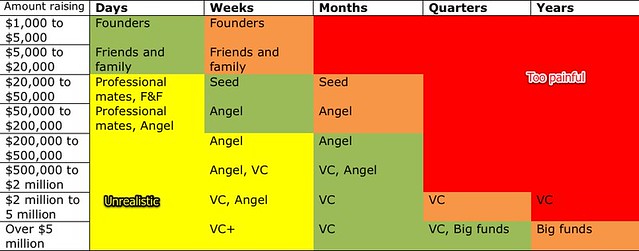
The ‘right’ level of preparation and rigour for investors and founders depends on the size of the investment, which also dictates the expected speed. The handy table below, and yours may vary, shows what I believe are the sweet spots for investment sizes and the expected time to complete a deal.

The green boxes are the target times for each investment bucket. Investing at these speeds is a healthy rate which allows founders to maintain momentum while investors can perform an appropriate amount of investigation, negotiation, due diligence and contracting. The orange section is worryingly slow, yellow unrealistic for most and the red section is far too painful for the founder, who should reassess the potential of the business and look elsewhere for funds.

The amount and time period dictates the amount of work done by each party to raise the money. Just how much work and what should be done, I intend to discuss, by investment size, in a series of forthcoming posts.

Saying no fast.

Speed of decision making and execution is an imperative for founders, as the fund raising process takes an extraordinary amount of time and effort away from the core business. While it might seem right as an investor to keep asking for more information, often the kindest thing to do when uncertain is to say no very quickly. Most investors will have defined investment criteria, which they and founders use as an initial filter. They are good tools to help to say no.

While the process will vary depending on deal size, there are always things each party can do to make things faster, or slower. From a founder perspective it’s smart to talk to previous people who have succesfully or unsuccessfully dealt with the investor. From an investor’s perspective it’s smart to make rapid decisions based on defined criteria, and to have simple processes. This might mean investing less than you really want to, or using tranches to ensure the company meets certain targets along the way. Other times it is going to mean cutting a few corners and taking a punt on the team – and that’s what a lot of this is about at the earlier stages.

Overall if you have lots of money to offer then you can afford to take your time and ponder the investment. If you are are throwing around only a few thousand each time then you’ll be expected to move very quickly. There is more uncertainty, but less to lose and higher potential percentage returns.

Expertise

Investors with industry expertise should be able to assess your product and strategy more quickly than their peers, for a given investment size. They might get it wrong (founders will see this as them saying “no”), but they should offer good advice along the way. They are preferred partners and and other investors involved will look to them for their lead.

Investors with less expertise are actually ok, provided they are bringing something to the table, which is usually huge amounts of funds or credibility. We should not expect those funds to appear quickly, and should realise that a significant amount of industry education may be required.

End note

For the record – I don’t regard myself as an angel as I’m not a HNW individual. The money I invest is generally all of the free cash I have earned from consulting, and has ranged from a few hundred dollars (with sweat) to a few hundred thousand per investment. I’ve averaged about 3 investments or companies a year for the last 3 years, and prefer to hold the investments, hopefully forever.

I tend to understand companies and industries very quickly and can make rapid decisions, but I don’t have the necessary  war chest.

I’m also “improving” on my ability to judge teams, as I tend to think everyone is awesome. That’s largely true as over the years I’ve learned that almost everyone is somehow held back from realising their true potential, and I’ve seen that start-ups have a way of bringing out the best in people.

Lotto investments

Well it seems the years of investment in lotto tickets for a Nelson couple paid off:

Nelson region couple celebrating their $8.2 million Lotto win say they will retire earlier than planned.

They had a strategy:

The couple has been playing 10 lines of the same Lotto numbers, with all the variations of the Powerball numbers, for several years.

So each week they bet using the same line of numbers, repeated 10 times, and had one of each of the possible Powerball numbers (0-9). This costs $12 per week.

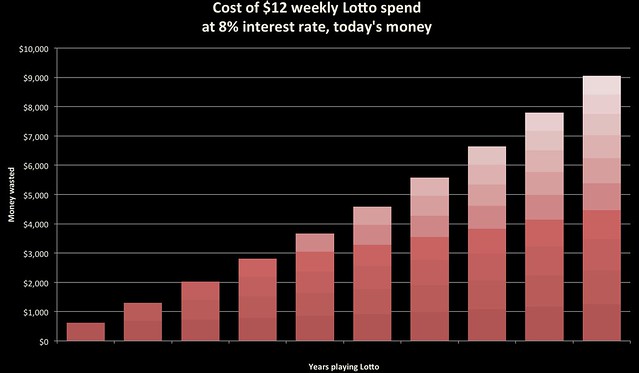
But let’s say they had a mortgage, and let’s say the mortgage rate was 8%. We don’t know what “several years” is, so we need a table to determine how much in today’s terms they had spent on Lotto:

In today’s terms, if they had been playing for 10 years then that is worth over $9000. That’s a healthy chunk of change, and it would certainly be welcome for the other hundreds of thousands who spend money each week. 

Where the Nelson couple were smart was in realising that the first prize is not worth much without the Powerball option, which doubles the price but triples or more the average return. Just $1 million is allocated to the first division prize each week and it’s split between 1-3 winners, from a brief scan. If it isn’t won, which is relatively rare, than the cumulative un-won amount is added to the next draw.

The Powerball minimum prize is $4 million, and it too cumulates, adding $1 million for each week is isn’t won. Saturday’s draw was preceded by 2 unwon draws for each category, so the pot was $3 million for the first division and another $6 million for the Powerball. The Nelson couple got 10 lines of the first division out of 14 won, and were the only Powerball winner. 

By picking just one combination out of 3.8 million the Nelson couple were admitting that 10 chances in 3.8 million is functionally the same as 1 chance in 3.8 million. The beauty of a lottery is that as wildly improbably outcomes happens now and then, and this helps sell more tickets to more fools.

Meanwhile I’m $9000 better off. 

Are you an Angel? Probably not.

The other night I was speaking to a self-described angel. I asked the standard questions of “What have you invested in?” and teased out approximate answers for “how much, with how many others, when and tell me about the company?”.

The answers were shocking to me – he had invested in just one company, it was several years ago and for $100-200k only, and he had limited insights about the company. To me the person was not close to being an angel investor.

Which brings us to the question – what is an angel investor, and how do you know when you are one? The answer to me is threefold:

  1. You regularly invest your own money in startups, spending $50,000 to $2 million when you do so.
    The evidence of this is a portfolio of investments, a track record of averaging 3 or more investments per year and the fact that the amounts you are spending are a small percentage of your personal or family net worth.
  2. You make very fast yet wise decisions based on very limited information.
    The evidence of this is that you got in early into some very successful companies, everyone says you are very easy to deal with and that you are very quick to say either yes or no.
  3. You offer superb advice, at the outset and ongoing.
    The evidence for this is that you understand and are connected in the industry, you are seen as a great and rapid judge of people and you have a very sharp strategic and business mind. Perhaps you don’t have all of these, but you are the go to person for what you are great at.

Now for some signs that you are not an angel investor, at least for how I define it:

  1. You only invest as part of an angel network
    Network investors are almost all followers, and are not actively attracting deals, meeting the principals alone and making rapid decisions. Arguably the person in an angel group leading a deal is acting as an angel, but the remainder are not taking responsibility for the relationship and ongoing advice.
    While an introduction service is nice for genuine angels, the vast majority of people in an angel network would be better off investing in a fund (VC or seed) as limited partners (without any control) and giving the mandate to a general partner who has the required skills. They are investors, not angels.
  2. You don’t have deal flow or a portfolio
    Real angels have people continuously trying to contact them, asking for coffees, advice and money – usually in that order. These meetings are productive regardless of whether there is a funding result as the transfer of informations is quick (they ‘get it’) and their advice is so good. They will also be able to point to a few companies that they have invested in, some of which are successful and some not. These companies ill provide great references.
  3. You are a VC or seed fund firm 
    A VC or early stage investment firm has multiple funders and decision makers. This automatically makes it very hard for them to make rapid decisions. Even if a single General Partner has a mandate to spend, she must still consider the needs of investors and the timing and structure of each fund. The pitching process, internal research and paperwork can be onerous. These firms are best for later stage funding, helping you build on what you already have demonstrated is viable.

I see that great angels are also still active, either in your or other spheres. They may be still working in their main business, or taking a leadership role in one or more of their investments. The Angel investing is something they do on the side, and they invest a quantum of time into it that is sufficient but not overly large. They are great at picking people, pick up fast on ideas and excel at identifying the weaknesses and helping to address them, and they do this without being a burden to ‘manage’.

Being wealthy and making the occasional dabble into a company might sound like the ideal life for some, but I would argue that founders are better of delaying asking those sorts of investors for money until after the first one or two rounds.

It should be pretty obvious to readers of this blog who the active angels are in New Zealand. Take a look at Pacific Fibre’s shareholder register and you will see several of them, as you will if you look at companies that those shareholders in turn own. The long term champion is Stephen Tindall, who has invested in a huge string of companies. Some of them have, in hindsight, been awful, others great, and others like Lanzatech, incredible. The best decision was made at the time, and with every new investment comes more learning, and over time the run rate should go up.

The magic about angel investing is that not every bet has to pay off, and a lot of rapid ‘smart enough’ decisions allocating a small part of your net worth will almost certainly result in some breakout successes. But it’s not for everyone, and losing all of the value of your investments is always the highest probability event.

The ultimate protective gear

This really has to be seen to be believed.

As the backbone of the imperial army, the Stormtroopers are the empire’s legions, a mass of menacing power in their awe-inspiring armor.

Now, one of the most iconic uniforms in the STAR WARS™ universe has been exquisitely rendered in leather by the UD Replicas’ team, setting a new standard in leather garment manufacturing.

But what’s it for?

Available in both Shadow Trooper black or the classic Stormtrooper imperial white, each suit comes complete with built-in CE-approved body armor to fully protect the motorcycle rider. If you want to ride in true STAR WARS™ style, have no doubts…this IS the suit you’re looking for!

It will cost you CDN$1165, but it will certainly attract a lot of comment!

They also do a nice Darth Vader suit.

You can pick up the matching helmets from eFXcollectibles, but while they might have “the asymmetric geometry that many feel capture the true evil essence of Darth Vader” they’ll be of no use at all in an accident, and probably make riding fairly difficult.


The Internet is more important for us than any other media

The New Zealand version of the World Internet Project survey, which Internet NZ funded, has just been released.
Apparently only 86% of us use the internet. I guess the others are too you, old, sick, or – and this is the big issue – poor and uneducated.
But the finding I most appreciated was that “69% of respondents rated the Internet as an important source of information ahead of television, newspapers, radio and other people”. This should speak volumes to advertisers and anyone seeking to influence people.

On the other hand only 59% use the web daily, and 58% feel the interent is important or very important in their everyday lives. The internet is a vital tool for many, but equally just not that important for a significant minority.

But then again, 72% of people that use the internet use it to buy online, and, amazingly, 48% sell things online. That’s a huge tribute to the power of Trade Me.

Introducing Define Instruments

At Texmate NZ we got tired of being confused with text editing software and our former US sister company. We were also increasingly conscious that the name that meant little to our clients or staff, and that we’ve  moved on a lot since the early days under the name.

So we embarked on a rebranding exercise.

We are now known as Define Instruments, and along with it we have a much stronger visual identity. We have upgraded our website, packaging and all marketing collateral.

We’ve also put the newest Define Instruments products front and center on the website.

It took a decent sized team to put all of this together, including Phil Roberts from Brighter Design and huge amount of work from our own designer Rachael Mulder. The process, from drafting and agreeing on a design brief through to the launch party a few weeks back, took over a year and a half. The time and effort was worthwhile, as we were able to get more people involved, and ended with a name and identity that the team and staff are justifiably proud of.

I’m sure it won’t be the last such effort, but it does signal another step on our growth journey, and one that I can’t recommend highly enough to those contemplating the move.

Meanwhile we’ve just bought three new machines to expand our production capacity and further increase quality, and have also expanded our premises by about 50% by taking over the next door facility. The machines are being commissioned last and this month.

Define Instruments is proud to supply our products, bespoke electronics design, and high quality manufacturing to some of New Zealand’s smartest and fastest growing high tech companies. We are also growing quickly – and featured as a top 10 growing technology company in the  TIN 100 2011 report.

Get in touch with the team if you would like to know more.

Shame Shame Shame MahiFX

MahiFX is getting rave reviews for the quality of their web design. That’s nice, and good that a local NZ company did to this sort of quality, but while the design is nice, the content is disgusting.

Here’s the home page. You enter your salary and wonder who John Paulson is. No – it’s not Hank Paulson – he’s the ex-CEO of Goldman Sachs who was the Secretary of the Treasury in the last years of the George W Bush administration and who lobbied for and later supported the sort of stuff that got us into the global financial mess we are in.

That phrase super trader is a little disingenuous, as John Paulson is not a trader, but a operates a hedge fund. Traders get in and out of positions rapidly, but Paulson spends a lot of time in analysis before making large bets on things like the mortgage backed securties market. He has traders who actually do the buying and selling to his instructions. Calling him a trader is a bit like calling Zuckerberg a coder.

I entered $100,000 and got to this screen.

Apparently I should feel bad about this. Actually I feel pretty disgusted at this. The site is trying to glorify the earning of money through trading. Any glimpse of the Occupy Wall St movement would tell you that this is anathema to a huge number of people – about 99% of them. What an absurd way to promote a business.

The statement is also just wrong, as John Paulson has not made any money this year at all – more below.

Scrolling down, and this is where the cool web design kicks in, I find out that a few billion dollars buys Demi Moore, whom I didn’t know had entered the prostitution racket. Perhaps if they had mentioned the character’s name in the Indecent Exposure movie, rather than the actor. Also – Fiji, no matter how much you offer, is actually not for sale. Their GDP is about $3 billion, but you cannot buy countries by paying a bit over one year of their GDP. That’s like saying you’d buy Apple (worth $362 billion) for one year’s revenue (about $105 billion). Good luck either way.

And now for the pitch. Apparently we need to start trading currency to be like John Paulson. The funny thing is – John Paulson lost a few billion this year for his clients.

He’s ok of course, still up a few billion no doubt, but his clients were not so lucky.

I give him full credit for shorting the dodgy US mortgage business cumulating in 2007, and he made some sharp bets for 2010. His research into the fundamentals and the individual securities he bought or sold in 2007 was absolutely exhaustive, and he has been doing this sort of thing for years and years.

So do you think that you can match this guy, who is a NYU Stern, Harvard MBA graduate, started out at BCG then spent years on Wall street and started his own fund in 1994? He works at this full time, probably that’s about all he thinks about and does. If you think you can match this sort of record by trading currencies, then you’ve clearly got Billy Joel’s Easy Money resonating in your head and disturbing your sense of logic or reasoning.

MahiFX will make money out of you whether you buy or sell. You will be trading against professional full time investors who have essentially infinite resources behind them, a desk of smart traders around them and computers that can nail a trend and make a trade in millliseconds. You might win, you might even win big, but realise that without serious consideration you are gambling, and the odds are stacked well against you. You might be tempted to trade on extreme margin – where you can multiply your gains, but also your losses, by huge amounts.

So please don’t trade currencies, unless you are doing it as part of a global macro strategy, and have a net worth above $50 million. Do hedge your currencies if you are in business or investing across multiple jurisdictions, but think of it as risk management rather than betting.

And MahiFX – you should be ashamed at that display of disgusting deification of dollars. If you are offering an easy way to trade FX then that’s a great gap in the market, but aiming at people who want to make wildly inappropriate bets is going to destroy lives. Aim instead at businesses who need to hedge their currency risk for items they buy and sell. That’s a smart move in these volatile times.

Nobody listens to me. Or you.

Via the WSJ are the sobering statistics on the share of people who have gone ‘wireless only’.

The article covers this in context of political polling. The law in the USA, where customers pay to receive as well as make mobile phone calls, is that pollsters cannot use autodiallers or robot calls, and must use live interviewers. Autodialers and robots are much cheaper, and faster than using real humans. Meanwhile mobile phone numbers are often initially tagged to a region like the landline numbers, but people generally keep their number when they move regions. This makes it harder for pollsters to build a sample from a particular set of regions based on numbers alone. Overall the impact is that calls to mobile phones are about 10 times more expensive than land lines, and so most pollsters have just ignored the entire mobile-only households.

It doesn’t take much thinking to see how this can skew results. The WSJ reports that the  younger and, it seems, poorer and African American or Latinos are undercounted. While in theory this can be corrected for with the right sampling strategy, pollsters are now finding that cell phone users are far more likely to support Democrats than their land-lined peers. All this flows back into the politics of the land, as pollsters represent one force that guides legislation and campaigns. (The other stronger force is, of course, the vast amount of money spent by corporations and lobbyists.)

In New Zealand I suspect much of the same is happening with polls and surveys. I’ve been landline free for years, and I suspect our charts look a lot like the USA ones, where older people are land line lovers, and younger people are more likely to have given up.

Existing data on NZ landline use is, I suspect, highly flawed because of the prevalence of ADSL and the almost universal requirement to have a landline along with it. I, for example, pay for a landline because I have to, yet I have never plugged a phone into that line. Others may plug a phone into that line, but use it for very little. I hear stories of such phones almost exclusively being used for receiving unsolicited calls.

Overall it’s very dangerous to ignore such a segment of the population. The wireless only crowd are more likely, I imagine, to be heavy internet users, to have smart phones like the iPhone and to be reliant almost exclusively on the internet for their content and communication. For pollsters this means getting a lot smarter about crafting the strategy for reaching a statistically sound sample of population. For now a hybrid fixed, mobile and internet-based approach may be best.

In the meantime, like internet-only based polls, take what you read from polls with a healthy grain of scepticism. And think about switching off that land-line of you do have one. It’s a wonderful feeling to be free of polls, surveys and robot calls.

Best post ever

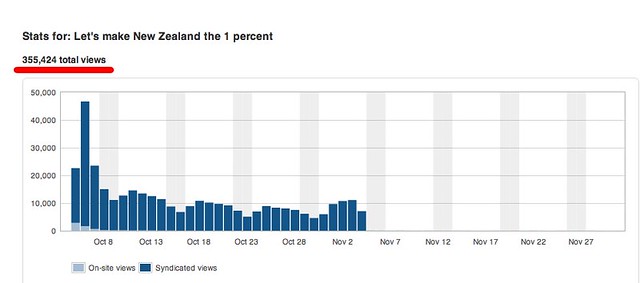
The jury is back – and the final numbers in. The Let’s make New Zealand the  percent post attracted an amazing amount of readership (for this blog). It got picked up …somewhere… and traffic went nuts, and then in early November traffic abruptly halted.

All up it received 355000 views, with just 6660 of them from this site and the vast majority syndicated. I have to admit I’m still at a loss as to where exactly they were syndicated to. If anyone can help on that score then please do tell.

AirNZ auctions themselves to the lowest bidder

Once again Air New Zealand has not partnered with Trade Me for their annual charity auction.

As I’ve said before this myopic decision decreases the amount of publicity, revenue and mojo Air NZ receives from the event. Auctions will sell for less, less people will se them and the brand association with Sella cheapens the Air New Zealand’s experience.

In airline terms this is the equivalent of Trade Me choosing Jet*Star for all of their corporate travel, or the New Zealand Government making Qantas their preferred airline.

It feels like some horrible politics inside Air New Zealand gets in the way of the right decision. Perhaps someone has a bee in their bonnet about Trade Me, and are making poor decisions.

Whatever the reason the custodians of the Air New Zealand customer experience should take note.

<update. Following the first comment below let’s put this in perspective. This is the relative market share between Trade Me and the number 2 auction site, as seen in Trade Me’s prospectus. It’s pretty clear that going with someone other than Trade Me is a difficult business decision to rationalise.>

Who deserves $1000 from Flowerpower?

Natalie Fergusson has eloquently written about our latest Flowerpower promotion – so here she goes:

$1000 charity giveaway

by Nat

A few years ago, when we set up Flower Power on Powershop, one of the big drivers was being part of a big change in an industry that seems to quiver in fear at the thought of progress.

Powershop is a huge success story, with around 40,000 customers by the end of August this year (now near 41,000), New Zealanders are really embracing the power that they have to control their energy bills, and enjoying significant savings as a result.

We set up Flower Power to jump on that revolutionary bandwagon. Flower Power has always been about the power of the masses (as an aside, it’s very hard to write a post about ‘Power’ as in electricity, and ‘Power’ as in control without getting the words all confused). As part of that, we have always wanted to get a picture of what our customers/supporters believe in, and do some cool stuff on their behalf, that none of us could do on our own.

The big, obvious one, is supporting people and organisations within our communities in a way that can go beyond the $20 donation that most of us can afford. At the beginning of this year, we wanted to get started, and then the second earthquake in Christchurch hit and there was absolutely no doubt that in New Zealand, the one and only option we had was to give a lump sum, on behalf of all of us to those who were suffering. So every single one of you who has bought Flower Power, contributed to the $5050 donation we made to the Christchurch Earthquake appeal.

Time has moved on, and christmas is fast approaching. We thought it was high time we resurrected our Facebook page and get it to start doing what it was meant to be doing all along – being the place where we could all get together and do some cool things. So this time, we’re leaving the choice to you: who do you think deserves a $1,000 boost this Christmas? All you need to do is nominate them and encourage others to agree with you.

Whatever group gets the most votes after nominations close on December 5, will get a $1,000 cash to cover some of the extra costs christmas brings.

So get nominating: On facebook or go to our website and click that nifty banner at the bottom of the page to enter your favorite.

And if you have any ideas about what we could do in the future, we’re always open to them… And thanks for believing in power to the people!

Thinking about voting in the NZ election

I’ve spent much of my adult life overseas during NZ elections, but when Ive been here I am in admiration at how little we allow the more boorish side of international politics to enter our country.

This year I find my self registered in Auckland Central, and facing with a genuine dilemma.

I quite like the MMP government of the last few years. National and their partners have managed to ‘not screw up ‘as NZ got battered by the global financial crisis, the Christchurch Earthquake, the Japanese Tsunami and the continued global economic meltdown. They even managed to ‘not screw up’ the Rugby World Cup.

Not screwing up might sound like a pretty thin complement, but I don’t intend it to be so. After nine years in opposition, any party would be tempted to ram home a load of politically charged policy that changed everything. Instead National kept a steady hand on the tiller, and largely didn’t change what worked. There were no draconian moves to save the country from the GFC, while the handling of the earthquake has been largely acceptable, though huge gaps are emerging.

The solid last few years are a tribute also to a solid previous 9 years with Labour in charge under MMP, and solid National and Labour led governments before that. We can quibble about the effectiveness of particular governments that have been in power for too long, and we can argue about whether particular policies are right or wrong, but to largely keep things moving in the right direction is pretty much all we ask as New Zealanders.

I  like the way our system works, how the Greens and Maori parties worked with National to temper the  politics, how Labour worked productively in committee, and how common sense largely prevails. MPs are almost universally good people trying to do good work. But it’s a strange profession, and the election process is a bizarre way to get a job.

I’m a swing voter.

I’ve voted for every major party over the years, which excludes ACT and Winston Peters, and as long I am largely sober those two parties will never get my vote. I’m a fan of economic reason dominating discussions of economics affairs, and of ensuring that every New Zealander (and everyone in the word) gets decent and fair childhood, education, medical care and employment and business opportunities. All three (National, Labour, Greens) major parties agree at least somewhat with these principals, and the differences are where they win or lose on policy.

Labour

Labour is currently demonstrating a poor understanding of public sector economics. Their promotion of removing GST on fruit and vegetables is particularly galling. The economic cost to society will be high. We will almost certainly spend more money and time (which can be measured in dollars) on compliance than we will make from this tax.

How about them apples?

Imagine – you are travelling on company business, and buy an apple as part of your lunch. Is that apple GST-free? Should you itemise it separately in your expenses? What if the apple was cooked – is it still exempt? What about canned apples?

Meanwhile the market price of fruit and vegetables is set according to how much consumers will pay, not on cost price. While the overall cost price is important, GST is a small component versus the effects of seasonality, the scale of the supplier and the type of store. Meanwhile it’s also going to decrease the input prices for burgers fast food restaurants like McDonalds – an unintended consequence that may not be desirable.

I don’t mind a low (15-20%) capital gains tax which Labour is proposing, and I do like progressive tax systems. The details of each of these is important though, and more work is required.

Labour is also beating a drum against on asset sales, of which I have more below.

The candidate in Auckland Central is Jacinda Ardern. I’ve seen her in the street 4 times now, once knocking on our apartment block door, once at a fair, at a debate and in Wynyard Quarter with Goff and co. She seems very eager and smart and approachable, and is certainly working hard. But there are also too many party hacks and old folks in the Labour team, with little evidence of the necessary refresh of the candidates that they will need to become electable. They have failed to confront the tough decisions internally, which bodes badly for them making the tough decisions for the country.

National

National also have some economically unsound policies, and the big one they are campaigning on is asset sales. I’ve heard three reasons for the sales – to raise money, to give more liquidity to the NZX and to get better management by a private sector board.

What’s missing is the effect on the end user – the consumers and businesses. These infrastructure assets, while a small part of the overall Government assets, have a critical effect on the efficiency of our economy. They sell vital services to us, and we need to ensure sustainable and low cost renewable power, and an efficient and low cost yet excellent airline.

The goal of raising money is relatively short term, and could arguably be accomplished by issuing debt from those companies for a much lower expected cost. Meanwhile the NZX is always going to suffer from a critical mass problem, as, frankly, does the ASX.

But it’s the last point where I take real issue. The economic events of the last few years are ample evidence that short term profit focused investors are lousy owners. The Occupy Wall Street movement, with participants in NZ, signifies the contempt for which we hold owners and agents who manage companies for personal gain.

Meanwhile the NZ Government are actually superb natural owners of infrastructure, and the current arms-length system of governance set up with COMU is a generally good way to run them. Governments have very long term perspectives and these companies should be focused not just on short term profits, but also on the overall impact on the economy and end-users. This means more direction to build low or zero carbon emitting power generators, to invest in both generation capacity as well as helping customers use less. It means Meridian spinning off more amazing little companies like Powershop, which was top in the Deloitte Fast 50 this year.

It’s true there are some private sector companies that are managed for very long term goals and focus, but while they are often wildly successful, companies like Apple and Berkshire Hathaway are few, and leaders of the quality of Jobs and Buffett rare.

However this doesn’t mean that National is wrong about selling down, nor that Labour is right about not selling assets.

We have some remarkable potential asset owners in New Zealand, owners focused on the long term gain for investors and for New Zealand. I refer of course to the various iwi, as well as to the superfund and ACC fund. They are the natural buyers for the assets, and it would be highly unlikely that any of them would want to sell to a hostile foreign investor. Many Kiwisaver funds will also invest, though some of them will churn away over time, they will also have a longer term perspective.

I feel that National have not, mainly because they can’t, pushed this point enough beyond a few coded statements. The assets will end up being owned by the Government and by funds investing on behalf of New Zealanders. Prime Minister Key has used the cringe-inducing phrase “Kiwi Mums and Dads” several times, to refer to potential investors, but while most Mums and Dads (and those of us without children) won’t invest directly, the big funds will be investing on our behalf.

Meanwhile the percentages sold could also be reviewed. Firstly we don’t really have to own all the power producers – so why no sell down more of the dirty coal/gas ones and keep the clean green ones. For the others, why not sell down 24% rather than 49% so we maintain super-control with 76% ownership, as with Air New Zealand. For Air New Zealand, please let’s just not touch it as everything is going so well in the Airline of the Year. When Air New Zealand focuses on being excellent at what they do rather than doing deals then we all win.

In Auckland Central the National candidate and incumbent MP is Nikki Kaye. She seems to work hard, though I have only seen her on the campaign trail once. The National supporters in the area meanwhile have collectively managed to rile me up, but then again so have several Labour and essentially all ACT supporters, so let’s call it even.

Greens

The Green party continues to mature, and this election is fielding 15 or so very electable candidates. It seems to be fairly widely agreed amongst observers across the spectrum that they have done a great job in selecting their number 10-15 list candidates, young, smart and potentially great additions to parliament.

Their policies are a mixed bag, but they are wisely front and center with the more sane ones – clean rivers, child health and green jobs. A sustainability focused party should have long term economic health at the forefront, and they seem to do so as well. They were also the only party, thanks to @garethmp, to front foot the copyright debate, and they hold the higher ground in the transport debate and in issues like food labelling and rebuilding Christchurch.

But the Greens cannot govern alone, and many of their policies won’t survive the test of the real world. So they need to be in partnership with another party.

But that party should, in my opinion, certainly not be Labour, at least not this cycle. They are not yet ready to govern again, and the dual-left of center parties will struggle with the coming economic events. National on the other hand need the Green perspective to add sustainability and a longer term focus to their government. I’d like to see the Greens work with National to moderate the approach to asset sales, but also to aim higher in other areas like the Christchurch rebuild and sustainable yet high economic growth.

ACT

I have no idea what ACT stands for beyond personal ambition with a healthy dose of greed. Their time has long past, and National will be well rid of them.

Winston Peters

I just hope he never comes back into politics, as his motivation always seems to be self-serving. He will bring entertainment but instability to parliament.

Maori Party

The Maori party, like the Greens, should be part of any governing coalition. It’s critical that Maori views and requirements are incorporated early into any new policy, and being on the governing coalition is the way to do so. National worked well with them in the last term, and should do so again. Maori have very long term goals, and this longer term perspective is critical to maintain across governments.

Mana, United Future

These are parties of one person who serve an electorate, and will likely get in and keep doing well what they are doing well.

Overall

I’m picking National will just win, draw or nearly win the election outright, that ACT will not earn more than one seat (hopefully none), and that National will choose to work with the Maori and Greens as they did in the last term (as well as Peter Dunne of course). New Zealand first won’t be showing up to the bar.

Overall that’s a bit of wishful thinking as I see this group as the best outcome for New Zealand right now. We need to continue to weather the global events, and certainly don’t want rapid politically driven changes.

For Auckland Central, hopefully Nikki Kaye will become a minister and Jacinda Ardern will elevate to a front bench position after a major Labour reshuffle.