
This is the sort of thing that happens when you have a genuine community and groups of kids playing together. It’s a shame about the bird though, which did not survive the experience fully intact.
This is the sort of thing that happens when you have a genuine community and groups of kids playing together. It’s a shame about the bird though, which did not survive the experience fully intact.
It’s been a while, but some of these pictures from NZ’s Field Day bring back memories.
One of the first signs we saw as we walked in.

The next sign was a little more detailed.

The Smartwater tech guys had a simple yet great product, that would display the water level of your tanks. I do like their display, which is the same size as a light switch and elegant.


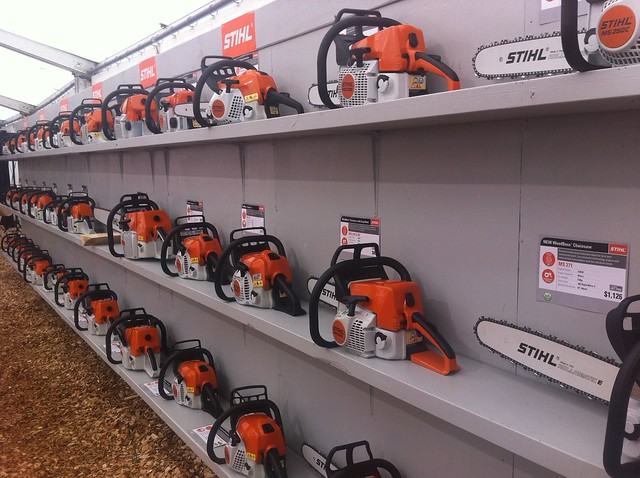
The Stihl stand set the example for how a common design signature and well-crafted display and branding can make a company stand out. Gallaghers also did a superb job.
This remote control mower could go at 45%. Awesome.

Who doesn’t love a good tractor pull?

High tech was not just about the machinery. The SAAS crowd close the link between sensors on the farm and financial control, dealing with farm management along the way. This is the present and future.


No surprise to see these guys there.

This however was clearly in the past – though which past I’m not so sure.

There were plenty of machines – including this generator.

DeLaval’s robot milkers were a hit.

Except for the price that is. They were several hundred thousand dollars each, dead slow and seemed like they needed a hydraulic, pneumatic, electrical, mechanical, fluid and electronics engineer to keep it going.

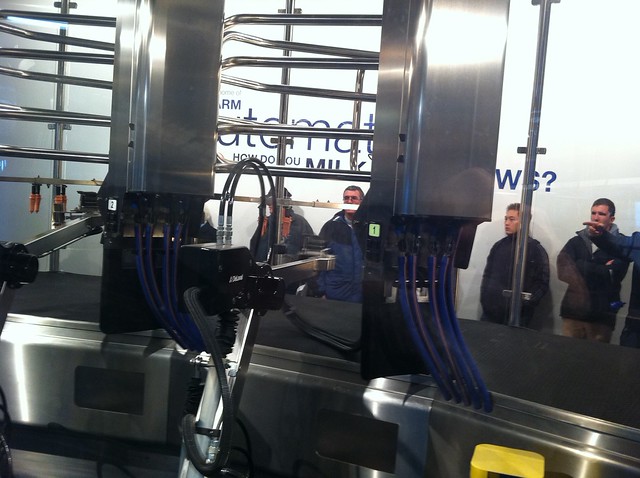
Their market is farmers with a small number of cows who want to be able to take off for the weekend and let the cows milk themselves. For a normal or large farm nothing beats the original NZ designed rotary milkers. Texmate supplies to the best of them – Waikato Milking.

One of the most common traps in early stage businesses, or even people with ideas, is underestimating your competition.
Clearbooks seems in clear denial about their competition, and is also, as a UK company, opening themselves up for challenge under their fair trading law. For the record Xero, which I use, has many of the listed items but its column has not been ticked. They have also been selective with what is in the column – I don’t see multi-currency for example.
While this might be a stuff-up, the lesson is to do regular surveys – I suggest systematically once a month – of your existing and emerging competition.
YooBee is a poor enough name, which I hear through the grapevine was given to the branding agency, BRR.
But how it must hurt when clients take your work and add other things to it. These are from the front of the Newmarket YooBee store.


Compare that to anything Apple, which if they ever build a store in Auckland, YooBee will compete with. Typically all they have on the outside of their stores is a giant Apple logo. Part of Apple’s magic is removing absolutely everything that has nothing to do with their product. It’s a brutally hard discipline to manage, but it pays off in our undivided attention to the thing they want us to focus on.
I wish the Financial Market Advisors bill would also cover people that write articles like this:
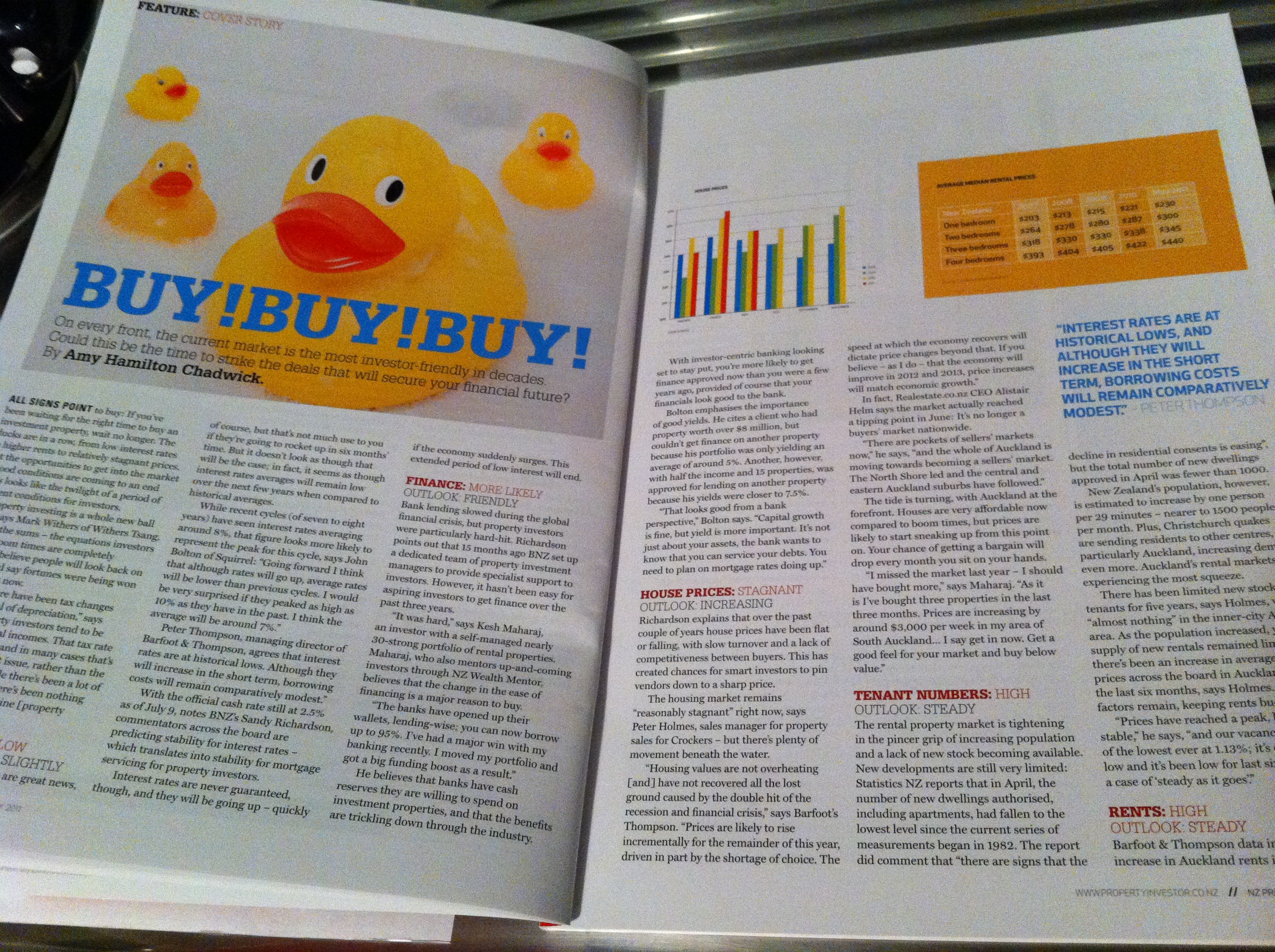
It was the cover story.

For the record now is a bloody awful time to buy a house. The economic fundamentals in the world are very fragile, the rent versus buy equation is horribly skewed towards buying and home prices versus incomes are far too high.
Thanks to Su Yin for the refresh of the blog design – which was several years old. The site is still hosted on WordPress.com and now uses the theme Twenty Ten.
I was recently in Western Australia for 2 weeks, spending 4 days in each of Kalgoorlie and Mt Keith, and the remainder of the time in Perth.

I arrived on Saturday night. While everything else was closed, after hours you can always be sure of the availability of alcohol and gambling. Seriously – they still have restrictive rules about the hours supermarkets are allowed to open.
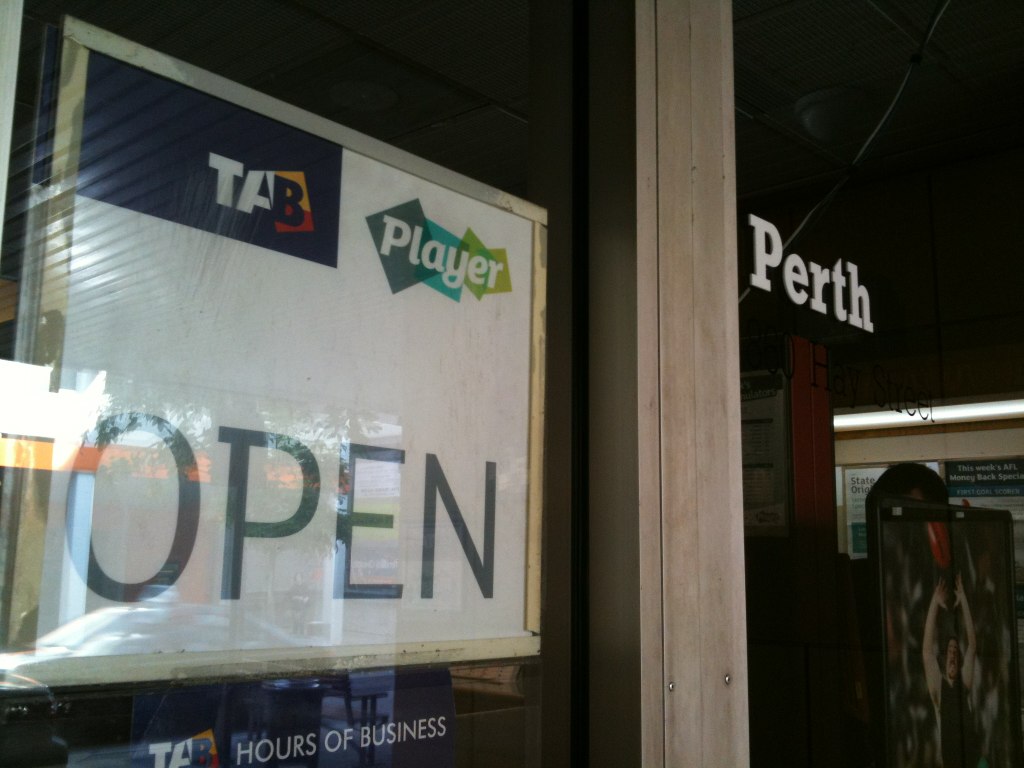
I discovered that I was staying over the road from Perth’s new Apple store. It took me at least 2 hours after it opened on Sunday for me to make my first purchase.

It’s hard to be empathetic with their competition. The Sony store was sad and empty – and expensive. My i7 powered, 256 GB SSD MacBook Air was just $1800.

This Dick Smith store had no excuse for their hours.
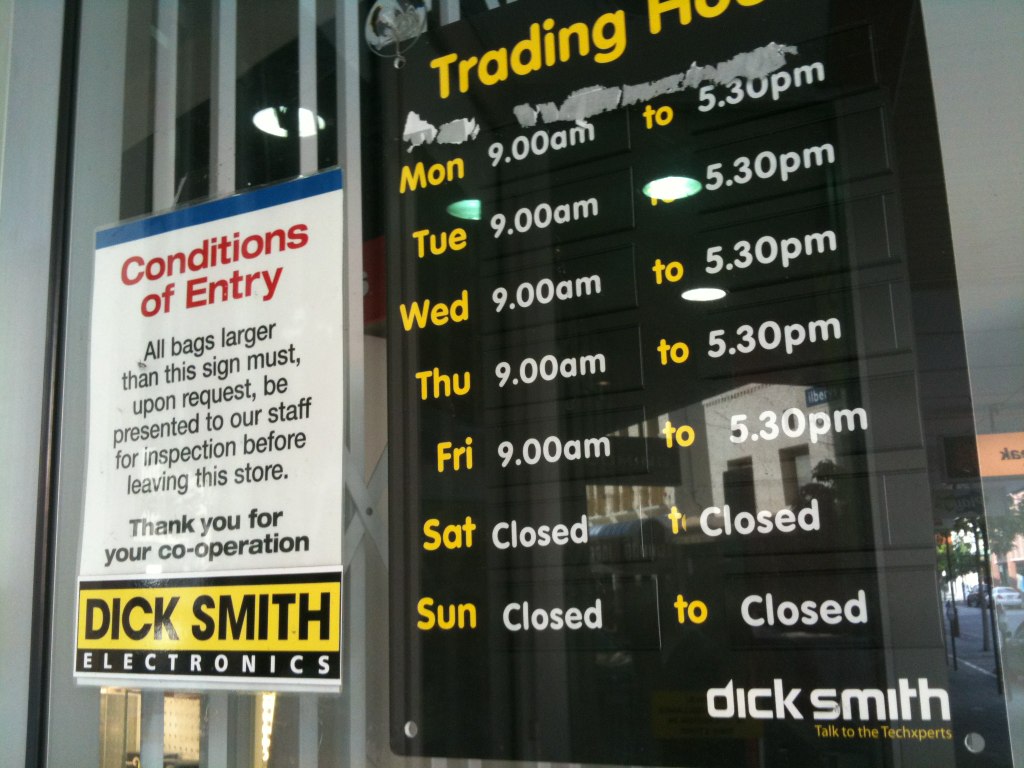
Kathmandu had a sale on Quelle Surprise.

(for non-locals, Kathmandu is famous for always having a sale on, despite local laws around what a sale actually is)
And Borders was empty.

Another hint that Perth is stuck in the past is the weighty classifieds section in the weekend paper. There is a Trade Me sized gap in the market that nobody has really gone after properly. Trade Me and Fairfax could grab it, combining the Trade Me skill and site with the existing Fairfax classified listings. There are plenty of Kiwis in WA to get things going.
My first briefing was held in Cottesloe. Perth has fantastic beaches and a pretty good train system to help you get to many of them. We drove.

What you wear at work is important – and in Western Australia reflective orange is the fabric of choice.

I didn’t stick out – here’s a typical airport scene. It’s actually really good to see all of the hi visibility clothing, as it’s a sign of the continuing improvement in health and safety that the mining and processing industries are experiencing.

When arriving at many mine sites, which are absolutely intolerant of any alcohol and drugs in the bloodstream, you can self-test to ensure you are fit for work. The culture has changed for the better, and continues to improve as more people realise they want the guy driving the 200 tonne truck or controlling the values on the high pressure vessel to be sober and awake.

This was most likely the only Webstock bag on a site in Western Australia and certainly the only one with an Angry Birds sticker on it. In the background is a bag containing a respirator – used when walking around some areas of the plant. Protective glasses are mandatory outside most plants and so are helmets. Gloves are carried at all times, and hearing protection is as well. Some plants have a gloves always on policy, which is successful at reducing hand injuries. Savvy visitors have their own prescription safety glasses (I stepped on mine the other week) and their own work gloves – out of shot.

Once in the middle of nowhere the scenery is fairly unvarying.

Kalgoorlie lacked an Apple store, but as always was well supplied with pubs.

I’m pretty sure this was in Kalgoorlie.

This fake grass was a Kalgoorlie classic – real grass would burn away.

Kalgoorlie will never be beaten on portion size – at least not out of the USA.

The Perth Taxi system, in a city double the size of Auckland, has just 1800 taxis. The price for riding and the number of cabs are both regulated. The outcome, naturally, is that you can never get a cab when you want, and when you do the cabs are second rate.
There are just two cab companies, and the largest. Swan, has 1500 of the 1800 cabs. A duopoly with controlled pricing and quotas – it’s out of the 60s.
Shown below are the taxis waiting for us.

And this is us – 200 or so. The taxi’s did come, but so slowly.

I often take photos of worksites in New Zealand, and they tend to carry from poor to appalling. That doesn’t mean to say that there are not better sites out there – those are usually behind purpose built walls and have strict health and safety rules.
This scene, shot on Quay street in Auckland recently, shows just how easy it is to get things very wrong.
It’s a spot the problem photo. See how many hazards you can observe – I’ve listed a few further down, including several fatal risks.

While it’s generally easy to spot hazards, the key is to help the people working actually change their behaviour. That means stopping the work, having a conversation with the people involved and asking them what they are doing, what the risks were that they observed and what they were doing to mitigate them. There’s an element of helping them understand that going home to their families and loved ones unharmed is more important than taking shortcuts.
That sort of conversation is very difficult to have when you are a civilian wearing office clothes, or a short term visitor to a site. On the other hand while I have had truncated versions of the chat multiple times in New Zealand, I’ve generally been treated a lot better than I had thought I would be. In Australia on the other hand it’s pretty obvious that crews increasingly expect others to be looking out for them and observing for safe behaviours.
In this particular example I made only two comment, as there were so many at-risk behaviours that the work should really have been stopped and a supervisor called.
The poor PPE (personal protective equipment) compliance from the three workers was the easiest thing to spot.
Their gumboots are likely not appropriate footwear. It’s hard to tell whether they are steel capped or not, but certainly the soles would seems more prone to slipping than proper work boots, and the fit would be less than satisfactory.
The man standing with the shovel has no gloves on, but does have high viz, safety glasses (I think), a hard hat and hearing protection. The short sleeves are a bit problematic in some jobs, and longer ones would give some protection against flying objects. He is observing the work, but is not (and nor was anyone else) observing or controlling the traffic. (I chatted to someone out of picture about this)
The man holding the water bottle does, from memory, have safety glasses on, is wearing gloves and I recall (but am unsure) that he has hearing protection. However given his proximity to the work he should be wearing two layers of eye protection – with a visor being the second layer, and some more protection for the rest of his body. Not only is he the person closest to the work, but he is also the person working closest to the traffic, which passes by inches away from his rear foot. If something happened in the work and he stepped back then he could be fatally wounded by a passing car.
His body position is also poor, his water bottle tool is certainly not out of the playbook and his feet, body and face are dangerously near the blade.
The man operating the cutter is, rather shockingly, not wearing eye protection. (I chatted to someone out of range and asked about it, and they all stopped work briefly to look for PPE). One of his feet is only half supported by the road, and while is is wearing hearing protection, he is not wearing gloves.
Even worse the blade on the grinder/saw is huge – and these large blades, banned at many sites, are liable to break into pieces and spray at high velocity everywhere. That’s a potential serious or fatal risk to both the operator and the water bottle holder. So if the cutter jams on something solid, the blade breaks and fires everywhere then two or three people could not just be hit by blade, but also get run over by passing traffic. All in all it’s an incredibly dangerous work act, and the three men and their colleagues are poorly prepared.
Ultimately we cannot assign blame to the operators, as their employers are the ones that set the standard, and that standard would also reflect the standards imposed by the people for whom they are doing the work. That’s difficult to know, but given that they are working in the street, at least one of the supervising agencies is the Auckland City Council.
At SafePlus we are working to help organisations train their staff to pass compliance tests in a way that goes beyond ticking boxes to genuinely increasing the safety value, and thus reducing harm.
Urgent couriers are sending the wrong message with this sign-up form. If things are really so urgent, then why waste my time filling out this oh-so complicated form?
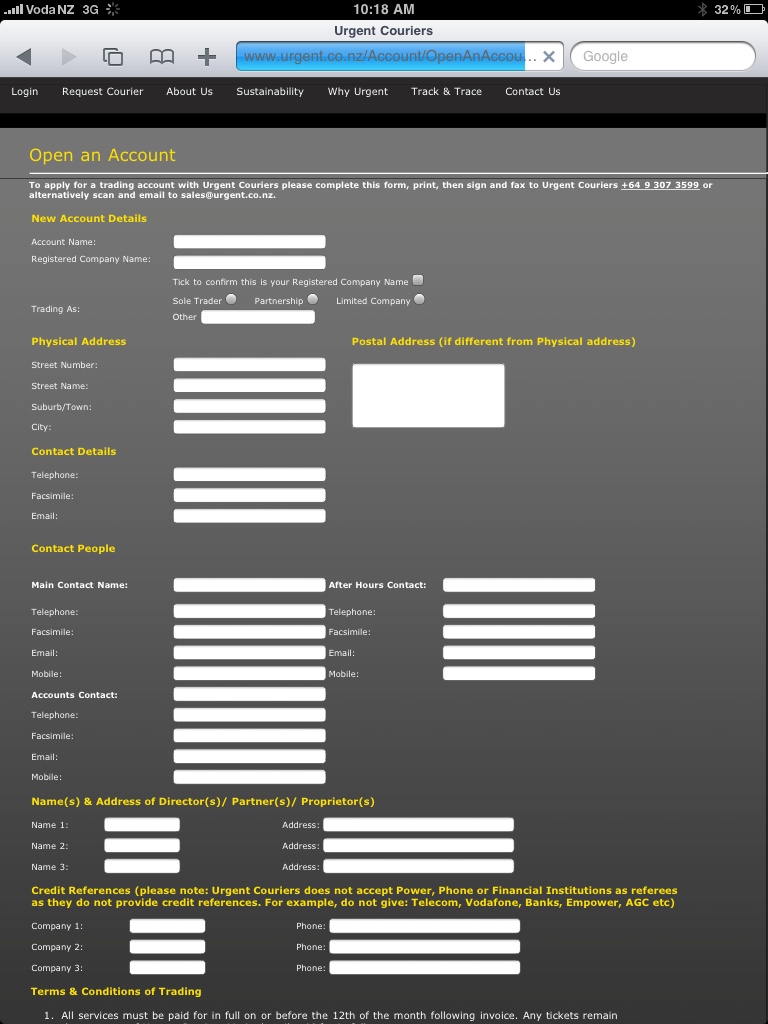
A better way is to ask for the absolute minimum information required, and do it at the appropriate time in a transaction.
Like Teresa Gattung I see very little broad potential in international stock markets. Many shares are overvalued, and it seems like a huge correction is coming.
But there are always exceptions, and for me in the US markets two companies stand out – Apple and Amazon. Each are critical players in the transfer of media from things you touch to digital. Amazon dominates the market for eBooks with the Kindle-everywhere approach, while Apple does the same for music, apps and has a strong play in video.
Sadly everyone else seems to agree, so both stocks are very expensive. Not so earlier this year, so I purchased, with my tiny US portfolio, some AMZN call options, seeing that the price would rise. It did so I sold down and bought some put options, so I would not lose if the price suddenly dropped.
Indeed the shares did fall, and so I sold the calls, waited and waited and eventually sold the last of the puts last night.
Meanwhile there was the still-ludicrous Linked In valuation, and so bought a handful of puts, as I saw there was huge potential for the price to drop.
After far too long (is there really this little reason on Wall Street?) the price did drop with the big market correction, and I’ve progressively sold down.
End result – betting against the market made me a lot more in percentage terms than betting on the market. It’s that sort of year.

All the numbers are pretty small as most of my investments are in private NZ and Australian companies.
I’m not a financial adviser.
The dumb as anything Abstain from Sex for the All Blacks campaign was something pushed for by Saatchi and Saatchi’s CEO Kevin Roberts. I’m sure he is an awesome bloke, but some of his advertising-agency-driven recommendations seem way off kilter.
Conflict of interest?
The Abstain campaign was devised by Roberts, as an excellent Press article by Neil Reid and Paloma Migone states:
“…Global Saatchi & Saatchi boss Kevin Roberts defended the ads.
The high-profile advertising company was responsible for the concept and delivery of the campaign.”
Telecom has Kevin Roberts as a board member, and the NZRFU used to have him on their board, so I am guessing the Telecom staff never really stood a chance against his positional and assumed NZRU insider knowledge power. It’s not a matter of whether he exercised that power, it’s the simple fact that he has it, so others find it difficult to go against it.
So while Roberts is on the Telecom board, he also created the concept and his company was going to earn ongoing money for the campaign. I cannot see what happens in the boardroom, but this certainly has the ability to create a tough situation.
How, for example, would you as an employee react when a board member and the board member’s company strongly advocates a certain course of direction? You could argue that you’d get the feeling that no matter what you did the decision had already been made far above you, and thus accept it as one of those internal political battles better left un-fought. I am certain that many of the rank and file inside Telecom NZ were appalled at the campaign, and the Reid and Migone article quotes one “Makes me want to work elsewhere, everyone is so embarrassed about it.”
I also feel for the more senior people, who perhaps felt pressured (whether applied directly or not) into this, and thus not giving enough consideration to the issue and enabling such a poor decision.
The Governance implications for Telecom
Board members should not, as a rule, be doing other external business with the company they are governing, and this is a wonderful example of the perils of such.
The Telecom Board Charter states that “The Board must affirmatively determine that the Director does not have a material relationship (other than solely as a consequence of being a Director); and disclose the basis for this determination in the annual report.” Roberts would fall under the material relationship clause which states “A relationship as a principal of a material professional adviser, a material consultant to the Company or Group or an employee materially associated with the service provided, or employed in an executive capacity by the Company or Group held at any time within the past three years.” This is all recognised in the 2010 annual report, which states that Roberts is “Not Independent”
The other document to examine in these sorts of situations is Telecom’s Code of Ethics, which states “A conflict of interest occurs when an individual’s interests interfere, or appear to interfere, with Telecom’s interests. Telecom expects its people to act in Telecom’s best interests at all times.”
All in all I am concerned at potential governance implications, and I hope that Telecom’s board is as well.
Credit to Telecom
The Abstain campaign was laughed out of NZ before launch – although we really didn’t know whether to cry. Telecom were very lucky that the campaign leaked before going live and kudos to the person that did so. I do wonder whether the leak was the only way some believed the campaign could be stopped, given the internal politics.
Whatever the reason for the leak, Telecom were good and nimble enough to stop defending the indefensible and cancel the campaign before it launched. The Telecom of 5 years ago would not have managed that last minute save, and while we all make mistakes, they deserve credit for realising it and making the right call.
Adidas
Kevin Roberts recently blogged that he liked the Adidas Rugby shirt (so do I), but was silent on the furor that accompanied the launch, when the local NZ prices were well over those of overseas. Adidas themselves (not a Saatchi and Saatchi client) mishandled that hopelessly, and as a result the company lost tremendous brand equity here. A really strong sign of diminished brand equity is when punters burn your logo in the streets and nobody really cares, or when people with your logo on their car remove it to stop harassment.
15 ideas of Dubious Merit
But Neil Reid wrote another article, where he notes that Roberts would like to do more – a lot more – to the All Blacks. The headline, “Roberts: Sell ABs dressing room access” hints at the list.
Roberts had 15 ideas – so let’s look at them all. But let me start by making the comment that 15 ideas is about 12 too many for any business to absorb. The administrators and players first have to prepare for and win rugby – anything else is a distraction.
1: Re-frame rugby at every level as a real family, social option
While that sounds good in theory – the details are where this will go off the rails.
“Look at what Stade Francais are doing in Paris. Flowery team jerseys, massive social networking. We need to move Super 15 games closer to 20/20 Cricket, NBA matches and pop concerts.”
Firstly, and it’s a cheap shot I know, but taking social network advice from a guy whose blog resides on krconnect.blogspot.com rather than on his saatchikevin.com site is a bit rich. More importantly it’s clear to me that rugby fans and players in New Zealand are not exactly as ready as the French for flowers on team jerseys, and I suspect such would be treated with the same sort of contempt as the abstain campaign.
I’ve been to a lot of rugby matches, some NBA games and 20/20 matches, Wellington 7s and pop concerts. They are different things with different purposes and expectations. The Wellington sevens is our Mardi Gras, and only comes out to play once a year. The NBA is a sad league, playing hundreds of meaningless matches and in a decline since the Age of Jordan. 20/20 is revitalising cricket though a format change, just as sevens has done the same for rugby. Test match rugby and cricket still remain the true form of the game, regardless of the machinations of the marketers.
2. Develop a super-amped global All Blacks community.
With real intimate, exclusive contact. Behind the scenes stuff. Dressing room/training ground banter. Player proper truthful post-match analysis.
I already follow a few All Blacks and other players on Twitter, and we get that. I could not find Kevin Roberts’ Twitter account.
We’d also be smart not to allow the mystique of the All Blacks to be punctured, and just like the SAS they have to build an elite team and anything else is a distraction.
Roberts goes on:”A global, premium social network of rugby people interacting around the AB’s. 250,000 members x $74 = $18.75 million!”
That’s not how I understand social networking works. While using free tools like Twitter and Facebook works, charging people to come to a site or receive marketing email does not work.
3. Build the global brand, especially in emerging markets.
We need to deepen and broaden our fan base geographically in a similar way to what ManU has done in China, Chelsea in Africa, the Lakers and the Yankees globally, opening the door for sales of merchandise, videos and training materials.
The spread of rugby is doing this already, led by the Rugby World Cup and the international Sevens. Last year’s Tri Nations match at Hong Kong was also an attempt, and the rise of Rugby as a sport and the All Blacks as the team to beat will continue. But this isn’t something that can be forced. I suggest watching the movie Invictus (or, better, read the book) to see just how hard it is to bring rugby to the majority of a nation that is already dominant in the sport. Bringing the sport to somewhere like China will take considerable time, while the energy is being spent in the right way, we cannot over-indulge in money and marketing.
New Zealand sport is first and foremost a participation one, and we can only hold the All Blacks up as the team to beat to countries that actually play the sport in the first place. Our objective should first be to expand the global niche of rugby playing itself before following the classic Better By Design advice and owning that global niche.
4. Develop an All Blacks training, fitness and leadership programme.
On-line. Off-line. For individuals and corporates.
I’d rather they played rugby. Really.
If some All Black alumni want to form such a company then they should go for it – and hopefully Kevin would stand up as an early funder. Even better – some All Blacks and the coaches are already peripherally engaged in TheRugbySite, and passing on Rugby training tips for money.
5. Host an NZRU school sports tournament every year.
Different age groups. All Black participation in training and leadership (old players). Sub contract to sports tour specialists.
This one has been running for 33 years, and the NZ Secondary Schools Sports Council runs stuff as well. NZRU stays out of running schools rugby, simply recognising a national All Blacks Secondary Schools team that is run by the New Zealand Schools Rugby Council. It seems to have worked for the last century of so.
6. Play more Sevens at School/Club level.
I found 162,000 results for a Google search for: secondary school rugby sevens site:.nz
7. Bring on the Women.
Include female Board members at every level of the game.
I’d rather worry about ensuring that the board members were the right mix of skills, concern myself more with ethnic mix than gender for a sport that is male dominated. However I would also point out that many rugby clubs are already being run by women – they just haven’t let the men know about it yet.
8. Ensure every seat is sold for every Test match.
Make it unforgiveable for a stadium manager to have an unsold seat at an All Blacks Test match.
I absolutely agree with this. Pricing tickets for stadiums or aircraft is a solvable science, and yet we see empty seats everywhere at rugby and other sports grounds.
The GFC is blamed for a drop-off in ticket sales, but it’s equally arguable that poor selling techniques have been used. Test match revenue is core.
Here’s where Kevin goes off the rails a bit, in my opinion. Firstly, Test Match revenue is not core – having people watching and participating in the sport is the primary goal. Just as Steve Jobs would always put the product experience first, so too should rugby. Its about the beauty of the game, the contest, the crowd and the fun.
There is plenty of scope for increasing the effectiveness of marketing tickets, but the primary concern to almost every New Zealander is the price. It’s just not right to charge hundreds of dollars for a family to attend a match of any sort, and the prices for RWC and super rugby are abhorrent for some. Get smart and price using the sort of techniques that airlines do, so that we each pay a number that gives value, and we fill stadiums.
9. Follow the British example and invest in one 80,000 seater home pitch stadium in Auckland
It should have a huge naming rights sponsor. Play all our big tests there and ensure there are stacks of high price corporate boxes, and special new, low cost family seating.
Sorry – the opportunity to build that stadium has passed, and the idea of not spreading the tests throughout the country is clearly putting money ahead of the sport.
10. The First XV
15 lifelong debentures that pass from father to sibling or back to the NZRU. Access to all areas (equal to NZRU chairman), special access to team/sponsor events, hotels/training, and one annual dressing room visit. Super, super exclusive. $1 million each.
The most hated 15 people in New Zealand. Let the players play, and let the coaches and players decide who they hang out with.
11. Offer corporations individual player sponsorships. 45 players at different options. Five days work per player per sponsor, split 50:50 player and NZRU. A $2 million annual return.
The players do great work for charity and sponsors now. Enough – let the players play, they are not slaves to be sold and purchased.
12. Change the model of game revenue distribution.
We get hammered fiscally on the November Tour. We get the glory. The British get the money. The crowds come to see the All Blacks.
That’s life I’m afraid, but it would be a great achievement. Why not lead by example and start by being more generous to the Pacific Islands? A game in the islands each year or two and a PI team in the Super Rugby competition is well overdue.
13. Appoint the world’s best foreign exchange managers.
Significant elements of NZRU’s profit/loss scenarios comprise management of foreign exchange. NZRU need to ensure they have the Goldman Sachs of foreign exchange on their team.
Goldman is not a great example these days sadly, as they may have made themselves a lot of money, but their clients were not treated so well in the GFC. However the NZRU should certainly stick to playing rugby and their treasury function should be prudent in managing foreign exchange risk. It’s really not that hard. Appointing an external adviser to play the markets is an invitation to ruin.
14. Bring on the Women (again!).
If women make 80% of the purchasing decisions, why then is NZ rugby a women-free zone?
Spoken like a marketer – not a rugby fan. Get to a game and you’ll see plenty of women.
15. Get famous by committing to film.
Get inside the AB’s heads, their training; the AB’s in Camp a must-watch programme for NFL, NBA, Premiership etc players. This is the serious business of being the best team in the history of world sports. For other elite sports, coaches and teams to learn from.
See 1:, 2:, 4:, 10: and 11:. The All Blacks are great rugby players, and have a limited life to be so. By all means let the former All Blacks do a movie, but we’d all rather the actual All Blacks played rugby.
It’s not fair to criticize and not contribute, and give credit to Kevin Roberts for throwing these ideas out there. So here are my suggestions.
My Suggestions
1: Focus on the values and passion, not the money
Too many decisions are made with dollars at stake. Signing with Adidas back in the day was a classic example in an era where money came first. The decision was to choose foreign dollars over our local icon – the Canterbury Clothing Company. So over the years following while almost every other international team wore our clothes, our national team was wearing clothes from a country, Germany, that simply doesn’t care about rugby. We’ve yet to win a World Cup wearing anything but Canterbury, and the movement of the sponsorship certainly contributed to the demise of Canterbury’s path to successfully conquer the world.
Every commercial decision should be made with reference to the values of the game of rugby and the All Blacks. Those values are things like of integrity, playing hard but fair, winning, strong integration with Maori culture, participation, stunning teamwork, acceptance of players of all shapes, sizes and backgrounds and of being proudly New Zealand. Would NZRU have reacted in the same non-committal way to the Adidas and Telecom errors of judgement if they used these values? If they had, then the response would have been as powerful and as controlled as an All Black team playing a minnow. All parties would have been told what to do and when, or where to get off the bus.
2: Reduce the number of top-level games
The NBA, Baseball, NRL, AFL and even Football (soccer) suffer from big game fatigue. There are only so-many must-win games that we really want to care about, but forcing the issue through extended final series, multiple games and enlarged competitions makes us stop caring. Bring back the true must-win games by reducing the number of overall and critical matches.
A start would be to reduce the Super 15 back to say 10 or 12 teams, and use a promotion/relegation approach, potentially eliminating one team from each country each year. Towards the end of the season the bottom teams will be scrapping to stay off the bottom, as the losers would play the best of the rest in order to stay in the competition the following season. That will make every game exciting at all ends of the season.
Let’s also put a Pacific Islands team in the mix – they deserve the spot and we know its the best thing for the game.
3: Fill the stadiums, and the grounds
I’m with Kevin on this one, if not for the same reasons. We have a huge opportunity to energize a new generation of rugby fans by using clever pricing to ensure that we fill every stadium. Give Air New Zealand a call, and ask them to help with revenue management, and while you are at it switch to a punter friendly ticketing system. If it means last minute $5 tickets for some games, then let’s do it.
Let’s also keep doing everything we can to fill the grounds with players each Saturday. Perhaps some more links with the top level rugby matches, even something as basic as recognising the senior grade or top schools winners over the PA at matches.
Doing business with a partner can be a lot of fun – but what if things go out of control?
A crazy case is playing out in public right now – with Kelsey Upson from Architectureblog.org, and what appears to be her ex Logan Douglas at NZ Cloud Hosting.
First hint was a tweet I saw from Kelsey – who has near to 3000 followers. Her tweet stream looks like this. Read from the bottom up.

Before these tweets were ones promoting updates to her blog, which apparently has been disconnected. Following one of those links gets us to this:

The About page says the Police Corruption site is owned by Logan Douglas, who has a beef with the NZ Police it seems, and no doubt they also have a beef with him. A quick Google turns up discussion of an alleged scam and Logan’s Linked In page. A longer Google reveals more of the same. Scary.
The NZCloudHosting Twitter account, which has 13 followers, has this to say – with the 16 July tweet particularly ironic given that it appears Douglas has removed Upson’s website from the internet.

So who is in the right? and Who is winning?
Well from my persepective the behaviour of Logan appears to be particularly problematic. He has redirected Kelsey’s Architecture blog home page to this below, which would appear to present Kelsey with a pretty good case for libel. Certainly this isn’t going to make any police officer or judge sympathetic to his cause.

It’s also showing up on Google:

But neither party are winning here. They both need to settle this, and quickly, and it seems to have moved to the stage where only legal and perhaps police involvement will solve things.
Meanwhile Kelsey should head across to WordPress.com and start a free blog (it’s simple), then rescue as much as she can from the Google cache of her website and repost it.
Five Lessons from this episode
It’s an awful story, but we can take some lessons from it.
1: As you enter into a professional or social relationship then Google the people that you will be involved with. If you find nothing, or if you find any hint of a scam or psychopathic behavior then run away, and quickly.
2: Meet and check that their colleagues, business partners, friends and, for personal relationships, family are solid and as described. Make your own decisions and be sure you have no qualms no matter how attractive the opportunity or person is.
3: Make sure your business affairs with your friends and lovers are on just as strong grounds as those with others. An email trail showing the agreement is better than nothing, and a legal agreement is best when larger amounts are involved.
4: Don’t be afraid of calling for professional help – that’s what lawyers are there for, and great advise is a cheap way to avoid years of trouble.
5: Maintain consistent ethical standards. If you find yourself doing business or in a relationship with with a company or person without your standards then either assert control or get out of that relationship. NZ is a small place and each industry is even smaller, and our personal reputation is ultimately all that matters.
and a bonus
6: Everything we do in electronic form is capable of ending up in the public domain. Direct messages, texts, emails, voicemail, or files and our browsing history are all discoverable. So we should not write anything that we would not be able to stand behind when it appears for all to see. That does not mean that we cannot have private conversations online, but it does mean that those conversations should be similar to those you’d have in a restaurant or on a bus.
A New Zealand executive from Marsh, the giant insurance broker, gave an unscheduled talk at the NZCID conference today. (I didn’t get his name)
While the good news was that even after Christchurch international insurers have appetite for insuring NZ property, the bad news is of course that prices and terms have changed for the worse.
The two main findings for me were that average Marsh negoatiated premiums have increased 140% this year, and that the earthquake excess amounts (the bit the owners pays in the event of a claim) have not ony increased, but are now calculated as a percentate of the total value of the insured property rather than the claim. That represented, in the example he gave the room, a 10-fold increase in the excess amount.
However these changes are probably a fair reflection of the true risk, though perhaps they have deliberately over-shot to compensate for an appalling year for insurance.
His estimate was that 20-40% of the insurance claims are to the NZ companies, with the remainder being held by international re-insurers like General RE and Swiss RE. Those re-insurers take massive global risks and despite Japan are still OK for the year so far. To me that means we will get 60%-80% of the estimated $25 billion insurance losses coming into NZ for offshore, and that’s essentially one way traffic, not investment. While the earthquakes have been a tragedy in many senses of the word, these funds allocated to fixing Christchurch will result in a tremendous economic stimulus.
But let’s look at pricing of insurance.
In the past Marsh and insurers understood that Wellington was a risk, and so had a property by property approach to assessing the likelihood and magnitude of damage in a large quake. Now that approach is being rolled out to not just Christchurch, but also to other nearby regions, like Nelson and Manawatu. (Auckland and Hamilton were not mentioned.) Wellington traditionally also had those much higher earthquake claim excess rates based on total insured value, and now Christchurch and other cities will take on those excess rates as well. For now @polarbeerfarm tells us that no new Christchurch (residential?) policies have been issued for the last six months.
But the most important change to me was a broad shift from “commercial pricing” to “risk based pricing”. Apparently, and I can back this up with what I saw in a brief consulting assignment with a Lloyds underwriter/broker, much of the commercial property insurance has been priced on getting a certain market share. Going forward in New Zealand the insurers will be wanting much more specific information about the property – starting with location (longitude and latitude), a recent building survey and so forth. One company is modelling location to within meters, and they’ll be able, if they have the technology, to model the effect of a large quake on their portfolio, and manage their risk accordingly. Thus insurers will be able to much more scientifically calculate an approximation of the risk and magnitude of loss, and then charge an appropriate insurance premium.
It sounds so obvious. It took Christchurch for the insurance industry, and those who pay premiums, to face the facts that the previous wisdom of crowds pricing can only take us so far. Perhaps it will gradually regress over the years, but the lessons should be held, and with today’s technologies there really is no excuse for not bringing an analytical approach to insurance.
But the insurance industry is not alone,as a quick look at the financial markets or US politics will show. Neither are showing a reasonable amount of reason at the moment. The US market crash over the last week is relatively small, but disturbing.
Disturbing because despite the correction, we still have individual stocks with ludicrous valuations. Linked In is trading at US$75 per share, but had earnings per share of just 18 cents over the last 12 months. That’s about 0.2%. Imagine giving your bank $75 and having them say they’d give you 18 cents in interest a year later.
A week ago the Linked In share price was over $100, valuing the company at US$9- $10 billion, which implies at some stage investors expect the company to make say $700-$1,000 million per year in net profit available to shareholders. Last year Linked In made just $21 million – so they need to grow earnings 40 times to justify the price. Looking at the business itself I just cannot see where the required extra income would come from. Linked In is a once a week (say) site, and simply isn’t valuable enough for most people to pay for.
Meanwhile Amazon earned $1 billion, and was valued at 80 times that after last night’s drop, and significantly more last week. Amazon is an awesome company, but that price exposes an investor belief that even after the market correction, investors expect net earnings available to shareholders will increase by 7-10 times. That may happen, but let’s also remember that there is a major downturn happening in Europe and the USA, and that’s where the majority of Amazon’s high paying customers are.
I’m betting that both stocks will keep falling – I bought options last week to do so. I only purchased a tiny amount, and while I wish now that I’d bought a lot more, the simple fact of the matter is that the financial markets are currently pricing using ‘commercial’ rather than sound analytical reasons.
I just saw a talk by Carl Hansen, the Chief Executive for the NZ Electricity Authority. He made a comment which is retrospectively obvious.
Electricity is a natural resource, and follows natural resource economics. So investors in electrical generation will build the the lowest price solutions first, and as time goes on the cost of delivering a power plant in c/unit terms will increase. So sadly, baring another gas discovery, we will rising real costs of electricity supply in the future. He estimated the marginal cost will be $90/MWh (9 cents per unit) by 2020, based on the prices to build and fuel the next up stream of power generation projects.
The Electricity Authority has 3 mandates – to increase competition (and thus reduce the chance of excessive margins), to promote reliability of supply (no blackouts) and to push for lower transaction and regulatory costs and thus increase efficiency. I asked Carl about feed in tariffs after he spoke – for now they are off the agenda, but it seems that making it easy for small businesses to get a fair price for their generated power is part of their mandate.

I’m surprised by these results from Campaign Monitor, who track clients that open their emails.
Microsoft Outlook and Apple iOS/Mail have 27% of the market each, Hotmail, Yahoo Mail and Gmail combine to have 28.7% and the rest is trivial.
Android mail is clearly not really working, despite Google bragging about the numbers of devices. Gmail is also a lot lower than I had thought.
But it’s Apple iOS devices and Apple Mail combining to be equal to Microsoft Outlook that provides the real surprise to me.
 Lance Wiggs