Three common mistakes made when former print designers design websites


BMW Online Shop, originally uploaded by LanceWiggs.

The BMW Online Shop shows three common errors that designers more used to print media can make on websites.

Firstly a website is not a fixed piece of paper, and end users expect that a page will scroll down and be full of useful information. We navigate the web with one hand on a track-pad or mouse with scroll button for that very reason. The fixed width and height website gives a limited amount of information and means more mouse clicks are required to find that information. Every mouse click is an opportunity to leave, so place the information on a page.

Next is the decision to hide text behind some sort of custom control, I guess to make the page look better. I had hoped this had largely gone away, but not for BMW it seems. That scroll bar is unusable on my iPhone, and simply frustrating anywhere else. Text should be readable and visible.

Finally the use of flash which seems so lovely to those used to other media, but so horrific to people that browse the web. The flash site that the “More details…” link directed me to did not ever actually load. Not only is the technology completely unusable on iPhones and iPads, but it makes your customer browsing experience slow, and also unreadable by Google.

My guess is that this website design was presented inside some sort of flip-book, and that the designer showed one page per page of the flip book. It’s a lovely way to get a design approved by a client, but an appalling way to design a website.

YOOBEE Spam


YOOBEE Spam, originally uploaded by LanceWiggs.

I have no idea what this unsolicited email is saying to me. I think these guys used to sell Apple products, and I think they are talking about training for those products, but I feel that they have jumped too far away from their roots with this effort.

The name YOOBEE disturbs me, something to do with the ALL CAPS, the unknown pronunciation of “yoo” and the way the logo and the way the logo typeface looks so different from the text typeface.

Why we need faster internet – reason #45


Dropbox, originally uploaded by LanceWiggs.

Dropbox let’s us sync computers so that the same files are on each of our laptops, desktops and even iPad and iPhone.

But with lousy capacity speeds and data caps this otherwise wonderful program is frustratingly useless. This a snapshot of Dropbox’s progress trying to sync 5GB of files between my laptops – apparently it will take 10 days at my current ADSL speeds.

Better By Design CEO summit notes – Day 2

Day 2 from the BBD CEO summit.
Jeremy Moon  restarts. Reminds that the purpose of design is to guide the user to a certain behaviour.

Reintroduces Stefan’s model from yesterday

Cause→ culture→ Customer experience:→Sum(Comms, Brand, Channels, People, Physical environments, Service, Product) Where customer could be consumer, trade or team.

Peter Senge from MIT (via video conference)
author of the book The Fifth Discipline: The art and practice of the learning organization

Involved with how to develop organisations that tap the creative potential of people. From normative to generative way of operating. Collective creativity.

Last 10 years shifting from individual organisations to supply chains – food system, industries, collaboration between business, civil society and government, including primary and secondary education.

Common theme is what are the fundamental changes? Very different world with profound imbalances.

Created sustainability forum in 1999 – big companies first. In 2002 started the Global sustainable food laboratory – governments and NGOs. Lousy food, poor distribution, emerging problem. Move to collate all the most innovate systems.

Vision, systems thinking, creating an environment where people can thrive

A family, team, organisation is a system. Never fully understand such a system. Can the members operate together to create the futures they want to create?

Most organisations start with a cause.

What is it to think of design inside a living system – a non trivial question. Systems are being continuously generated by the participants. Culture is the most obvious embodiment.
Key to be reflective – for example after a meeting (a client did this after every management meeting, even leaving their self-assessment score on the meeting room wall – to stunning improvement)
Problem is not that the organisation has a cause, the problem is that the cause is vast.
Beauty of the (Stefan) model is its simplicity. The danger of the model is the simplicity. A picture is one thing, but making it alive is much more difficult. It’s only when we reflect (e.g. After meetings) on the cause when we determine what we really want to happen. When you reflect though you make yourself vulnerable – perhaps you have lost touch with the cause, lost touch with reality.

Culture we have grown up with is one of hierarchical control, which is quite different from a cause driven business.
Theory/Paradigm of the business is part of the system. Need to find ways to disentangle this. Easy to fix the tangible system, but the deeper human system assumptions and habits may not change. Habits are thoughts, actions, projections, assumptions. We react to the short term problem with tweaks rather than actually change the fundamental issue. Doing marketing promotions while your products stay lousy (Telecom in the mid 2000’s) doesn’t help in the long run. The power shifts to the people that are good at the short term fixes (marketing) and away from the core issue (product and technology). Once you realise the root of the problem then you need to change the people – elevate the ones that will address the issue (they need positional and informal cultural power)

Q: As CEOs is it our role to create change or to deal with it?

Answer: Yes. (both) You can’t not react, but if that is all that is happening then there will be deep holes. Danger is not quick fixes or reacting, but only doing this. Organisations over time spend 90% of their time reacting, which sucks life out. CEOs need to be always moving balance between reactive and generating.

Peter Drucker called it the Discipline of Abandonment – sometimes you need to abandon something while it is still working as it takes up too much resource.
If there is only one person who is the visionary for the organisation then you are in big trouble. There are pockets of visionaries, and (as CEO) you had better have some people close to you that are pushing you personally. It’s not one person – thats a formula for disaster – you become a limit of what is possible in the organisation.

Q: Rick Wells (Formway): To what extent does the culture derive from the values of the CEO versus the behaviour of the employees?

A: usually founders, even way after they are gone, are the ones that are the key influencers. But culture is shifting and changing with each day, each interaction. Key question to keep asking is what do we intend to conserve? Asking a question about the future, but you are holding the past in a way that conects you to the future. The key is a future orientation, grounded in the past. Big belief that culture is distributed, and ind crazy if it comes from the top – if it does you are describing a disempowered organisation.

Q: Mark Templeton: What are the behaviors of CEOs who have companies with great cultures that is different?
A: Really good listeners. Listening to what the organisation was trying to say, and then forcefully articulate that. (Motorola’s Bob Galvin) Organisations are more creative than anyone realises. Also listen to customers, to markets and so on.
Hates the “CEOs who drive change” phrase – means that people are sitting around waiting for change to happen to them.

Q: On culture versus Politics
A: Organisations are dominated by game playing. Surface conversations and subtext conversations. Private conversations. The culture becomes very political when this happens. Turn it around – what does healthy politics looks like? Is there such a thing as healthy politics? Yes – politics is about power, everyone does not have equal power. If you equate power with influence then you want the power to be distributed in a fashion that suports health and well-being of organisaton. If everyone knows that some people, not in hierarchy, have earned trust and right to be influential then that’s a meritocracy, and is consistent with the goal. This is not common – organisations are dominated by pockets of power that exist because people have gathered that over time. (I agree – the informal networks are what make companies work)

Evolutionary versus revolutionary change – distrustful of people in positions of authority who state they want a revolution – but can guarantee they have no intention of them selves falling out of power. Real systemic change is quite gradual. Can make instant changes by fiat, but not embedded, nothing really changes. (I agree – the best change comes from both the top and the bottom).

Lesson from an organization dealing with impoverished kids: Systemic change is the process of incremental shift in habits.

Q: Maximise shareholder value – one purpose of a company – what are others?
A: First off – if you are a business you have to make a profit. Drucker- profit for a company is like oxygen for a person – you gotta have enough of it. But if you think your purpose is breathing then you have got it wrong.
Warren Buffet – my favorite timeline for assessing a business is forever.

Profit over the long term is great, but managing in the short term will drive the wrong behaviour (Apple and Berkshire Hathaway versus the rest of Wall St). Gotta have a cause. No more insidious, destructive idea than the idea that the purpose of the business is the maximisation of return on invested capital. Nobody wakes up in the morning and dreams of maximising profit. Longer time period have to have passion, imagination, reason for being. That’s the only way to have something that generates profit over decades. The sin is that without the cause employees have nothing to drive to.

Ingrid  Fetall IDEO
Design and Culture – always been a link, they mirror and influence each other. Design emanates from culture. The society on products. Design impacts culture. e.g. the car on cities.
Most of the things that we use and consume are made by people from other cultures. Many will be designed there as well. Asia is going crazy building design schools. Every thing we consume and make has a multicultural story. McAlooTikki, Burka Barbie,

Design is about more than things, artifacts. Design is a verb – a process. Design process is like a universal language that enables cross cultural relations/activity.

Why care about culture – growth, export. Productivity when offshore, innovation sources. Harness the dissonance, pull together the disparate ideas.

IDEO love the “How might we?” questions.
How might we – facilitate collaboration, express what we stand for, create respectful exchange,

12 approaches they use at IDEO
1: We begin with empathy. (listen, immerse themselves in end users)
2: We use culture to inform our process. E.g. In Brasil an idea doesn’t come from the brain, it comes from the body, so got people playing and working with material to generate concepts.
3:  We stay flexible in our process e.g. Used a worksheet in china to generate ideas for snack food, but it failed in Thailand. Discovered that Buddhists prefer the freedom of blank sheets of paper and changes the exercise.
4: We study cultural analogues e.g. For Cisco project took inspiration from places in India that they visited – what places bring together people naturally, means change the design of informal gathering spaces for Cisco building there. Adding things to draw people out and rally around.
5: We identify assumptions e.g. Icebreaker – working on a project to translate Icebreaker success into the USA. What do we know, what do we think we know, what do we know we do not know. Assumption about NZ. What comes to mind when you thing of NZ? (Hobbits, funny accent, beautiful, long way away). Then they showed the Ram with ’no shrinkage’ tagline and there was a connection.
6: Use design to translate culture: e.g. Be naked, wear Icebreaker. Campaign. ‘Make friends with benefits’ tag inside shirt.
7: We visualise the journey. E.g. Icebreaker: Awareness, Orientation, Visit/browse, Try on, Trial. Beginning engage with culture, later on talk about the product details.
8: We use design to share stories : Icebreaker uses Baacode to send story back to the farm. Cisco planet – video screens across different office. What did you observe, hear, what stories did you hear? Greek economy example – 52 stories of success over 52 weeks on website.
9: We look for ways to go with the grain. When working with another culture, try to build from behaviour already existing in another culture. Dubai starting a business (so bad people used to hire people to do it for them – which is common elsewhere too). In Emerati culture -’service is for servants’, but they have  strong idea of hosting visitors. So IDEO designed the offices to take people out from behind desks to make them hosts. Created intimate areas where they can be hosts. Can let some people self-serve, freeing hosts up to be better hosts.
10:  We make the abstract concrete: e.g. Democracia Activia (Peru) – used invitations, actually handed them out. Invitation to a cause. Ofrecete papa una causa. Actua ya. Wrote campaign promises on the sife of municipal buildings and checked them off when done.
11: We get tangible quickly. Days or weeks. Peru – put things out in markets and fairs and got engaged. Icebreaker – turning paper concepts into foam models, trying them in stores. Dubai – 4 months from rendering to building an office.
12: We create forums for collaboration – Open IDEO. Live and online – involve people from the world in refining ideas for big challenges. http://openideo.com/

A cultural design consciousness fosters growth.

Designing with culture in mind is not optional, especially for NZ companies (whether market is here or offshore)
It’s about the impact you can have in a global society – what kind of impact do you want to have?
Icebreaker have the story – ‘Born and Worn in the mountains’ – Ingrid said to Jeremy ‘convince me about the worn first before you tell the story about the born’. Icebreaker will be opening a big store in Soho.

Stephen Tindall asks questions: How did you interpret the understanding of NZs into the Icebreaker pitch?
Answer is different depending on category: Tourism – beauty of place. Otherwise look wht is around you in the USA market already. Be different and good, in a way that is still authentic to you. Tone and humour works really well, and we have  native kiwi quality.

Americans do tend to take themselves too seriously, more inward looking. More Europeans hav visited NZ, closer proximity to UK culture which is similar to ours. Europe is ahead of the USA with consumers making decisions on sustainability. Leading with a sustainability message has less resonance in the USA, so lea with another message.
Lindsay Faithful: Beer swilling blokey company – dealing with designers is tough. How would you build empathy?

A: Gotta sell the maleness of design – historically a male territory (industrial design). Power tools involved. Many of the most famous designers were men. Hard to have empathy for a process, a lot easier to build empathy for the people. Start with the consumer. Put photos up on their stories. Take video. That can be the inspiration for why people want to embark on a new way of doing things.

Jeremy – what did you do for Icebreaker?
Ingrid: Spent a week going into people’s homes, pull out all of their active wear, talk about it, how they use it. Window into the way they use the products, need to do it in an ethical way.

Jeremy: we had a good system, needed to know how to get our system into the wardrobe.
Jeremy – what are your communication principles for Icebreaker?
A: Design principles – tactility. Try tactility first. How could you make every moment of the journey try on? Enter the store there is a sign called Touch lab – encourages you to try.

Embrace the quirk

Be complementary not competitive – don’t seek to replace the homegrown brand, but complement it. Patagonia owners do not want to give it up. (I called them Patagucci in the USA due to the prices. Good stuff though and I had this issue with Icebreaker as well). Will show a window display – ‘Hey Patagonia how do we get into your pants?’. Store is directly across the street from Patagonia.

Better By Design CEO summit notes – Day 1 note 3

Last note of the day

Alan M Weber, Co-founder Fast company

Change and leadership are the themes of our time. Profound need for organisational change to address fundamental shifts in global realities

Sees the world is full of VUCA – Volatility, Uncertainty, Complexity and Ambiguity. (I think he misses a bit here – where is the information overload – perhaps in the complexity?)

Thinks that most organisations want to change but are stuck. Gives example from Europe. (Closest equivalent to me is when I saw Toyota CEO speak in 1998 about how Toyota was moving as fast as possible to be green by going hybrid – he seemed genuinely nervous that they were not moving fast enough, and then a few weeks later the General Motors CEO talked about delivering even bigger and bulkier SUVs. That disconnect had obvious conclusions and over the years I made good percentage returns by shorting GM versus Toyota)

Sees that leadership can come from grassroots as well as the top. Portland municipality example.

If the challenge is change and leadership then how does design help?
– Design serves as a problem poser
– Design acts as a problem solver – helping specify and solve the issue.
– Design serves as a tool for making sense of the world.
– Design as inspiration and aspiration

A strategy is something that solves more than one problem at a time.

He is using Portland example about delivering the right results to the targeted population – young middle class families. Apparently Portland is different from other US cities. (He really needs to visit Wellington, which seems to have a lot of this done, but it does make me want to check Portland out)

Apparently US military buys gasoline for (not in) Afghanistan and Iraq for $1 per gallon, but the real cost of that to the forces includes cost of convoys, which means soldiers die and s forth. Real cost delivered cost is $50 per gallon (promoting this as design thinking, but it’s simple economics/cost accounting.) Therefore US military is looking at energy efficient and alternative fuel vehicles.

Jeremy asking questions: So you believe it is scalable across a country? Yes. Jeremy notes that Icebreaker set up in Portland, after a intense selection process. (That seems to be working well.) You don’t get to Portland, Oregon by accident. (I’ve yet to get there, though I’ve hit about 47 states so far. The rest of Oregon was great though). Cannot invest character. Aspen I s fake – the millionaires have been driven out by the  billionaires. Portland have bumper stickers “Portland is weird” and locals like them.
“Nobody in America knows that AirNZ is the best airline in the world. The power of story telling – would be great if you tried it.”
Trying to challenge NZ to be very different from the US. (not really selling it well as he has not been here for long, but it’s a good idea though – we have many of the elements in place, and the LOTR movies were a start. How do we become truly good and different. We also have to toe the line on international politics – it’s hard, for example, to legalise all drugs because of the impact that would have on our exporters and travellers.)

Start small, put your idea in a petrie dish and let it grow. (Or how about a bunch of petrie dishes, much like we have in our dot com economy here)

Panel
Takeaway:
Jeremy – design integration can be empowering, but the trick is to rescue design from designers, don’t leave it to the designers only
: As businessman the emphasis is on ‘Better” in the BBD – conscious choice.
Stefan: envisioning the end shows you the beginning.
Myth that it is easy – it takes time.
Jeremy – believes the business model for NZ is to have bases in markets. Icebreaker has 8 bases around the world (Portland, Switzerland, France etc.). Our challenge is to collaborate and create new networks by reaching out.
Adam (who has been here before): why can’t NZ be as unique and weird and different. Seems like it is ingrained, but it is not true.
How do CEOs survive in a VUCA world? Get good information, measure the right thing.

What would you do differently after today?

Jeremy: Spend more CEO time on fostering a great culture – it’s his number 1 priority. (great stuff)

Stefan: Default is that we glorify for individual achievement, but we shoul move to glorifying those that create the structure for achievement of groups. Need to surround ourselves with people that are both right and left brain thinkers. Create spaces where people can collaborate together.

Adam: Sharing – go back and exposed.wealth of examples that people can contemplate. He takes photos and shares when he returns.

Jeremy: agrees on space working harder. Feels that he has to radically redesign aspects of his life every 2-3 years. Go from doing it all yourself to building a hundred year company. His role is to help his direct reports embrace design thinking, decentralizing leadership across the entire organization.

And that’s it. Jeremy Moon has kept the pace right on time, and ends a great day. Now we need to sample the Villa Maria wines, a BBD client company and a fantastic company at that.

Better By Design CEO summit notes – Day 1 note 2

Next up at the BBD summit was a panel giving feedback from the CEO tour of the SF Bay area, lead by Stefan Preston. 25 people got to see all the awesome companies including Google, Facebook, Mozilla and IDEO. (Yes – I am jealous as heck)
Stephen Tindall first had a cameo talking about the YikeBike http://www.yikebike.com/, which is an investment. It sells for $4000 NZD.  Internet only sales. (The bike is right in front of me and Stephen has invited anyone to have a go. Last time I did I got told off for speeding by the founder. Stephen is a cofounder and director of Pacific Fibre)
Jeremy acknowledged Stephen’s investment vehicle K one W one which has invested is a host of New Zealand companies. (Including Pacific Fibre)

Grant Webster from THL
IDEO
The team was thrown into the thick of things – asked to design a gift, going through the process starting with interviews and so forth. Process was 1: Start by gaining empathy, 2: Generate alternatives to test, 3: Reframe the problem, 4: Iterate based on feedback and 5: Build and test

You can prototype with anything. Prototype room at Ideo was a kindergarten playground. Team started generate gift ideas, prototyed a number of ideas in a very short amount of time. Deliberately not investing ownership in the prototypes, which opens up the ability to make change as it goes. Easier to criticise when it isn’t someone’s ride and joy.

Prototype like you are right, listen like you are wrong

US Customs wanted to change from being experienced as a rotweiller to a pointer.

Damian Camp from Pacific Aerospace
While they have had a product (light airplane) on a stamp, they were performing poorly and then bought out. New owners bought in lean manufacturing, which felt like a stretch at the time, but they have done it. They see design transformation as similarly scary but that they have to do it.
Intuitive Surgical
Damian noticed that the plant used lean and asked question. They saw it as a price to play – and had moved on to design thinking.
Damian talked about the waterfall design process and how it fails – cited an example of a six month design process that had a vital input wrong, and resulted in wasted work. He has now moved the company to a more iterative design process, with early benefits.
(I was a bit lean on notes for Damian and Grant while I tidied up the last post)

Vaughan Schwass from Les Mills
(@Toxaq does their internal website)
Sees that the businesses were saying that people were the greatest risk and greatest opportunity to the businesses. Adam Lowry said the biggest threat to method was the next 100 people we employ.
Les Mills is in 75 countries, 14,000 clubs, tribe of 70,000 highly motivated instructors, millions of workouts per week. They license IP around the world. They pioneered the group workout and see that it keeps people coming back for more. People doing the workouts visit three times more often. On a mission to create a fitter planet. It’s a two way commitment between Les Mills and end users.
Summed up what they saw in the trip.

It’s hard – making the experience they design here same as the one delivered.

Get the right people on the bus, and the wrong people off the bus. Typical Google employee goes through three months process. 50-100 interviews per role hired. Weed out people who tread on others to achieve success. No bullies. At method – 10-15 people involved in nterviewing a new employee. We’d rather have a hold than an asshole. Recruit to culture.

Look for T shaped people. World class skills in one area, empathy and understanding in other areas.
Focus on team speed – not individual speed. Performance reviews team played biger rolw than the person’s own manager.

The had a go at being a Nascar pit crew – changing tires. Teams that do eat teams that talk. They had 4 minutes between goes to improve, reducing at a minute each time. The limited time meant idea ownership didn’t exist, forced action.

To fail is not shameful – Type 1: Fearful of making and error is not desired – they want Type 2: Fearful of losing out on opportunity.

Employee as an entrepreneur
– Google 1 day a week

Nodal organisation versus formal structure – Mozilla balance need for chaos and order to get ‘chaordic’. They are willing to let go of control to get better outcomes.

Invest in culture – its the only thing you truly own. At Google you get everything.


Peter Chrisp – new NZTE CEO.

Background in commodity manufacturing
(NZTE is supporting Pacific Fibre, and has supported Texmate and Valuecruncher in the past)

US hosts found them to be intense, asking too many questions and bubbling with enthusiasm and excitement. (Sign me up)
Peter toured NZ as he started the job recently. He saw it is still pretty tough going in NZ from GFC, the platform is burning, market is tough, but a lot of innovation happening and a lot of people hard wired for innovation.
We are blessed in NZ with courageous cause driven energetic leadership in NZ. Another shout out to Stephen Tindall helping companies.

Henry Ford – “If I asked my customers what they wanted they would have said a faster horse”

It’s about being ahead of your customers, solving problems that customers didn’t know they had.

Klutz Books.
It’s a toy. Its a car. It’s solar powered. It needs assembly. They launch a product a month. Cause driven, beleif that kids should be constructing, playing with their hands, and not sitting in front of TV all day.
IDEO – insight is an art and a science. Empathy, observation, science (same as earlier)
Impact on NZTE

What does this mean for NZTE? Who are the customers of NZTE? What are their latent needs?

There is a revolution going on Commodity economy is important but insufficient.

Are the 250 people in 38 NZTE offices there to push NZ products into market or to reflect back insights, intelligence, demographic trends and latent demand to NZ companies?

The tour group saw much wider potential for NZTE to expand their role and approach.

So Peter Chrisp and senior NZTE team have decided to do a BBD Design 360 assessment and plan on themselves – Ray Labone (Equip), and Matt McKendry (Deloitte – who we will likely work with at Pacific Fibre) are leading the charge.
Peter believes NZ needs both public and private sector leaders reaching out and taking risks. It looks like NZTE are up for it and it will be and interesting few years.

Stefan Preston
Summed it us as seeing that companies had something to believe in (a cause), something to belong to (culture), something to contribute to (which I would put as the end user experience)

Hears a lot of ‘yes but’ but says it’s just a matter of giving it a go – ‘try something’. (I agree)

Visit the BBD Website soon for tools to help. (currently shocking, as so many designer websites are <ducks>)

Better By Design CEO summit notes – Day 1

These are very very rough notes from the Better By Design CEO summit, being held as I write these on Wednesday and Thursday 2nd and 3rd of November.

Judith Thompson, who has lead the NZTE BBD team for five years kicked things off.

Design is important. Apple is a recurring theme, their products have opened customer eyes, and the revenues and profits have made investors and other CEOs take note.

Design is now on the business agenda and there is a critical mass of businesses and business people believe that prosperity depends on design thinking and design integration

Designed business means business cause, culture, experience of customers all align.

IceBreaker’s Jeremy Moon was next – is the chair of the BBD board and is the facilitator for the conference. He is doing a super job.

BBD has had 110 companies pass through, companies that represent $4 billion of the economy. All exporting, growing, hungry to learn.

“Purpose of design is to guide the user through artifacts towards certain behaviour called for by the program”
Masamichi Udagawa

Design is:

  • About the impact on human behaviour
  • Uses anything that has an impact (artifact). Ca be prototyped. Build to think.
  • Towards intentional not random behaviour

The conference is about Design Integration, which Jeremy defines as Integrating Design Thinking into all aspects of your business to create a powerful customer experience

Marty Neumeier
First speaker up was Marty Neumeier, author of the brand gap and the Designful Company, who claims Apple amongst a long list of former clients
He started with anecdote on how he almost ran over Steve Jobs when Steve was walking to work with ipod plugged in. Apparently he narrowly avoided destroying the future of US design. Jobs is famous for saying that to stay ahead and keep growing “We intend to keep innovating”, but you cannot just say that and expect margin to ensue. Marty says “to innovate you gotta design.”
He defines a designer as “anyone who devices ways to change existing situations to preferred ones.”

“There is a whole level of reflectiveness that is absent in traditional management that we can find in design. Richard Webster (Case university)

Traditionally you know something and then you do it. However business is speeding up. No longer good enough to pick two of Cheap, Good and Fast, it’s now Free, Perfect and Now.
The market is cluttered. Brands are fighting to be seen – 4 times the number of active trademarks than 1989, supermarket brands have tripled since 1993. Customers may not actually want this choice.

The real competition comes from clutter – Product Clutter: too many products, Feature Clutter – too many features per product, advertising clutter – too many ads, Message clutter – too many messages per ad, Media clutter – so many channels we don’t know where to look. Every blogger (and twitter) is now a channel.
Can’t make people think they way you want – you can encourage them but you cannot make them
A brand is not a logo, corporate identity or a product
A brand is a customers’s gut feeling about a product, service or organisation. It’s not what you say it is, it is what they say it is. You need to look at your products and services from the outside in.
Brands are built on being different. You have to exaggerate that difference because of all that clutter out there. Remember this is from the customer perspective, not the internal one. You need to force yourself into the discipline of being very different. Neumeier wrote about this in ‘Zag’.

A simple way to judge ideas is to plot them on two axes – Good and Different. Select the ideas that are both good and different. (I’d add another axis – easy versus hard, and select the biggest, easiest, good and different products.)

‘Different’ descriptors are pretty rough – wrong, interesting, weird, ugly, baffling and so forth.

Marty’s talk was stopped exactly on time by Jeremy Moon and we are now in question time – questions from pre selected product designers, including Equip’s Peter Haythornthwaite.
(I work with Peter, Ray Labone and Andrew Jones at Equip doing BBD assessments and plans)

Marty: Start with a big bold mission, such as Google’s make everything available to everyone. Choose something that seems like it cannot be done and attract fellow travellers to your cause. When transforming a bigger company start with product design and give them a seat at the table.

What’s gone on at Apple and Jonathon Ive – did Steve Jobs actually make this happen?
Marty: You don’t have to get a designer to be a CEO but you definitely have to have one that supports design. All Apple are doing is hiring the kinds of people that are being graduated from design schools. Most students don’t get to do the work they did at school and Steve has created a place where they can do it. Steve is the customer’s best friend, and loves his customers more than his people. Don’t stand in his way.

How do we know as a business that we are achieving that goal of differentiation?
Marty: Companies that are innovative challenge themselves all the time, always trying to improve. At innovative companies people internally are scared of the place you are going – scared of the new things the company rather than your own status on the company. Design forms live or die on their creativity – perhaps manufacturers need to be more like design firms.

Design thinking is becoming more important – CEOs can get help though. It enters a place where CEOs are not comfortable – how to make is easier? Try it, open yourself up, come to confernces, get courage and don’t be afraid to fail. Fail fast in safe ways – stage gate innovation.

Dick Powell – cofounder of SeymourPowell
Dick led in with an advertisement for a TV program called “better by design” in the UK – a show he was involved with creating.

SeymourPowell is a design shop that have a lengthy list of products.
Designing Innovation is good design good business – but this audience already gets this. Design Council in the UK compared share price (Should have been total return to shareholders) returns on FTSE for companies that embraced design and saw over 2x returns over 10 years than without.

The key for businesses is to be able to embrace change. The bigger they are the more they are like giant jellys, but they only wobble but then go back to how they were before. The jelly needs to be chopped up.

Dr. Martin’s (Doc Martin’s boots) was a business that could not change. They were given the Crocs concept 4 years before Crocs appeared, but they could not adapt to make it happen.

The best concepts come from push/pull between marketing and technical. Designers are the bridge between the two. Poor communication disables innovation. Technical engineers will deliver a cost effective products that nobody wants, marketers will deliver (unmanufacturable vapour). All focused on meeting social need or desire.
Why designers are good at creativity – we need design thinking as most companies only have a rough idea of what they want to do. (I dispute this). Designer help create a Vision.

There are plenty of great ideas, but the creative process falls over later. The design process means having great idea, then belief, then actually make it happen. Add the bandwidth of knowledge – designing the car of he future requires the knowledge of car design to make ideas relevant. These guys continuously look at new news in society (people), technology (science) and business/economy. It’s about the capacity to absorb – the bandwidth – all of that stuff.

Envisioning the endpoint the critical to getting there. Look (ahead) rather than see. Ethnographic research is about spinning of ideas that turn into products. Uncovering insights. It’s not a solution, just a tool. Example of a video of a user of a in house stair lift who fumbled with a key while extolling the virtues of the lock itself.
Anthropology comes before technology. The more you observe that you realise that political correctness goes away, Men and Women are different.

The holy grail is “the unexpected but relevant solution.” YouTube folding t-shirt problem.

They like drawing while working with clients. Have to design product for the middle man as well as the end user. For example they created for a client a shower product that takes half the time to install for plumbers. Example of remote control to fill bath to your desired temperature and level while you are in bed.

Innovations is rarely about a big idea, more usually to is a series of small ideas bought together in a new and unusual way.

New Tefal iron example.

johniewes

UK Better By Design TV programme: 34% of women wear the wrong size bra. Cups used to make bras were not actually shaped like bras. (Not sure he knows about zafu.com which helps women size and select bras and jeans.

As a business keep asking yourself “Why not?”. (This is something that Yale school of Management’s – Barry Nalebuff wrote about and there is a website.)

If you want to change the world you have to give yourself time to do it – slow is the new fast.

In summary: Think Differently. Embrace change. Invest in push of engineering and marketing pull. Bandwidth is critical. Look at customers, engage with people, don’t look at big idea but small ones, shift paradigms. Be courageous. You cannot discover new oceans without first losing sight of the shore.

More Q&A:
Killer of innovation is the inability to change. If you are outsourcing that knowledge bandwidth then how? Answer is a maverick withing the organisation. At Unilever one of the key guys there used to ‘fix’ the results to get work authorised through internal processes. Need to be able to receive the knowledge and help, and these guys spend a lot of time proving themselves and gaining trust.
If companies cannot change then you end up pissing in the wind. They do a lot of products that are better but not different – they don’t make the presentation.
Damian Camp: what about smaller organsaton that lack the bandwidth? Outsource to businesses that do this kind of research. (I say this is doable yourself – just get out there with your customers and get active online).

Cameo from Murray Higgs from Structurflex
The World Rowing championships (which clashes with this conference but goes on this weekend) embodies great design. It’s 50% bigger than the 1978 version, but the facilities are superb, and after much planning and prototyping. In every respect it ticks like clockwork, races start when the previous races are still on the water, scheduling and marshaling are designed in. Customers are treated superbly – e.g. On the shuttle bus from car park to course the CEO of championships rode the buses for 2 hours talking to passengers.  Most of the volunteers knew exactly what to tell everyone.

Adam Lowry – Method
Design for good.

Method – style and substance – 2 friends started it in San Francisco. Eric (the other guy) is a brand marketer.
Adam is an engineer, ex Carniagie institution doing climate change research. He made the charts that Al Gore used in his movies.

Decided to go after the cleaning products market – nothing green in there. Mixed products in their apartment. Pitched to grocery store managers and persisted, Feb 28th, 2001 – first sale. They had no product and scrambled to get some. 2006 – #7 on Inc magazine. Fastest growing in California. 1th most innovate by Fast Company.
Design is the most confusing word in the English language. Design is the first signal of human intention
20th century – great products, not necessarily green. Apple example. (A fallacy – Apple have continuously evolved their greenness – reducing packaging, increase greenness and so forth.)
Safety = Hazard x exposure. Traditional “safe if used as directed”, but better to reduce hazard to zero. Source responsibly, make it healthy at home, design for the health of the planet. Be transparent. They do real time open source sustainability reporting. Everyone must become a designer, every thing must be designed.
Example of biodegradable wipes – now the competitors are copying and the category is shifting.
How does design create massive change. Iceland example of geothermal power – change from coal to geothermal started in the small towns and gradually gained scale. Now seen as a place for high energy intensive industry such as smelters and server farms.
Evolution moves quickly when there is a rapidly changing environment.
Laundry detergent – was previously 80% water. Developed a 3x concentrate laundry detergent in 2003. Showed retailers how much they could save by compacting detergent. Walmart pushed other manufacturers to get into the space. @008 Wal*mart announced they would sell only concentrated products.

Doesn’t it piss you off that people copy you and take the credit? Doesn’t pis me off that they copy us – does that they take the credit. Now have a squirt pump detergent that is 8x concentrated. Design create change. Design creates stories.

Advertisement for the product – ‘for a jug-free America’. ‘Say no to jugs’ ‘are you a jug addict’. They used the word ‘Frickin’ which got lots of responses, including Jay Leno. They wrote this copy themselves.
Design is  culture, not a department. On the wall and on the slide in front. Can prototype and get a bottle on shelves in 30 days. They have a very collaborative environment. Started gathering plastic ion the ocean to see what they could do. Reground some to make into something, but not really usable yet.

Call themselves “people against dirty”, based on 5 values. Care, innovation, collaboration, Keep method weird, (every employee is required to give presentation on how to do so.) and What would McGyver do. Blur the lines between who they are and who they serve. We are idea whores – a good idea is a good idea.
Have to get the basics right, make hard decisions fast.

Sheryl from Trilogy. Where do you think average consumer is on making choices about sustainability. Answer is obvious – it’s a secondary driver for all but a small sliver of the population. For everyone its part of the quality – believes premium products require it. Premium will be green, but green won’t be premium.
A good summary here

Follow Adam on Twitter: @adam_lowry

Addendum: Afterward Ecostore’s Malcom Rands, who was sitting next to me, said that Ecostore launched a 3x detergent in NZ in 1993 and the mass market in 2003. They used the same advertising agency as Method. However he sees Method as a great company, and the pump as revolutionary. Malcolm was also sure that Germany was even earlier in this market. .

Facilitated Q&A session
The audience wrote questions in the break and the first one selected question was mine:

What happens when Steve Dies? (How do you maintain the advantage)

Marty: Someone calculated that they would lose $15 billion of value. A lot f people think their model is not sustainable, but they have 2000 creative people working inside Apple. Thinks they are building a culture, someone else needs to step in a keep leading b design. For other companies go directly to build a culture of innovation.

Adam: Thinks idea of maverick visionary business leader is overblown. Hear Steve is brash and directive and if he goes away it will be different – no more boom boom boom boom boom. Ada, as founder, has veto over everything at Method, but the most powerful thing he can do is to never use it. If the company is right then the results will be right. Has little to do with Adam, but all to do with the people that create idea.

Marty: thinks that Adam is wrong, it’s everything to do with Adam. Adam is the embodiment of the culture. There needs to be a strong and deep enough culture to continue after the founder goes.
What happens when the founder does not die?
What are the problems when the maverick is the CEO?

They cannot copy your culture, but they can buy you. How does that change things?

Adam: sticking to the dirty core – don’t want to get big by going wide. Big alone is not incompatible with great culture, and lets them do more and faster change.
Marty: Bigger you get, broader you get the more vulnerable you are to attack.
Marty: how much does design cost?
Adam Its free – you need to invest but it pays for itself. Hard to measure ROI but as founder he does not have to do justification – he just does it. It’s not an investment – it’s a thing that you do that gives you a competitive advantage.

Both different and good and different and bad look the same at launch – and it’s not good. How do you tell the difference?

It takes an experienced innovator to see the difference, and you get that through trying and failing. Some people just know. Steve just knows. (But even he gets it wrong sometimes)
Adam: put the onus on themselves to be the designers, rather tan asking the consumers. (Same as Apple). Do it according to a brief, then use research to determine how user feels versus the brief. Key is to have feeler up to new ideas, regardless of the source. The guy that came up with the idea for the pump bottle was a Kiwi, but a huge process after that to get to the result.
Dick: Briefed by companies to come up with something innovative and different. $16m later killed by poor testing plan. ‘Basis testing’. Dick says ‘ask someone that knows’ – the designers, creators are already working in the future.

What initiatives do you know about to get staff on board when this is new?

Marty: Lew Gerstner – transforming IBM from big blue. Booklet on every employees desk showing journey, roles. Took 18 months to launch. A lot of communications and training internally.

Adam: send people into stores, to customers.

Dick: get everyone involved, keep it open.

How do you best get big innovation into small companies from a cost perspective?

Adam: creative ideas come from within. (I think he built this in – the change was there at the start). He has built design in as an overhead.

Marty: how do we compete with big customers with big budgets? It’s a disadvantage – they have their silos and are sheltered. Working sma and having authority over what you do is cheap.  Design is cheap and often free as it pays for itself.

Dick: thinks process is scalable if you are a little company, find the right person, bring them in. Work with outside experts and work together. (This is exciting stuff – I want to go out and start a company)
Can you comment on extension from designing products to designing experiences?

Adam: experience a person has is what we design.

Marty: Starts with empathy – go out and live with them a bit. Tell stories about their lives to yourselves, how it is to use your product. Then prototype experiences. All helps you understand how to do that.

Dick: Adam talked about ‘our product’, which includes the packaging. The future is about the entire user experience, and you will not be in business if you do not encompass the complete experience from purchaser to end of life.

Determination

That’s Paul Graham from yCombinator’s  number one quality he looks for in start up founders.

Everything can and will go wrong, but drive and an unwillingness to accept defeat will see great founders through to success. It may not come on the first start-up, but it will eventually come.

Flexibility, imagination, naughtiness and friendship are his other four, but its no secret that he also looks for people that scare him slightly.

To me a scary person is someone who has such high levels of determination and imagination that you, or they, really don’t know what they cannot achieve.  They back themselves to go all the way, and see you either as someone who is helping them get there or an obstacle that needs to be avoided or dealt with. Employing scary people is, well, scary – as you never quite know what’s going to happen. It won’t necessarily be comfortable, but comfort won’t change the world.

NZ Oil and Gas email scammer

NZOG’s CFO apparently not only wants to shift a bunch of money, but he also has an email address in Kazakstan. Who knew. Sadly the chances of a random person on a spammers email list being from New Zealand is much higher than, say, Nigeria.

Good day,
It took me a lot of time to summon courage to email you.  It is a fact that we have not had any previous business dealings, but I strongly believe that with understanding and trust we can have a successful business relationship.
My name is Craig Jones, the Chief financial officer of New Zealand’s Oil & Gas Company Ltd. For proper confirmation, visit http://www.nzog.com/staff
We have been on a project called The Kupe project. This project is to be the first phase development of gas field discoveries first made by New Zealand Oil and Gas (NZOG) in 1986. The project was given the final go ahead to move into the construction phase in July 2006. However, a large amount of design, assessment and pre-development work preceded this decision. For proper verification on this project, visit http://www.hydrocarbons-technology.com/projects/kupe/
I have access to very vital information that can be used to move a huge amount of money out of the project account to a secured account. I have done my homework very well .I have the machineries in place to get it done since I am still in active service. If it was possible for me to do it alone I would not have bothered contacting you, ultimately I need an honest foreigner to play an important role in the completion of this business deal.
Kindly get back to me for the next line of action if you are willing to commence. I look forward to meeting you in person and doing good business with you and please treat as confidential.
You can reach me on my private email: craig_jonescfo@yahoo.co.nz
Signed:
CraigJones
Craig Jones
CFO- NZOG

How to save money by being more green with no pain

Change your printer and your AC unit.

That’s pretty much all a small design firm did in California, along with swapping their SUV for a Prius. They first tried a bunch of other stuff to reduce emissions, and only replaced the printer and air conditioning when they had to.

The results were startling: they reduced greenhouse gas emissions by 65%, and electricity costs by 40%. Read the article at Yale360.

The most important learning is that the entire exercise saved them money, and doing something similar could save you money as well. It’s not that hard to do so, and here is how:

How to save money by being more green with no pain

  1. Measure your baseline electricity use. Start by signing up to Powershop so you get pretty charts along with great prices
  2. Measure your fuel consumption if you have cars. Sign up to an oil company card and track your fuel use in litres.
  3. Plot your weekly or monthly  electricity and fuel use on a chart, and display it to everyone in your area.
  4. Watch the lines go down
  5. No really – the lines will go down on their own – just make sure those charts keep getting updated

It might seem as if this is no plan, but the point is to give the right information to the people that control the resources. That means each department or large team should have their own information, and judge themselves on their own reduction in consumption.

The teams can also track waste and recycled waste, water use and of course net savings in dollar terms.

While you can give teams occasional hints on how to reduce, it’s far better to let the teams self discover and then share how they have reduced and saved.

It might pay to invest in a meter that can measure power being supplied to each electronic item – whether in sleep mode or not. No doubt there are some shocking power draw measurements for the older and the cheaper equipment.

Remarkably this technique works not just in small companies, but also in giant ones. The Kwinana Nickel refinery saved millions of dollars through a combination of an external energy audit and subsequent projects along with asking teams in the refinery to come up with cost saving ideas. In my time there I saw refinery teams implement several ideas that saved hundreds of thousands of annual dollars each, and almost always did so for little cost. The top down projects were also good, but all required substantial investment of scarce capital.

Big data – what will you use it for?

I was speaking to a colleague today in Australia – he was upset that Telstra  increased his data plan to 50 GB without changing the price. His point was that he only uses 4 GB per month, but Telstra gave no option for him to reduce his cost by reducing his cap – the next step down was a tiny 2 GB per month.

That’s clever pricing by Telstra, but it is also opening them up to any competition, offering, say, 20 GB plans for $20 less per month.

On the other hand I see it as a good thing.  Almost everyone downunder uses the internet with one eye on the usage meter, which constrains our activity. With a much larger cap we can begin to use other services that until now are out of reach.

Three examples that come to mind are:

DropBox.com

Dropbox lets you sync your files across computers and devices. I use it, but not as much as I should. I’m pretty sure it added at least 5 GB per month to my use, and at a time when I was mainly using data sticks and tethering.

I only synced a few files – but I have 60GB of songs and about 23 GB of core business files that I’d like to have backed up on the cloud and synced with all devices. I cannot see a way to do so with data caps and the relatively slow speeds we have.

Back to My Mac

Back to my Mac lets you control your mac computer at home from afar. It’s a wonderful feature, but useless on ADSL which has slow upload rates, and with low data caps. I would like to run light computers when I travel and have the big kahuna and server back at home, but for now I carry the home computer with me almost everywhere.

Flickr (and others)

I have a flickr account, but use it almost exclusively for uploading pictures for this blog. I’d really like to have the rest of my phot collecton online, synced and available to all of my devices. I’d make most of the photos private, but thousands would be public.

Sadly I have 71,794 photos and 1,298 movies on iPhoto, which is 120 GB of files. That’s a ludicrously large amount of data to be syncing in a world of ADSL and data caps.

Facebook is making a good case for storing my photos and videos as well, as is YouTube for videos.

What other data intensive services are we missing out on? I’d really like to read your answers to this.

One answer is of course ‘the future.’  YouTube only turned up in 2005, and we have no idea what the big data applications will be in 2020. We certainly won’t be developing any downunder unless we are able to fully enjoy unconstrained, uncapped and unfiltered internet.

Time to fix the jury service

There is a good article and excellent discussion on the jury service issue over on Kiwiblog. The system is broken it seems, with a paltry 15 of those called to service actually showing.

There are many that complained that the jury service fee is pathetic, especially for those who run their own businesses and cannot afford to take time out. Many also noted that  business and white middle class people (readers of Kiwiblog all) are generally not favoured by defense lawyers and get preempted.

Spector proposed some changes:

  1. Get rid of Jury pre-vetting. The jury you get is the 12 people that turn up. If one of the lawyers doesn’t like the look of them then tough.
  2. Extend court hours. Give people the option of jury duty at night and weekends so it lessens the disruption to their employment.
  3. Create two tiers of trial. Major trials (which should be the minority) are given three weeks to run. Everything else is given a maximum of four days. If the two lawyers can’t make their case in the time given then tough.

I’m for the court hours one, but the third would be unfair – imagine if you were the defendant. The first is more problematic, but there has to be a case for making it harder to biff people off juries without serious cause.

Mike added

  • We should be able to list what time period we are available to serve (1 wk, 2wk, 3wk) and be allocated to a court case accordingly.

I’m a fan of that – say if you are between jobs then it’s a great time to stick your hand up and do your civic duty.

Others called for banks giving mortgage holidays to those called, employers purchasing or providing jury selection insurance to ensure staff keep getting paid. I think the private sector has an opportunity with the mortgages and insurance.

So let’s sum up, and add some other ideas. Clearly the answer is a proper commission to study this, but lets make sure that some of the people on the commission are willing to be daring, and that they understand the power of all of the new tools available to us all.

  1. Clean up the system of identifying and asking potential jurors to show. Move it almost entirely online, and have people confirm their receipt of the summons electronically, and for them to give a reply. Deal with all requests to be excused online.
  2. If a juror is excused then allow them to commit to a future time which is doable  – months or even years ahead (e.g. in the case of small children). Follow up with then at that time and place them on to a jury.
  3. On the days when juries are called place people into a virtual queue, giving them notice of when exactly they will be required through a series of texts and emails. Physical appearance in the court should only be required less than 45 minutes before selection.
  4. Extend court hours to allow for afternoon, weekend and evening sessions
  5. Defence and prosecution lawyers can only pre-empt jurors for cause.
  6. Someone, even Government, offers small employers Jury Duty Insurance – covering the cost to the business when s critical employee is away for service.
  7. Potential jurors can self-select and identify themselves, increasing their odds of being selected. This is particularly relevant for people between jobs, with older children or recently retired where they have available time. (I would have liked to do jury service last year, would find it extremely difficult now)
  8. Allow jurors to research cases, case law, and anything at all online – though not to engage in conversation. The legal system would see this as a tremendous challenge to their way of operating, but the reality is that we acquire knowledge and make decisions with all the tools at our disposal. What is wrong, for example, on researching the drugs trade in NZ when serving on a dealing case?
  9. Create jury panels  – juries of 15 people (to allow for sickness) that sit for 6 months and hear a multitude of smaller cases, generally in front of the same judges. There would be a higher standard of empaneling for these, and pre-empting individual jurors for certain reasons would still be allowed. However the jury would soon become professional and work as a team with the judge.
  10. Consider virtual juries – we have the technology almost in place for jurors to be not required in the court room. Video conferencing will ensure that the jurors are awake and paying attention, whether they are home or perhaps in a regional centre.

These are some starter ideas only – as I mentioned it is time for a professional group to take a look. I for one would be happy to help that group.

Where does the NZ Government get money?

I am doing some work after the previous post on tax spend, and here are a few top line results so far. I want to end up with  spreadsheet, as Rowan did a couple of years back, where you can enter your income and see the spend.

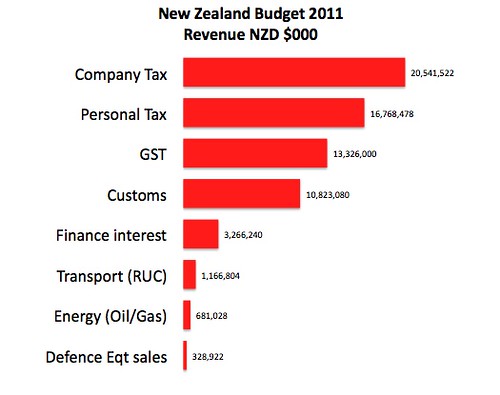
However income tax is only one of several ways the Government obtains money – with the largest source is rather surprisingly Company Tax. (Source)

I was also surprised at the size of Customs tax, until I saw that 64% of it as GST charged on imports, with the remaining $387 million excise and customs duty. Adding that GST to the main amount would make GST the second largest source of income, and then just by a whisker.

So personal tax, while it affects most of us, is only the third biggest source of tax.

It’s quite different to the USA’s system, where personal income tax is about 50% of the Federal take, Social Security taxes are most of the rest and business taxes are absolutely trivial. The State’s take a bit of tax from business, but across the entire tax system it is only 13%, while income tax is 31%, Social security 22% and property taxes 25%.

I absolutely prefer the NZ system with the tax burden spread relatively evenly across the different sources.

Digging into the department vote (how much is budgeted) and projected revenue numbers was also interesting – here are a few:

The Transport vote attracts a decent swath of revenue – most from Road User Charges and the rest from registrations.

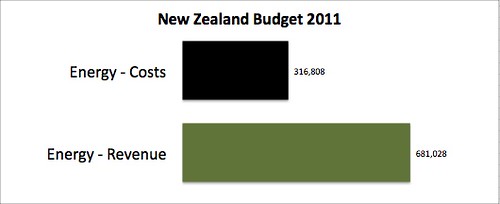
Energy revenue, while relatively small, is mainly from petroleum royalties, with almost all the rest coming from the electricity industry.

The IRD costs 13.5% of the money it raises. That’s higher than I thought.

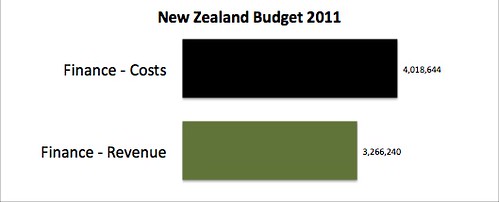
The Finance vote is offset by a good amount of revenue, but half of that is finance charges to other Departments – for borrowing money I guess. The rest of the revenue is mainly from  interest ($538m) and SOE dividends ($466m) along with a big ‘other’ bucket.

Our courts don’t pay for themselves. Add in $1.4 billion for Corrections and it is a pretty sorry picture. We can do better – and legalising activities like drug consumption would be a start.

More to come in a another post.

Telecom some ideas for your prepay recharge screen

This is Telecom’s prepay information screen. I’ve been looking at it a lot over the last two days as both my T Stick and iPad needed recharging. It was a frustrating experience, and the T-Stick just failed again yet the screen gives no useful information:


Please – can someone redesign this?

Here’s what I’d like to see:

1: Show the one thing we want to know – should my phone/stick/iPad work or not? Perhaps a big line near the top of the page saying something like – “Your data is ACTIVE” or “Your data is INACTIVE” would be good.

2: If it is the second, then show us what to do. “You need to top up at least $40 to continue your plan” could be good, followed by a big “top-up $40 now” button.

3: Make the Credit Card page work all of the time, not just one in the three days (my experience). Show the phone number that we can call if the credit card page is down.

4: Let us add more than $60 (or is it $80?) each time. These data cards eats money like anything, so let me give it to you.

5: and last but not least – please automatically recognise and log a customer in if they surf to the page with a particular device. That will save the painful SMS SIM card shuffle which should be consigned to usability hell.

P.S. Vodafone’s iPad recharge screen is not bad – not perfect, but not bad. Check it out.

Show me the receipt please

This is a great idea – from 3rd Way and via npr. Taxpayers would receive a receipt for their tax detailing where there money was spent. A person earning $34,140 would get something like this (minus the red notes)

And yes – it’s amazing that almost 10% of the tax is spent on military, that National parks artract more tax than the woefully under-maintained highways, and that poor Amtrak, their rail system, gets $2.23 while the highways get $63.

It’s also disturbing how high the IRD number is – $17.69 is just 0.3% of the total tax take, but it’s a lot of money in total, and should be added to the local and state system expenses. A simple tax system reduces IRD costs, increases compliance and, most of all, reduces compliance costs by individuals and businesses. Simplicity is found by removing all but a very few excuses not to pay set rates of tax.

But most of all the 5th highest expenditure is one of choice – the war in Iraq and Afghanistan. Removing that cost would have allowed, say, an infrastructure boom, an environmental new age and massive lifts in education quality for all. Or something closer to a budget surplus.

I’d like to see one of these for NZ – and I’d like to see one for me.