Future Digital: InternetNZ’s discussion starter

InternetNZ’s discussion paper for the NZ election lead-up is now online.

The paper, and it is a quick read, contains a lot of the themes that emerged from NetHui, which was an excellent event with engagement from across the industry, society and Government.

The key points for politicians and voters are:

  • Embrace the fact that the Internet drives economic growth and invest accordingly.
  • Guarantee a vibrant, multi-cultural identity with continued local funding but more importantly the next generation of copyright law and strong defense of initiatives from abroad.
  • Become a digitally inclusive society, where everyone has the ability to connect to and open unencumbered Internet.
  • Protect the environment for future generations through the obvious moves, including smart metering for all sorts of things
  • And above all, for this election, have a Government that ‘gets’ the Internet – as part of everything they do.


There is plenty of opportunity for all parties to embrace and extend some of the themes in this document, and I am sure most voters would like to see that happen.


More text and fewer articles visible equals more pageviews

NZ’s own RWW reports that readers of the FT’s mobile Web app consume “about three times as many pages through the app as they are through the desktop in an average visit“.

Drawar.com concludes in turn that the reason is that the the articles are in a single column in the web-app, while on the ordinary web page the articles are scattered across the page, so the eye is not distracted.

I agree, but would also add that the articles in the web app show a lot more article text than in the ordinary webpage, as I’ve shown below by annotating a screenshot from Drawar’s article.

The text lets the reader know whether it is worth finding out more by clicking the link, and the column format tells the reader exactly what to read.

This, to me, is one reason that the blog format has been so successful. It’s easy to scroll down, read one article at a time and then move off the site when you are done.

I’ve written about interest.co.nz’s appalling redesign before, and not kindly. The site before that was pretty bad as well, but at least they had a single blog page with all of the text. Given the current state of the site I still do not visit, although I often will follow a link through Twitter.

The NBR site is pretty good on this score provided you ignore the stuff on the right and read the single column. They don’t post many articles so it is easy to keep up.

I wish interest.co.nz would use this format, but before NBR gets too cocky I wish, again, that NBR would fix their @#$@#@ commenting system.

The thinking (single column is better, more text per article showing is better) makes it obvious why Scoop has always struggled to break through. If you think of links as unreadable then there is only one article to read on the snapshot below.

The AFR is getting better, certainly since the complete Flash-ridden dreck of a few years back. It seems readable, but click on any of the links and you’ll need to pay A$1140 per annum to read any more.

There is no discount for beng in New Zealand where the salience of AFR’s content is lower, and the price is still absurd in international terms.

The WSJ has long understood the value of single column reading, with the front page of the newspaper employing the technique for seemingly decades. Their website uses two columns, but provides plenty of text per article. I read it a lot, helped by an annual subscription which is tiny compared to the AFR’s extortion.

In summary this stuff is not that hard. A single or double column of articles, enough text showing so we know what it is about or can read the entire thing, and, obviously, great content.

A well-designed news site places the reader experience first as if the site is easy to read then readers will read more content on the site.

If designers and MBAs try to increase pageviews using the various tricks (multi-page articles, links not snippets, too much content visible) then readers may react by clicking some of them but in the long run they wil be confused and will simply go elsewhere.

It’s what Steve Jobs would do – so why not do it at your news site?

Let’s make New Zealand the 1 percent

The posts at WeAreThe99Percent are sobering, shocking.

They are some of people caught in the downward spiral of the US economy, but in reality it’s been happening for years as the split between the wealthy and the ‘middle class’ gets increasingly large.

The stories are of cripplingly high health care costs that destroy families, of foreclosures on mortgages and of the obvious result of years of banks pushing debt to customers.

There are also strong themes of ever-increasingly expensive education that is of diminishing value in the job market, and people are loaded up with tens of thousands in debt and low paid or no jobs.

These are signs of a society that is failing its people, and a strong articulation of exactly what the Occupy Wall Street movement is all about.

Is this the real Tea Party?

David Koch, second richest man in New York is apparently a cornerstone funder of the Tea Party, and he and his brother hold strong Libertarian views. Some of those views I regard as part of a fair society (legalisation of prostitution and drugs, gay marriage, removal of farm subsidies) but some are downright dangerous (removal of Social Security, the Federal Reserve Board and welfare).

The Tea Party movement was arguably taken over and certainly accelerated by Fox News into what seems to be a nutty right wing group, but the mass membership are driven by much of the same concerns as Occupy Wall St.

We are faced with interesting times over the next weeks – will the Tea Party followers increasingly realise that they have been duped?

This newer Occupy Wall Street movement appears to be a genuine one, rising from a sea of frustration from people who are under-served and with little prospect. It started from a suggestion in a email from Adbusters to their readers, and seems to have no leaders.

Many of the participants made mistakes, perhaps taking on too much debt or studying the wrong degrees. But many more of them have done what society demanded of them, attending university, paying insurance, buying a car – and then got clobbered. The safety net in the USA has many holes, and doesn’t last for long.

The problems are not so simple

A lot of what the financial industry (Wall Street) does is good, even the slicing and dicing of mortgages up into CDOs was a good idea. What was not good was the pricing of those CDOs, the way they were sold and the way that mortgages were granted to people who realistically had no hope of ever paying them off. What is worse is the propensity to clip the ticket for increasing amounts. The short term dealmaking, get the money now nature of the street has its place as lubricant for helping businesses make tough decisions, but it encourages unacceptable banking practices in the long run. The US really does need to reinstitute the separation of retail banks and investment/trading banks, and bring in adult supervision.

The financial institutions do not stand alone in being recipients of fury. US corporations there are paying an increasingly small share of the overall tax burden, with some such as GE earning billions and paying little or no tax, or even receiving rebates. This is the result from years of corporate lobbying for tweaks in tax law, and the results are repugnant. The USA could learn from New Zealand should dramatically simplify their tax code, much like Roger Douglas did in 1984, and introduce a GST.

That’s not to say that that everyone on Wall Street is repugnant, or that even they see themselves doing wrong – far from it. It’s a game where the choices are laid out in front of you, and if you excel then the money will come. It’s a game where the amount of money flying around is so high that it’s relatively easy to ensure that a little sticks to those making the transaction.

Financiers however play within rules set for them by legislators in Washington DC. Those legislators are there thanks to a host of donations from thousands of people, but some of the larger amounts come from companies and individuals on Wall Street. That mixture of politics and money has lifted the concerns of corporations and diminished the relative concerns of individuals. It’s got to stop, but a recent Supreme Court decision actually went the other way – defending the right of corporations to get involved in elections.

A decent society is decent to everyone, regardless of whether they are old, young, sick, or healthy, or even whether they chose at times not to abide by our rules. I reject completely the idea of living in a society that accepts homelessness, that does not care for mentally and that locks up people for offenses that are relatively harmless. We humans are better than that.

Being part of the 1 percent

I was lucky enough to study and work at two elite USA institutions – Yale University and McKinsey & Co. The experiences at those two places were outstanding – the level of education at top schools and the scale of the work available in the USA at the top end far exceeds anything here. I helped, for example, 2 organisations with over $500 billion in assets at the highest level. I was taught by people that wrote the books we study from and met a group of ultra smart, globally savvy, fun and driven people. In short I was becoming part of the 1 percent, even though for four of my five years in the USA I was in debt, and even though my income paled in comparison with those on Wall street.

I deliberately chose not to apply for Wall Street jobs during my MBA, as despite the fun of playing with large sums of money there seemed to be little reward beyond chasing the money god. I was lucky (or unlucky) enough to temp for a few months in a bank that sold structured financial products in London, counting the amount of money that the bankers had made over and above the internally calculated value of those products. It was a calculation of a knowledge advantage, and the units were millions of dollar per day. Those bankers or traders were seen as the elite within the bank people, but in reality they were arseholes, and like everyone else there, including me, they were dedicated to making money and to little else. I was lucky because I managed to get kicked out relatively quickly.

Being part of the 1 percent as a professional isn’t easy either. You are expected to work incredibly hard, maintain a certain sense of decorum and not rock the boat. It helps to have gone to the right school, for undergraduate and graduate studies, if not before. You don’t get much in the way of holidays, and are expected to be on call at all times.

I managed, courtesy of the last recession, to again break away from the USA corporate scene.

New Zealand

Meanwhile in New Zealand many are experiencing at some of the negative impact of the GFC, though I am unsure as to how bad it really is. Compound that with the hammering that Christchurch took, and while we are just getting on with it, we potentially have some real problems.

However we are blessed with a society and politics that, ACT party notwithstanding, generally and genuinely finds it unacceptable to treat people so harshly.

We are seeing increasing disparity between the wealthy and the rest in NZ, and we therefore need to doubly continue to ensure that the social welfare safety net is working. That means free or cheap education and health, as fundamental rights, it means a living income for everyone regardless of their circumstance and it means making sure we don’t have a situation where housing is unaffordable and can create catastrophic losses for families.

At the same time we need a society and economy where businesses can start, nurture, grow and prosper. We already have some good elements in our tax system, but there is a way to go before we get a fair tax system that rewards entrepreneurialism and has minimal loopholes. We don’t, for example, tax capital gains at all here. A simple across the board 20% tax on capital gains worked well in the USA for many years, and a tax I would welcome here, excluding only primary residences.

While there are problems, we have a good society here, and many live the life that many of the 1 percenters do not manage to live in the USA. We have the lifestyle many in the world dream of, while we have the ideal economy to start and grow businesses.

So what can we do about it here in NZ?
There is not a lot we can do about US policy, and it is senseless to get buried in US politics as it is something which we can and should not try to influence. Also it is, as far as I know, illegal for non-citizens to donate to campaigns.

But we can make sure that we don’t follow in the footsteps of the US by making sure we stay vigilant on the things that make our society great. We missed for example,  decent regulation of finance companies, resulting in the loss of billions. We succeeded though in standing up to banks, and their current strength is partially a function of that.

Why can’t we make our 1% into 100%? Why not aim to make New Zealanders the envy of the world, combining a (minimum) decent living with a vibrant economy and the world’s best lifestyle.

It’s something worth pushing for, and here are some of the basic elements I believe we need to (continue to) push for*:

  1. A simple social welfare system that ensures everyone gets a living wage, regardless of the reason they need help
  2. Low or no income taxes for those earning under a minimum amount
  3. Free or near free high and consistent quality education for those who cannot afford otherwise
  4. Free or near free health care for those who cannot afford otherwise
  5. A flat capital gains tax (say 20%) on all capital gains except for sale of the primary residence
  6. Decriminalization of all and legalization of certain drugs, to drive safer drug taking though better messaging, less drug taking (Portugal example), higher income from tax on drug sales and removal of the largest cause of crime from the mandate of police.
  7. Constant effort to maintain our short election campaigns and campaign financing that cannot be influenced by wealth of individuals or corporations.
  8. Constant effort to increasingly simplify tax law, making it as easy for corporates to understand their income liability as it it is with GST.
  9. Firm and fair regulation from well educated and informed regulators of companies that take money from investors.
  10. Continued celebration of individuals who make it big by building great companies with strong values, and condemnation of those who create wealth through financial trickery and do not give back.

There is more. However for now my main question is just how bad is it in New Zealand? Are we seeing the desperation of the US, or are our limited resources being largely applied where it matters? We will always have perceived and actual individual injustices, and we should seek to clear them, but for now it is the systemic ones that we need to worry about.

*Note that I don’t believe, for now anyway, in a financial transaction tax as has been mooted by some. The call is for a, say, 50 cent tax on each financial transaction. The difficulty is in understanding exactly what a transaction is. Traders could simply gather up all trades for a day between themselves and other institutions and call them one transaction. Alternatively if the tax was based on the number of securities exchanging hands, then bankers would simply construct products with higher face value and lower numbers of securities. And so on. For every tax a financial product can be created off-market that avoids the tax, but only the largest banks will be able to do this. The smaller investors would pay the tax regardless.

The steps for Apple beyond iPhone 5

Apple are releasing another iPhone, or iPhones, tomorrow, and the rest of the industry is understandably nervous.

However as what is now called smartphones catch up, Apple will increasingly be playing in a space with diminishing hardware margins. Sony used to own the Walkman market (they named it), but the remainder of that industry started churning out extraordinarily cheap players that brought margins down for everyone. Sony responded with a variety of products, going up-market by adding features and technology, and defending the lower end of the market with a ever-expanding range.

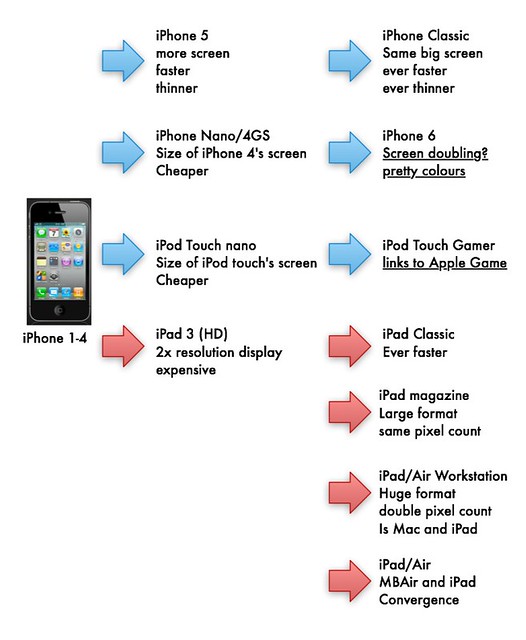
Apple did the same with the iPod, where we saw the original (now known as the Classic) gradually evolve and then splinter into several variants, eventually ending up with the Shuffle (tiny, no screen, lots of colours), the Nano (small, screen, lots of colours), Touch (big screen, iPhone without the phone) and the Classic (high capacity, large, 2 colours).

The iPhone is losing its technology edge, and while US telco Sprint is making a huge bet on the product, Apple’s hardware and software technology lead has diminished to about a year. However, just as with the iPod and iTunes, Apple own the software infrastructure behind the device with the App Store on iTunes. This will slow the decay of margin, but ultimately apps will be made for all large competing players.

So while the iPhone will continue for now to earn the lions share of profits in the industry, we can expect to see the beginnings of splintering along the lines of the iPod to shore up those margins.

So I predict we will see a cheap iPhone product – perhaps the existing iPhone 4, or perhaps a smaller screen-only sized product. This will compete against most of the rest of the industry.

But Apple will also punch for the higher margin products, as they did with the incredibly successful first spin-off product, the iPad.

There there are a range of opportunities as the size of the iOS device, the resolution of the screen and a whole host of other, less important, features will differentiate the offerings. Here’s my take on some possibilities – there are more:

Apple, if they stay true to their core, will keep the product range relatively small, and not introduce tens of variants.

I have not included features such as 3G/4G mobile data versus wifi, new software features which should be available to all (newer) devices, NFC and so forth.

Apple Convergence

There is plenty of scope for convergence of the Apple ecosystem, and we know they like to keep their product range simple.

One well-known missing link is a serious set-top gaming device, and Apple could quite easily have an approach that uses iPhones/iPod touches/iPads  as controllers, and an iPad, MacTV or iGamingDevice connecting and displaying the game on the TV. The AppStore already has a vast game library, and many would thrive on a TV.

The other obvious step is the convergence of MacBooks, iPads and iPhones. The iPad is still a media consumption device for business, and while it is ok for consumption and annotation, real computing still demands a keyboard and either a mouse or track pad. Despite, for example, a promising launch the Numbers spreadsheet is a usability failure on the iPad, while coding on the iPad is a distant dream for now.

But what if a high resolution iPad was your main computer (the iPad PC), which operated normally as an iPad but could also be unleashed as a Mac – in particular when connected to a keyboard and external monitor? There would be no need to have 3 devices as I do (an iPad, MacBook Air for travel and a larger MacBook Pro for office), as with just one device  all of our computing requirements are met.

There is, if we think about it, no reason that the iPad PC cannot eventually shrink to iPhone size, so that we could just connect our iPhone to a keyboard, mouse and monitor whenever we want to get down to serious work.

We can also turn back to the iPod, which as the iOS devices catch up could well be assimilated into the iOS range. The iPod nano, for example, could double as an input device for a gaming machine or simply as a tiny high resolution phone.

Technology has a way to go before i7 power chips end up in iPhones, but that day is fast approaching. This is Apple’s problem to solve, and solve it I am sure they will.

Their next problem is larger though – what on earth will they do after that?

And yes – if it is shiny and has an Apple logo on it, chances are I’ll be investing buying splurging on the new iPhone.

Stop the terrorists

Sea Shepherd do not deserve our protection, sympathy, and increasingly arguably, the ability to freely operate in NZ. Their latest blog post makes it clear that they are not playing by the rules:

They will have to kill us to prevent us from intervening once again,” said Captain Watson. “Are the Japanese people ready to take human lives in defense of this horrifically cruel and illegal slaughter of endangered and protected species of whales? Do we have to die to appease Japanese honor? If so, my answer to the Japanese government is “hoka hey” (Lakota for ‘it’s a good day to die’), and we will undertake whatever risks to our lives will be required to stop this invasion of arrogant greed into what is an established sanctuary for the whales.”

Indeed it sounds like a declaration of war. Stuff reports more:

A radical conservation group says it is going to launch “dramatic” attacks on Japanese whalers south of New Zealand later this year.

and goes on to report:

IFAW’s Patrick Ramage said Japan’s whaling industry was out of gas and crashing..

“This move is more about pride than profit, more about politics and prerogatives of the Japanese Fisheries Agency than it is about public support.”

I contend that Sea Shepherd should also look to their motives. It seems to me that their motivations are about shit-stirring in the Southern Ocean and having fun playing mock-war with boats, rather than the cause itself.

These guys are nuts, and we should not let them embroil NZ in a horrible sea rescue operation or degrading diplomatic relations with one of our biggest trading partners.

As for the whales – they don’t need the radical idiots from Sea Shepherd actually turning people against the otherwise overwhelmingly positive anti-whaling campaign.

Giapo 2.0

A while back I blogged about Giapo, the Queen Street, Auckland gelateria run by the amazing Gianpaolo Grazioi.

The title of that blog post was “It’s about the Gelato, not the brand“, and, well, it seems that these days it is indeed about the Gelato.

The post led to a series of comments, and I met Gianpaolo and have had many a tasty gelato moment and entertaining conversation since. The business was successful from the start and is increasingly successful.

While the initial rhetoric was about the brand, Giapo is increasingly and relentlessly focused on the quality of the product.

It shows. The gelato is significantly better to me than it was at at launch, and than it was even 12 months ago. It’s a classic continuous improvement case study, and a blog post today from Giapo explains some of the reasons why, starting with ingredients:

“It took us a while to understand where to go and what to do to be better and better….
..we decided to start making our own organic chocolate, white and black, instead of buying standard ones made with cheap ingredients and far away from us…
….Then we bought an oven and we started baking our own cookies, brownies, cakes, pavlovas, meringues, ladies fingers, short breads, and every single other baked product that we use to garnish our ices… instead of buying standards products at the bakery that we could not change or improve.

….we now make our own jams and toppings so we can have it all natural, sourer, less sweet and denser.

We also make our own cheeses, and the butter used in our own baking, all organic.

We currently make sour cream, cream cheese, mascarpone cheese, ricotta and we inoculate our own yoghurt with the lactobacillus bulgaris and acidophilus with pro and prebiotic, so we can make it denser and fresh everyday.

Yes, pretty much all the ingredients made in store are also organic because organic are the raw materials used.

We have optioned to buy 12 organic jerseys cows….
We have bought 120 hens…..

The product can only be as good as the raw ingredients, by driving to the source Giapo is making sure its gelato is the best. It’s reminiscent of the attention to detail shown in the excellent

But that’s not all – the quest to improve goes into the kitchen as well:

Food Pairing is a big thing for us, we are always looking for new combinations, we follow intuition and hints on a molecular level. We are experimenting with all sorts of ingredients and products from meat to fish, from flowers to tobacco and many other types of spices and fruits and vegetables that grow in New Zealand. We turned our kitchen in a lab, where the most amazing things can happen.

I’ve had Salmon Chocolate gelato there – and it tasted exactly as it says on the label. It’s not something you want to put into a cone, but certainly an entertaining addition to a savoury course at a dinner. Restaurants should be queuing up at Giapo’s door to commission their own flavours. Should be – but I suspect they are not yet.

Gianpaolo is formally studying the science behind the food, his boundless energy managing to juggle a life centered around gelato and a young family.

He takes that learning into the kitchen in a natural way:

Although we love science and we do geek out in the kitchen, our ice creams is not loaded with chemicals or any junk confectionery, what we do are pure unalloyed, straightforward ice creams, easily made from straight forward obtained ingredients.
Giapo is likely to be producing the most expensive and exclusive ice-cream ever created in the world and it is not doing it for profit. All the profit are currently being re invested in scientific training, research and new innovative machineries and technique to create the ice cream of tomorrow.

I’d be happier if a good chunk of profits were used to secure the financial stability of Gianpaolo and his family, so that he can continue to keep doing this. Of course by reinvesting in the business he is doing exactly that.

The store is incredibly successful. If you are in Auckland then go there – it’s that simple.

Meanwhile the gelateria that I originally unfavourably compared  Giapo to has taken a big dive in quality – and Giapo reigns supreme.

Well done so far – and the story is only really beginning.

Deciphering the HP departure and arrival letters

Corporate language has a particular style, often difficult to understand for those outside an organisation. On the surface they can appear fairly banal, but employees, contractors and analysts can extract remarkable amounts of information from them.

Let’s take a recent example, the emails sent during the changing of the CEO at HP.

HP is sadly in all sorts of trouble, where the board kicked out 1 year CEO Léo Apotheker and appointed fellow HP board member, former eBay CEO failed Republican California governor candidate Meg Whitman to replace him.

It’s been messy. 

The departure and arrival letters are wonderful example of corporation speak, so let’s get going in our deciphering exercise: 

First up the letter from Léo:

TO/ All HP Employees

One of the few powers a CEO has is the ability to email everybody in the company. I am exercising that power on my final day. Watch out.  

FROM/ Léo Apotheker

The accent on Léo is important – as I am sure every employee knows by now. Get it right in all of your communications

Dear HP Employees:

No contractors or suppliers are on this message, so it can be a little more ‘insider’. However I hope that some staff will pass on the message, and it will get out to the public.

This afternoon, HP issued a press release announcing my resignation as president and CEO,

Today I was fired, and I didn’t like it

positions I have held with great honor this past year.

I, at least, respected the company and the role

Meg Whitman will assume the role of president and CEO.

I don’t agree with Meg as the new CEO. 

As you know, Meg is a technology visionary with a proven track record of execution and has served HP well as a member of the board for the past eight months.

You already know about Meg, and she has only been here for 8 months and is part of the board that has pushed the failed strategy.

Meg will be supported by a broad and deep management team, and I have the utmost confidence that HP will succeed in executing its strategic evolution.

At least your manager will be ok, and hopefully HP will get along despite the shuffling at the top.

On a personal level, I cannot begin to express the admiration I have for all of you—and what you have accomplished together.

It’s been amazing to be CEO, and I really appreciate the chance to run such a huge organisation. I felt a bit out of my depth but never said that I was a dictator. It was not about me – it is about you.

Over the past year, we were tasked with developing a strategic vision for HP and I know we have made important contributions to the company’s future.

The board told me to do this strategic vision, which I don’t really agree with any more and looks increasingly stupid. Thanks for your help during this sad exercise

Your efforts on behalf of HP and your dedication to our customers have inspired me—and I am confident that HP has a bright future because of the talented people that come to work here every day.

You guys rock, and HP will succeed, if it does, because of you and despite the board who set the strategy and just fired me. They who don’t come to work every day (the board) need to go.

Thank you for your commitment to HP and for your dedication in serving HP’s customers and partners.

Its about the customers and you.

It has been a tremendous honor and a pleasure to work with you here at HP.

It has been an honour – I hope you make it through this board. I’m not sure you will

Sincerely,

Léo Apotheker

While I was made to write this, I managed to get what I wanted to say out without the board even realising.

Mashable found Meg Whitman’s email:

TO/ All HP Employees

Léo is gone, we have the conch now

FROM/ Meg Whitman and Ray Lane
We are writing today as the new CEO and executive chairman of HP.

Writing this together will show we are aligned.
While Meg and Ray think this shows a coherent approach, the joint email shows to staff that Ray is the one calling the shots. Meg is not really in control.

First let us say that we are true believers in the future of HP.

Despite a clusterfuck of recent events we still think our strategy is right. Meg is only new and is happy to be in a CEO role again, and may change her mind if the board is moved on.

We have always had enormous respect for HP and its well-earned iconic status as one of the most important technology companies in the world.

HP is just one of several companies we could be running. Ray and Meg have not demonstrated that they understand how HP is different from every other company they could run. 

We look forward to working with you as we take HP to the next level.

We are impatient to get started.

By saying ‘as we take’ Ray and Meg make it sound like the success of HP will be due to them, not to the people who are ding the work. It may be a grammar typo, but it comes across very arrogantly. 

As you may have seen in the press release we issued earlier today, Leo Apotheker has stepped down as president, chief executive officer and resigned as a director of the company.

We fired Léo. They either didn’t understand that he is called Léo and not Leo, are being deliberately vicious or cannot figure out how to make an “é”.

We very much appreciate Leo’s efforts and his service to HP since his appointment last year.

He tried hard but the company went rather spectacularly backwards. However by not mentioning anything that he actually did they are giving a backhanded insult to him.

In addition, Ray Lane has been appointed executive chairman of the board of directors.

Ray is running the show now. Executive means he works here closer to full time.

This means that Ray will play a more active role in guiding the company.

We repeat: Ray is running the show now. 

To ensure good governance practices, HP also intends to appoint a lead independent director soon.

Having an executive Chairman AND a CEO is very strange, so we need a third party to keep things straight with shareholders. There is no clear boss. Will Meg be the person making decisions, or will he be second guessed by Ray all of the time. It is really unclear. The lead independent director may end up being the arbiter between the two, which bodes poorly.

We know that change is difficult.

We’ve heard that change is difficult. 

The decision to change the leadership of HP is one the board took seriously.

The board does not meet that often, but we consider that we spent a lot of time on this. In reality it appears that this is only hours or days, and that no real search was undertaken to find a new CEO. Moreover it also appears that the major decisions made recently were also under-considered by the board. It’s time to look at the individual board members and wonder just who will break ranks and tell it a it is. 

We assure you that it was a difficult decision – and one that was made after careful and thoughtful deliberation – but one the board believes is absolutely necessary for the success of the company.

Something had to happen – the knives were out on Wall St. So the board made a quick decision. 

HP is a leading technology company with a real purpose and the ability to positively impact the way the world works.

This is more evidence that we are not really bought in to an HP customer cause. This sentence could also be construed to mean that Ray and Meg are going to change the purpose of the company. That said, the corporate objectives and shared values are don’t mention anything about customer purpose beyond quality and value.  

We all recognize that the technology landscape is changing rapidly and we have to do more than simply adapt.

If we don’t do something quickly our heads are next. However it seems clear that Meg and Ray are not really clear exactly what to do.  

We must invest in innovation

We are losing to Apple and other competitors. This is a motherhood statement that may be a laugh-line for many in the business. HP already has a value of “Meaningful Innovation: We are the technology company that invents the useful and the significant.”, and Ray and meg should be reflecting back to these values. 

, leverage the strength of our core businesses, enhance our software capabilities and integrate our assets to maximize the value of our investments.

We have to use our muscle to grow, diversifying away from the lousy low margin businesses that are getting increasingly commoditised. We are also thinking of combining some of the divisons, and we are treating our intent to buy Autonomy as a done deal – we need to absorb them.

This is confusing and misleading. The biggest business-line is actually in PCs, and the board wants to sell that. Next biggest is Services, but Enterprise Servers, Storage, Networking and printing are bigger than services. Software is 2.9% of our overall business right now. So HPs core businesses are making things, and Services ‘leverage’ off that. The recent move to spend a huge amount of money on services and sell the world’s largest P company seem to be contrary to this sentence. 

We believe in HP’s strategy,

Actually it’s the board’s strategy, and Ray controls the board. Despite analyst cries employees won’t see any other way forward until the board is changed, and Ray and Meg are asserting their power throughout this email.

and we are confident that together, with renewed focus and energy, we will deliver on our priorities for our stockholders, customers and other stakeholders.

The main priority is to deliver returns to shareholders. Again we see real purpose for HP to exist in the email.

Our hallways are filled with the industry’s brightest and most talented people.

We know there are great people working here, but are signaling that we have not really met many of them.

We believe we all understand that we have a lot of hard work ahead of us.

You – each of you – will work hard.

Each and every one of you contributes to our success.

Those not contributing to success (such as the entire PC division) will be moved on. We have not had much success – so be prepared for redundancies.

The board wants to continue proving to our customers, partners and stockholders why HP is—and should remain—a leader in our industry.

The board wants the company to stay huge, regardless of what we do.

A top priority for us will be to refocus the energy of the organization on our mission and on the performance necessary to accomplish it.

We will use this crisis to create a wave of ‘restructuring’ and a performance culture based on fear

We need you to be the ambassadors of HP and work both collaboratively and effectively to usher HP into the future.

Stay on message or leave HP

To reach that goal, we need your best work and a focus on execution.

Again, work hard and you may stay.

We believe that HP matters. It matters to Silicon Valley, California, the United States and the world.

HP matters to shareholders only. There is no evidence that Ray and Meg understand why HP matters.

We will maintain and build upon our proud and deep-rooted legacy.

Ray and Meg really do believe in the strategy. They really have no idea of the damage we have caused and are causing to the great legacy that is HP.

We understand the strength of this company, and we know we have the right tools and the talented people to achieve our goals and execute our strategy.

Ray and Meg are are going to keep pushing this demonstrably stupid strategy without apology. They are not able to articulate the goals.

We want to hear directly from you.

Apparently we need to ‘engage’ with you.

Good ideas come from everyone, so please send any thoughts you would like to share to employee survey.

All of our ideas are good, some of yours may be deemed to be good. This will come across as a good way to end your career (if the sugestions are named) or a black hole (unnamed) or both.

We also invite you to join Meg tomorrow at 9 a.m. Pacific Time as we discuss this announcement. Details for the meeting will follow shortly.

We are having a mandatory meeting tomorrow so Meg can demonstrate her common touch with the people, just like at eBay. This won’t be looked upon favourably, except in an observing the train wreck kind of way.

We look forward to working with all of you. Thank you for your ongoing and deep commitment to HP.

We think this is enough to get you motivated and raring to work. Meg and Ray don’t understand that this is 100 million miles away from what would really work, that the message could have been written and been just as ineffectual at any corporation and that staff are shaken up. AFAIK neither are engineers, so they will struggle to earn respect from many.

Sincerely,

Meg and Ray

Using our first names makes us feel less threatening to everyone. Seeing the two names feels incredibly false.

10 ways that NBR.co.nz can fix its comments

One would think that The Wall Street Journal comments would be rancid. After all it’s a right wing capitalist newspaper in the bastion of all that is right wing and capitalist. And yes, the comments do skew a certain way.

But overall they are not nearly as bad as they could be. The reason are reflected in this screen shot below. 

I plead with the NBR to update their creaky comment system to incude some or all of these features. Here it is, along with some classic comments for our indigenous right wing idiots:

1: Put the time of the comment, make it relative to now.

2: Highlight paying subscribers, and have them use their real name, so we know who is real and will stan behind their comments.

3: Allow us to hide all comments from non-subscribers, so they don’t destroy the conversation. Allow us to (3a) uncover the comment so we can read them if we want the humour.

4: Let us reply in-line to a comment, rather than placing the comment at the end of a long list.

5: Allow us to thumbs up comments,  so the best comments rise in the rankings and get read.

6: Allow us to report abuse – a feature that is particularly useful if it is potential libel.

7: Allow us to receive emails of any  new comments – that encourages us to reply and continue the conversation.

8: Provide a link to the actual comment

9: Let us message the commenter

10: Let us connect with ech other – not this way, but let us provide our Linked-in public pages as part of our prifile, and make them clickable.

All of this promotes the idea of adults talking to adults in a civilised manner. Is that really to much to ask for in our only national business newspaper?

Facebook’s desperate pleas for attention

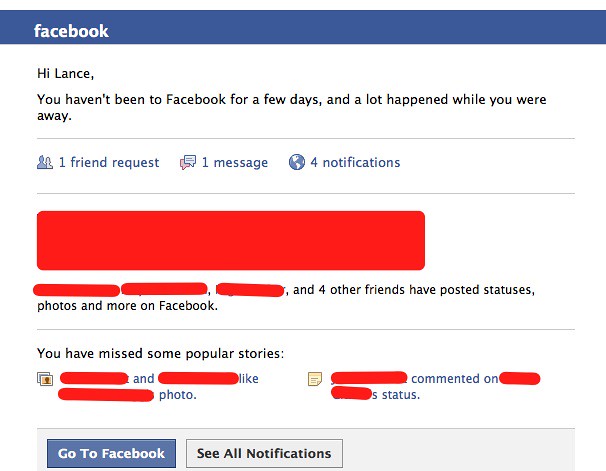
In August I received this email from Facebook, which was similar to one I received in June:

and like others I received this over the weekend – telling me that I has not been to Facebook in the last few days, and that, well, nothing has really happened anyway.

There are several things wrong with these emails.

The first is the assumption from Facebook that I need to visit their site every day or two. I don’t, and nor does anyone. Meanwhile the amount of ‘events’ that I have ‘missed’ is trivial, and is dwarfed by the activity on Twitter. While Facebook (and Twitter for that matter) is a nice tool, we should never feel that everything that scrolls by requires a piece of our ever decreasing attention.

The second is the rudeness of it all. Even if I were still at school and all of my classmates were on Facebook, this email is so arrogant that I would be tempted to say goodbye – at least for a few hours. Perhaps I would even start a competition with my friends for the email with the greatest number of missed events.

Thirdly, and most amusingly the email doesn’t seem to take into account activity via Facebook apps or by the email to reply feature of Facebook comments and messages. So ultimately Facebook is telling me to interact with Facebook when in fact I have been doing so.

Overall I see this as another signal that Facebook’s time in the sun will end.


Vizualize Me

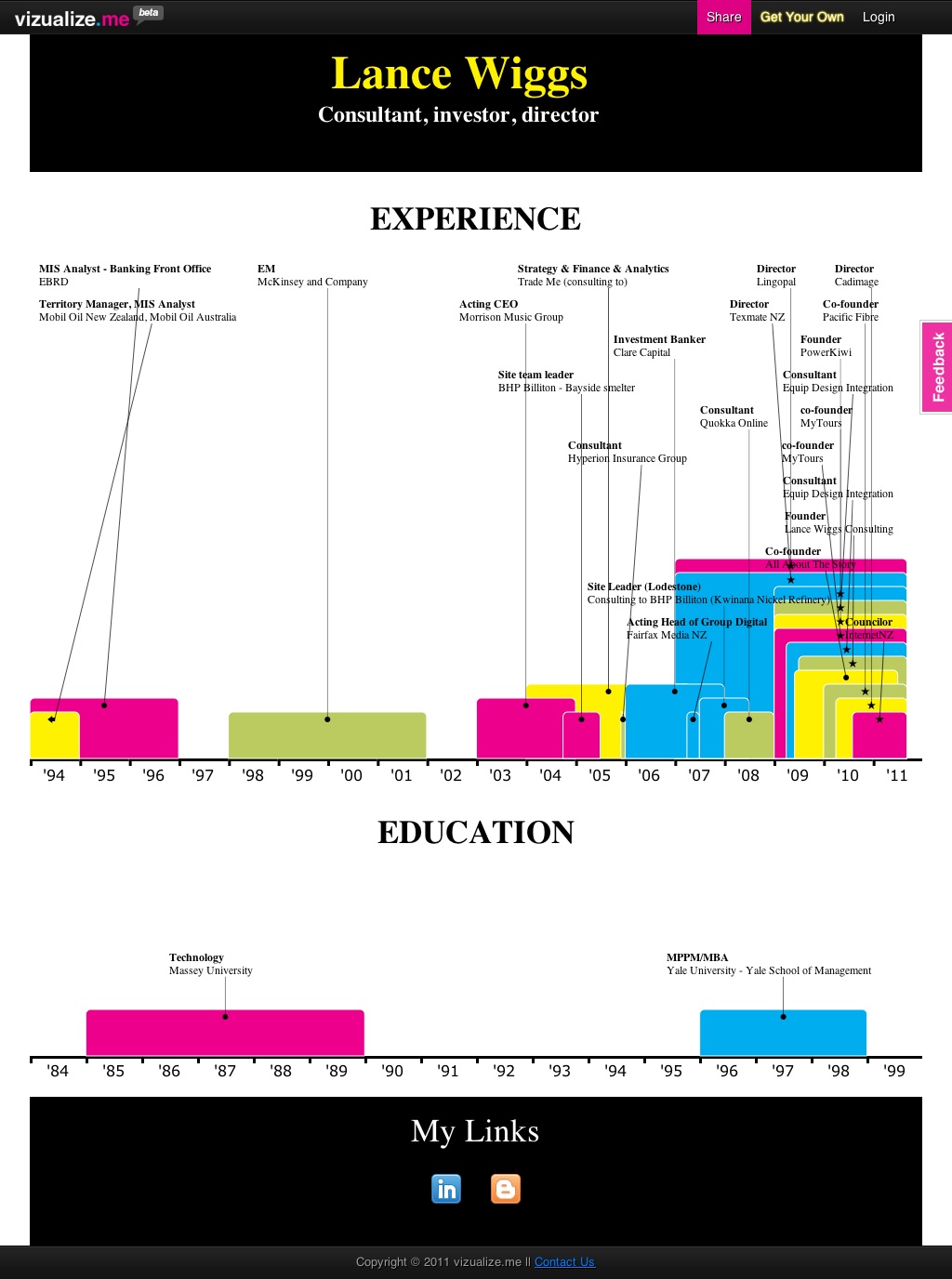
I got a beta invite to Vizualize.me today, which maps Linked In data onto a page – a visual resume if you will. Here’s the output (and below).

It’s interesting to see it all laid out graphically – for a start I spotted a number of mistakes which I will need to fix. It seems, for example, that I was simultaneously in the UK at the EBRD and in NZ at Mobil Oil. I was not. There are also gaps that denote periods of travel, which I need to fill.

It’s also fascinating to see the changes once I went out on my own. It seems I’m doing a lot these days. I’d like to see the directorships extracted from the other jobs though, or some way to show the share of time spent on each.

They have other styles to use, but these do things like replace the boxes with semi-circles, which while perhaps pretty are not useful.


Hey MPAA – so where can we buy Boy online?

Commenter Jonathan Hunt pointed out in the last post that while the MPAA likes to complain about downloading of the movie Boy, he still cannot see it in iTunes 18 months later.

He is right, and it seems the MPAA are well out of order.

Here’s what I see from the New Zealand iTunes store. There are 18 movies found when searching for Boy, but not the March 2010 release Boy.

Here are the US iTunes store search results. There are 45 results, getting on to three times the number of NZ results, and sadly still no Boy.

This is a simple demonstration of much that is wrong with the retail side of the movie industry in New Zealand. The international content isn’t here, and our domestic content isn’t getting out there.

It’s worse. Let’s zoom in on the buying options:

In the USA you could buy the HD version of Astro Boy for $19.99 or the standard version for $14.99. You could rent Fat Boy run for $2.99 or buy it for $9.99.

Let’s switch to NZ.

We cannot buy an HD version of Astro Boy, and our standard version is $17.99 (US$15.31) which is about right versus the USA’s $14.99. Neither store offers the movie to rent in any format.

Run Fatboy Run is also $17.99 (US$15.31) however, which is 50% more expensive than the US price of US$9.99. The rental price of $4.99 (US$4.25) is also much higher than USA iTunes store’s US$2.99.

So in general, and other experience backs this up, the amount of content is much smaller, the formats not as good and the prices higher, perhaps much higher. I suspect there is some value to be gained in being careful where you buy if you were shopping in both stores.

Note that if you want to buy from a foreign iTunes store, then you can. Whether it is for movies, songs or apps, for personal use or, if you are in the  business of iPhone and iPad development, for business, then follow the instructions posted here previously.


The MPAA needs business people not lawyers

There have been suspiciously few (none recorded) notices from the MPAA (or NZFACT) to alleged copyright infringers in New Zealand since the law came into effect this week. Perhaps the tsunami is to come, or maybe they are waiting to pick the perfect case.
However no notices issued to ISPs is despite their long-time rhetoric around the incredible damage that downloading (often otherwise unobtainable) content does to their industry, and the allegedly high incidence of such in New Zealand.

I strongly suspect that some in the MPAA have done the numbers, and realise that the  $25 fee that ISPs are able charge the MPAA for each infringement notice is well in excess of the value of the download itself. While in the USA the lawyers are able to bully infringers and make them settle for thousands of dollars, under New Zealand’s new regime I suspect that a more balanced result will apply, except to the worst offenders who were already covered under previous law. Perhaps the MPAA, instead of paying $25 to ISPs, can get $25 from us directly by renting or selling us a few movies? There is plenty of untapped scope to do so, as the rise of Netflix in the USA demonstrated by pushing down the relative incidence of unpaid  downloading.

I’m going to wildly guess that a huge percentage of the ‘illegal’ video downloads to New Zealand is of material that is already legally and cheaply available online elsewhere, but not legally available online here. For example, the Boardwalk Empire show, which the SST mentions in an article on this topic today, is not planned to be here anytime soon (November, as @dubdotdash point out), and the Daily Show is not showing, as far as I can tell, on any NZ channel at all now.

All this is going to make the first cases that make it through the three strikes process interesting. If the infringing content were  movie available on, say, the USA iTunes store for US$15, then how could the MPAA/NZFACT claim that the content is worth anything more?

It’s the same for TV content, which is available for free in the USA on TV, for a small monthly fee on Netflix also in the USA, for a few dollars on iTunes USA and sometimes even online for free. However US and UK TV content is often released very late, if at all, in New Zealand. As the article in the SST points out, some people here really want to watch US content, and are willing to fight, or pay or download torrents to do so.

So to make it very clear to the MPAA. There is a decent sized market of people in New Zealand who would like to buy your content. You don’t even have to put it on to shiny disks, or even do much beyond ensuring there is a local cache. If you let us buy the content for a reasonable price as you release it in the USA then we will do so. It’s all incremental money for you, and at virtually no cost. Yes you may lose revenue from TV stations that may want to buy the content, but they should be buying and playing that content at the same time you do.

But it’s not looking good, despite the lack of notices. The evidence is that the lawyers are in charge at the MPAA, and the business people, those who would seek to maximise their client’s returns, are AWOL.

The MPAA here is fronted by NZFACT, but the T&C’s for respectyourrights.co.nz make it clear who is in charge:

Let’s look at the site. First impressions were not good.

It’s sad to see their rhetoric in the site, and clearly absent are any hard numbers on what downloading costs their industry. Instead we hear that “It’s fundamentally an issue about New Zealanders’ livelihoods”, referring to the ‘tens of thousands’ in the creative industries here. Of course it’s impossible to link downloading to loss of income for someone working here, simply because you can’t. The global movie industry is doing very well thank-you, and NZ’s backward consumer facing version of it means little lost revenue in the scheme of things. The MPAA keeps raising the torrenting of the movie Boy as an example for dropped sales, while failing to mention that said torrents were only because of their poor release strategy, while the torrents were also great publicity for the movie.

Next up – the useful links page (remember those from the 90s?)

Conspicuously missing is 3strikes.net.nz, the impartial site put up by InternetNZ on the issue. Why is that?

Their list of legitimate sources highlight the lack of alternatives problem. There is no Netflix, nor Hulu and the iTunes store in NZ is bereft of content.

Music is no longer an issue, which is why the site is owned by the MPAA, and not with the RIAA. The RIAA should really have little interest in downloaders these days as their content is on YouTube for free and iTunes for $1.29. Their members are busy making money.

TV, as mentioned above, lacks the latest international programmes. It’s sad as we are well past the era of staged releases for big media across countries. Imagine if the Harry Potter books or movies were released later in the USA than the UK – millions of ‘illegal downloaders’  would have been created.

The MPAA’s lawyers and their retained firms do very well out of the scandalous chasing down of alleged downloaders in the USA, but the MPAA’s member firms would do a lot better here if they worked on, as they did in the USA, on giving us the ability to legally obtain their content at reasonable prices. That means taking a pricing cue from Apple’s app store and the success of Amazon’s Kindle. Both companies make it trivial to buy, and both price at a level where you don’t have to think. I’ve bought hundreds of books from Amazon for Kindles, and buy songs and apps from iTunes without thinking. Movies and TV programmes in NZ need to be so easy to get and priced so that we just buy them without thinking.

However it seems all is lost. I have not linked to the respectyourrights.co.nz website because, well, it’s forbidden. The disclaimer on the MPAA website, and I have @NZBen to thank for this, reads as follows:

The T&Cs also state that the T&Cs should be read before accessing the site.

For those not already laughing, the reason this is sad is such language is, like the MPAAs approach to date, completely driven by lawyers rather than business people that face up to reality. Lawyers want to, it seems, cover the downsides, while business people would recognise that inbound links are a good thing and more traffic is better.

It’s the internet. Sites link to each other, and this sort of lawyering is backward beyond belief. It’s time for the business focused adults and technologists to step in, and it’s beyond time for the MPAA members to make money by delighting their customers, rather than taking them to court.

The end game is clear – all content is released globally simultaneously across multiple formats with multiple price points, quality, ad supported or not and delivery mechanisms. Make it happen.

<Update: Jonathan points out that Boy is hard to find – so I tried to find it myself.>

Will the opening match be full?

I’m seeing a rising sense of excitement for the World Cup – in spite of, it seems, the sponsors best efforts. The streets of Auckland are busier, cars and people are increasingly decked out in team colors and businesses are looking their best.
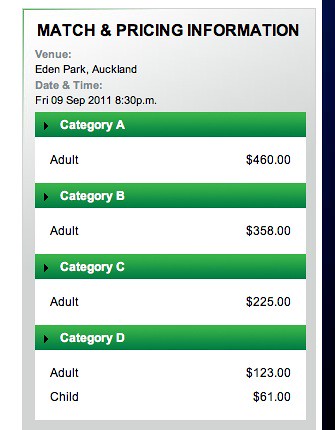
However the ticket prices leave a lot to be desired. The opening ceremony and game, which is a projected walkover between the All Blacks and Tonga, costs as above. Since nobody really wants to go to a match alone, the overall cost for a couple or family is extraordinary. There are 48 games in this competition, 15, including the 3 biggest, are in Auckland.
If the stadiums are not full we all will know why. If they are full then I hope the rich corporate types that bought or got comped tickets know how to yell loudly.

Around Auckland

Doesn’t this building look like a transistor radio? Or an old mobile phone?

pwc

Real gang members don’t turn up to the Viaduct on Auckland’s waterfront for coffees on a Saturday morning. Therefore these bikes belong to the local accountants, who are, while not being such good riders, considerably more welcome than their brethren.

Bikes

A new word introduced to me by Glen Barnes is “Facadism”. For a complete explanation of this see the atrocity below.
facadism