Is online ad spend in NZ doubling?

The just released IAB report is showing $57.6m in online advertising spend for 1H 2006. That would imply we will hit well over $120-130m for the 2006 calendar year, once you take natural growth and the Christmas season into account.

Indeed the IAB is showing over 20% growth from Q1 to Q2, which would imply$145m for the year (call it $150m)if the growth continues. That would be rich rewards for the industry in a year where we have finally seen some real investment and engagement by big media.

Last year the ASA collected $65m of total spend, and if we compare the two directly then we’d be seeing a year on year growth of 80-120%.

That’s pretty wild – but is it reasonable?

There are two things to consider.

Firstly, and most importantly, are measurement differences. The ASA and IAB stats are collated in different ways and for different purposes. The biggest difference vetween the two is that the IAB numbers include an estimate of search revenue – which is 25% of the total. That would drop the year on year increase to a ‘mere’ 40% to 70% increase.

Secondly, is this possible given what has happened in other markets? The answer to that is easy – a resounding yes. A lot of the overseas markets have seen years with over 100% growth as they moved up towards (and beyond in some cases) 10% of total ad spend. That 10% would be $220m in NZ, so we have a way to go.

So – are we  seeing that epic year in ad spend increase? or is something else going on?

Both. Ad spend is certainly on the rise. But also the way the two eries of data are collected is different.

It’s not just the introduction of search data. Here are some of the things that I am unclear on:

Are agency commissions included (they are in the IAB version)?

Are internal ad placements included and at what price? (Some companies place huge amounts of internal advertisements on their websites e.g.  Xtra and all the Telecom ads, or MSN* and the Seek, Autotrader and other PBL ads).

Are advertisements priced at market rates (or are they part of a bundle, and the online component over valued?)

No matter. The results year to date are outstanding, and it is wonderful to see online advertising in New Zealand finally come of age. What follows, of course, is more investments, better sites and new businesses.
*the MSN site, incidentally, still sucks the big one. How hard can it be?

24% of kiwi’s are creationists..

..and 26% say the Theory of Evolution is not true.

I’m stunned.

The article also says that 42% of kiwis believe the death penalty is ‘morally acceptable’.

I’m doubly stunned.

..of course this survey is subject to the same sampling bias that other surveys are: people at home at night, with a home phone they actually use, and that say ‘yes’ to surveyors that call during dinner. That will naturally knock out a whole heap of young folk, who tend to be more liberal.

Fast Broadband is here – in Perth that is

Finally I have broadband again. It took Perth based iiNet about a week to arm-twist Australian monopolist Telstra into connecting me. Their communications and service (24/7 help desk) has been faultless – which is stunning in this industry.

iiNet uses ADSL2, and here’s what I get:

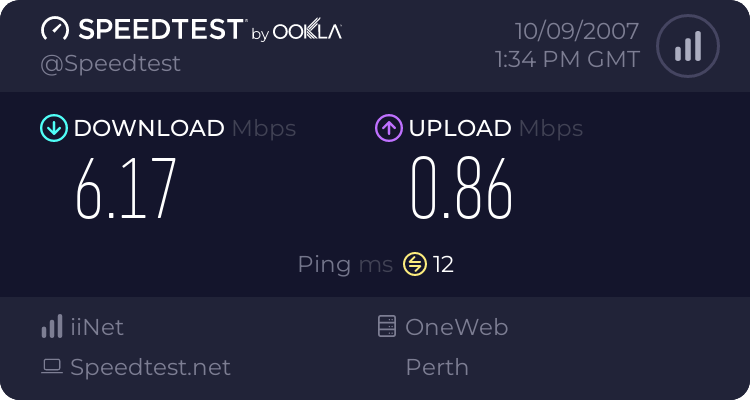
From me at home in Perth to a local Perth server.

speedtest

From me at home in Perth to  San Francisco

speedtest SF

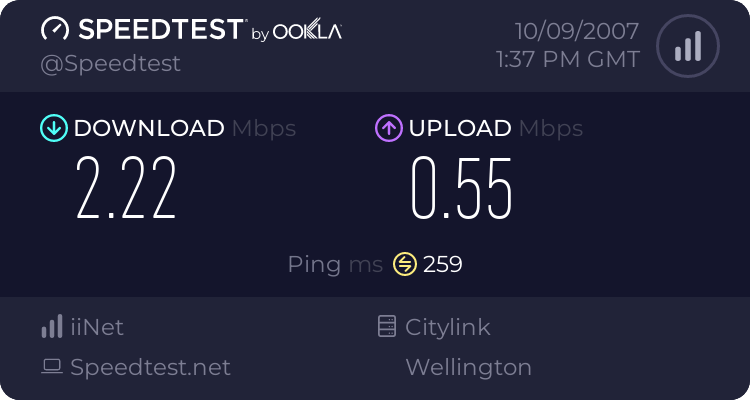
and from me in Perth to Wellington

speedtest - wellington perth

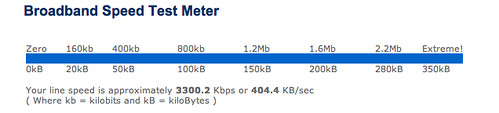
Meanwhile Telecom’s Broadband test shows a speed of 3300 Kbps – which is almost 50% above the maximum on their meter:

xtra

Finally – do check out the cool graphics on speedtest. It knows where you are, and lets you test your speeds from where to are to anywhere in the world.

speedtest

Burma is Myanmar not Burma

It’s one thing to complain about anther country. It’s quite another to call it by the wrong name.

The United Nations accepted name for the country between Thailand, Laos, China, India and Bangladesh is Myanmar. Not Burma. Even Wikipedia gets it right – it appears that Myanmar is the formal name, used since the 13th century.

The BBC has a great article on the issue, which helpfully points to Iran (Persia),  Burkina Faso (Upper Volta) and Cambodia (Kampuchea) as other countries that have had a relatively recent name change. And yes – expat Iranians like to refer to their country as Persia, which has fascinating rings of antiquity, but is clearly not the right name for publication in serious media.

Fight the right battle, and stay away from these despicable Republican tactics.

It’s all about Gino’s

Next time you are in Fremantle (visiting me for example), make sure to drink lots of coffee, and eat breakfast and dinner at Gino’s cafe.

Why?

They are the only place in town offering free Wifi internet. The other cafe’s and restaurants have nothing, which is frighteningly archaic for a funky seaside tourist town.

Meanwhile I’m waiting two weeks for broadband to be connected at my new pad. That’s two weeks thanks to Telstra, who will deign to connect me on a date chosen at whim. My actual ISP is local iinet, who seem to be pretty good aside from their dependence on the monopoly provider.

FT goes free

UK’s Financial Times has set itself free, in a half-baked kind of way. You get ’30 views’ per month, which I suppose is meant to suit bloggers linking to articles, but not much else, such as reading other articles.

Not enough for me – I’ll keep them off my list until they get it. Guys -the idfea is that the traffic increases as the linked articles drive traffic to other parts of the site.

 Like AFR.com.au FT was not up there, for me, with The Ecponomist, WSJ and NYTimes columnists, so did not have enough mana to receive payment from me.

Shipbuktu apologises and will refund for slow shipments

This was sent to me by Paul Ryan, and is about to be posted on to Shipbuktu’s website – on the control panel which is registered members only.

It’s a pretty impressive response to the customer service issues they have been having, some of which have been reported here. Bolding is mine.

Some customers are experiencing issues with the loading of items into the control panel and issues with delivery delays. Shipbuktu Limited contracts New Zealand Post to provide the logistics services and we have asked New Zealand Post for urgent answers as to why the service levels are unsatisfactory. We have escalated this to the General Manager of Postal Services for New Zealand Post in order to ensure we get more timely responses and can advise our customers in a factual way about the status of their items.
 
The staff and management of Shipbuktu recognise that these issues are unsatisfactory and we are letting our customers and supporters down. We expect New Zealand Post to resume normal service levels very shortly and they have committed to an urgent investigation as to why resolution has taken so long.
 
Meanwhile, we welcome emails to Paul Ryan (paul.ryan@shipbuktu.com) and Liam Beuth at (lumbo@shipbuktu.com)  who will attend to specific service issues. Shipbuktu will credit all payments for items not delivered within the promised delivery window and all items not entered into customer’s inboxes within one working day of receipt at our LA facility.

We share your frustration and we’re working very hard to sort the issues out and return to normal service levels.

Well done. Now for the NZPost issues to be resolved.

NZInstitute BB report: Telepresence growth benefits are limited

NZ Institute

That’s the second part of the tree on page 7 of the NZ Institute report. It shows total annual benefits of $165-$335m in increased exports from decent broadband allowing better telepresence. Telepresence I guess is defined by the authors as basically video conferencing with big screens and higher resolution.

To work it out the authors have basically said we’d get 5-10% increase in overseas sales productivity, which is applied to new sales activity 20% of the time, and as a result we wll sell and export more stuff.Now this is a really tough thing to work out, and credit to the NZ Institute for giving it a go. The validity of the answer lies, as it always does, in the numbers on the right hand side of the tree. Let’s go through them.

Current Exports: $3,200m

Continue reading “NZInstitute BB report: Telepresence growth benefits are limited”

NZInstitute BB report: Telepresence costs savings are minimal

Let’s start comments on the NZ Institute Broadband report with the top chunk of the slide on Telepresence, which is page 7. It is the first page that shows how the topline number of $2.7-$4.4 billion in economic benefits is built up. I believe the $95m in annual cost savings is far too high.

NZ Institute uses, in true consulting style, driver trees to calculate and show the benefits. I’m a fan of this method as it is a great way to identify the ‘drivers of value’, or the bits of a business or sector that create and cost the big dollars.

This is the top half of the telepresence driver tree.

NZ Institute

It shows that there are $95m in potential savings from an increase in the use of telepresence due to higher broadband uptake. Continue reading “NZInstitute BB report: Telepresence costs savings are minimal”