Introducing Pacific Fibre

We’ve just sent out this press release. Pacific Fibre is a big deal – and we have a lot of work to do!

Check out PacificFibre.net and follow us: Twitter.com/PacificFibre.

Press release: Thursday 11 March, 2010

New Zealand businessmen propose project to build international fibre cable

Aim is unlimited high speed broadband for New Zealand and Australia

Pacific Fibre, an early stage international fibre venture founded by a group including New Zealand businessmen Stephen Tindall, Sam Morgan and Rod Drury, announced its plans today, aiming to break the digital divide between New Zealand, Australia and the rest of the world.

Other founders include Mark Rushworth, former Vodafone Chief Marketing Officer, technology industry veteran John Humphrey, and strategy consultant and entrepreneur Lance Wiggs. Pacific Fibre is engaging in early discussions with cornerstone investors and customers.

The group is looking to secure funding and build a 5.12 Terabits/sec capacity fibre cable to be ready in 2013 connecting Australia, New Zealand and the USA – the initial proposal is a cable which will deliver five times the capacity of the existing Southern Cross system.

Sam Morgan commented: “We desperately need a cable that is not purely based on profit maximisation, but on delivering unconstrained international bandwidth to everybody, and so we’ve decided to see whether we can do it ourselves.”

Stephen Tindall commented: “The New Zealand Institute identified billions of dollars in economic potential by unleashing the internet, and it is beyond time to address the issue. This is necessary and basic infrastructure – we must decrease the distance between New Zealand and the international markets. Doing so will be incredibly valuable for New Zealand and Australian businesses and consumers. If we are able to deliver on this cable this it could be as valuable to our NZ economy as the quantum leap refrigerated ships were to our export trade many years ago ”

“This is a bold vision which, as realists, we know will not be easy to deliver, it will take a huge effort to complete, and has many risks. While we have completed early feasibility work it is essential for people to know we now need to determine the level of interest from potential partners before we go to the next stage of a full business case, risk assessment and proof of concept to take to investors and bankers. We realise the risks are large but are prepared to push through to the next stage. We have released this news today primarily to ensure that any parties who are interested in this space have an opportunity to speak with us during this early planning phase.”

Pacific Fibre’s ambitious aim is to deliver the highest capacity and lowest latency international internet service to Australia and New Zealand by connecting Australia and New Zealand to the USA with 13,000 km of cable. The cable from New Zealand to the USA would be direct, substantially reducing the distance versus existing cables, and thus delivering lower latency, or lag, associated with the cable. The planned cable would also offer potential for branching units to provide connectivity to several Pacific islands.

Rod Drury commented: “We are seeing a growing digital divide between New Zealand and the rest of the world. We need this infrastructure if we are serious about growing international businesses from New Zealand.

“The introduction of a new cable would drive competition and capacity in the international bandwidth market, building on the success of the Southern Cross cable, which was critical for New Zealand when it was built 10 years ago. This proposed cable would provide internet service providers and large and small businesses with a major boost in capacity and speed, but also give the extra redundancy that another cable provides.”

Mark Rushworth commented: “We have a lot of work to do to make this happen and I am excited by the challenge. With 90% of New Zealand internet traffic going offshore, a major boost in international capacity is needed to fix the 7pm bottleneck. The situation is bad now and only going to get worse as the New Zealand Ultra-Fast Broadband initiative and the Australian National Broadband Network start delivering fibre to the premise.”

“We are seeing a huge increase in demand from consumers and businesses driven by the use of video which is increasing in resolution and use. Businesses love very high resolution multi party video conferencing – all the way up to telepresence systems, while grandparents expect to be able to Skype video their grandchildren – and that too will be in HD or better. But mostly we want to unleash that creative talent New Zealand has, and be on a level footing with the rest of the world.”

The current proposed cable configuration would be 13,000 km long, and have two fibre pairs with 64 wavelengths (lambdas) each at 40 Gigabits/sec per lambda. The maximum lit capacity initially would be 5.12 Terabits/sec, but would be upgradeable to over 12 Terabits/sec as the emerging 100 Gbit/sec per lambda technology becomes reality. The newer cable and repeater technology that Pacific Fibre proposes to use will be substantially more easily upgradeable than that of existing cables.

Pacific Fibre will seek to work alongside existing industry players and also seek to aggregate any existing initiatives into a unified project.

Mr Rushworth commented: “We are delighted by the early interest in Pacific Fibre from industry players and financial backers. We believe a unified approach to building the cable is good news for the entire telecommunications industry, including Telecom, who will finally be able to deliver innovative new services expected as normal in other countries.”

For more information please contact:

Mark Rushworth
mark@pacificfibre.net
+64 21 244 0777
www.pacificfibre.net
Twitter.com/PacificFibre

Theresa’s blogging fodder

It’s sad and essentially irrelevant any more, but the excerpt (not online) from Theresa Gattung’s book printed in Friday’s Business Herald is beautiful blog and commentator fodder. The book emerges this Friday – and it is certain to have more.

Gordon Campbell has had a good go, and of course The Standard is not above putting the boot in. David Farrar was more even-handed.

I feel sad because Theresa did opt and perhaps does not even now, seem to understand, even know, how she and her board failed. Nor, it seems, do unnamed “insiders”, interviewed reported by Tim Hunter in the Sunday Star Times.

“My recollection is the team were genuinely surprised by that [the government’s decision to split Telecom]. There had been a significant amount of engagement over a long period of time.”

One thing that struck me after the attacks in the USA on 9 September 2001, was the number of people that asked “why us? why did they do it?” They asked because they had not been looking outside the USA for information, but were seeing the world through their own media and navel gazing.

It feels to me that the senior Telecom management may have been in a similar reality distortion field – they they simply failed to understand that after  years of monopoly pricing and under investment that they had lost their license to operate. There was even a petition for separation – signed by 100,000 people!

So the book will make for entertaining and interesting reading, but ultimately it is a sad story. I wonder why Theresa Gattung has written it – is she really putting herself up to be attacked? and will she be treated with respect, with aggression, or worst of all, indifference?

You decide – and I’ll end with three quotes from the book:

“That night I could barely stand to go to the board cocktail function with senior Australian staff”

I had talked about the need to simplify Telecom’s pricing structures, and acknowledged that telecommunications pricing, being confusing as it often was, had contributed to keeping telco margins high. I very explicitly pointed out that this was not good enough and that we wanted to be much simpler and clearer in pricing”

“As I went back to my office Mark Verbiest called to see if I was okay and I was so upset and incoherent I could barely speak to him. Concerned he came back to the office – it was after 7pm by then and everyone had left for the night. When he came into the office I collapsed ad he held me up and stopped me falling to the floor

Major changes required

I feel sorry for the people at NZTA – when something as simple as changing from a CC restriction to a power/weight restriction requires “major changes” to an IT system.

I guess the current system simply states the CC size, whereas the new system will need information on the power output and weight of the bike.

It’s even tougher when we have many bikes with restrictor plates (which are removable) and with all of the grey imports. In short – it is probably not possible to do it accurately or completely.

So a suggestion – rather than power to weight – why not just use maximum speed as a proxy? Make any bike than can go faster than, say, 140kmph, is not allowed for beginners. It’s easily testable on the road, and easily observable if you find someone over that speed.

Note that I would keep the maximum speed over 100kmph – because riding on our roads with anything less is dangerous to both rider and to the other vehicles.

We could use the WOF system to test the bikes – although of course they would not be able to do so on the road. So more problems.

The case for zero tolerance

A few suggestions on driving emerged from the Safer Journeys first actions paper. While some are controversial – such as raising the minimum age to 16 from 15 – others, like better training for motorcyclists and longer supervised driving periods are good. If we think of being an expert driver is completing the 10,000 hours of doing the task – a theory that Malcolm Gladwell popularised in the book Outliers – then the more time on the road the better.

I take issue with one of the proposals though, and that’s drink-driving.

This chart below, via Offsetting Behaviour, and the Law Commission report, shows the effect of blood alcohol leel on the relative risk of fatal crash. The proposal is to both lower the limit to 0.05 (though it’s a soft proposal) and to have zero tolerance for those under 20.

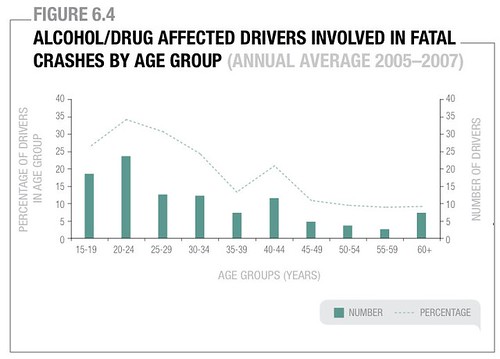
The point of the chart is twofold – that older drivers are less likely to have a fatal crash, and that alcohol increases the odds of all drivers having a fatal accident. This is probably not the point the Law Commission were seeking to make – they are trying to say that older people can have a higher tolerance of alcohol than the young and still drive. That may be true – but not for tolerance reasons.

The more interesting chart for me is this one, which shows that the absolute number of people dying from alcohol infused crashes in each age range is about the same. There is a little drop off through the years, but we can put that down to other factors – such as experience, how often people are driving, when and why people are driving.

Experience: Older people will reach and exceed the 10,000 hours limit – especially professional drivers. This gives them lot more road sense and instinctive ability to survive than someone that is just starting out.

How people are driving: Being young comes with its hormones and angst – and driving is a new experience that creates a real rush. So of course younger males, in particular, are going to want to test the limits – of themselves, of their screaming friends and of their vehicle. Meanwhile those 30-50 year olds are slowed down by the  kids in the back, by a history of near misses and by a sensibility that comes with being older.

When and why people are driving: Older people are more likely to be racking up their miles by commuting – a pretty safe endeavor with low average speeds and a higher likelihood of any accident being non-fatal. Younger folk are more likely to be exploring, driving at night and driving on rural roads that they are not familiar with.

Between those three, and adding our incredibly dangerous (yet fun and beautiful) roads, it’s shocking that the chart isn’t skewed even more to the young. Perhaps it is sending a different message – perhaps we have a different problem?

Regardless – my question is why we tolerate any alcohol at all – for any age. People are dying as a result of drink driving and if the first chart is true and increasing alcohol from 0.00 increases risk, then why not stop it altogether?

It would be a lot easier to implement in practice: If you are driving then don’t drink.

It’s a lot easier for yourself, friends and establishments to police – if you drink then you are over the limit.

It’s harder to determine your BAC in the morning after, but if you are drinking that much the night before then the combination of alcohol and tiredness means that I really don’t want to share the road with you.

This is a system that already works – and works well – in heavy industry across the world. If some of the best minds on safety are mandating zero tolerance for any alcohol at, say, Rio Tinto or BHP Billiton, then why do we accept less on our roads?

One thing that many plants do is allow staff and contractors to test themselves before going on site. We can do the same with driving – either by having interlocks, or by making sure we have a cheap but reliable enough breath tester in the home.

But ultimately if we need to test ourselves before we drive, then there are greater problems to be dealt with – and a zero tolerance driving regieme will help peoole face up to those issues.

It’s not a popular cause. People like to think they can have a beer and safely drive home. But why not?

Failing at Ignite Wellington

Tonight, at similar times around the world, are the O’Reilly Ignite sessions. Wellington is hosting one, and I’m last up after an otherwise impressive line of speakers.(scroll down the homepage to see the speakers and topics)

I’ll be speaking on the topic of Failure – and why it is right to set yourself up to fail rather than to succeed – at least when motorcycle travelling.

Come along

The Atlantic Redesign

At first I thought The Atlantic redesign was good – they are doing interesting things by putting stories in the tab drop downs.

Then I tried to find Andrew Sullivan’s Daily Dish blog (responsible for a good chunk of the Atlantic’s traffic), and failed – I had to resort to search.

On reading the blog I see that Andrew and co-writers are fielding a host of complaints from readers, and that he, a master of the blogging art, had essentially no influence on the redesign. Incredibly he had passed on readership feedback and none of the recommendations were implemented in the redesign. This goes against the fundamentals of good design – observing and listening to customers.

Overall it seems to be a classic case of designers driving to an answer without involving the audience. I can only hope that The Atlantic now starts listening to the audience and delivering what they want through continuous tweaks.

Otherwise it appears that the writers are not in control, that the readers are being forced to do things for business reasons and that ultimately this will be bad for an otherwise wonderful site and magazine. And Andrew Sullivan will simply migrate to elsewhere.

Portfolio – 2009 results

I last wrote about my US equity portfolio in November, and here are the year-end results. Things have been steady since then – mainly becase the portfolio is almost entirely in cash at the moment.

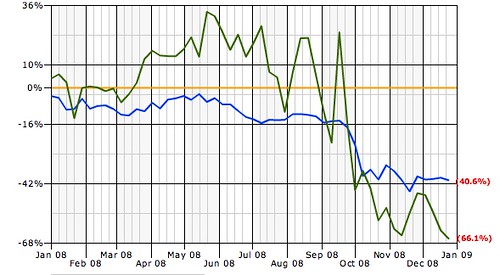
Overall it was a quiet investment year for me in 2009, despite the good results. I went long on Apple, and exited a few months ago, and stayed with Warren Buffet’s Berkshire Hathaway. The results were good, even if the amounts involved were tiny:

Lest I get the feeling that I am good at this stuff – here again is the 2008 calendar year. Not a good one, and the amounts were, sadly, larger, and the total return over two years easily negative.

This year to date the portfolio is up a little under 5% while the S&P500 is down 0.95%. I have no strong investment ideas at the moment, so am staying in cash for now. That may çhange after I visit the USA in March/April and see how things are on the ground. Anecdotal evidence is that that second crash may be still coming.

Vodafone fails to take advantage of Telecom woes

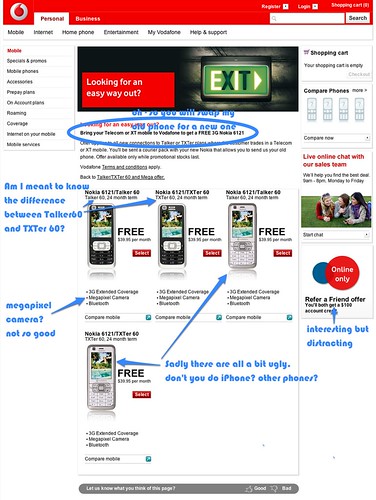
Good for Vodafone on putting up www.vodafone.co.nz/leave-the-xt-network/ to try to take advantage of Telecom’s difficulties, but from there it just goes downhill. I’ve annotated their pages. First up the main promo page is pretty cluttered, and I have to say I am really unsure what the offer actually is. It seems Vodafone wants me to buy a phone, and wants me to post a copy of my final Telecom bill. That’s confusing in several ways – as for a start I would not want to get a final bill from Telecom before I switch.

The next screen explains that this is a phone swap offer – bring your XT phone in and Vodafone will give you an ugly Nokia. You have to select one of two colours and one of two plans, and so this offer is not going to appeal to most XT customers – just the ones that like this phone and those plans.

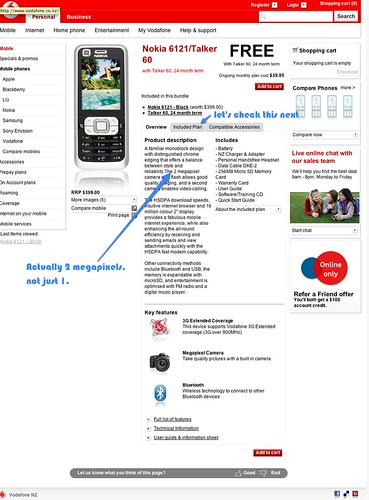
The next page talks about the ugly phone – which seems to be about features (HSDPA, 2 Megapixel camera) but very little about whether you can tether it, check your email, download a Facebook app and all that other useful stuff we increasingly take for granted.

On to the plan – whis is where it starts to get really nasty. These are limited plans – use more than 60 minutes of talk time and Vodafone will charge you 79 cents a minute from then. Every call, even those 3 second ones, is taken to last at least a minute. Meanwhile you get signed up to data at $10 per month, but you need to click on the data plan bit to find that out. There is no option to scale that plan up or down, so if you use no data then bad luck, and if you use 1 GB then you are up for $100 or so.

It gets worse – If you did not sign up for that broadband then you’d be up fro $1000 per month – but rest assureed, the Broadband Lite was selected and impossible to unselect.

In summary the offer fails in three ways:

  1. It’s too confusing – the fist screen does not match the second and so on
  2. It’s narrowly focused on one phone and two similar low-end plans
  3. It’s hard to do – what with final bills and so on required from Telecom

So here is my suggested promo page for www.vodafone.co.nz/leave-the-xt-network/. The actual options can change of course, but he idea is to give something valuable to most disgruntled XT customers, while being simple to drive and it focusing on the direct benefits of the deal. I’d suggest that doing a number change from Telecom is sufficient reason to grant those benefits.

Credit to Telecom, but a lot of work to do

Telecom has its XT and 111 woes, and the knives are being wielded across all media. Of course we in the blogosphere got our knives bloodied back in last year, and it just feels a bit sick to see the carnage now.

So let’s be nice and give credit to Telecom for three things:

  1. For building the XT network at all – they were stuck with an obsolete technology (CDMA) and made the best effort to get modern. It’s still the best network for the iPhone.
  2. For getting the network built so quickly – about a year I believe.
  3. For embarking on the required cultural change withing Telecom – kicked off by Paul Reynolds,

There is still plenty to do. Here are my top 3:

  1. The cultural change that is taking place within Telecom needs to be dramatically accelerated, and the XT outage is the proverbial burning platform that Reynolds and the team need to effect that change. I hear very positive signs from within Telecom, and the few that are not on board are, it seems, being asked to leave.
  2. Meanwhile Telecom also need to understand just what their core competencies are, and work to be best in the world at those. A hint – it’s not marketing, it’s not content, and it is not eCommerce – in fact Telecom is lousy at all three. My take on what Telecom should be immensely competent at is providing high quality telecommunications services at low cost, and providing superb customer service to demystify what is a complex technology for their customers.
  3. Finally Telecom needs to own their competencies – which means a reassessment of exactly what should be done internally and what should be out-sourced. While Alcatel-Lucent are looking pretty poor at the moment, in general vendors are only as good as their customers. Without knowing much I would guess that Telecom needs to be a lot more hands on in their control of their networks.

All this is happening while the Government is pondering next steps with the Ultra Fast Broadband submissions. It cannot bode well for Telecom. Why should the Government give Telecom the work when the installation and operation of it would probably be outsourced, when Telecom have a track record of under-investing and when through their part ownership of Southern Cross they have made monopoly type profits and constrained our international bandwidth?

License to operate

I believe that the media fest and the anger is a result of Telecom losing its license to operate. The public (and the Government with separation and perhaps with the UFBB contracts) are reacting to the years of poor practices and short term shareholder approach. The new board and CEO, and the turnaround work that Reynolds et al. are doing started years too late, and when we think of Telecom we think angrily of the sad legacy.

It’s similar to what happened to General Motors, who, in the USA, started making well-rated cars a few years ago, but found that the years of selling appalling vehicles created cumulative brand damage to the point where a critical mass of buyers would not want to buy or be seen in a GM car.

Telecom are, it seems, doing everything they can to get out of the situation, and to learn and grow stronger. They are lucky to be blessed with relatively incompetent competition that seems intent on ignoring their own advantages, and are inept at taking advantage of the current Telecom woes. More on that soon.

Power supply is up – what will your prices do?

<shameless plug>

Via Radio New Zealand we hear positive noises about the supply of electicity this winter:

New Zealand’s third largest state power company believes the country will avoid a winter power shortage this year.

..The company (Mighty River Power) says a 130 megawatt geothermal plant being commissioned near Taupo will, on its own, exceed the North Island’s entire annual growth in power usage.
It also says storage levels and inflows to the South Island hydro lakes are favourable.

That’s great news. Basic economics says that when supply rises more than demand then prices will fall. That mean spot market electricity prices will fall – something that was talked about on the Morning Program.

That’s nice for enormous businesses that pay using spot prices, and it is great for the power companies whi will make more money as their costs fall.But it means no change for normal homes and businesses as electricity retailers like Mighty Power seem unable to drop their prices.  Indeed the price you pay for electricity is fixed – aside from yearly changes that see them inexorably rise.

So what should you do? Well – there are two ways to take advantage of the economics of excess supply.

You could own a power company – and it so happens that we do actually own a few as taxpayers. Those returns may help us ultimately, but is there is a way to reduce costs for yourself and your business.

There is – and of course, it is by switching to Powershop – where prices reflect the reality of the market, and not the whim of the marketers.

Powershop is already much cheaper than alternatives, has a new business marketplace for big spenders, and this winter it looks like the prices will remain sharp.

Powershop is also a lot easier – everything just works, I’ve yet to see any paper and you can, if you like, shop around for specials or buy in bulk to save even more. You can also buy our very own FlowerPower, plant trees with TreePower and feel good when you carbon neutralise using Green Power.

So switch now and Flowerpower will even kick in $20 to help you along.

</shameless plug>

Want to start a new company? We need developers and designers

I’m in search of designers and developers to work on a specific project. It’s going to be in competition with an existing site, so we are keeping the industry under the radar for now.

Market

The market is one that provides a service or product to businesses in Australia and New Zealand. There is a demonstrated and sizable market and ability to pay is high. The competition is poor, with the primary online competitor offering woeful usability and limited functionality.

The Team

The founding group are deep industry experts and have passion for what they do. They are looking for help with the website side of things and will give considerable autonomy to the developers and designers to identify and respond to customer needs as they grow the site. The founders  will drive initial sales, have strong contacts amongst potential clients and are receiving very encouraging signals.

The Product

The product is a relatively simple web application – providing a framework for the founders to complete with their industry-specific information. There is some ecommerce required to accept payments, and some work required to design the product in the outset and ongoing work to extend the product features. It provides genuine benefit to customers, making things easier, cheaper and better than existing industry solutions.

The Approach

If you saw Eric Reis at Webstock or Foo then you are off to a head start – and you’ll be able to put what you learned into practice. We will start small, iterate often, learn what customers do and focus on organic growth. The product will earn revenue from the outset – and has potential to grow at a very good rate. The design and dev team will work closely with the founders and myself, and take control and drive the key metrics.

Equity

This is an all-equity deal – in fact we’ll be asking you to stump up a little cash (a few hundred dollars) to purchase shares as we found the company. We have at least 30% of the company (perhaps 40% for the right team) to share between the developers and designers. We appreciate that paid work will often take priority, but you will also need the capacity to deliver in a reasonable timeframe. This will most likely not suit someone in a full-time job (unless it is in your own business)as we will need to meet during the day at times.

Location

The founders are based in Auckland and I’d prefer the rest of the team was, as well. We are also happy with folks based in Wellington – the coffe is much nicer and I live here (I visit Auckland most weeks.) I do feel strongly that face to face interaction is critical, so overseas is out, and regional NZ offers will be harder to land.

Technology

We need speed, low cost and something that lends itself to the application. Otherwise I’m pretty agnostic on technology – and will even entertain proposals from talented developers that want to use an appropriate technology that they are not familiar with. I’m a fan of what Rails is doing for development speed, and of open source in general. While scalability is important, it’s much better to get something up and worry about deep infrastructure issues when we have to.

Interested?

If you are interested then please get in touch. Soon. The opportunity is waiting and I really want to make this one happen.

The perils of customer reviews

Apple sent through a promotion email the other day – pitching the new version of We are the World.

There was though, a problem when I clicked through:

Their heart is in the right place but this song is terrible.

“This new version, borne out of hubris and greed, features Auto Tune and rappers going yo-yo-yo over a five-year old backing track. In an effort to throw together numerous artists and cash in on a tragedy, they forgot the harmonizing that made the original distinct.”

Two out of the three reviews on the linked to page were very negative:

Meanwhile the song has an excellent 4.5/5 star rating, from 7475 reviewers (this is the US store).

So would your business link through to a product page with potentially negative customer reviews? Would you massage the results? Should Apple?

A clever pricing approach for growing companies

Spreedly operates a service to make the process of selling subscriptions easy, and they are themselves, it seems, very good at locking in customers. One example is the Spreedly Kickstart offer, where they capture revenue and lock in early customers by asking for a large payment up front to lock in lower ongoing costs.

The advantage for Spreedly is that they receive cash faster, while encouraging companies to commit to using the service rather than just running a trial. They will land bigger customers more easily (they see a deal) but will also capture excess revenue from companies that over-estimate their future transaction numbers.

Oh – and Speedly does not work for New Zealand companies. There seems to be a real gap in the market here for easy payment acceptance services for new companies.

Wotif launches Wotflight – let’s test it out

Wotif have launched a new site – Wotflight. It only applies only to Australian flights for now, but it is certainly worth a look.

I like the simple approach, and there are some nice user interface elements.

Looks great doesn’t it? Clearly there has been a good designer involved.

I went ahead and tried to book a flight. However I failed on the first page trying to search for a one-way flight Sydney to Perth.

That’s when I noticed the large “one way” and “return” tabs on the top left. They seem to be on most airline’s sites, but I contend that they should be history by now. If I don’t want a return flight then why can I not just leave the date empty? Alternatively (and additionally) why not give me a click-box?

While we are at it the return date is in a strange place – why not move it over under the outward date?

So I’ve had a go at editing the home page it to remove everything that is not required. What do you think?

You could remove even more if you try. I’m guessing the designer was told what to put in, and that the usability person didn’t have much say.

The results page has also been designed – and is stunning looking.

It’s quite a lot to take in, but I found it easy enough to navigate. It shows all the options on one page – from flight times and durations to seat types and costs.

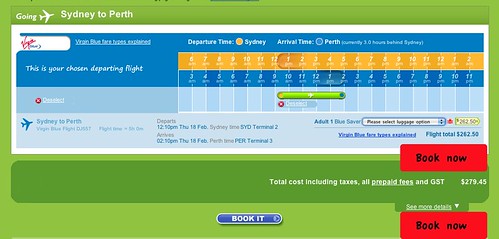
Click on “select” under a ticket and you come to the buy summary page. It is not too bad:

However once again while it looks nice, some improvement is required. Here’s the really obvious one:

and there is plenty more to do on that page. So let’s look at the next, payment page:

Scary. It’s lovely to look at in one sense, but simply too scary in another. My hypothesis with the site is that it was done by some pretty good designers, but it was not user tested very much, if at all, and it was subject to some constraints by a business person.

But then – I’m just one more user.

Overall – a good launch effort, but the real work starts now in the daily tweaking.