Pretty good education NZ

In an article in the NYTimes that focuses mainly on Shanghai’s stellar results we find a table, and in that table we find NZ’s education test results. This is the PISA test of 15 year olds. I’ve often said that NZ has a good average education, while the USA has a much wider distribution, and a lower average. This bears some of that out.

Obviously we’d be much better off further up the table, especially for mathematics.

Judgment day – when will US and China, India and others

It’s hard to see how the United States can resume the rapid GDP growth necessary to reduce its fiscal deficit when almost 20 percent of its working population is unemployed or underemployed.

A McKinsey Quarterly report on Globalisation’s Critical Imbalances.

Prepare for large currency shifts between developed and rapid developing countries. If we are lucky these will be gradual, but in the currency game shifts can be sudden and dramatic, the so-called judgment days.

However while I do see a shift in currency is required, I would not bet long term against the US economy – it’s proven time and time again how resilient and powerful it is. That 20% un/underemployment can also be seen as spare capacity in the engine. The USA does have an issue with the lower quartile of population though – generally under-educated and stuck in a horrible poverty cycle. It remains to be seen whether they can turn that into competition for China et al.

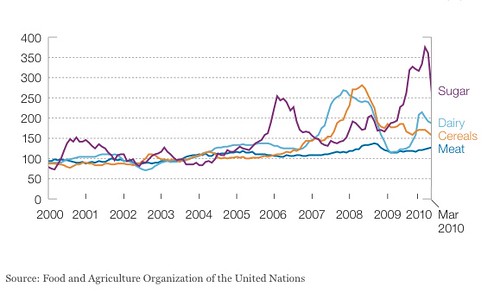
This chart from the report showing food commodity prices shows that dairy prices have risen a lot from their base – but that they have plenty of room to either grow or contract versus historical norms. Mostly contract sadly.

Neither beautiful nor usable

Seen the Review your Website page before?

Wondering what it is all about?

Wondering why it ever existed and was so ugly?

It was an experiment. I put the Review your Site page up to see whether it would be found, whether anyone would contact me, and whether anyone would actually pay me to criticise their site. I did it also because my time became incredibly crushed, and I simply was not blogging as often, but I wanted to let people know that I could help if they were serious about needing it.

Nothing happened

Perhaps I should have blogged it, but overall all I got were a few snarky comments about the overall website being poorly designed. (It’s a standard WordPress.com template otherwise)

The design of that page is meant to look poor – cheap even. It’s a ripoff from the world of ebook sales. Do go and check it out that murky world, as they are dominated by A/B testing and the resulting websites are ugly but effective.

It’s similar with many great sites – beauty is not equal to usability. The first impression of Trade Me for many people coming from overseas, including myself, is that it is simplistic, cartoonish – and not serious. After a while though we realise that it’s just simple to use, and deadly serious in staying simple to use  – and that’s why it gets used a lot.

Anyway – without further ado – the results:

The page had just 315 WordPress.com measured views since it went live on the 20th of May. That’s about the number of views this site gets on an average day when I do not post.

Nobody contacted me about the offer.

That’s less than I expected, but not unsurprising. I’m leaving the page up for a little while longer to make this blog post relevant, but basically the experiment is over.

It was neither beautiful nor usable.

NZGirl is not safe

Perhaps it’s because the site is aimed at teenagers, and they are asking teenagers to show their breasts to everyone.

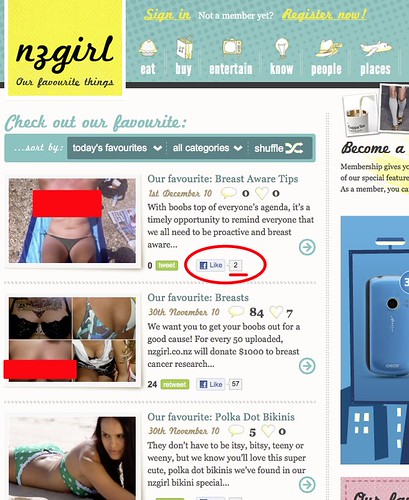
Or perhaps it is because they are saying some breasts are better than others – when breast cancer folks are very careful to avoid that <update – this was reported by 3News, but @jenene says it is not at all true><update 2: Actually it is true – there is a Facebook Like button next to each pair.

Here, pointed out by @boganetteNZ, is what happened to some of those pictures:

>

Or perhaps it is because it’s such a naked attempt to get publicity for a site that is dead in the water due to Facebook.

Or perhaps it’s just bad <database/server> design.

It certainly is lousy website <infrastructure> design – the site has been offline, apparently, for much of today.

Whatever it is – any reputation NZGirl had is now toast.

As a reminder:

  1. Parents – don’t let your kids go there. It may be named ‘girl’ but NZGirl is aimed at older folks. It’s not safe.
  2. Those over 16 – don’t ever place pictures of yourself naked online, and don’t even take them in the first place. Your current friends and colleagues will see them, as will your future employers, boyfriends, children. Data always escapes.
  3. NZGirl – fess up that it was a dumb idea, take the promotion down and pay $10,00 to the cause immediately. You’ve had your publicity now stop the damage.

Check out the Dr K Breast Checker (from Lingopal) to help you check your breasts regularly. No photos required.

Also check out the Susan G Komen website for good information on the issue of breast cancer.

And this article in Salon talks about selling breasts for cancer

<update. Some tweets

It’s hard to answer this without sounding like a fusty curmudgeon.

Kate may or may not be a victim – that depends on exactly what she uploaded and what else is already out there. However feeling like a victim is not an essential element of being one.

To that point, I really hope this is not true yet.

(later)

Oh heck – it actually is:

@wandaharland raises a good point here:

My take is that they thought it was a clever idea but never really considered the implications, or tested it with enough people outside the NZGirl RDF. It was perhaps driven by both business and a passion for the cause, but not, as very little actually is,  deliberately evil.

I’ve called out a lot of businesses and websites here and elsewhere. The responses range from defensiveness, to aggression, to heavy internal discussions but nothing public (but a quiet word a year or two later) to (my favorite response) a phone call, decent conversation and thanks for pointing out an issue.

This one is tough for NZGirl  as the mainstream press picked it up first, and stances have been set, and yes – I came out angry and swinging. I still believe the right thing to do is make a splash of paying some money to the cause and exit stage left.>

Telecom – why not walk in our shoes

This is me googling to find out how to recharge my iPad prepay SIM card. The link I used to have to Telecom’s site no longer works, and so I sought help. Last time I got the answer from twitter.

Telecom has a great opportunity to not only write text that responds to the query, but also to use the ad placement to answer the question. I have not charged my iPad for abut a month because it is too hard – so please, pretty please, walk in your customer’s shoes for a while, and figure out how to help us buy your services.

That’s not friendly Air New Zealand

I’d rather Air NZ admitted it and just charged us slightly more for fares.

This card payment fee is ludicrous, as essentially every private traveller will incur the fee. It’s another line on the statement, makes us annoyed when we see it, and will no doubt appear after the headline rate. Are we going back to the days of a low low fare with heaps of fees added later? That didn’t pass muster.

And why do business customers (using the Air New Zealand Travel Card) get a break from the fee, but GlobalPlus co-branded/affiliate credit card holders or Gold or Gold Elite customers do not?

This isn’t how friends treat each other Air New Zealand.

NBN cost benefit notes

There will be 7 million new fibre connected premises in the world this year, for a total of 50 million up from 43 million. Most of these will be in Asia.

Not many in the scheme of things, but this will be an interesting number to track in the next 20 years.

“The NBN will also facilitate a major reallocation of capital in the telecommunications industry, which has historically been dominated by high Public Switched Telephone Network voice revenues.

The decline of voice revenue is already underway, and is expected to accelerate with the advent of high quality Voice over Internet Protocol (VOIP) under the NBN. However, declining voice revenues are expected to be substituted by increasing broadband revenues, as business models continue to shift from toll calling charges to access charges.”

Telcos make lots of money from the telephone and the line charges they make you pay. Going forward we will stp paying these but pay more for internet. Many of us went this way last century.

NBN Co’s objectives:”

  1. The network should be designed to provide an open access, wholesale only, national network, covering all premises;
  2. The technologies utilised should be fibre to 93 per cent of premises (including Greenfields developments), fixed wireless to 4 per cent of premises (delivering at least 12Mbps), and satellite to 3 per cent of premises;
  3. The pricing principles to be employed should ensure uniform, national wholesale pricing accessible on non-discriminatory terms; and
  4. The network expected rate of return should be in excess of current public debt rates.


The NBN Co product set will be offered as follows:

  • A uniform product construct across fibre, wireless and satellite, featuring the same four product components across each access network, and based on the technology-agnostic Ethernet Bitstream framework.
  • A 12Mbps downstream and 1Mbps upstream entry-level offer across all three access technologies (i.e. fibre, wireless & satellite), at the same price (network ubiquity).
  • An initial fibre product suite with committed speed options of up to 100Mbps and peak speed options of up to 1Gbps (performance certainty and speed).”

I like these a lot, but it’s hard when you try to match satellite and fibre. The idea that everyone in the nation should pay the same, that 93% of premises have fibre and that anyone can use NBN service is fantastic.

By December 2011: “Capability to fulfil, activate and assure an increased number of products with multiple RSPs and up to 19 per cent of premises passed.”

Over 20% of the fibre rollout possible within a year, or maybe this just refers to the ability to accept those connection.

Underlying assumptions: “the most significant … growth in speeds and demand and hence revenue.”

The question here is not whether demand for speed will increase, or whether prices will come down, it’s what the total pool of money spent will do over time – and that goes back to end users choosing to spend more money on things that require fibre and less on other things such as voice calls.

The stated internal rate of return is also dependant on the completion of the Telstra deal, which has a material impact on construction costs.

Part of the reason for the delayed cost-benefit is that exposing the Telstra deal benefits gives Telstra more negotiating power. The deal is not yet done.

The internal rate of return does not take account of any external benefits anticipated from the NBN to the economy, productivity or social outcomes.

The economic benefits to society make the rest of the the returns look pathetic. It’s impressive that the project stands alone, but if Australia (or NZ) are serious about competing then these fibre projects are a must. There is much to lose and much to gain.

The number of GB/month in June 2010 is an average of fixed downloads (9.2 GB/month) and wireless downloads (1.2 GB/month).

Does your wireless device download 1.2GB/sec per month? That’s the average in Australia

NBN Co has also referenced usage projections against a number of independent sources:

  • Historic ABS data, showing a 36 per cent per annum compound average growth rate from 2000 – 2010.
  • Cisco international forecasts for internet traffic to increase at a 34 per cent compound average growth rate from 2009 – 2014.


In NZ Southern Cross is reported to have said it’s 35% a year for the last 10 years. Everybody is forecasting much higher CAGR going forward, as better plans and higher available speeds release the pent up demand.

A conservative approach has been taken with regard to long-term data usage growth, factoring in considerations including saturation of usage, slowing growth in online hours and increasing delivery of content on multicast applications. This sees growth fall to ~8 per cent p.a. from FY2030, well below the baseline increase in access speeds forecast.

Every cost-benefit or Investment Memorandum incudes the words “A conservative approach”, and it usually isn’t. However I disagree with their findings and see no reason why a 30 year trend of 35% growth would suddenly stop in 2030.

“At the end of the contribution and deployment period, the total capital expenditure (capex) is estimated by NBN Co to be $35.7 billion…. The Agreement between NBN Co and Telstra, worth an expected value of $9 billion, in net present value terms(NPV).. ..$13.8 billion decommissioning and infrastructure payments by June 2020”

It seems like $35.7 bilion of capex and $13.8 billion in opex, but the NPV for both is of course lower as it is spent over time. These are scary numbers, but NBN pays for itself, just over a very long time. And don’t forget to add in the economic benefits.

A capital weighted WACC has been derived at 10 per cent-11 per cent over the 30-year period.    This has been factored into the business model.

NBN are using a multi-staged discount rate for the project, as the risk changes over time. However the chart below shows that the average cost of capital is above 10% until 2025, so I struggle to see how they can have an average of 10-11%. But I do like the idea that the various stages of investment are at a declining risk.

And finally, once again, there is nothing on international capacity, as it is out of mandate.

With 10.9m (current, growing each year at 1.6%)  premises on 100Mbps connections, that’s a combined capacity of 1090 Terabits/sec. That’s about 200 times the current unlit international capacity for Australia and New Zealand, so if all unlit capaicty went to Australia the contention ratio wuld be 200-1. That’s about 10 times to large – in NZ Crown Fibre  wants about 20-25 I think. So it implies that we need 1090/20=54.5 terabits/sec of capacity from Australia by the time the build is complete, in about 2020.

But we’ve under-estimated the combined capacity number, as a large percentage of households will choose the 1 Gbps plans instead of 100Gbps (and ther are other adjustments up and down to make). However you look at it though, there will be a huge demand for international capacity that Pacific Fibre will only partially meet.

The size of the cost-benefit

Australia’s Prime Minister Gilliard said it would be 50 pages, but instead the summary of the 400 page NBN cost benefit paper released yesterday was just 36 Pages.

Here they are:

Doesn’t this look a little like someone’s homework where they try to expand a set amount of text to reach a certain number of pages? Have a look at the first two pages of text:

There are just 28 lines of text in the first page (nice large typeface) and an orphaned 2 lines on the next page. Scanning the full document there appear to be 6 other orphaned pages, along with another 7 pages that are half a page or less. A quick reformat would see this document crunch into about 20 pages, which, to be fair, is now approaching the right length for a document that will actually be read.

That’s it. Read the document yourself if you’d like to know the actual numbers. I’m a supporter.

Beautiful giveaway

In a season of pre-Christmas shopping madness most retailers try to bombard us with special offers and incentives to buy.

The folks behind 1Password are doing something different – giving their stuff away for free.

It’s a great way to sell, and expanding their customer base is critical for Agile Web Solutions, but it also stands out amongst the rest of the emails in my inbox, and, well, just look at the beautiful design:


The 20% off store wide special is for one day only.

The just in time consumer

A long article in the Wall Street Journal says essentially one thing: People are holding lower stock levels in their pantry, and buying less items at a time.

The Great Depression replaced a spendthrift culture with a generation of frugal savers. The recent recession, too, has left in its wake a deeply changed shopper: the just-in-time consumer.

It’s an interesting phenomenon, and one which makes complete sense when we think about it. If we buy in bulk we may save a little per unit, but the downside is often a drop in quality and freshness, and the potential to overestimate consumption and have items sit in the shelf for years.

We have also see several cases of manufacturers reducing packet sizes, though sadly not the prices to match. But are we also seeing the lower pantry levels in New Zealand? Are the average shopping trolley sizes going down?

10 ways to stop the cyclist killings

It’s madness.  The recent spate of bicycle deaths is no doubt partially caused by the nicer weather and people getting out there on their bikes. But the families and friends left behind and all of the rest of us have cause to be angry, as the deaths were arguably caused by known hazards that did not have actions assigned and closed out. For example Auckland regional transport knew that Tamaki Drive is “the city’s the most dangerous stretch of road for cyclists” despite it also being one of the best tourist spots. So why was it not fixed? Why was the prospect of someone losing their life not prioritised and addressed?

It’s not time to accord blame though, and it really never really is. It’s beyond time to fix the underlying problem – and so here are 10 starters. Retesting car drivers is not on the list, as it isn’t the underlying issue. Increasing safety is about reducing physical hazards, by for example physically separating cars, bikes and pedestrians, and by changing the values of the people on the road to put safety first.

1: Extend the authority of the NZ Transport Accident Investigation Commission from all other transport to include all road transport. This group has the right to investigate, in a non-blaming way, all other transport accidents and incidents, and delivers remedies that save lives. Allow them the right to dip into any road transport accident and do the same — this in addition to existing accident investigation. Do nothing else and this will save the most lives.

2: Temporarily ban cyclists from the most dangerous roads to cyclists, such as Tamaki Drive, until actions have been taken to redress the danger. Yes this will be a wildly unpopular thing to do, but we need to stop killing people and this will ensure action is fast. At the very least put up signs informing all road users of the dangers.

3: Review all of “the most dangerous roads” before Christmas and implement temporary fixes to all of them, either banning bicycles permanently or, preferably, removing hazards such as the parked cars on Tamaki Drive. That particular road should be one of the most pleasant to ride in the country, and instead it is the most dangerous.

4: Change the law to presume that the driver of a vehicle that causes death is guilty of manslaughter, and embark on an extensive and never ending advertising campaign to drive that home. While mitigating factors can be bought into play, changing this law will result in actions such as vehicles moving further to the right when over taking bikes, people looking before opening car doors and the even French approach — slowing behind the cyclist to wait for a safe moment to pass. When we step into a vehicle we should be aware that we are stepping into a potential murder weapon and drive with due care and attention. If we are not willing to accept the consequences then we can take the bus.

5: Conduct a review of the cycling law in New Zealand, including changing the law to enforce a certain safe distance that cars must leave beside bikes when overtaking on 50km and 100km roads, allowing bicycles to have signaling equipment on their bike (such as indicators) and clarity about where bicycles can ride in the lane when there is insufficient room on the shoulder.

6: Cyclists wear high visibility gear so that you are seen. Put a bell on the bike or be prepared to yell frequently so that you are both seen and heard.  When there is no bike lane or sufficient room to ride safely with the cars on your right, then move into the car lane, right in the center, and stay there until it is safe to move to the left again. You are a vehicle and have every right to a safe journey.

7: Wield your camera phone and take pictures of drivers, and bike riders for that matter, who behave unsafely. Post them to twitter, facebook, the web and the Police. Direct the attack at the person’s behaviour not the person themselves.

8: Finish the New Zealand cycleway project. NZ should be paradise for bike riders but our roads are literally killing our reputation. (I’ve motorcycled safely in 70 countries but do not recommend that people ride bikes on the highways in NZ. Go to South America or France instead.) Extend the bike path project to include safe paths on routes between all major cities.

9: Abandon the idea of shared footpaths and cycleways — they may work for promenading on Oriental Bay or Tamaki Drive, but they are unacceptable for cyclists and pedestrians wanting to train or commute.

10: Ensure that all bike paths, such as the Hutt Motorway one, are in better condition than the road, which means the surface should be smooth and regularly swept clear of debris.

1-day – live is completely unacceptable


1-day – LIVE, originally uploaded by LanceWiggs.

If the 1-day live site is real then it is completely unacceptable. It may be fine to show John from Waikato, or Tim from Auckland, but I suspect there is not more than one Kanwalpreet in Upper Hutt. That person has purchased something and had that information broadcast to the world, which, and I write without even looking at it, is clearly in breach of the privacy act.

Ultra Fast Broadband Will Render Telcos Irrelevant To End Users

“UFB will render Telcos irrelevant to end users”, and it’s time to have some fun debating that.

It’s a breakfast and debate, at the Westpac stadium and on the 30th November. Check it out and sign up by emailling events@ffxbusinessgroup.co.nz – it’s $45.

I’ll be on the Affirmative with the superb Vikram Kumar from InternetNZ, and our rigorous logic and rollicking rhetoric and will see off any threat from Alcatel Lucent’s Gabrielle Gauthy and Brett O’Reilly, who will be negating.

Clare Curran will introduce the debate in her inimitable style and Sarah Putt from ComputerWorld will Chair.

The audience just has to eat and try to stay awake during what promises to be a terse and dry discussion on the merits of competing fibre technologies.

Or not.