Starting with pain

Both Paul Graham, in a post about start-up ideas, and Vaughan Rowsell, with a just published interview, talk about the importance of understanding customer pains and needs. Vaughan first, from an interview with DoesWhat

I started Vend completely by accident. I actually had another idea, as awesome as Soapbox, that was mobile and could let you find Cat Jumpers in stores near by from your phone. Well that was one of the premises, but basically it was a social network for shopping. A little before it’s time, but it made me look at what would be required to make something like this actually work. The further I dug into it, it became obvious that the whole offline retail platform needed to be rebuilt from the ground up, starting with the software retailers used to run their businesses. Product, inventory, payments and customer data all needed to be on the cloud. So I started there, and that became Vend.

I got the fuller version of this the other night at Vend’s AGM. Vaughan was smart enough to validate his “awesome” idea for social networking while shopping, and had assumed that he would be able to connect with existing retail point of sale systems. The POS scene was mired in the 80s, and so Vend was born. It’s that persistence of digging and digging to fund both the underlying problem and to validate the need for a paid solution that created the kernel of the great idea. Since then Vaughan and the ever expanding Vend team have done little wrong. They are growing at 400% a year (or so), and I’m starting to refer to them simply as the next Xero. Well done all.

As for Paul Graham’s post – it’s superb, and everyone should just read it. He has distilled most, if not all, of the sensible advice to founders on what to work on into a single article.

(I’m a small but happy Vend shareholder)

Pacific Fibre II: Background and questions for new players

Kim.com is the first, among many I believe, to try to resurrect the case for Pacific Fibre. This has created a bit of a media kerfuffle, and so let’s get some background and questions for Kim and any other potential new players to answer.

I remain a very strong believer in the business case for a Trans Pacific cable from Australia, through NZ, to the USA. The basic business case that I mocked up on a spreadsheet after a chat to Rod Drury was improved countless times as we learned and even redone completely two or three times by others, but the drivers of value and the results for investors and customers never really changed.

There are three main activities to successfully complete to build a cable system – financing, operatons and sales to customers. Let’s look at each of them in turn and understand the key questions to answer in order to determine what new player have to do to be credible.

Finance.

The company will need access to funds in the order of US$300m (NZ$400m) for an Australia-NZ-USA cable. This can be raised from a combination of debt or equity, but investors will demand substantial credibility to back up the proposition. The business case credibility seems obvious to me, but unfortunately people who run funds generally have very restrictive rules. Those rules can even make the investors appear to be  illogical or unsophisticated, but rules are rules and when you are running huge funds managing the downside risk is everything.  So sadly Pacific Fibre was unable to bridge the gap as investors  demanded an out-sized book of signed pre-finance customers, along with known costs.

Pacific Fibre delivered on tight cost projections, but were unable to build a book that would justify the $300m raise. The potential investors collectively insisted on to many restrictive and overlapping covenants, including what I consider to be unrealistic customer signings given the market structure. Some major domestic potential funds essentially ignored the prospectus, and others were unable to understand the combination of cable system investing, investing in Australasia and the unique characteristics of the local submarine capacity market.

Finance Questions for new players:
Can the new player secure US$300m of financing? Does the new player have the money really lined up, sitting in a bank account and releasable to the vendors?
Is the new player credible to any other required investors?
Does the new player have a track record of raising large sums for similar local ventures?
Can the new player get financing without a full customer book?

The best answer is “yes – we have US$300m in cash ready to spend – let’s go”

Pacific Fibre shopped the prospectus to a large number of local and foreign investors. Some of those, perhaps government owned funds, may be regretting their decisions, but all will be far better informed for new player conversations. I believe those conversations need to be far deeper and collaborative – we are all in this together.

Operations

Getting a well scoped and priced contract to build takes time and credibility. The suppliers do not want to deal with fly-by-nighters, and it was to Pacific Fibre’s credit that they were able to run a very good tender process and eventually sign a compelling contract with TE Subcom. We had a world expert (really) on the team and learned a huge amount.

Beyond the master cable contract, the cable system needs to secure landing rights for each of the countries, and the authorities will look hard at the vendors, the technology, the company and the investors and owners. This makes it very problematic for certain vendors in certain regions, and for certain investor types as well. One obvious example was the recent damning (yet not substantiated) USHR report on Huawei land-based telecommunications equipment. The scrutiny for sub-sea equipment is even higher.

The cable landing requires fibre to be laid, landing stations and connection and colocations deals. All these take time, money and industry expertise.

Pacific Fibre learned a lot in the process, as did the vendors, and much of the operational risk for a new player who can learn from the experience is mitigated.

Operations Questions for new players:
Can the new player convince TE Subcom and their peers to invest in responding to a tender?
Can the new player and vendors secure landing rights in all countries of operation?
Can the new player attract industry technical and legal veterans to deliver the goods?
Can the new player get NZ, US and Australian Government support?

The best answer is “yes, we have a signed master contract with an approved vendor and landing rights and arrangements for all countries of operation.

Customers
For new players without financing building a customer book is the vital part of convincing investors that the project is credible. The business cases and modelling are simple and compelling to me, but players have to be able to bridge the credibility gap between the model and contracts. As inferred above truly sophisticated investors will see enough evidence in the model and small market validation, and a project that does not require up-front customer contracts makes higher returns due to less discounting.

If Pacific Fibre had had $300m in cash then signing customer contracts could have waited, but instead this was the main activity for much of the time. It took an extraordinary effort (on both sides) to contract with the large telcos who could take the volumes of capacity required to make the numbers work. From our perspective they absolutely validated the demand, but investors did not agree. There were a few smaller players to sign, but some who didn’t – Pacific Fibre, for example, didn’t even manage to sell to Government owned Orcon.

However the biggest issue, the elephant in the room that investors also struggled to deal with, is market structure. Telstra alone represents about 50% of the combined Australasia market for international capacity (before Telstra Clear was sold to Vodafone). They, along with giants Optus and Telecom and Australian ISP TPG, have ownership stakes in existing cables. It’s obviously not a very competitive market, and so those existing cable owners have every incentive to keep prices high by not helping  out a potential new entrant with orders.

This is an extension of a well know game theory scenario from other cable markets, where typically incumbents drop prices just enough to discourage credible threats and then prices remain static and monopoly rent-taking ensues. Indeed the self-reported historical Southern Cross prices were amusingly static and then plummet arguably around about the same time as various credible threats turn up. Even given that I would argue that this market probably has less price drops reactions than others, simply because well over half of the capacity demand is withheld from new entrants. Withheld that is until after any new systems are financed or built, in which case it’s in the best interests of incumbents to diversify their own capacity demand, and they become buyers. It’s a well-worn road, but investors were never able to truly grok it, especially with their imposed investment rules.

For the (awesome) customers who did sign up with Pacific Fibre, the process generally took well over a year, and perhaps two or three.

Any new players that are telcos will bring their own demand, but they will also bring even more potential problems with finding customers before the cable is built. The normal approach is to join together with other telcos, but in this market the largest players already have cables in the water, mainly going to Australia. The giant Telstra, with the sale of Telstra Clear, now has very little incentive to go via New Zealand, and so the New Zealand market cannot rely on them being the next to build.

Customer Questions for new players
Is the new player credible enough to negotiate and sign individual contracts worth $10-100m before the cable is financed?
Can the new player sign a critical mass of customer contracts to convince investors to invest?
Will the largest industry customers ever buy from the new player?

Pacific Fibre warmed up the market somewhat, and there was a good learning curve for all parties. Any credible future players should find that sales conversations are easier, but will still need to invest serious time and legal expertise.

End note
I was one of the four original and six public founders of Pacific Fibre, leaving the business in June 2011 when we handed over to a finance team.

Paying our tax – step 1 of 10 complete

It’s great to see that NZ Customs has introduced a website, WhatsMyDuty? to help us calculate how much GST (and other duties) we owe when importing goods. That includes ebooks, it seems:

I’d assumed eBooks were duty free, but it’s going to be hard to have them assessed as they don’t actually arrive in NZ, at least not in the physical sense.

This website is an important first step, but it isn’t enough.

The next step is to place a giant Pay Now button on the site, and accept tax payments via credit card against our IRD and importer numbers. After that provide an API so that this service can be entangled with everything else online, and then systematically work with the largest importers so that GST is charged at source.

  • When physical goods arrive, with pre-payment they could be shown as tax-prepaid and cleared instantly, matching up against our importer number.
  • Shipping and sending entities can accept payment from the customer and clear it through this system, publishing the results to the customer so they they know they are compliant.
  • Those payments could appear in Xero, personal finance managers and the like so that we can track and prove compliance
  • Allowing us to easily pay and track payments for purchases of non-physical goods, like ebooks, that are not currently assessed gives evidence to be used in later years when the IRD ties up with large importers like Amazon.
  • and so on.

As with the IRD, the emphasis should be on helping people understand their liabilities, and making it easy to pay them. This is part-way there, but a great minimum viable product.

Overall this is the first step to a future where only people choosing to cheat don’t pay GST & duty on imports of all goods, physical or virtual. It’s not nearly enough to tilt the balance yet, as the collection of import duty from individuals is currently inconsistent and painful. But close the loopholes, provide us with some great tools and we’ll start to solve the big issue of tax collection for purchases made offshore.


Plotting Apple’s next steps: Giant screens, merged iOS and OSX devices and cars?

A year ago, in The Steps for Apple beyond iPhone 5, I tried to map out the future of the iOS product range – focussing on the iPhone as the base. Let’s review how it went, and look at the next 12-24 months for Apple’s portable devices.


iPhone

The initial miss was that the iPhone 5, with more screen and thinner, didn’t materialise for a year. However it did eventually appear and the 4S that appeared last year nicely fills the iPhone classic category.

There is no nano format iPhone, and I still believe there is scope for a smaller iPhone. Apple can use the same approach as with the iPad mini, scaling down the physical screen size of the iPhone 4, while retaining the 3GS pixel count. The new iPod Nanos could be a great size for a fully functional iPhone, although perhaps a bit thicker in the hand.

Apple have a policy of keeping the last two generations of phones on the shelves, and progressively lowering their price as the cost basis falls. It’s a hard strategy to beat, and says a lot about the quality of the initial products when they are still selling well against the latest phones.

Prediction: A smaller form factor iPhone within 18 months.

iPod Touch

The iPod Touches are lower range products, fitting underneath the iPhone and iPad. As a result they will increasingly skew towards fashion as well as technology, and we should not be surprised to see the lovely range of colours for the latest generation. The product is  quiet achiever, arguably Apple’s key answer to the gaming market, bypassing the home console and placing pretty amazing gaming power in the hands of everyone. Yes, it’s primarily aimed at younger people, but after picking one up recently I was delighted at how superb it is to read books (easy to hold, light, larger screen) as well as to  play games and browse.

The issue with this delightful product is “where to next?” The iPad Mini was one obvious next step, though obviously that’s being sold as a smaller iPad rather than a bigger iPod Touch. I do believe there is scope for a smaller version of the Touch, as with the suggested smaller iPhone, and in the current iPod Nano form factor. I also see a lot more fun in the future with form factors and colours. Perhaps a 3G-data only version, perhaps one in the iPad form factor, and perhaps all of the above. It’s reached the stage where the innovation is in fashion, as the smaller iPods have been for years.

Prediction: More iPod Touch colours and form factors within 18 months.

iPad

As predicted we did see did see a higher resolution iPad, called iPad rather than iPad 3. We did not see an iPad/Air combination with a high resolution screen, but instead saw the rather excellent series of Retina Display Mac Book Pros.

The iPad mini was an obvious, in retrospect, miss, with instead a prediction for a larger magazine size iPad rather than smaller. The smaller product is cheaper, going to sell in much higher quantities, and addresses a gap being serviced by other tablets.

There are still gaps to fill in iPad’s space, starting with a larger, table-top, iPad. It’s hard to define the use-case for a table-top iPad, which may be one reason Apple is holding back, along with the high cost and energy required for a screen that large. However this product is, in my mind, something that developers will quickly find compelling software for. Three examples are table-top multi-player games, wall mounted dashboards for news and views and wall mounted computers. I’d hope (not expect) to see a double size iPad with the same pixel count as the iPad 3 emerge in the next year.

Wishful prediction: Double sized iPad within 18 months.

The lower resolution iPad 2 and iPad mini will fairly clearly migrate up to high resolution displays as cost and battery life improves. That means in effect that the iPad 2 will be dropped as a new iPad fills the gap from the top. While that could be a table-top iPad, it may be a new physical design that lowers weight (it’s still a heavy thing) and increases speed, or as below.

Prediction: iPad Mini (HD) within 18 months

Finally Apple can experiment with changing the shape of iPad, going for a squarer or more rectangular shape, and playing in different sizes.  I don’t really see this happening, as Apple has been smart in the past to stick to a few form factors to make it easier for developers. However the obvious pick would be for more horizontal pixels, as with the move from iPhone 4S to iPhone 5. So here is a sad but necessary:

Prediction: iPad Stretch within 18 months.

Sad because what I would rather see is the full table-top double or larger sized version.

Putting it together

It’s easy to be frustrated with Apple’s apparent pace recently, as it feels as if they have not really delivered anything new. We’ve seen bigger, thinner, higher resolution and prettier products, but no new category of products. There is still a tremendous amount of growth left in the iPad and iPhone lines, but competitors are catching fast, and are even showing signed of nudging ahead in some instances.

However Apple did begin the high resolution battles this year. The iPad 3 emerged in March, and we have seen two Retina Display MacBook Pros so far. These are all amazing products, but Google’s just announced Nexus 10 tablet will be even higher resolution, delivering 300 dots per inch, than the Retina iPad. That’s the same resolution as the original laser printers, and was touted then as the readable resolution. Google is a long way from being Apple, as a simple click on “Shop” will inform you. But for Apple to be beaten on such an important technical metric is stunning.

More importantly Microsoft and a host of hardware vendors are moving quickly with the long-awaited Windows 8. The first batch of Windows 8 machines seem mostly flawed, but there is enough on display to show real potential. It’s a real wow moment to experience using a MacBook Air-like computer with a touch screen and a operating system designed to take advantage of touch. While it’s not ‘Apple’ ready, Microsoft and the manufacturers are not going to rest, and Apple for once has lost the initiative.

So the clear challenge in the shorter term is from Microsoft, and Apple’s response should be to somehow bring the iPad and MacBook experiences together in a way that delights. This may not be possible, but Microsoft have given this a very good go, and Apple risks everything by not responding. If the Windows 8 tablet/laptop succeeds, and I believe it will really take off in 6-18 months, then the Apple stand-alone approach will seem dated and inefficient. That’s a rapid step backward for the leader.

Prediction: Windows 8 hybrid touch/laptop/tablets are clearly a huge success by 6-18 months. 

To regain the initiative we need to see a MacBook Air-iPad merger – at least that’s what I’d personally like. That could be a touch screen MacBook Air running OSX, or it could go as far as a hybrid of iOS and OSX. Whatever it is, the Windows RT and better machines will soon be delivering a more compelling, and cool even, experience and Apple needs to respond.

Prediction: A MacBook Air with touch screen within 18 months
Wishful Prediction: A MacBook Air with retina display and touch screen within 18 months

Looking further ahead

So on one side people with Windows machines will be able to mirate to a Windows tablet/PC, and on the other side the Android devices will continue to offer up more flexibility and technology. While Apple does retain a huge advantage with their installed base, their app store and the sheer loveliness of their products, this improved competition will eventually mean that Apple’s margins will decline for iPad, and likely iPhone as well. It will take a while to really flow through, but I believe that Apple has another year or two to launch the next wave of revenue. That will be in the form of an announcement of a new product category.

Prediction: The next big category gets announced within 18 months

As to what that is – who really knows. The usual suspects are TV hardware, payments, TV streaming, and so forth. There is certainly plenty of media industry disruption to come – imagine if Apple backed me.ga for example. However Apple has struggled for years with cloud based software, and the jury is still out on whether they can be leaders in the next wave of software-led change.  Their core strength has always been in industrial design, but if we keep thinking about gadgets then the physically small, high dollar item categories are shrinking.

The real genius of Apple in the last decade was to create task based computers to disrupt industries, from music with the original iPod, telecommunications with the iPhone and PC, broadcast media, books and gaming with all three of iPod, iPhone and iPad. They can keep pushing on those industries, but what if they looked beyond?

If I had one wish, then it’s hard to look past transport as the biggest major industry in serious need of change. The transition to electric vehicles and then self-driving over the next 10-20 years is a major disruption that perhaps Apple could take advantage of. Let’s get beyond cars to integrated private and public transport, reinventing our cities along the way. It’s a huge task, but one that $100 billion in cash will make feel a little doable. Even so, hopefully they’d start with a niche and expand from there, rather than taking over an incumbent auto manufacturer.

Else look to areas that are not automated at all, or to the market for what to do with the data from an increasing number of connected internet-enabled sensors.

Absolutely wishful thinking. Apple Cars. And motorbikes.

US Campaigning: Money please

This is the sort of email spam that I get from both sides of the US presidential election.

First – the National Rifle Association. Apparently if you are a rifle owner then you are automatically Right Wing.

From a previous NRA email:

Obama gave a clear warning to you, me, and every gun owner in America that he’s coming for our freedom if he wins reelection


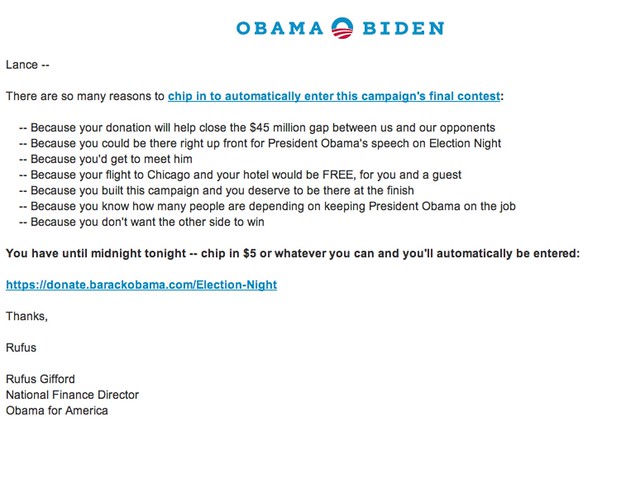
But the bulk of the email spam I get is from the Obama campaign. It runs at 2-4 per day. Here’s an example:

And here is my BarackObama filtered email:


I signed up (a while ago) as a Texas voter, and Texas is always going to vote Republican. Hence essentially all of the spam is aimed at extracting money, though here was a sincere Hurricane Sandy one in there.

I did not sign up for the Republican party spam, which is a shame as I asure it would have been fascinating during the Primary phase.

Overall I find it an appalling way to elect people and to then run a country. The election is all about money, whether from individual supporters or more importantly (for the campaigns) from bigger donators and businesses who run their own SuperPACS (Political Action Committees).

I’m very grateful to live in NZ, with our very short political campaign season, limited campaign spending and voting based (with the arguable exception of Winston Peters and John Banks) on policy not personality. Our politicians even talk to and work with each other. Long may it continue.

Oh – and as a foreigner I cannot contribute to a political campaign – one of the few US campaign finance rules that does make sense. One could, of course, start a US corporation which in turns funds a PAC, but be sure to put aside at least $100m to being able to make any sort of impact.


PowerKiwi and the Fast50

We entered PowerKiwi into this year’s Deloitte Fast50, and the results are announced tonight. Powerkiwi sells FlowerPower and other products on online electricity retailer Powershop.

We’ve had an incredible growth rate over the last few years, and just hit over 220 million units of electricity sold to date through Powershop. Since launch we’ve been responsible for over 22% of the energy unit sales through Powershop, mainly through our FlowerPower product, as well as our carbon neutralised Green Power, and Tree Power, which supports global rural communities to plant trees.

So far this year we’ve already reached over 80 million units, and we’ve already beaten last year’s top line revenue. That’s not quite at the growth rate required to be on the stage for next year’s Fast50, but when the numbers get bigger, maintaining the growth rate in percentage terms is much harder. We are grateful to our thousands of customers, and aim to keep bringing little smiles into their lives.

Deloitte do a great job with the Fast50, recognising companies that are emerging household names. The deserving winner last year was Powershop itself, and we are absolutely riding on their coattails. We love what Powershop has done to electricity retailing in NZ, changing the very nature of how utilities can sell and work with customers. My favorite part is no paper ever. So thank-you Powershop for welcoming us into your ecosystem.

We, the owners of Powershop, are involved in a range of other early stage ventures.

Rowan, Koz and Amnon are with well respected Southgate labs, who invest time, money and their substantial experience in early stage companies . They invested in and are helping Vend, GoVocab and others.
Lance and Nat helped found SafePlus and MyTours, which Nik also helped found.
Nik meanwhile founded MinuteDock and 200Square, a fast-growing online real estate agency.
And finally I’m part of Define Instruments, a designer and manufacturer of control systems, as well as several other businesses visible on the blog.

Any of these firms could appear on future Fast 50 lists. My money is on Vend to be the first, which itself is part of a few ecosystems, including Xero, a Fast50 star.

Overall we are all enjoying building great businesses and delighting customers where we can. We wil be happy with whatever level of success we earn tonight.

Thank you Deloitte, Powershop, and to all of our customers who have bought ‘the flower’ on Powershop.

Trade Me Values

It’s great to see that Trade Me’s values have not changed in the years since I was there. The success of Trade Me was in no small part due to the sometimes rigorous enforcement of these.

It’s no surprise to see that customers come first at Trade Me, as they do at many other organisations. By many would wonder why usability (awesome online experiences) is paramount. It’s because everything else, including customer happiness and ultimately profit is derived from having web products that are delightful.

That’s one to take note of – we can all win by focusing on delivering incredible experiences to our customers.Trade Me Values

Cash matters

As part of an email to a client negotiating a deal I mentioned:

Cash matters. We might contemplate equity arrangements as making us fortunes, making sure that you are swimming in cash along the way is a much surer way to build a fortune.

He is putting it on the wall. Maybe I should too, awkward English included.

To explain:

For founders and owners it means making sure that not every penny is invested in company growth, but that you are, once sustainable, taking something out along they way in salary and dividends. The prospect of a huge pile of cash in 10 years time is worth delaying for one year if you can have great lives along the way.

For doing deals or becoming an employee it’s the same – insist on a minimum cash arrangement that provides healthy return for you, and treat any upside equity or bonus arrangements as completely unreliable (that’s why it’s a “bonus”).

For advisors (like me) it’s also the same. While equity is a lot of fun, the clients that necessarily rank highest today are those who feed you today. The legal profession in particular understands this, and seldom deal in anything but dollars. They will however simply waive fees for worthy “pro bono” clients.

Set up your own email account under your own name

Telecom has adopted a mercenary stance and will charge $20 per month to former customers (who have moved to other ISPs) to retain their Xtra email account. I have several issues with this:

  1. The cost to service these accounts is less than $2 per month, even if outsourced completely. While Yahoo.com offers free accounts, they can be upgraded to Mail Plus accounts for US$20 per year. I would imagine Telecom can negotiate a bulk discount. I also trust (and hope) that the $20 fee is applying to a version similar to the US paid version rather than the free version.
  2. The cost of offering an email forwarding service is essentially $0 per account.
  3. The people most affected are those who have not migrated to an independent email service, who self-define as those who are less technical or internet savvy. They may find it easier to pay the $20/month rather than to perform the technical dance required to migrate to another email address. It’s not just themselves to change, but all of their friends and family who need to change the email address they send to. As this group would skew towards older people, and the less educated, and this task may be very difficult for some.
  4. The affected population is also skewed towards those who are the least able to afford the $240 per year fee, a considerable amount for anyone regardless.

The threat of a fee will be used as a weapon to prevent migration away from the dominant Xtra ISP, and given the ridiculous size of the fee it feels like Telecom is exercising legacy muscle that their market dominance gave to them. This matter is apparently before the Commerce Commission.

I’ve written about this before. This is another great reason for never becoming  dependant upon an ISP provided email address. I suggest never setting them up in the first place.


I’d also suggest migrating away from yahoo, gmail or hotmail accounts, and move directly to your own name:

Setting up your own email

Setting up your email address using your own name means you will forever have the choice of which email service to use. Here’s one easy way to do it:

1: Find and register a domain name. I use IWantMyName.co.nz*, who make it a spam-free and very very simple. Select a .nz domain name (e.g. lancewiggs.co.nz or lancewiggs.kiwi.nz) for the extra protection and due process that the New Zealand DNC provides. Your own .nz domain name costs around $30 per year including GST.

2: When you have purchased a domain name, click on “Domains” and choose “Install new service”. Choose Google Apps.

3: Follow the instructions to install Gmail (don’t worry about the other stuff). There are a couple of places where the IWantMyName instructions differ from the Google process, but overall this is really easy and free. Just keep clicking next if in doubt.

There is a delay built into the process as the records updated by IWantMyName will take time to propagate through.

4: Test your new email service, and when you are comfortable then start using it as your primary email. Forward all of your Xtra email to your new address, and tell your friends about the change. Encourage them to do the same.

If your email is set up using a local program like Exchange or Apple Mail, then use Google’ instructions to set up the new account there too. (POP or IMAP). If you use the Xtra web interface then you should enjoy the switch to Google’s web mail.

5: As a bonus: Go to WordPress.com and set up your own website under your new domain name. It’s also just a few dollars a year.


*I have no interest in iwantmyname. I am an elected councillor for InternetNZ, a non-profit incorporated society which has the delegated mandate for .nz. Join today

Gidday cobber – the Kiwi story

It seems, according to insiders, that allegedly the winning firm for crafting the great Kiwi story for NZTE, Tourism NZ and Education NZ is actually an Ozzie import. That’s appalling on the face of it.

I’m not sure whether this is an artifact of an RFP lowest bidder process. I do wonder at the impact of apparently having the person who was collating the tenders working for an Australian Agency assessment firm (I kid you not). Who knows what happened – but this has arguably left a sour taste in more than one local firm and could backfire badly.

But I’m not a journalist. Perhaps a one* could chase this down and find out what happened. As a starter:

  • Ask sponsors NZTE, Tourism NZ and Education NZ what went on.
  • Ask the local firms who missed out – Designworks, Interbrand, Assignment and BRR what happened.
  • Google and call the Aussie winners – Principals. They seem to be 100% owned by Australians, with the local company registered in Feb 2012 and a ‘resident member’ at Generator – seemingly a very shallow footprint in the country. I cannot find a .nz website for them.

Onya mates.

*OK – One did.

The Webstock ’13 website

Webstock ’13, originally uploaded by LanceWiggs.

It’s a brave team who will put up a blink-tag site for hordes of web designers and developers waiting for the latest news.
That’s what the lovely folks at Webstock did, though they did replace it with a more modern version , complete with the speaker list, later in the day.

Here for posterity is a screen shot of the temporary site. I’m told that even the HTML was formatted in an appropriately dated style.

More seriously, Webstock is the single must-do event of the year if you are at all involved in web design or development, or even with innovation or conference organisation. Do go.

How to win at team building exercises

Building towers out of spaghetti, marshmallows or paper, creating paper airplanes, crossing water with a man made bridge, changing Nascar tires, designing clothes with paper – we’ve all been exposed to team building exercises, and they just keep coming. They are generally designed to teach a certain issue, but they are also often designed to be gamed, and they should always be designed to be fun.

Above all though is the mandate to be yourself and to enjoy the process and the learning. So without further ado, here are:

The top 10 ways to succeed at team building exercises 

1: Check the team

Look at the team around you. Are they genuine colleagues or are there some ring-ins? I was exposed once to the peer pressure experiment, and some juggling was required to fool the participants into believing that the team was random, when in fact the participant (me) was the only new factor each time. So keep an eye out for where they come from, and retain that suspicion through the exercise (I guessed almost immediately).

Look for hidden and open assigned roles. Sometimes certain or all team members will be given roles to play, perhaps aiming to deliberately disrupt the overall team progress. Keep an eye out for people being tapped by organisers and given a sheet of paper, and hold a suspicious mind during the exercise itself. If you have a role assigned, then turn on your acting skills and become that character. It’s an amazing learning experience to be in role, especially when the lessons are successfully applied to you and your character is motivated to change behaviour.

Check for observers, and find out or guess what are they looking for, and if it’s being videoed then take that into consideration as well.

2: Check the rules

All of these games have a set of rules. Take the time to learn them, and ask a bunch of clarifying questions to the organisers – perhaps quietly so others can’t hear. Talk to each other in the team so you are all clear. Try flipping the rules around and asking yourselves ‘what is missing?’, and think about ways that you can work within the rules while also being outrageous.

Check especially for the competition clauses. Are you competing against the other teams, or are you all in this together and competing against the organisers? One game called “win as much as you can” is set up so cooperation amongst the teams is by far the best strategy for everyone, while for others there really is no team competition at all, except in your mind.

3: Play

Play with the materials before you make decisions – do this at the same time as you are talking. Think like a child. Kids instinctively get how to play and build, so unleash yourselves and try a bunch of random and playful things. Often the answer is unintuitive, and playing around is a great way to find the answer.

4: Take a role.

Take on a role quickly, whether as doer, the leader or just an observer. If a lot of repetitive work needs to be done, then get started and lead by example. The key is to get the team working fast, and a team needs team members. During the exercise the roles often change, and that’s a good sign. Let it all flow naturally.

5: Have fun and keep your head up

These exercises are usually set up as competition, but they are also only exercises for your to learn from. So the best approach is to adopt an attitude to enjoy the process while learning and also trying to game the result. Keep your head up, eyes and ears open and be aware of what’s going on around you. Keep the team conversation and the team dynamic light, and make sure it’s an enjoyable experience

We decided, for example, to combine teams part way through a marshmallow and spaghetti exercise, as it wasn’t explicitly banned, and so we were able to use more materials and win. That meant double the number of winners, a lot more satisfaction and yet the same lessons were learned. We could, for example, simply have asked for more materials, as apparently children usually do.

6: Iterate and learn.

Ask “what did we learn” to each other after each change in a process. This is remarkably powerful question which immediately focuses everyone on improvement. For events where you have to improve over a number of iterations, try to change only a few things each time so you can manage your learnings. If it’s a big job, like changing a tire, then each sub-team should agree what they are going to change, then communicate that to the rest of the team. And for competitions like the tire change, keep the number of changes, if any, to a minimum once you are through the learning stages.

7: Cheat

Cheat by copying other teams, checking the internet, asking for more supplies, using other props and anything else that is not explicitly prohibited. Assign someone to watch other teams and bring back information – ask them “what did you learn”, just like everyone else.

8: Try to finish early with an ok solution

Finish then iterate from there. Just producing a compliant product is often all that’s required to do well in tower building competitions, so make sure you steadily build to the end and not just aim to have something appear in the last minutes

9: Manage the mood.

Be conscious of your own role, and that of other team members. Self observe to make sure you are being a great team member and contributing to the whole. Observe the team to make sure all roles are filled, and fill that role yourself or nudge someone else to it if you can. Observe your other team members – are they happy, working in the common cause and at maximum output? Are they pondering a different approach, or, worse, are they simply demotivated? Try to understand their concern – asking what are you thinking, what are you feeling – and you need to use both words unless you know whether they make decisions with their heart or head. The power of language is such that “I feel it would be great if we folded these planes together” and “I think it would be smart if we folded these planes” elicit vasty different responses from different people. This I know from experience. Oh – and screw the paper planes up and throw them in the last stage – you’ll know what I mean when you are there.

If someone is being actively disruptive in the team then take the time to sort it out. Either solve it or send them away, or perhaps walk off with them so the rest of the team can get on with the job. Panicking is always inappropriate and disruptive, so look for signs of that and actively calm the whole situation.

10: Keep the T-Shirt.

It could be useful for business times in the future

BBD CEO tour: What shared agenda should NZ set with the world?

Keith Yamashita is an inspiring chap. He wasn’t content with sharing how SYPartners engages with clients, but wanted to reach further. He asked us “What shared agenda should New Zealand set with the world that drives deep impact – and also advantages the nation?” He then facilitated a session try to answer the question.

The group was admittedly bias in membership – skewing heaviliy towards middle aged white people. But it’s a chance to keep the conversation going and explore together the common cause we have with each other, and what we can be great at. To that end I for one am happy to facilitate similar sessions to this one with other groups, and I am sure other BBD coaches are as well.

Keith set us four questions to answer, dividing us into four teams to do so.

  • What does the world hunger for?
  • What big fixes do we want to address?
  • What is timelessly us?
  • What must we fearlessly become.

We didn’t have much time, but we did have some great discussions. These notes reflect my own perspective, building from the perspective of the wider group.

What does the world hunger for?
We want a safe, peaceful, trust-based society where we can work and move across cultures and borders; and

We want to be happy, valued, have meaningful work, strong family life and healthy relationships; and

We want long term sustainable economic growth, but not at the expense of the environment. This means improving the quality and having sufficient quantity and fair distribution of our food and goods while improving the world’s environment.

The world needs a quiet hero, a Frodo, to take on the challenge of balancing growth, sustainability and happiness.

What big fixes do we want to address?
We can (and quietly do) spread our values throughout the world, through our diplomatic efforts, our media and through our diaspora of well educated kiwis who are influential around the world.

We can promote equal opportunity societies, the power of a great education for all and the ability to enjoy life through activity rather than possessions. We can spread our New Zealand values about tolerance, living in a truly multicultural society and a very long-term and guardianship perspective.

We can continue to act as honest brokers through our diplomatic and business efforts. We can take principled-based leadership on issues such as free trade and copyright law.

We can show how to restore, protect and embrace nature, exposing our native ecology to ourselves and our visitors.

We can lead the charge on sustainable food production. We are both green and major food producers, and can take the lead in managing the trick of growing better quality natural food, and more of it, while improving the environment.

Overall we can nudge the world towards being truly interdependent, sustainable, fair and with economic growth.

What is timelessly us?
Our values are honesty, fairness and pragmatism. We trust each other quickly.
We are adaptable, inquisitive and enjoy learning, valuing education and independence.
We are unafraid of change and we have a bias for action.

We are blessed with emerging integration and celebration of our Maori and other cultural heritages. We are working hard at being the best in the world at this, and many people’s frustration with progress is a positive sign that we all want to get even better.

We are accepting and welcoming to everyone regardless of their culture or behaviour.

We enjoy getting outside in our beautiful country, and have an increasing desire for long term guardianship of this natural resource.

What must we fearlessly become?

We can be the honest brokers to the world, the diplomats, the business people, the brokers. A nation with the courage to lead – authentic and fearless. Let’s stand up against the bullies, the warmongers, the ones seeking personal gain over an improving world. Let’s export our values.

We can become best in the world at nature, at creating world leading nature reserves without pests, becoming the premier tourist destination but also helping other countries improve their own environments.

We can lead the world on sustainable growth – more food, better quality food yet an improving environment.


Overall I quite like the result – they feel like tough challenges, but challenges we have already taken on. I’m not seeing anything that drives our web or other businesses, aside from the sustainability angle of course. Perhaps we could add one more:

We can be the best in the world at understanding cultures, markets and end users, designing and developing delightful products that, together with partners, dominate global niches.

That’s close to straight out of the Better By Design playbook – but why not?

BBD CEO Tour: Method

Method co-founder Adam Lowry presented at the BBD CEO summit this year, and was excellent.
The tour reinforced what a great company this is and also showed how small and simple they really are. There is nothing going on here that is not reproducible in New Zealand. The difference is scalability – easier access to the giant US market, but more importantly the simple gumption to grow and keep growing (sustainably). As big as they are, they keep it lean, with, for example, only 1.5 people managing the social media and customer email, doing so using simple tools and Twitter and Facebook directly. The tools and numbers of staff are not the issue – it’s about having passionate and excellent people doing the work.
Increasingly graduates want to align work with their personal values, and Method sees themselves as one of very few companies who can offer that. It’s tough to get hired there, and they include homework in the process along with interviews. Retaining staff is relatively easy – Method is made to great fun place to work to keep people there. They are casual with dress and security, and deliberately so. It’s not forced fun, but authentically enjoyable. One employee said – “I’m the exact same person at home as I am at work”, and Adam was really encouraged by that. He sees that employees want freedom, and that companies can lose the plot when they institute rules, whether around around dressing, clean desks or other behaviours.

Ecover, a large European sustainable cleaning products company, ‘purchased’ Method last week. Adam characterised it as a merger – the exact deal details are private.

Each company was privately held and the new owners remain committed to continuing the same values and approach. The combined revenues are reported at $200m, still a minnow in the billion dollar world of cleaning products. It seems that Ecover is strong in manufacturing and in Europe, while Method is strong in product development and design, and the US market. It’s always difficult to make a merger of equals work, but this seems like a great combination..