Let’s ignore ie6 already

<UPDATE – I’ve created a page on the tab above – if you send me information then I’ll add to the HALL OF SHAME>

Microsoft’s new ie6 countdown site records ie6 usage of just 3.1% in New Zealand.

The overall number is now small enough for almost all local sites to ignore. I’m guessing that the holdouts are:

1: the occasional corporate with an IT department stuck in the past

2: A few folks with computers that have not been updated for 10 years and who are not savvy enough to download Firefox or similar

3: developers testing that their sites still work on ie6

I have no empathy for any corporates stuck on ie6 – it’s well beyond time to change – you are holding the rest of us up.

I feel for the second category, so what we need to do is make it simple for them to change. A banner as advocated by Microsoft’s site is a good idea.

As for the third? just forget about ie6 already – and focus your development efforts on making awesome websites that work on any modern browser.

The rise and rise of mobile broadband

The table shows that each iPhone or Android device uses as much data as 4 ordinary smartphones, and each iPad or tablet uses 5 ordinary smartphones worth of data. But mobile connected laptops are the biggest consumers, and that will only get worse as more and more computers are delivered with embedded SIM cards. Apple and telcos figured out how to do this with the iPad, and can it be far away before the arrival of Macs with 3G cards inside? Days perhaps. Regardless of whether it’s embedded or a stick, mobile broadband enabled devices are set to become the norm.

Meanwhile the amount of traffic that each device generates will also increase – as technology gets better and the mobile prices drop and use cases emerge.

The outcome is simple – Cisco estimates that global mobile data traffic grew 159% last year and will grow another 131% this year. They contend traffic will increase 26 times versus 2010 levels, a 92% cumulative annual growth rate.

I hope the network engineers are ready.

Better by Design CEO Summit videos

The videos from the 2010 BBD CEO summit are up. The conference was superb and I do recommend viewing these edited videos.

Rob Fyfe: Air NZ’s journey. Strong mesage and well delivered

Ingrid Fetell – Human Factors – IDEO. How end user observation leads to great design

Adam Lowry from Method – how to deliver green mainstream products

Transformation medley: several speakers on how BBD approach transformed their business

Alan Weber – founder of Fast Company

Dick Powell – SeymourPowell. Designing Innovation.

Robert Sutton – from Stanford GSB.

Marty Neumeier – Author of the Brand Gap and Zag

Dell’s descent into usability hell

Is the Original Dell.com homepage better or worse than the current one?

The original page let you go directly to what you wanted – be it to buy a particular type of computer, get service or check your order. It was ugly but so simple.

The current site is a brick wall. I suppose the logo is nicer though.

Here’s the current USA site with flash turned on (after a frustrating few minutes trying to use the country selector and failing I had to change the “c=nz” to ‘c=us’  in the url).

It’s similar to the NZ experience – Visitors cannot just start shopping, and have to decide what sort of customer they are first. I’ve never figured that one out for myself, and am certain that others struggle as well.

I won’t bother putting up a screenshot of the Apple.com website. It’s just too cruel to Dell.

The hot weather in Greece

I switched a long time ago from watching TV for the weather to using the internet or more recently mobile apps.

Perhaps that was a mistake – it seems that in Greece at least the TV weather forecast is compelling.

It’s all on YouTube. I could stand about 2 minutes – your employer may stand for less. I guess it’s a warning as to where we could all end up if we are not vigilant about endorsing and supporting serious media.

I found it from an email that has been doing the rounds. The email shows several Mexican weather presenter photos, such as this one:

and after the sey becomes the routine, we were confronted with these.

It’s hard to make judgement about other societies – whether Greece and Mexico for their demeaning of women, or the Middle Eastern  countries for their backward approach to women. The simple facts are that societies have different norms, and we shouldn’t necessarily impose our own standards, unless they go too far. But what is to far?

Focusing on the long term

The NBR rustled up just four analysts who gave opinions on Telecom’s latest results. Here’s what they had to say:

Guy Hallwright, Forsyth Barr: ACCUMULATE
Geoff Zame, Deutsche Bank: HOLD
Greg Main, Credit Suisse: UNDERPERFORM
Tristan Joll, Goldman Sachs: SELL

Four analysts, all with different opinions.  That’s better than the reverse, as we know that at least one of the gentlemen is correct. The question is which one, and I;m afraid I don’t know that answer. I would dearly like to see Telecom split into two so that investors and the Government can have certainty of which entity they are dealing with.

I do take issue with Deutche’s Geoff Zame, reported as praising the Telecom for  forecasting spending LESS on capex next year.

“They’ve had the highest sales-to-capex ratio of any telco in the past 20 years so they’ve got to nail that,” Mr Zame told NBR.”

In other words Zame is praising Telecom NZ for under-investing in infrastructure over the last 20 years. That’s the primary reason they got into the regulatory and business pickle that they are in, and it was driven by short term thinking that announcing results too often  to the market can lead to.

It’s far better to focus on investing for long term sustainable success. Telecom’s greatest investment was the Southern Cross Cable, which, delivered a cool $83 million to Telecom for the last year. That’s pretty good for a project that was essentially paid off 10 yers ago – the day it all went live, and rivals the sale of Yellow Pages as the overall best financial decision from the group. Each of these decisions, along with the investment in XT, was made with long term focus on what where the industry was going, and delivered results.

Don’t let your Apple iOS developer license expire

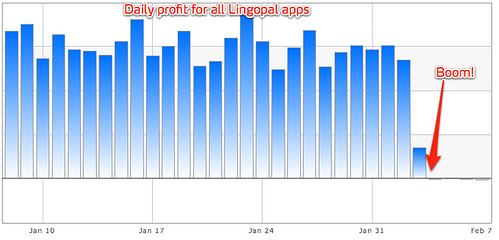
One email, no reminder and BOOM. All of our 139 Lingopal applications have been removed from all of the global iTunes stores.

Apple is a cruel master – and we’ve been offline for a five days now trying to sort this out. The latest is that it will take yet another 48 hours to sort out.

We paid the developer license immediately we found out we were offline, but that was a day late as CEO Richard was offline for the weekend.

Now our rankings in every global store will be slipping and I would not be surprised to see our daily sales drop off a whole lot.

So a warning to all – pay that iOS developer license immediately it turns up.

And three requests to Apple:

  1. 1: Please send us all another reminder, or even three before you switch off our source of revenue
  2. Please switch it back on again immediately we have paid the bill – automatically
  3. Consider taking the money automatically and directly from our earnings – or allowing us to set that as a default action.

This isn’t a credit issue, it’s a process weenie issue, and as sellers of iPhone apps we have to abide by the conditions, such as they are.

Air New Zealand phone hijack is a rort

Air New Zealand is testing something which I view with grave concern.

They are testing a system that hijacks cell phones on their flights, and charging extortionate data rates along the way.

The proposal is to place a mini cell-site inside the aircraft, and have it connect to satellite.  Any calls or data traffic made during the flight would attract roaming rates which are beyond the standard international extortion:

  • Calls will be $3.50 per minute
  • Inbound calls will be $2.00 per minute
  • Data will be $20,000 per Gigabyte
  • Texts will be 80 cents to send

The calls are expensive, but we want calls to be short up in the air, and given the noise of an aeroplane and the discomfort that fellow passengers will project to loud callers I see little issue here.

However beware your teenage daughter texting her mates as you wing your way North – 30 texts will leave you $24 short

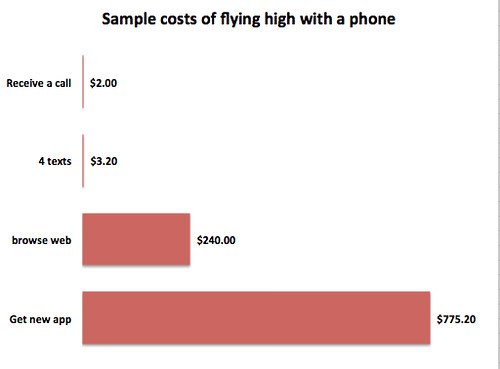
But it’s data that is the problem. Let’s look at a sample flight. If you leave your cell phone on then receive a call ($2 if you hang up within 1 minute), send 4 texts ($3.20), check out the news on a few websites  (say 10 pages at 1.2 MB = $240) and update your copy of an iPhone app (say Penultimate at 16.5MB, or $330) then you’ll be up for $775.20. That’s all possible within the space of a few minutes, and it shows the ludicrous nature of those data charges.

Don’t even think about tethering or using your T-Stick or Vodem. If you happened to receive an automatic OSX or Wndows update that was just 100 MB then that’s $2,000 thanks. Getting an updated movie from iTunes syncing across in the background? That’s about 1.5 Gb and a cool $30,000 thank you very much.

This isn’t just a rant as I use a lot of data. The average amount of data consumed on one mobile network in NZ (not sure which one), reported by Akamai, is 481 MB per month. Do that while flying with Air New Zealand’s new system and that will cost you $9,620.

This is not about safety

A decent percentage of pasengers leave their phones on during flights – it’s proof that phones out in the passenger section don’t really impact the flyability of the plane, especially larger ones, and that we’ll never get everyone to switch off. This is not the purpose of the exercise, and many people have realised that there are patches of cellular access on many domestic routes.

Why this matters

Passengers that leave their phones on now risk data being transferred and calls arriving while they are otherwise sitting in their pocket or suitcase.Welcome to an unexpected bill.

Other passengers could see that their phone was working and then start surfing away, thinking that $20 per MB sounds cheap. It’s not – it is  rort.

Vodafone and Telecom will look terrible in this exercise, as they are the ones that have to bill their customers. The customers will complain, the satellite provider will demand their money and Vodafone and Telecom will be stuck in the middle.

The transition moment is important. When does the in-air service take over from ground? Before takeoff? during takeoff? Is there an announcement? If the system was always on then passengers doing last minutes texts and tweets would be unexpectedly stung, and even people outside the plane could be affected.

Above all Air New Zealand has committed to treat us like friends. Friends don’t present each other with bills of this size.

We want to be nice to each other when we fly, and we are increasingly online when we sit down. But these prices are driving us to yak on the phone instead of quietly surfing.

How to solve it

1: Announce the prices each and every flight, and announce them in correct terms – as in $20,000 per Gigabyte.

2: Change the prices to be reasonable. Virgin America charges US$4.95 for all you can eat on flights less than 1.5 hours. I’d pay that. You can even get a $40 monthly pass. I’d pay that too. It’s actually only $19.95 for a 30 day pass for handheld devices, and I’d certainly pay that.

3: Make sure that phones are not automatically roamed onto this system. Customers need some warning before they do anything, whether it’s voice, data or text. The warning should apply to all three configurations so that we are fully informed whether we are using a T-stick, iPhone or regular phone.

It’s all in the eights


Apple store in Singapore, originally uploaded by LanceWiggs.

The Apple store in Singapore shows one difference between there and here – the prices end in the digit ‘8’.

Eight is an auspicious number, and so I guess the SG$2888 MacBook Pro is looking particularly good.

Sadly in the NZ store our prices end in ‘9’s. And even more unfortunately that very same MacBook pro is NZ$3499.

Our exchange rates are essentially 1-1, so if you are in Singapore and coming downunder, then grab a mac or two.

The Daily don’t

It’s new, it’s news but it isn’t anything new.

The Daily has certainly created a media fuss, but the experience itself is less than perfect, and I struggle to believe it will succeed as a subscription model.

The Daily is long on sports and entertainment, and short of hard news. The issue I read had guest articles from Skeptical Environmentalist Bjorn Lomborg, and the Economist’s blogger Will Wilkinson. It also had an article on candy, plenty of the latest from Hollywood and extensive coverage of the Superbowl.

That Superbowl coverage is ok – for seemingly no reason at all you won’t find The Daily on New Zealand’s iTunes store. If you really do want to have a look, then get yourself a USA iTunes account.

There were a handful of hard news articles – just three in fact. One on Egypt, including some great photos, another on the big snow dump in the East of the USA  and a third on a 360 degree view of the Superbowl stadium.

No wait – that third one doesn’t count, and neither does a video that Senator Giffords starred in before she was shot, nor an article on whether Steelers Ben Roethlisberger  should or shouldn’t back up his words. The final article in the news section was on the break up of the White Stripes – sad but sadly not news.

There was plenty of magazine content – fluffy articles of dubious merit including this one on schoolkids buying duty free cigarettes and selling them to their friends. Ground breaking reporting.

The Daily is graphics hungry – every page is bespoke designed, and the magazine will keep a tribe of designers employed while it operates. This was the cover page to an article on un-pasteurized milk delivered to New York by Amish. an interesting story, but something you’d expect to see in a magazine, not a newspaper.

and that’s what The Daily is – a daily magazine. There is precious little of this:

and far too much of this – at least for my liking.

There is Sudoku, a crossword and paragraph snippets, and an article on cell phones on airplanes – a topic that has been covered before a lot. As usual the writer missed the obvious – that cell phone use is about data not voice, and that voice conversations would be kept short, as most are not oblivious to their environment.

There are embedded tweet streams, but no links – none. It’s old media, and old media thinks that each publication is a walled garden of delights. We readers beg to differ.

So would I pay for it? Not at all. The same news – in fact a lot more – is available as a web page or application from lots of other sources. Start by subscribing to daily emails from The Atlantic’s 5 best columns. It’s a great way to catch the opinions and news of the day – without the cost or the heavy graphics, requirement to use an iPad or the occasional crash.

Editorially The Daily is in a conundrum. It’s hard to appeal to the mass market in the USA when writing about hard stuff like politics and news. There always seems to be a slant to the news. My take – I think The Daily will migrate towards the Fox News crowd – less news, more entertainment and a right wing slant.

What’s the important news Stuff?


Stuff.co.nz – Feb 2, 2011, originally uploaded by LanceWiggs.

I’m disappointed in the ordering of the headlines when I went to Stuff this morning. I have no idea who the person is who has has had a third child. However the news from Egypt is surely one of the news stories of the year, and the storm that is going to hit Australia could make the recent floods seem tame.

Some perspective please.

Fix the basics NBR.co.nz

The NBR’s website went through an upgrade just before the end of last year. It wasn’t smooth sailing for them, but the timing, when everyone was away at the beach, was smart.
However the site is still in a bit of a state of disrepair. Firstly – the news seems to have scrolled way down the page, and an annoying “upgrade…” message appears. I want it to go away forever.

The NBR is meant to be the business news authority in these parts, but the amount of whitespace and the pushed-down tab bar means it feels like someone’s blog.

The worst the introduction of a captcha system for checking that commenters are real. While that’s perhaps ok to stop the flow of spam to unlocked articles or from commenters who are not logged it, it’s completely unnecessary for locked, subscriber-only, articles, and for any time a reader is actually logged in.


I’ve added a few comments to NBR articles since the new system was bought in, and the Captcha system has failed on me just too many times. Perhaps I’m just lousy at reading the damn things, perhaps the NBR website people don’t have iPhones or test this bloody stuff. whatever the reason – I’m now done. I will not add any more of my original, insightful, highly opinionated and well-loved comments to the NBR until that woeful anti-accessibility piece of @#$ feature goes away. And I won’t add any more of the normal comments I make there either.

The Groupy promotion impact

A Neil over at Webdrive sent through this chart showing the impact of Wednesday’s Groupy $1 Hell pizza promotion with advertising over on Stuff. This is showing the amount of traffic coming in and going out, which approached 60 Mbits/sec inbound as the news spread.

Our page impressions stats show a similar result.

Sorry I cannot report the actual numbers on this, but the percentage increase was certainly dramatic.

While the site threw up a few errors it didn’t actually go down, which is critical during events like this. The traffic was a lot larger than expected, and Webdrive put a couple more servers to the task to cope.  The external email provider rate limited the sending of emails, despite telling us that they would not. This took a while to resolve but eventually they got sent later in the day or evening. The subscriber base went up by several times, and 15000 people and their friends get to eat Hell Pizzas for $1.

All in all an excellent promotion for Groupy, Hell and customers.

Photo opportunity

A photo from last year’s visit by Secretary of State Hillary Clinton. US submarine cable vendor TE Subcom invited Pacific Fibre along to an American Chamber of Commerce event in Christchurch, and Pacific Fibre CEO Mark Rushworth and I went along. Thanks for that.

Our time with Secretary Clinton was necessarily very short – a quick word and photo opportunity. All in all a very professional show and a pleasure to see the world’s top diplomat at work. It demonstrated to us the strength of the desire of the USA to get the cable built, and their ability to get behind a key potential vendor.

On my right is Ambassador Huebner, the US Ambassador to New Zealand. We’ve met him twice now, and he is a fan of the project, which kicked off shortly after his arrival in New Zealand.

We are lucky to have Ambassador Huebner in NZ. He is an experienced lawyer, and a Yale Law alumni, as is his boss Hillary Clinton. (I popped into a Yale Law lecture once – it was scarily impressive).

So there you have it. No time to talk politics, and as this was just after the mid-terms there was no real desire either.