Back to Vodafone, sorry Telecom

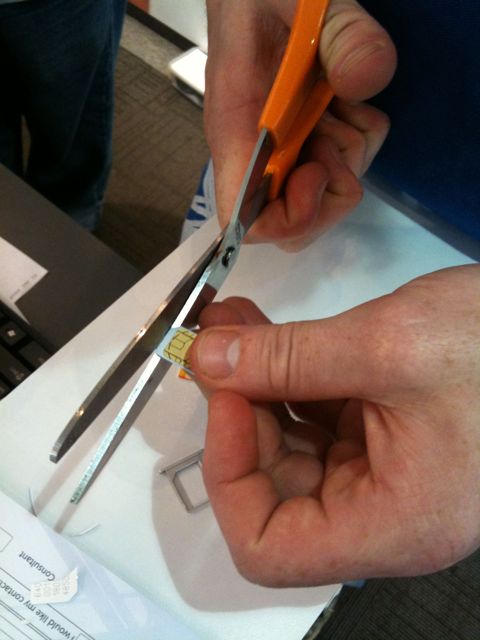
Another Telecom store experience just now, this time on Queen street. The good news is that they have a SIM cutter that will quickly turn a standard SIM card into a micro-SIM. The bad news is they were reluctant to pull it out of the drawer, and were certainly not taking responsibility for doing the cutting.

Worse yet were the details. It turns out that recharging the pre-pay SIM is done on the Telecom website, and it uses flash to do so. It also turns out that the $29.95 plan is not available on contract – even as an addition to my existing contract. So I decided to move on and use the Vodafone SIM that came with my new iPad 3G.

Yes – I succumbed. And in other news I now have a 32 Gb Wifi iPad for sale.

Well done Telecom, you made it easy

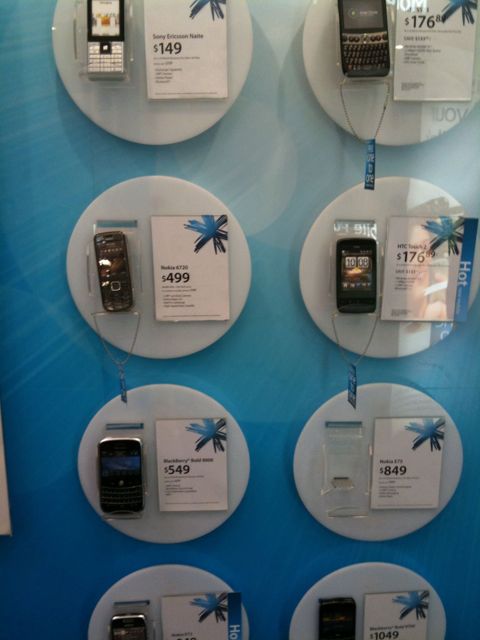
Telecom’s store also has the mock phones. But they have a nice low use prepay data plan, a friendly guy giving tips on how to cut a mini sim and no form in sight. Nik gave his name and address, and that was that.

Indeed they even offered to cut the SIM card for Nik – superb service.

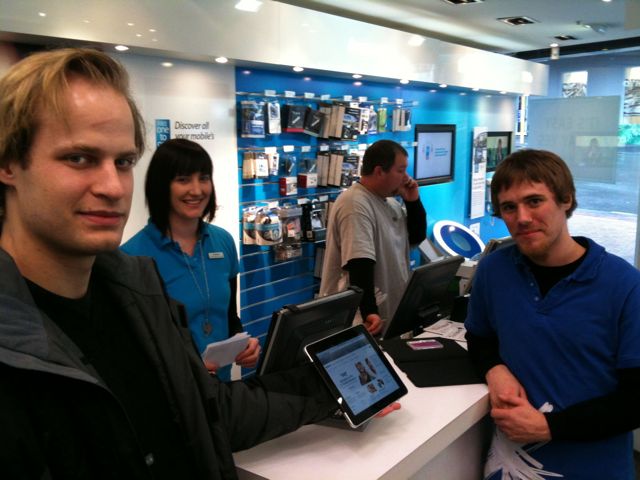
Well done Telecom. Your store outperformed Vodafone’s in every way. The staff were wonderful with Nik receiving constant attention from 3 during his visit. They even put the right settings into the iPad.

Of course the Vodafone store had a lot more customers coming to and fro.

Just let me try and buy Vodafone

Three different things getting in the way of customers buying at the local Vodafone store.

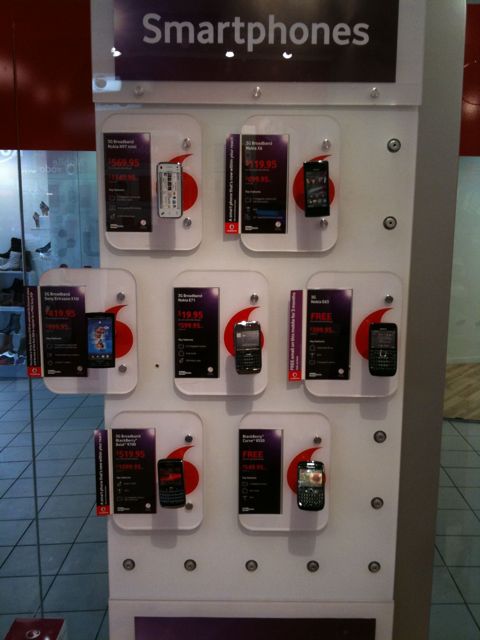
The first is the wall of unusable phones. The mock phones let you check the look of the case, but they don’t let you experience the most important thing of all – the software.

Next is the sign up form, a usability and excessive information disaster.

Finally is the buying process. Even with an existing account Vodafone conducts a credit check before adding another account. That’s 5 minutes, and in this case (@nikz) despite spending $120+ each month the credit was referred for more checks. Suffice to say he moved on.

InternetNZ: 5 questions

Dave Farrar asked each of the 12 candidates for the 5 InternetNZ councilor spots to answer some questions. I’m one of the candidates, and as they were good questions I’m posting the answers here.

What do you consider the (up to) three biggest threats to InternetNZ’s vision of an open and uncaptureable Internet?

  1. Insufficient infrastructure and lack of genuine competition in the exchange to home, national backhaul and international capacity markets. All three of these markets need to be resolved so that ISPs can afford to offer customers plans that are cheap, high speed and essentially uncapped. Failing to get this done keeps us behind the rest of the world and will stifle our ability to provide innovation and a stream of 16 year olds coming out with the next big thing.
  2. Any legislation or regulation that seeks to deny personal access to the internet for any reason that does not also involve jail time.
  3. Any drop in pace, professionalism or passion by the wider community on the issues (s92A, ACTA etc) that just keep arising and need to be dealt with.  Along with that I’d add any change in the way the Government (including the opposition and public service) does business, as they have a great track record of engagement and change in the last year in particular (s92A, ACTA).

Council governs InternetNZ on behalf of members. How would you ascertain the opinions of members on important decisions?

This is a bit of a trick question – InternetNZ’s constituency goes well beyond the 200 or so members, reaching all domain name registrants and indeed all New Zealanders. So the council needs to understand issues from the point of view of members, constituents and in the perspective of what is happening in other jurisdictions and across government, industry and society.

Three ways I stay in touch are:

  1. Through the InternetNZ email lists, including PAG (political action group). I’ve also been a long-time subscriber to Dave Farber’s IP list, which provides a US/global perspective
  2. Through my own interactions with a wider community of people, government and businesses, internetNZ members or not.
  3. Through research. There are some issues in our space that are wide and deep

I blog, write columns for newspapers and speak here and there. I try to do research to make sure what I write or talk about is correct. <no really I do>
Are there any activities that InternetNZ is not currently undertaking, that you think we should be undertaking?
Membership drive: Our membership numbers (200 or so) are hardly representative and should be higher. We don’t have to do much, but a little promotion and a refresh of the website and payment system is perhaps due.

If InternetNZ was to suddenly gain $3 million, what do you think they should do with it?
It’s not a lot of money, so I’d put it into commissioning research (preferably by people on retainer) to gather trusted information on key issues. For example, we could turbocharge the work on helping the Government understand the benefits of open data by commissioning a report on the economic benefits of such.

The alternative is of course to reduce the domain fees again.

If you had to choose, which would you choose as your least bad option – an Australian style filter for the Internet or an American imposed three strikes and you’re disconnected policy for copyright infringement?

Hobson’s choice, but I’d go with a filter, as at least we will have partial connection. Neither of these are acceptable, and it is good to see Australia’s position soften somewhat in recent days.

Reducing roaming costs

Column number five for Fairfax is now posted online at Stuff. The columns are printed in the Businessday section of the Waikato Times, Dominion Post and Christchurch Press. Fine papers all. We are working to get them all online in a Stuff blog.

It’s hard, really hard to reduce roaming costs as they are based on agreements between Telcos across the world. Some excerpts:

In the last year 2.4 million people visited New Zealand. Almost all of them own phones, many own data cards attached to laptops or iPads, and almost all were unable to use the data functions.

The current data roaming rates are orders of magnitude out. The $7813 per GB that Telecom charges for New Zealand visitors to Australia is almost 100 times larger than the charge for domestic customers on their cheapest plan, $79.95 for 80GB. We can also assume that the $79.95 for 80GB is a much fairer reflection of the true physical costs of delivering data to a handset or data card that is in New Zealand.

So here is my proposal for the Australasian carriers and their respective ministers – Steven Joyce and Stephen Conroy. Aim to cap data roaming costs between Australia and New Zealand at $40 per gigabyte, with that price automatically reducing by 25 per cent per year thereafter.


Once the results are in, use them to cut bilateral deals with other countries and carriers, letting the eventual snowball effect follow so that we can leave our devices on. It is your chance to change the world.


Won’t these scams please go away?

Another scam today, this time from SMSbargain.net.  I have no idea how I got there but somehow this page opened up in my browser (despite pop-ups being blocked). I’m pretty sure I was not on a New Zealand based site, but the ad is targeted towards NZ:

<update – I found this ad later on – which directs to the above>

I tried it out to see what would happen.

The timer and the question answers are, of course irrelevant. Take your time, select Bill Gates and eventually you’ll see this:

And no – I could not read the fine print – a least not without expanding the font a few times. Here’s a closer look. Suffice to say by signing up you commit to 3 x $3 texts per week.

But that’s not all. This is a particular “competition” drives customers to enter multiple texts to win. It seems the winners are those scoring the most points, and to score points you simply enter multiple times. Each entry, after the first 3, costs 20 cents. That doesn’t seem entirely unreasonable until you think about it. The winner of this competition is probably playing to 100 games per month maximum (at least they have a maximum), which costs $20. The bit I am not clear about is whether each game (“jumble”) requires multiple answers to be sent, which would start racking up those SMS costs.

Regardless. It’s clearly at least somewhat deceitful – given the tiny white on grey text, and it is clearly expensive. Stay away.

The only answer to these is education – as regulation seems to be failing.

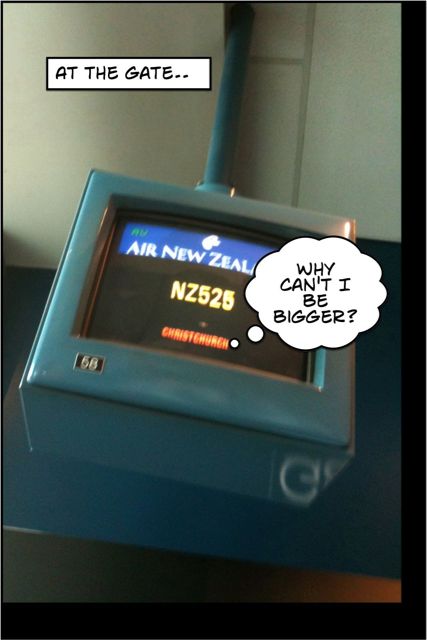
Well we know where we are going

Well we know where we are going
But we can’t see which gate it is.

I cannot read the destination on the departure gates in Auckland domestic airport until I am quite close to the gate. This is frustrating.

So why not increase the size of the type for the destination on the gate screens Air New Zealand?

While you are thinking about it, would you please also consider a departure screen outside the exit to the Koru lounge in Auckland? That way we will know whether to turn left or right.

Betting on design

A great look at how important the iPhone has been to Apple’s success over at Bullcross. My favorite chart is below. The last two quarters are projections:

During this seismic shift in revenue source Apple’s overall revenue rose from $24 billion in the year ended September 2007 to $42.9 billion in the year ended September 2009. The March 2010 quarter showed $13.5 billion, and so Apple is still growing quickly.

It’s easy to see how the iPhone rose in relative importance to be the biggest earner, and combined with the overal revenue numbers it is clear that iPhone is driving overall revenue growth for Apple. The iPad, meanwhile, may well be the new iPhone and be the main source of revenue for the next few years.

Apple deals in revolutions, and the iPod, iPhone and iPad all created new markets. The iPod is now a small part of the overall business, the iPhone the main part and the iPad represents the near future.

This is classic McKinsey 3 horizons stuff. Here’s how Apple would have seen the world through the three horizons spectrum in, say, 2008, when the iPod dominated, the iPhone was new and the iPad was locked in secret labs.

Apple ensured that there was a continuous stream of new products to replace the older ones in its portfolio. They needed to do this as the fast follower companies quickly catch up with each product category (such as iPod) and make that market too competitive to earn excess returns.

The question for now is what is after the iPad, and in particular what is next that will justify the enterprise value of $209 billion, and a price over earnings (trailing 12 months) ratio of 22.6x. (These are big numbers)
The iPad and iPhone are not enough, as they will eventually be commodities. That’s not to say that Apple won’t have the best products in each class, but the margins will be a lot smaller.

Apple’s valuation implies that the market not only believes the iPhone and iPad will be successful, but also that the next big thing will emerge and be a success as well. That’s a good bet given Apple’s track record, as their design-led approach has given them a sustained product development advantage over their competitors in the last 10 years.

However success in business is hard to hold for a long time, and companies will increasingly copy Apple – not their products, but their design-led approach to business. Being design led is very difficult to achieve, as I’ve seen through Better By Design work with Equip Design, but the results are worthwhile. It’s a long process to be design led, taking years. It’s difficult to do and hard to keep – with Sony’s design-led dominance in the 1990s not carrying over into this century. Companies place design and designers into core roles in the business. It’s hard to find design thinkers that get business and vice versa, but the resulting culture change and the benefits of being design led are increasingly obvious.

Perhaps being design-led will become a business prerequisite. It was not too long ago when lean manufacturing and total quality management were foreign concepts – concepts which are now part of most large manufacturing businesses.

We consumers can only hope.

Air New Zealand looks at bulk discounts

Back in January I drafted* a lengthy post on what Air New Zealand could do better, and part of that was on regional airfares. I sampled five regional, seven domestic, two trans-Tasman and two international fares for travel in a month’s time. The results were startling, though not surprising:

It’s twice the cost per kilometre to fly on a regional turbojet than it is on a normal domestic jet, while international travel is a bit of a bargain really. There are reasons for this, as the longer routes can amortize costs over more passengers, but the impact remains. That difference between the regional and domestic market is concerning if you live in a small town a long way from the bigger cities.

I sampled used the flexi fares available for 18 February, looking at them on Sunday 16 Jan. Full table under the fold. This was a few months ago, and I’m sure things have changed a bit in the meantime, but the main lesson remains – regional fares are a lot more expensive per kilometre than international ones.

The regional pricing problem is a big one for Air New Zealand. They are often the monopoly provider on these smaller routes, and the next best alternative can also be high cost. Flying from Wellington to Nelson is expensive, but taking a ferry and driving is also expensive, and also takes a lot of time.

In that unpublished post I proposed some answers:

  1. Price against buses, trains and cars – and advertise against them as well. Southwest Airlines are famous for this – they offer a cheaper alternative to alternative modes of travel. That does not help Nelson so much with the ferry crossing (probably why the fare is so high now), but why not start comparing prices for families? Indeed – why not offer a family ticket – certain flights only?
  2. Sell ten-trip tickets for the same route, so that individuals can start treating the plane like a bus and commute from and to the provinces. You could also offer “book the next 5 weeks” of this flight (at the same time) to receive a lower price category.
  3. Give guaranteed a maximum price guarantee for higher status flyers – so that people that travel a lot can get access to cheaper fares (e.g. the cheapest flexi fare) even after they have been sold out to regular folk. Make this apply to all flights, not just regionals and you’d make this Gold Elite flyer very happy.

A guaranteed rate (options 2 and 3) would be good for flyers and for Air New Zealand. Flyers would have certainty around their travel costs, and be able to book closer to the travel time.

Air New Zealand would lock in capacity sales and prices, rather than see travellers buy a combination cheap and expensive fares, and choose not to fly when fares are high. They would receive a nice up-front payment for those 10-trip tickets, and see increased travel from frequent flyers in #3 as they seek to get their money’s worth. There will be a few bonuses as some flyers don’t meet their expected 10-trip flight numbers in time.

So it was with considerable interest that I read Roeland Van Den Bergh’s article in the Dom Post today about plans for a new Air New Zealand product:

  • A card costing $1000-1500) that gives discounts of between 20 per cent and 35 per cent on any regional fare.
  • Card includes  Koru lounge membership
  • Fares earn airpoints

A lot of these flyers will automatically have Koru membership due to the amount that they fly – so I’m not going to put much value on that.
If we say that the average discount is only 20%, and the card is $1500, then flyers would need to spend $7500 each year to make money (discounting the time value). That’s 22 return flights each year between Napier and Wellington at the full flexi-fare rate ($171). If the card cost is $1000 and the average discount were to be 35% then flyers would need to spend only $2857 each year to make money, which is just 8.4 return flights between Napier and Wellington.

So it’s too soon to tell, but there is potential here for Air New Zealand to deliver a very interesting product. I would imagine a 2-tier approach could work well – with higher discounts available for those that spend more up front and fly more.

Other good news is that those Koru memberships may be worth something, as Air New Zealand apparently plans to upgrade some Koru lounges and add more to the regional airports. That’s good news, as the lounges I’ve been to in the regional airports (most recently Napier and Palmerston North) are tiny, essentially un-staffed, and can be more crowded than the airport itself.

At the lower end of the market Air New Zealand will aparently double the number of grab-a-seat deals to regional airports – which will keep the aircraft load factor nice and high.

So it remains to be seen exactly what this product will look like. But it’s a move in the right direction.

Continue reading “Air New Zealand looks at bulk discounts”

Apple increases market capacity by 12 times

During the weekend y I found out about Sidhe’s iPhone apps – marketed under the Pik Pok brand. They are a series of games that use a flicking motion to kick a ball – with Rugby, Football (European), Football (US) and AFL versions. Simple and fun.

However after I downloaded them they were nowhere to be found on my iPhone. It seems I’d run out of screen real estate, using up the 16 places on all 11 available screens – that’s 176 applications, for those counting.

I did manage to find those Pik Pok apps by searching on the phone, but it was clear that some apps would have to go, and that future buying would be constrained.

No longer.

The timely iOS4 version of the iPhone software, released today, lets you put up to 12 applications inside a folder. There seems to be the same number of pages (11), and so that means we can now have up to 2112 applications. That’s a lot of $1 apps.

It’s a clever move by Apple, one that will cost me dearly.

How to launch a GroupOn clone: Groupy Deals

A few of us* founded Groupy Deals earlier this year, and we went live over Queens Birthday weekend. It’s going really well.

Check out the GroupyDeals business site as well.

*Groupy Deals was founded by Scott Kitney, along with Andrew Hunt, Fay French and myself.

Groupy Deals is following in the footsteps of Groupon – a US business that has managed to dominate the US market for daily service-oriented deals. They also managed to raise US$135m in 3rd round funding at a valuation of $1.35 billion – a feat which garnered a lot of global attention.

Alas we are not alone.

So it’s no surprise that we were not alone in our idea to copy Groupon. Our competitors include DailyDo – an Auckland based crowd, DailyOffer – another Auckland crowd, and APN/Bradley Media <edited – thanks Shane>  backed Groupdeal, which is yet to launch. We are quite disappointed with that last, err, group, as our business name of Groupy Deals Limited and our business site (GroupyDeals.com) are very similar to their proposed trading name. It was close, but we were first, and we’ve asked them to change. <update2 – they have – thanks Shane and the team.>

Then there are the one day sale sites. First-in was the first one I found a while back, but check out TheSniff and LoveOneDaySales for the lengthy list of sites now.

We think we are going well. Since launching 2 weeks ago we have had some cool deals, and sold 190 coupons for services. The businesses love it as they get new customers to try their services, and customers love getting great deals – and trying those new services.

Our next step is to launch in Auckland and other cities. If you’d like to help, and you can sell, then please get in touch.

So what are the secrets of starting a GroupOn clone?

Well – you need great deals, a good number of fans that are looking for great deals, and a simple to use website.

We have great deals in Wellington, found by our own super sales person – Fay French. We integrate with Facebook well, have our own Facenook pages, such as WellingtonGroupy, ability to like a deal and good conversations. We have also given away a bunch of credit to people referring friends – payable when those friends also buy a deal.

Our website was build by Scott, who as part of the Trade Me dev team just gets this stuff. He’s also spent time at Cannla and Winnla, and gets how to develop for Facebook.

In the spirit of open competition, and fairness, here is the site along with some annotations. Please – if you are a competitor I am sure you can do it better your way. Really ;-)

Never forget to user test

Microsoft just keeps getting it wrong on usability.

Here what happened when I updated Microsoft Office on the Mac this evening with the latest fixes.

After running the update program (top, background), it downloaded and ran the updater itself (bottom). That program then popped up an error message telling me to close the first program.

Rather than making me feel as if I have done something wrong, Microsoft’s updater should have automatically closed the first program and got on with it.
Then I would not have been bothered to take a screen shot and write a blog post.
The moral of the story is to never forget to user test, whether you have millions of customers or just a few.