How to write a promo email – Apple sets the standard

It’s a great product – but I really don’t think my Mother will use an iPod touch, and I really don’t think Mothers day in an economic downturn is the time for Kiwis to give expensive presents.

However  the email is so nice that you just want to click:


Apple just gets these promotion emails exactly right – you can tell there is considerable design and language effort that goes into them. Let’s have a look at a few from the last year or two. I challenge you not to go to the
Apple store and  peruse some of the goodies on display.

While you are looking – think about your own personal and business emails. Are they up to standard? Are they reflecting what you want your company to reflect?

Trade Me can hold their head high (e.g. Mod’s Motors is beautifully written and produced) but not many others come close to this. Why not give it a go?

So Pink

Apple email

Christmas is red and white

Apple email

Boys valentines

Apple email

Christmas season begins

Apple email

Cheap offerings for Kiwis
Apple email

Oh-err

Apple email

New books

This had some localization issues – a version went to NZ where Treasures are a nappies/diapers brand.

Apple email

Floating

This one worked on me

Apple email

Mac Pr0n

Apple email

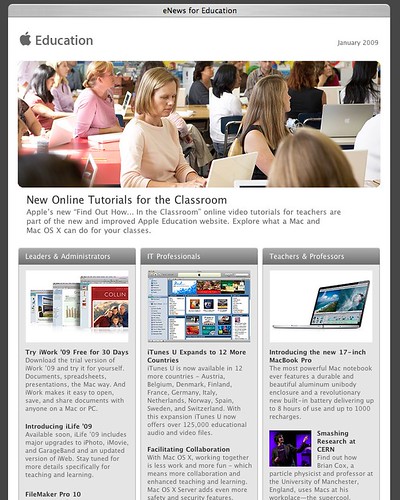
Edu.mac.ate me

Even newsletters are done well. Thus is a sales brochure really

Apple email

Uber cool

Apple email

Nerd mail

Even iPhone dev emails are beautiful. This was from a year ago.

Apple email

Two McKinsey pieces on education – do read them

Two astonishing reports on education from McKinsey.

The first shows the effect that the USA’s poor schools have had on their economy – and was just released. It finds the economic loss in the order of US$2,400 billion to $4,200 billion of GDP in 2008 alone. That’s more than enough to compensate for the current economic crisis.

It’s a tough number to get to though, as it means that the US schooling system would need to be the best in the world, whereas in fact is is close to the worst in the Western world. Their top schools are astonishingly good, but their average and below average schools are appalling.

NZ fares better than the USA, but there is a lot we can learn from this report. It wouldn’t be too hard for the local McKinsey office of the NZ Institute to generate the economic loss numbers for New Zeaand – how about it?

The Economic Impact of  the Achievement  Gap in America’s Schools
The Economic Impact of the Achievement Gap in America’s Schools

Poor school systems mean the students have poor grades, which mean that a lower proportion go to university, the average income is lower and they are more likely to have low civic engagement and criminal records. That’s summarized nicely in a page, as is a McKinsey team’s wont:

Somewhat frightening are the differences in scores relating to being black and/or low income – things which are also correlated. I wonder what the sme chart looks like in other countries.

While the most recent report stays well away from asking why the education is so poor, the report from 2007 does so – and it is fascinating reading as well.

How the worlds best-performing schools systems come out on top
How the world's best-performing schools systems come out on top

The summary is simple – get great people, help them become great teachers and support them with an equitable excellent system:
McKinsey

The difference a great teacher can make is immense – lifes are changed:

The end of the document has this wonderful check-sheet to determine whether you have an excellent education system or not. The gaps are pretty clear:

I would like to see this on every headmaster’s wall, along with everybody in the Ministry of Education, every member of a school board and all teacher of teachers:

In closing my recent favorite question to ask teachers is “how often are you reviewed by your peers?” The answer is usually close to “never”, and that is sad. It is very hard to improve if you are not getting continuous feedback related to normal situations.

I strongly feel we need to get to the stage where peer teachers can wander into and out of each others classes, sitting quietly at the back (say) without the students changing behaviour, and then giving and receiving 1-1 feedback after the class. This means the teachers need more time in the day, which in turn means more teachers.

We need to also better reward great teachers, those who work in lower decile schools and tough areas,  bringing back the student and society’s respect for teachers. It’s a tough job, and the teachers themselves (in the form of their union) are often against performance pay.

However I have yet to meet a teacher that would not welcome the feedback from peers, while the pay for the people to whom we entrust our children’s future is a national shame. Teaching is a calling, and we should not be doing it for pay, but I really think we owe it to them to allow them to live a decent life.

The New Zealand iPhone 3G network debacle

The iPhone will dominate the top end of phone sales

Even if you are a fan of other platforms, we can all appreciate that Apple has bought new levels of usability to the phone. It’s most obvious in the seamless connection with the App store on iTunes – a system that  makes building, selling and buying applications simple.

For me it’s  like 2003 and iTunes all over again – remember the plethora of MP3 players? They are still out there, but Apple grabs almost all of the revenue, and one imagines almost all of the profit as the others compete out any margin.

I sometimes see a future for Blackberrys, simply because of their installed user base and Apple’s unease with selling to giant corporates, but I also remember that everyone used to have Palm Pilots back in the day.

I am predicting that Apple’s iPhones will grab 40-70% of the top end of the phone market over the next 3 years.

Vodafone NZ iPhone data rates will always be lousy

It’s complicated [Geekzone], but worth going through. All of the network providers are upgrading their networks, and from about June everything will be different.

Vodafone are the sole sellers of the iPhone in New Zealand – they have a monopoly. Their 3G network is currently only in cities, and it is excruciatingly slow compared to, say, Telstra’s Next G service in Australia.

In the next 2 months:

  1. Vodafone are rolling out a new NZ 3G network – but it will not work at 3G speeds for (current) iPhones.
  2. Telecom are rolling out a new 3G network, which will work for iPhones. (similar to Telstra’s Next G)
  3. Telecom seem to indicate that they will not be selling iPhones.

Nobody seems to know anything about NZ Communications.

Buy an iPhone from Vodafone, use it on Telecom

Vodafone, to their credit, are selling the iPhone in unlocked state. You can buy it for about $1130, or for cheaper if you sign on a contract.

But you wouldn’t sign a contract – instead the logical move will be to transfer your iPhone and number to Telecom, grabbing a new SIM card and using it on their new 3G network.

If Vodafone starts locking phones then you will need to crack it – the Dev Team are on to that and I am sure there will be plenty of options for those not nerdy enough to do it themselves.

But for now – just wait

We don’t really know what is going to happen in June, and it gets quite fuzzy thereafter.

  • Telecom may launch with the iPhone in June.
  • Apple may emerge with a new iPhone that is compatible with Vodafone’s new network. They are due for a new one soon, and the timing is auspicious
  • NZ Communications may surprise us all by carrying the iPhone
  • Data rates will be in a state of rapid change as the carriers compete
  • I could have some of these facts wrong

Summary and implications

Apple doesn’t really care about New Zealand – as we are so tiny. But if they wake up then they will realize that either they need to give Vodafone a phone that works at high speeds here, or else they will have to sell the phones to Telecom as well.

Vodafone will fight to retain exclusive rights to sell iPhone in New Zealand, but the slow data rates will mean a much poorer experience versus overseas.

Telecom will try to add iPhone to their list of Phones – as not doing so would be a move equivalent to their decisions to go and then stay with the obsolete CDMA standard. Imagine leaving out 70% of the premium iPhone market.

Vodafone will be hoping that Apple deliver a phone that will work at 3G speeds on their new network. Unfortunately for Vodafone, hope is not a strategy. If they have delivered a high speed network that Apple has no intention of supporting, then I have to say that they have just commited equivilent of the CDMA blunder. If they know something that we don’t – then good on them.

The best answer for all of us consumers the iPhone working on all three networks, and sold by all three networks.

Stealing content from bloggers

The latest blog to steal my – and others – content is jobs.org.nz.

They should know that they are in good company – the previous offender of note was a <redacted> site.

So I’ll do the google-ads-filled jobs.org.nz a favor and directly  link the two together: redacted

<update 2 – after a chat with a very polite domain owner I removed the link above. See comments at the end of the post>

Incidentally I saw ads for Starnow and Finda – guys you are wasting your money.

So along with that childish response I also did the adult things

First I complained to Google Adsense. They have a nice little set-up for receiving complaints – just click on the gooooogle link by the ads.

However I got an auto response which says Google’s policy is to respond to all alleged infringements under the DCMA – which is right. However in order to do so I need to send something in written form – which will not happen as bits of paper confound me.

It should be really easy for Google to make this work automatically.

They just need to give me a form when I can put the copyrighted material (mine) including links to specific copied articles, along with a link to my feed. Similarly let me put a link to the stolen copyrighted material and a link to the culprit site’s feed. If the site is taking other site’s source information then give me the ability to put their feeds in as well.

Then it should be a trivial matter to automatically monitor the feeds of the source sites and check that the culprit site feed is appearing after the source. Automatically take the Google ads off that site – it is clearly of low quality anyway.

If the site wants to challenge Google to get the ads back, then so be it – but the onus is now on them to prove the content isn’t from the names sources.

I do recall when I first got Google ads for a site that it was actually quite tough (it was SmokeCDs or Snow.co.nz I think). Now it seems any man and dog combination can get the ads, and the results will vary for adsense buyers.

Next I did a whois search, and found that the owner of this shame is <edited> from Christchurch.

I’ve emailed him and also the hostmaster at 1stdomains to request that they stop. We shall see what happens next.

I am happy for people to grab content from this site with attribution and add commentary  – it’s all adding to the conversation. But to do so to a google ad filled site with no context is clearly wrong.

<update 1: I’ve received an email reply (2 actually) from the site domain owner who tells me “I did not set any feeds up personally” and offered to remove my content.

I also notice that right now there are no longer any Google ads on the site.>

<Update 2: As noted above I’ve now chatted to the domain owner Rob. While he owns the domain but the site is owned/operated  by a student out of India. He proactively removed the Adsense code from the site once he saw this post.

I’m struggling with this exchange. I think I was a bit heavy handed and perhaps wrong – and I give credit to Rob for being so proactive and polite. The jobs.org.nz site does after all link back to my site, and doesn’t take entire articles – both the right behaviour.

So I removed the references to a previous offender site that dabbled in pictures of unclad gentlemen engaged in mutually consensual activities.

And as Don asks below – what is the difference between jobs.org.nz and Google News? – aside from the site design, the number of ads (Google News has none) and so on. Shouldn’t sites be glad to have their content syndicated elsewhere?

My answer rested in the design of the site, the number of google ads and an over-riding sense that the purpose of the site is simply to harvest content and surround it by Google ads.

My determination was that is is a splog – a spam blog – something that Louise talks about in her post on Changememe. She links to an article on Techcrunch which talks about sharing the joy. Perhaps it would be ok for ad-laden sites to grab content if they do so with permission pay the content providers a commission. You could see a world where this is semi-automatic, but also one where there are lots of errors.

There is something else going on here – we are in New Zealand. I was able to find the domain owner, he was able to find me and we were able to have a nice conversation (and emails) about it all. Because we are a small country we can self-edit to an extent.

So I am going to let this rest as far as jobs.org.nz goes.

But what do you think? is the site (and it is more informative to see it with the ads turned on) adding value? Should I be upset or happy that my content is taken? I feel my response was pretty tough – was I clearly in the wrong?

>

How to twitter if you are a corporation

Twitter, for members of my family and those other 4 people that read blogs and have not yet discovered it, is a microblogging service that has just hit the main stream media. By definition it is therefore passé, but in the meantime we may as well use it well.

Examples: How not to twitter.

@NZStuff (sorry) sends through groups of news, either at 530am or during the day. The 530am news is from when the news is posted to the Stuff.co.nz website in an overnight process. The news sits unreleased until the morning so that the newspapers are not scooped. I don’t agree with this approach as to me news fails to be news when I can read it somewhere else first.
The ones during the day are the ‘most popular’ (I think), and also released by a bot (I think). By definition they are already out of date when they are tweeted, and almost by definition the audience of active twitterers will have already read them.
@nzstuff

Rather than @nzstuff’s automatically redundant articles, instead follow @NZStuffEditor, who is not very prolific but at least sends out news that is timely – and timeliness is a vital component of the definition of “news”.

Examples: How to Twitter
While the Wall Street Journal (@wsj) also twitters articles, it does so very rarely in groups of three, and most often the tweets are through the day. Almost invariably their tweets are before anybody else’s, and are therefore news in the truest sense. @NYTimes is not quite as quick, and will sometimes deliver in clumps, but they tend to beat the local alternatives and like the WSJ also link to longer articles on interesting and topical things.
@wsj

What all so far are missing is the human element.

I’d really like to see @NZStuff reply to people’s twitters, and to give a bit of extra juice that we don’t get from the website. Stuff and others need to remember that their customers are not just people that read the news, but people that evanglise their services and want some inside scoop, people that want to send them news (but need to know it will be looked at) and, most of all in these times, people that are thinking about buying advertising,

Rather surprisingly the best corporations at Twittering in New Zealand are the telcos. I’ve had conversations in public and private with @TelecomNZ, @VodafoneNZ and ISP @orcon. They reach out to customers and help them – often walking down to the customer service folk and asking them to resolve an issue. Indeed they have each helped solve (or at least help me understand) a personal customer service issue, and their corporate reputations with me are all a lot better for it. Here they are earlier today each helping someone out:

@telecomnz
@orcon
Vodafone

I’d like to see them extend this beyond the corporate communication people – especially to Customer Service and also to the real tech-heads.

Air New Zealand’s  @flyairnz does well – sending out specials, but also being a human – replying to questions and making comments – such as welcoming @johnkeypm to Twitter.

Trade Me has  unleashed a few people – with twitter names like  TradeMe_Ross , TradeMe_Jay, TradeMe_Jobs along with Trademe_NZ and Travelbug. The latter has a combination of background tweets and specials. Kudos for this topical tweet:
@travelbug

This stream from TradeMe_Jay is an exemplary example of how Twitter can extend your corporate PR reach well beyond what a PR team can do. In four tweets Jay helps a member (and ex Trade Me employee admittedly), personalizes the continuous development work that Trade Me does and links to an ‘expose’ video that most corporations would cringe to see appear on YouTube.

However Trade Me’s main twitter account is dormant, and we have yet to see Motors, Property or Customer Service make an appearance.

Google allows their staff (it seems) to twitter as they like – here’s Webstock speaker Pamela Fox announcing the release of Google’s new analytics Data Export API – something that I think has tremendous potential to change the advertising scene in NZ and elsewhere.
pamelafox

I’ll point to @powershop and @lingopal as two other examples, but to be fair I am involved as a supplier to the first and shareholder with the second. That shouldn’t stop you following them though :-).

Enough of the examples – what should you do if you are thinking of twittering?

How to take advantage of Twitter

The real power of Twitter is the 1-1 interactions, and yet there are only so many people that sit in corporate relations units. Moreover their job should not be to look after every tech nerd’s customer complaint, nor to understand every bizarre happening on the internet.

To me a great corporation would have three things on Twitter:

  1. A corporate voice – run by the corporate relations unit and staffed by a person. They would tweet press releases, reply to tweets that discuss the bigger picture (investor, employee relations, big stories) and generally have a slower beat but positive and official response.
  2. An active Customer Service voice – this would be staffed 24/7 but owned overall by a single person. That means that while a number of people will answer the tweets, the owner would make sure that there is consistency, speed and humanity behind it. The CS twitterer would continuously search for good and bad experiences from the organisation’s products and give thanks or help accordingly. They are the front line and so would have a very quick response time. They would deal with problems in public, take them to Twitter direct messages and ultimately call the customer directly.
  3. Unleashed individuals. Great companies would unleash everybody inside their organization to tweet about what they are doing, engage in conversations and show a genuine human face (warts and all) to the company’s customers and the public.This last one is scary.

    However if you are concerned that some employees will somehow destroy your company and brand then perhaps instead you need to do some serous internal navel gazing – and ask yourself “why would they do that?”. Even if some employees do tweet negative things, then see it as a fine way to take the pulse of your staff – and also fix the underlying problems.

    While I would put in place simple guidelines, most of those would already be in any employee contract. The main things not to tweet would be things like investor-level commercially sensitive information, competitively sensitive pricing and Apple product development news.

The progress made by the companies above is pleasing – and I hope we will see more of this as the use of Twitter and other tools expands.

Amazon is failing to be the iTunes of book world – so far

I’m warming on the idea of the Kindle – Amazon’s ebook reader.

  • I like it for mass reduction, especially when travelling – it sharply reduces mass that you need to cart around on an airplane or  motorcycle.
  • I like it for convenience – You’ll get books that you purchase instantly, rather than waiting for days or weeks for them to be delivered.
  • and finally I like it for price – books are US$9.99, which is a lot cheaper than their paper equivalents, and a heck of a lot cheaper than buying in New Zealand.

It’s clearly the path to the future – a single device that removes the print and distribution industry from the Author-Reader flow. (There is still, and I believe always will be, a role for (book and news) publishers, to raise and represent quality of their branded products.)

So while the Kindle is not perfect, it is certainly a vital step to the end game. That’s an endgame where we stop using so many trees, we stop manufacturing so much paper and ink, and that’s good for our ecosystems.

But sadly I cannot buy a Kindle.

Amazon, apparently hamstrung by publishers, will only allow those with US issued credit cards and addresses to buy the Kindle, and only those with US issued credit cards can buy the books.

This is transparently protectionist – and stupid – as Amazon has always allowed me to purchase US published books in paper form with my NZ credit card and NZ address. There is no real difference – save that I don’t have to pay 25-100% of the price in shipping costs, and that I don’t have to wait 14 to 40 days to receive the books.

Amazon’s international sales could explode if they released the Kindle offshore – and the future of local rivals such as Fishpond and Whitcoulls would be doomed in the long term. To be blunt, Amazon has the ability to be the iTunes of the book publishing world, to move books sles from stores to online, to move book selling power from bookchains to Amazon. Hoewver by constraining sales to the USA they are blowing it, and risking being like Sony, who released beautiful yet DRM crippled music playing devices that left the market wide open for Apple iPod and iTunes.

At this stage I should be able to turn to Shipbuktu, a promising Kiwi startup that provided US addresses and also wanted to provide US credit cards to Kiwis. However their forwarding service is on hold, and has been since Christmas:

Meanwhile their US credit card service never emerged. That’s sad for all of us.

So Amazon just continues to piss me off. Their US-centric approach means that I can actually buy less and less from their store, while locals like Fishpond and MightyApe just get better and better. Still-  they have enormous critical mass and they have the Kindle – so if they can get their act together quickly enough then they will be hard to beat.

On the other hand Apple, while US-centric themselves, now have 80 countrybased iTunes stores, and must be learning quickly. What if their next product, as some rumopurs have noted, is a kindle-sized device with the iPhone software? Kindle reader is available for iPhone, and if Amazon opens up their service then it is game over.

Meanwhile I’m searching for someone in the business of providing US-based credit cards to foreigners (cash up front, clip the ticket on each transaction). I’m guessing there is nothing there – so does anyone want to have some fun?

Understanding our animal spirits

Prof Shiller (remember him from “Irrational Exuberance) has partnered with George A Akerlof in a strangely titled new book: Animal Spirits. I’m recommending it even before reading it.

It’s basically about why we don’t behave as rational consumers when faced with economic choices.

If you don’t want to wait, then there’s an excerpt from the book – the first chapter, which you can read over at Yale MBA’s Financial Crisis website.

Here are the five animal spirits – emotive things that often dictate our economic behaviour.

  • The cornerstone of our theory is confidence and the feedback mech­anisms between it and the economy that amplify disturbances.
  • The setting of wages and prices depends largely on concerns about fairness.
  • We acknowledge the temptation toward corrupt and antisocial behavior and their role in the economy.
  • Money illusion is another cornerstone of our theory. The public is confused by inflation or deflation and does not reason through its effects.
  • Finally, our sense of reality, of who we are and what we are doing, is intertwined with the story of our lives and of the lives of others. The aggregate of such stories is a national or international story, which itself plays an important role in the economy.

Just those five statements make for interesting pondering – so here is my quick take.

Confidence is everything – it is the difference between buying something (on credit even) and choosing to hunker down and not spend. When a depressed or optimistic feeling rolls out to entire populations then it causes and exacerbates busts and booms.

It’s true that we care most about parity and fairness when setting wages and paying prices. This is particularly evident in New Zealand where we tend to look down at those with unhealthily large incomes and spending habits and where we have a nationally loved TV program called Fair Go that goes after companies that rip people off. Interestingly the feeling of fairness to members was the overriding thing that governed our thinking in the days when I was involved in setting prices at Trade Me.

We also score pretty well as a country on corrupt and anti-social behaviour – scoring at of near the top of the list in the annual Transparency International surveys as a result. On the other hand we are a little divergent on our strong norms about what is anti-social behaviour – though we tend not to shoot each other and mostly we don’t rip each other off.

It’s true that we all tend to compare our income now to our income years ago, and fail to understand that $1m now is worth a whole lot more than $1m at retirement. This is the money illusion – where we look at the dollar figures and not at the real worth, the nominal not the real. Having grown up through inflationary times it did improve my own approach to this versus, say, my grandparents generation who often didn’t change the dollar value of their Christmas presents to grandkids (mine were a bit different). The trick is to constantly reset the current value of everything.

Finally I am guessing “stories” refers to the formal and informal coverage of things like bubbles and busts. Everyone was talking up dot coms in 2000, real estate in 2007/8 and stocks in 1929.  Fast forward a couple of years and the picture was (and will be) diametrically opposed – the media coming down hard on what were correctly seen in hindsight as speculative investments. I try to be contraian, using taxi drivers and ultimately my mother as the unfailing barometer – if Mum says buy, then I go ahead and sell.

They use these five animal spirits in the rest of the book to answer eight questions – such as why do economies fall into depression and why do real estate markets go through cycles?

Interesting stuff to be sure – I recommend just reading the first chapter and having a ponder – the answers may not be that difficult to work out, and if we can be internally aware of those “animal spirits” then perhaps we will make better decisions.

Now I need to decide where to buy it from. Fishpond don’t have it but Amazon who do. However I am really annoyed with them as most of the things I want (electronics, accessories) are not shipped to New Zealand.

ANZ’s tragic teller system

First you dub an application as “Platinum” – critical to your business. That’s a good idea, so you now know you need to get the system and support absolutely right.

You choose to run a trial before rolling it out to all branches – another good idea.

However that’s where things started going wrong for ANZ.

You chose also to run it on Windows, which not exactly secure nor stable in a banking sense, and attracts licensing payments for each installation. But that’s not necessarily a bad thing if done right.

However it seems that it takes 30 to 45 people to support the application at the 20 pilot branches – which implies that it really doesn’t sound like you are “providing tools to make banking easier” for your branch staff.

You next announce to staff that you will outsource support for this application to India, which means the 30-45 people that are currently supporting the trial are going to be out of a job or very nervous about being so. Their personal inclination to professionally support the pilot will be challenged as concern about job stability preys on their minds. This does not bode well for the roll-out.

Finally it all gets leaked to the media, and as a kicker it appears that the Reserve bank may need to approve outsourcing these jobs supporting a core system. Meanwhile an Australian bank gettting rid of New Zealand jobs will not play well in the media or with customers contemplating the (currently) better mortgage rates over at Kiwibank.

The application is MyTell, the new teller application for ANZ and National Bank. It is, I guess, only used when tellers and back office staff are actually in banks, which is during normal working hours, and the jobs to be lost are in Wellington.

From the short article my guess is that ANZ was overwhelmed with the budget required for the amount of support demanded by this application, and are seeking to do everything they can to reduce costs.

I would humbly submit that either fixing the system so that it needs essentially nobody to help, or abandoning it and trying again are the more viable medium and long term options.

This is of course my analysis from a scant 7 sentence article – not doubt there are nuances large and small.

However I’m guessing that this saga will bring a smile to the faces of the folk at Kiwibank.

Lingopal is launched for iPhone

We at Lingopal were pretty happy this weekend-  as Lingopal was finally released for the iPhone.

Check it out

We think it’s vastly better than any other translation application on iPhone – with 42 languages (next best is about 6) and some really crazy fun phrases.

Where else can you learn how to say “I am a Dolphin Trainer” in 41 other languages?

Perfect for when you next meet someone from somewhere exotic.

iTunes

Homepage review: Pundit

I was shown Pundit the other day. It’s a site that is agglomerating a few writers to create a super blog.Good idea, but the home page needs some work.

The site design does little to draw me in, and indeed I was not tempted to click on any of the articles during the time I was looking at the site. So I trust that the owners are constantly improving the site usability.

pundit

Dick Smith sale still three times more expensive

It’s nice that Dick Smith have a 15% off everything sale, however I am simply not interested in shopping there any more.

Dick Smith are meant to be a cheap place to get electrical and electronic kit, but they seemingly abandoned that cause a while ago, and are now selling products to unsuspecting consumers at unjustifiable prices.

I refer of course to HDMI cables (or any cables really).

The cheapest HDMI cable you can buy on sale at Dick Smith, with the 15% discount, is a staggering $55.23.
DSE

Meanwhile the cheapest HDMI cable on Ascent is $18.23 – and they have 14 HDMI cables under $36.
Ascent

HDMI cables carry digital signals. Digital signals either get there or not – there is no degradation. So you can compare those prices directly.

Simply put – Dick Smith is selling HDMI cables for three times more than Ascent. They are doing this because they are either buying expensive branded cables, or they are marking up the cheaper cables by outrageous amounts. In short they could give their customers a  much fairer go but are choosing not to.

The Lesson

Dick Smith has now successfully completed the transformation my impression of their stores from cheap places to buy stuff to expensive rip-off merchants. It now seems that I will go out of my way to tell people to avoid Dick Smith stores.

The 15% off sale seems to be an indication both that their margins are far too fat across the board, and that they are struggling with sales volumes. It raises the question of just what their business model is, and how much longer they will last.

What you can do

We need to send a message to Dick Smith. They are destroying their business, and frankly I’d rather they didn’t.

So ask for HDMI cables at your local Dick Smith store, and when you see the prices loudly exclaim that they are three times more expensive than Ascent and ask “Why is Dick Smith so expensive?” The people behind the counter know just as well as you do that the prices are out of whack, but this is a fun exercise to do with the store manager.

If you do need cables, or anything electronic, then buy them at Ascent or Trade Me.

Wait a few more weeks or months, and then pick up the real bargains at the Dick Smith closing down sales.

To summarise it all nicely when I tried to repeat the search for other types cables I got this:
DSE

Xero’s capital raising

Staggering.

While I still believe that Xero’s IPO was expensive, I also believe in the business opportunity and how Xero is going about pursuing it.

While the latest round of share issues at $0.90 is dillutive to the original $1.00 IPO,  it is an excellent price nonetheless:

  1. The IPO was expensive – and that was proven as the price languished well below the initial price of $1 for most of Xero’s listing period. As an early stage deal the offer should have been for a larger share of the company per share as the information available (actual results and plans) was sketchy.
  2. Times have changed, and changed for the worse in for the economy and particularly for the money raising game. Getting any money at all is hard these days, and finding over $23 million is an excellent acheivement.
  3. The source of the funds is telling – one of the founders of MYOB, a lumbering giant that owns the top end of the market that Xero is intent on stealing. They must be feeling pretty desperate right now. MYOB have proven, and will no doubt continue to prove, that they are  culturally incapable of  replying to the threat from Xero.

Xero has managed to execute well on their business plan, with features coming out at a steady rate and after a slow start, pleasing customer growth. They have also cracked their approach to selling – convert the accountants and they will bring along their clients. That’s not exactly viral for now, but it’s a path to sustainability.

Well done to the entire team at Xero.

The money eases pressure for Xero, and means they can focus on the three tasks at hand:

  • Keep the feature improvements coming, becoming clearly superior in feature volume and usability than the competition. Also have some fun and offer features that the MYOB’s have no answer to.
  • Sell sell sell – expand within Australiasia and in particular the UK, and make a beachhead into the USA.
  • Become sustainable – in theory this should be the last capital round required for sustainablity, although the option remains for a much larger further round to really launch hard into the big Kahuna – the USA.

A great story.

Getting the basics right makes money – Ascent

Yesterday I went shopping for a laser printer. I went to Pricespy and Trade Me, along with Ascent where I have successfully purchased before.

Pricespy sent me to a few stores, including Ascent, but I will pick on Computer Direct who came back  as the cheapest. They have a good url, but they are not a company that I have heard of. Still, they looked professional enough, and so I placed printer into the cart.
computerdirect
All good, if a little dated, but when I clicked on check out I was confronted with this:
computerdirect

Sorry – I don’t know you, and although I’d buy a printer from you I have no wish whatsoever to register on your website. You have also not yet told me how much shipping will cost, and given that I do not trust you I choose to stop. Goodbye.

For a simple lesson on how to do this (and to buy my printer), I headed on over to Ascent. Here is their cart:
ascent

and here is the next screen, which is excellent. I can simply click the center button and buy what I want to buy. I don’t have to register, I don’t have to remember a login and password.
Ascent

Oh – and before you can say lock-in and email spam, you should know that not only did I buy something else from Ascent two days ago, I have also purchased several expensive items from them over the years. Each time I just go through a normal checkout process. What I am trying to say is that it is not being registered that increases loyalty, it’s the site usability and the service. And that’s clearly worth a few extra bucks.

Ascent were first recommended to me by a red headed chap at Trade Me a few years back, and I’ve since recommended Ascent to others over the years, and I also commend them to you.

From Twitter @normnz agrees – “Ascent are worth every extra penny. Their service levels are extra-ordinary” and @vavroom says “Been dealing with Ascent for years. Service is *exceptional*. Would not think about using anyone else.

This sort of word of mouth marks the difference between really successful businesses and lousy businesses.

What are you doing for your business to generate this sort of response? How do you stack up versus your competitors? Do you even know?

Getting the details right – ACC’s ActiveSmart doesn’t

Years ago I had a boss at Mobil Oil who had a mantra – “Retail is Detail”. He was all about getting the little things right, and right every time, in order to maximise sales. It was pretty smart, though it helped to have the big stuff right first!

Web sites are the same. The greatest looking websites can fall over in a screaming heap if the little usability things are not done well.

Today’s victim: ACC’s ActiveSmart website, which looks oh so nice, but using it is not so easy. I’ll walk through my experience. Each interaction is a chance for the site to build (or destroy) my trust in the site, the service, the developers and the owners

I arrived there by clicking on an advertisement, which looked pretty cool. I got this landing page which also  looked  interesting.
activesmart
I just started clicking stuff as unfortunately I couldn’t see a way to check out a sample plan, which was not a great sign – but I nosed around a bit, and eventually clicked the home button.

and got this:
Activesmart
It’s different from the first home page I saw – and I was confused and my trust in the site dropped a bit.

So I went back to the original page and decided to give it a go, and entering the login process.

activesmart

Whoops – it seems that I failed to create a sufficiently long password. This is for a site where I am unlikely to want a password that I can’t remember, and where you didn’t tell me to make the password long and complicated. More loss of trust.

But whatever – I guess for some fitness can be really personal, and so out came the industrial strength password, and on I went, a little miffed.

activesmart

Whoops again – it seems that I didn’t click the T’s and C’s box. More trust gone and I am more miffed – why didn’t the website tell me this when I got the last error? Despite the cute website I am beginning to suspect all is not well.

But I plug on, and get told that I have been sent an email.
activesmart

I suppose that’s fine, but why not log me in now so that I can keep moving? If my account isn’t verified you can always delete me right? It’s not as if this is a bank or anything.

But off to me email I go. Can you guess what I see?

my email, munged a bit
That’s right – there’s my top secret password. In the clear. Thanks a lot you lot – now everybody on the internet can see it. My trust in your site just went from 80% to 20% in one hit.

Losing all hope I clicked on the link in the email, and got this:
activesmart

So although I’ve just seen my login and password in the clear, the included link does not result in a populated login screen? That really dumb, and I am clearly feeling that you are not with the program. Say goodbye to yet more trust.

But still – it is cute looking, and I do want to see what I get, so onwards I go to create a plan.

Next, well it’s an ACC site I know, but really – do I need to tick this many boxes to get to a plan? (I’ve reduced the size to save space – the questions are things like “do you have a heart condition”). More trust gone.

activesmart

Next you want some details. I understand you need my age and weight because this is a fitness thing….
activesmart
But I don’t understand why you need my birth-day. That’s personal. I’m getting pissed off now – I don’t trust you with my details any more and you are getting a bit too personal.
activesmart

Now I need to choose what sort of plan I want. I wanted something across multiple sports – running, walking, cycling and so forth. Sadly that was not an option, and more sadly it took until now for me to realise that.
activesmart

I chose cycling but by this stage had lost all hope and trust – and was just making stuff up. The site was no longer potentially useful to me, nor was the resulting pretty but useless plan.

activesmart
So I decided to cancel my account. To ACC’s credit this was actually pretty easy – trust enhancing even.

First I “archived” the plan (why couldn’t delete it?)

and then I canceled the account:

Great – I’m done. It seems that canceling accounts is a strength. That’s a little worrying.

Well no – not so fast. When I tested by creating another login with the same name, my old one was still hanging around:
activesmart

So now my information is on your tables for posterity – I’m not really deleted.

What part of delete don’t you understand? This certainly sounded the death knell in the “do I trust this site” stakes.

How to fix it?

It’s not really that hard as the website is fundamentally there.

It needs to be tweaked, and constantly, which needs ownership, resources and a mandate.

Somebody that ‘gets it’ needs to own the user experience, looking constantly for the sort of stuff I have mentioned above. That person may already exist, but they need a mandate for the  time, money and people required to make the continuous improvements, and those people themselves need to have the time and talent to make the changes happen.

I would firstly fix what I have mentioned above, but more importantly do some usability testing. Don’t spend any money, but sit individuals down and simply watch them use the site, without prompting, aside from asking them to do tasks. Get them to talk as they are doing stuff. The results can scare, but will also give obvious ways to improve. This advice should not be surprising to anyone in the industry.

Buy and read Don’t make me think. It’s title says a lot, and the text is even better.

Overall I am worried that this site was built with a budget and then left alone. I cannot stress enough that websites are living – they need to be constantly improved. I like to think of the ongoing spend on website tweaks as a maintenance budget, as just as with a large piece of equipment if we fail to spend enough on website maintenance and improvements then the website will ultimately fail.