There must be a better way: Airlines that get it right

Third in a series.

Sadly no airline gets it completely right, and we won’t be happy until almost all airlines (and airports) get it right. But the good news is that some airlines are getting some of it, and one even gets most of it. Let’s have a quick look at some good practices, and in the next post look at what great could mean in reality. I’d love t hear of other great things that you have experienced while flying.
Virgin Atlantic take care of you from your house to destination – but only if you pay full fare business class – which is pretty steep. They will pick you up in a limo take you to the airport, provide pre and post flight lounges and drive you to your end point.  The lounge in Heathrow is something else – last time I was there I got a last minute haircut (distressingly quick these days), while I usually grab a shower and breakfast when I arrive in London.
In flight Virgin Atlantic offer an “eat anytime” service, which is fantastic. It means you eat on your own terms through the flight, and that the servers have their work staggered through the flight. Manwhile the legendary on-board massages are for real, while the bar in Virgin Upper is a bit overrated, but there nonetheless.
Other food experiences are less expensive yet impressive – several airlines give you a cardboard box, which they can hand out really quickly and you can eat then, leave until later or even take with you. Some cheap airlines simply leave it up to you – if you want to eat, then bring your own food, which is perfectly acceptable on short flights with no delays.

With JetBlue, and others, they offer drinks using a restaurant approach – asking for orders and then fulfilling them a few at a time. This takes away the massive carriages blocking the passageway, while making you more relaxed about when you get attended to.

On Air NZ long distance business class, amongst others, (not AirNZ to Perth though) the tray can swivel out of the way, and with the angled seats you don’t have to squeeze past someone else. That swivel isn’t perfect though, but you can squeeze past for a walk if you need to.

Checking in has improved substantially with check-in machines, and great airlines see that there is no queue to drop bags. Meanwhile several airlines offer a physically separate check-in for business travelers – giving a peaceful environment in a area of chaos.

This week I noticed with Qantas in Perth a separate and pleasingly short queue for those that got “rejected” by the machine – which probably means those that are running a tight schedule, as well as those with mucked up flights. A nice way to accelerate the needy.

An the ultimate check-in was, pre 911, on the Delata and US Air Shuttles between NYC, DC and Boston. We could check in at the gate and board shuttles a handful of minutes before the doors shut. If too many people turned up for a flight, then another would be rolled out to accommodate the overload. Meanwhile you could always cross over to the other airline’s shuttle (they ran at staggered times) and use the competitor’s ticket to get a seat. Fantastic.

But security is now an issue we have to contend with. However at many smaller airports it is pretty efficient, and at larger airports, well, the TSA seems to have an answer. In Denver (first) and now in a bunch of other cities the TSA has instituted ski lanes for security. Black for the professional traveler moving fast, red for the experienced and green for the less professional and the encumbered. Go black if you are traveling light, have your laptop out of your bag and shoes off, but watch out for the New York style reaction if you get it wrong and hold up the other punters. Go green if you have a family in tow, or just lots of time to kill – you’ll get friendlier and more personal help.

As mentioned before, Virgin America puts a lot of this together. You can check in online, at a kiosk or at a counter. On the plane they provide eat when you want food service, power at every seat, MP3’s to play, big screen seat back video with even 25 pay per view movies along with games. And that’s just economy. In Business (“First”) you also get a bigger reclining seat – with massage built in. The fares are pretty cheap – $127 for economy and $489 for business is showing right now for a flight from DC to LAX in May. A Qantas Brisbane to Perth flight for the same date – more or less the same distance – costs $AU344 economy and $1084 business. No comparison, but still there are not many routes for Virgin America.
So – some airlines are doing it right, but there is so so much more we could do to make air travel more pleasant. Utopia is up in the next post in the series. Meanwhile – are there any other examples of good?

There must be a better way: Qantas shows how not to do it

Second in a series.

This is the Qantas airline lounge right now. It is 7:10pm on a Friday night, and these folk are standing because all of the seats are taken. It’s much better outside in the normal section of the airport, though it’s also manic there.

Qantas Brisbane lounge

Airline lounges seem to be designed for good times but fail during peak traffic time, and when flights are postponed or canceled – which happens pretty much every Friday night here I am told.

There must be a better way.

There must be a better way – The Pain of Flying

It’s 320pm – and I’ve just been trapped in a chair for over 2 hours. Trapped in one location with no chance of standing up, no chance of stretching, and no chance of working.

Clearly I am flying.
However, it isn’t meant to be like this. I’m sitting in business class, the plane isn’t delayed, nor circling before landing nor trapped on the tarmac.

No – it’s just after the time between boarding and the completion of the meal serving process, when the solid steel barrier between me and freedom was finally removed, and I am free to walk the cabin.

I cannot stand the waiting time associated with airline travel. So I try to game it.

I arrive at the airport at the very last minute that I can. An empty airport departure terminal frequently confronts me when I arrive – the rest of my flight already checked in. That’s when it helps to have airline status and to travel business class. I’m very often greeted by name at the check-in – the process of elimination in action.

Over the years my strategy of arriving at the last minute has sometimes backfired and I’ve missed quite a few flights. Only one or two of them mattered – I still recall the frosty look I received when I turned up half a day late to a team conference with a new boss early in my career, but consoling my then girlfriend when we missed a flight for a surprise holiday she had booked was much much worse.

Even with those two there is nothing that caused any real harm to my career, personal life or wallet. Meanwhile I’ve saved a huge amount of time that would have been otherwise waiting in queues in in airports, and have a few great stories to boot. For the record, the, err, record for me is 10 minutes and 20 seconds for a domestic flight (post 911) and about 20 minutes for an international flight. YMMV.
But there must be a better way.

Once checked in I’m often one of those final few names announced frantically on the intercom. I know that is poor social behaviour, but it seems I combine a deliberate plan to be in the last batch to board with a tendency to complete disorganization and unbelievably optimistic estimates of time it takes to get to gates. I mean – I do not try to be late – it just happens. Still – I’ve never failed to get on a plane once I’ve checked in, and I’ve reduced my time waiting in lines in front of departure gates to almost zero.

A pet peeve is that even if I am last to “depart”, and the departure gate folk disappear when I am through, I’m often left at the back of a disgustingly slow line in the departure tunnel. Not being a fan of queues (if that wasn’t abundantly clear) I usually stop at the back and wait a while – letting anyone who is even later than me pass on by.
There should be a better way.

Once on the plane there is the usual disorganization, which people trying to deposit bags in lockers, get to their seats, chat to friends and, mostly, wait for everyone else to do the same.
There must be a better way.

So finally I’ve stashed my bags, fiddled around to get my earplugs (which are staggeringly effective – airplanes are LOUD), my iPod, noise canceling headphones, book, magazine while turning off my phone, depositing it and any other clunky electronics in my bag, putting my laptop in the seat pocket and generally fussing around. No – this is not a smooth process, which is embarrassing for someone that flies as much as I do.
There should be a better way.

I’m then trapped. Last to board, last to stop fussing (I do hurry if the plane awaits) and last to get a drink (if at all) , the seatbelts must be on, the pane starts moving and I am now trapped.
Once airborne there is no escape. Servers rush up and down the aisles, often sporting metal carriages of colossal size and momentum. Drinks are proffered, and then dinner. Dinner requires a tray table, which acts as an excellent blocking mechanism to restrain you to the seat.
There should be a better way.

Now I can hear you saying – aren’t you traveling business class – in luxury? Sadly no. Well yes- I travel business class, but luxury this is not. The domestic business class in Australasia is akin to the US business classes. Shoddy. Confined. Painful. And not at all conducive to “business”. I’m writing this on my MacBook Air – a tiny computer, but the angles are just all wrong, my elbows are jammed between me and the chair or they are on the rock hard armrests, again at a painful angle. There is often no power supply or it doesn’t work, and there is almost certainly no internet connectivity.
There should be a better way.

But they do boast a more extensive food service than back in economy – so that’s a good thing right? Again – no. It’s that lengthy food service program that’s kept me trapped here from 1230 to 1540, and let’s face it – we don’t fly to eat well. Eating passes the time, keeps the passengers busy for a while and provides and interesting assortment of aromas for the passengers – before, during and after the meal. But not only are we trapped during the meal program, the tray is jammed full of the paraphernalia of dining, allowing no space for a magazine or book, let alone a computer.
There should be a better way.

That’s a lot of whinging and whining. Economy is worse of course, although they have a simpler meal program, the ratio of servers to passengers is much lower, so you are confronted with an empty plate for longer.

There must be a better way.
And there is. are.
So let’s talk about that in the next post – my next flight is boarding, and I need to go finish my drink, hit the head, shop for a magazine and time my arrival at the gate perfectly to last.

Blockbuster and Circuit City = AOL TimeWarner

A brilliant move for Blockbuster – Blockbuster’s business is dying, while Circuit city is in retail – which always has some sort of future. If Blockbuster can raise the money from markets that do not realise their business model is dead, then good on them for exiting a bad situation early.

Ignore the rhetoric.

The combination of Blockbuster and Circuit City will result in an $18 billion retail enterprise uniquely positioned for the convergence of media content and electronic devices

It reminds me of the AOL-TimeWarner deal. AOL cashed out by buying old media, which had lasting rather than AOL’s ethereal  value.

Vertical and Horizontal

If you were following the comments on a previous post, you may have noticed an arcane commentary about “Vertical” documents versus “Horizontal” documents.

It’s consulting gobbledegook, but the differences between vertical and horizontal documents are important. Our friends at the NZ Institute are a bunch of consulting refugees, and their output will serve as good examples of the difference in formats.

Here is a horizontal document: (the broadband report)

nzinstitute

Horizontal documents are word, data and diagram packed powerpoint slides – aimed at being used in a small setting, for being written on and for pushing thinking along. They are the notes for a conversation, where the clients and consultants fill in the gaps.

And here is a vertical document. (the NZ emissions report)

NZ InstituteNZ InstituteNZ InstituteNZ Institute

Vertical documents are horizontal documents with the words filled in. Notice the charts and tables in the above – they are pulled directly from a horizontal predecessor to this written document. It’s a much higher quality piece of work as a result, worthy of serious contemplation.

It is much harder to write a good vertical document than a horizontal one, as the writing needs to be incredibly structured as well as readable.

The same high standard of logic applies to the horizontals, but for the verticals you also need to fill in the gaps of logic, and bring out examples and evidence that support (or counter) your case.

However – it’s much faster to read the horizontal deck, and they are much better to quickly engage people with. You do need to maintain a conversation though, to make up for the lack of detail.

The art of the vertical is a disappearing one in consulting-land, which is a real shame, but it does mean clients and consultants spend less on writing up and more on the thinking, which is what they are there to do.

However as someone that has worked both sides of the fence I’ve at times been absolutely appalled at what consultants have left behind. Sadly I cannot name names or clients, but I’ve seen some shockers.

So these days I try not to leave anything at all behind, especially in powerpoint form. Consultants are infamous for advising and then leaving, and while that’s enjoyable for the intellectual challenge, it is much more rewarding to stay the course and see the results come from the clients themselves.

If you must retain a consultant and if you must want a report – insist on a vertical, and be critical on the quality – hand it to people that were not involved in the project and ask them whether it makes sense before you sign off on it.

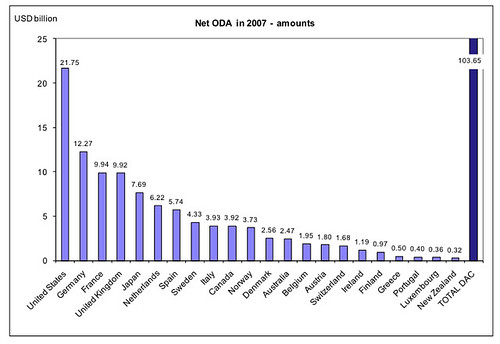
Global official aid falls – NZ languishes at the back

Pathetic.

Official development aid worldwide actually fell by 8.4%, in real terms, last year. This meant a drop from 0.31% to 0.28% of OECD member’s GNI, rather than rising up towards the 0.7% of GNI agreed to at the Gleneagles G8 and UN Millennium + 5 summits in 2005.

Much of the change was because debt relief programs last year were not repeated – they should be and they should be extended.

Get informed on this stuff by reading Stiglitz’s book – “Making Globalization Work“, which captures the concerns of the globalization activists and NGOs and answers with some very practical solutions. It’s highly readable to boot.

NZ’s ODA contributions rose by 3.7%, but we are languishing at the back of the pack in dollar (acceptable as we are tiny) but also %GNI terms.

Some charts

OECD

OECD

New site TheVine shows what really interests “18-29s”

thevine

Fairfax Digital Australia and youth publisher LifeLounge have launched a new site: Thevine.com.au, “aimed at 18-29 year olds”.

Now like everyone I’d hate to be in a “target market” and I suspect, like “young adult literature”, the real target is somewhat younger, although the design of the site is pretty placid:

theVine

The surefire killer sign of a young audience is the Top Stories section, which I take to be auto-selected by popularity. I’d go on, but, well – just look at the titles to the top articles:

theVine

Nice, Tight, revealing, Miranda Kerr, Sex Marathon, hedgehog. Yup – that sounds like teenage minds hard at work – and teenage boys at that. Let’s take a sneak peak at that second story ” new revealing figures

theVine

case closed….

now – did Fairfax and LifeLounge really mean to do that? Well – I’ll leave that to FD MD Pippa Leary:

Asked if Fairfax’s editorial staff was too old for the target market, Ms Leary said “yes”.

China: all but wheat, sugar and rice

Wheat, sugar and rice, along with “certain paper products” those are the items that will remain subject to tarrifs when we export them to China. They represent about 4% of our exports to China, so not a bad outcome.

All three grains are subject to some pretty serious subsidization and quota-driven distortions in the world markets, and we are not serious contenders in the field. So forget about it – let the USA and Europe carry on paying their farmers billions to grow uneconomic wheat and protect from cane sugar imports. This does deprive the developing world of huge export markets for their otherwise competitive farm proucts, but that is a different war.

Overall I’m impressed with the deal – pretty straightforward lowering of barriers and some cultural exchange (working holidays and the like) built in. No horrilbe DCMA copyright provisions, no distorting pseudo free trade – this is pretty close to a good as it gets, though dairy products will take until 2017-2019 and wool is subject to a quota.

Well done to both China and NZ’s negotiators.

The rules of origin seem to be pretty fair – a lot of “change to heading xxx from any other chapter”, by product, which I interpret as meaning that  if a country makes a product from sub product parts that came from elsewhere then it is still duty free.

But what of the human rights, I hear squealing from the left?

Well, another way to look at that question is to ask a similar question: do we believe that the USA should remove their distorting sugar quotas (that keep Cuba’s producers down), trade embargo and travel barriers to Cuba?

Of course they should – engagement is the best way to help another country move forward, and by being open with China we are able to help them welcome them to the world.

And besides – do we really think we, the last decent sized habitable land discovered by humans, can tell a 6000 year old civilisation, land of 1.3 billion, how to behave?

I think not – we punch above our weight, but they are in another game entirely

Healthcare – double the inflation rate is unsustainable

I’m reading Stiglitz and Bilmes’ new book – The Three Trillion Dollar War. It sets out to show the cost to the USA of the Iraq war, and they go to lengths to be conservative in their calculations (the end number goes over $5bn, but I have not got there yet).

But that’s not the issue here. The authors mention en passant that:

Both scenarios predict that medical health care inflation will continue to increase at double the rate of general inflation, as it has for decades

I smell bad forecasting – Nobel prize (economics prize) winning Stiglitz is using standard projections for the cost increases, assuming that the future will be the same as the past.

as anyone offering securities for sale will tell you, past performance is no indicator of future returns. Or as I like to put it, when something is too good to be true, it isn’t.

With health care costs rising at a much greater rate then everything around, then the point of absurdity will be reached where health care costs subsume everything else. In reality things do not work that way, and the market is begging for a discontinuity to “fix” things.

So, in 2004 the USA spent 15.3% of its GDP on health care, rising from just 7% in the 1970. The CMS forecasts that the trend will continue, and we’ll see 20% GDP share, or $3.5 trillion dollars, or $12,300 per person, by 2015. That chart in the linked pdf just keeps rising, implying 30% in another 10 years beyond 2015.

That’s crazy, and it  reeks of opportunity.

While we do not know how and when, any number that big is begging for someone in a garage to reinvent the system. Medical doctors have moved from amongst the most highly paid in society to solidly middle class, while their prestige has also taken a hit. The money appears to go to hospital care, physician and clinical services, big Pharma, and so forth,  but the US health insurance industry and others are responsible for a tremendous amount of waste on the way through – 26% of costs are admin, versus 3-5% in France. Those big players are fat, happy and dicing with people’s lives – perfect targets for a discontinuity.

So – what are we waiting for? Here are 10 ideas for governments to pursue:

  1. Shift massively to preventative health care programs, which cost a lot less and are much more effective.
  2. Deregulate the pharmacy industry, removing the need for prescriptions for the top 80% of drugs. This will reduce the need to go to the doctor for simple cases, reduce admin costs and allow for proper online pharmacies. The entire “third world” operates this way, which is why I now do not stock up on drugs when I travel, but just buy then for pennies when I am there.
  3. Reduce the length of time that patents apply to newly invested drugs to one year. This will vastly reduce the cost of drugs as generic companies can get drugs to consumers orders of magnitude cheaper. Most new drugs, especially in dollar terms, are lifestyle rather than health drugs (think Viagra), anyway, so ignore the plaintive cries of big pharma who claim all development will stop.
  4. Nationalise health care in the USA – the current private system is woefully wasteful and misses vast sections of the population.
  5. Remove the industry barriers to certifying doctors and other medical professionals that qualify in other countries and jurisdictions.
  6. Remove mandatory FDA or similar testing of drugs, but mandate labeling. The FDA approval process adds years and huge amounts of cost to drug development. Allow companies to sell non-approved experimental drugs under the proviso that patients accept all risk, and that they pass basic “no obvious harm” tests. FDA approval should still exist, but would be instead a gold-stamp for safe drugs. This would reduce the development and retail costs of drugs, and allow the market to decide for themselves which drugs are the best
  7. Promote and pay for better food, better fitness, safer roads, (e.g. autonomous vehicles) and other basic life expectancy increasing efforts.
  8. Legalise and tax all “illicit” drugs, with the tax revenues going to rehab and medical costs
  9. Legalise and simply implement voluntary euthanasia, reducing care costs for the terminally ill.
  10. Legalize of sale of body parts such as kidneys, provided certain conditions are met (i.e, ensuring there is no extortion etc.). This will reduce waiting time, and carrying costs, for transplant recipients to essentially zero.

and some science fiction for the private sector – some of which may be more likely in the USA than some of the the politically unpalatable choices above. Actually none of these are beyond reason in the medium term, there is plenty of work on elements of each

  1. a DIY doctor kit that lets you perform most basic medical and surgical tasks
  2. a “doctor in the house” unit that will diagnose and fix almost all medical problems, right down to intensive surgical techniques. Simply install the unit, keep it stocked up and make sure each family member pops into it once a week for a check-up.
  3. Genetic modification – both before birth/conception and during life. Pop a pill and there goes that male pattern baldness, oh, and that nasty predisposition to cancer.

3 weeks

It’s pretty obvious that a better offer for Yahoo is not out there, as Microsoft has the wonderful combination of being cash-rich and desperate – and can outbid anyone else out there.

But Yahoo directors do not want to lay with the lumbering giant.

So this week Microsoft first whispered that the offer may be lowered, then had an eventless meeting with Yahoo, and finally then gave an ultimatum to Yahoo directors to play nice or they will start a proxy fight, and at a lower price:

The substantial premium reflected in our initial proposal anticipated a friendly transaction with you. If we are forced to take an offer directly to your shareholders, that action will have an undesirable impact on the value of your company from our perspective which will be reflected in the terms of our proposal.

A proxy fight is an expensive and bruising messy endeavour – which has its own set of strange rules. Basically Microsoft gets to send documents and market to every Yahoo shareholder, aiming to usurp the Yahoo board and put in their own candidates that will recommend the deal goes ahead. Each shareholder gets to choose between taking the money and rejecting the suitor, and Yahoo’s board also markets to the shareholders.

The fiduciary duty of a board of directors is to maximize value of a company to it’s shareholders. Microsoft’s approach is clever – if they win the proxy battle, which they will as it is a simple financial decison for investors, then the Directors can be blamed for the loss in value between the current offer and the reduced offer that Microsoft is threatening would occur in that hostile takeover. If Microsoft lose the proxy battle, then the directors are even more exposed.

The Directors could go to jail for that, but more realistically they are exposing themselves and Yahoo to a class action suit from angry shareholders – there are plenty of lawyers out there that will want to do this.

Last word to Steve Ballmer:

It is unfortunate that by choosing not to enter into substantive negotiations with us, you have failed to give due consideration to a transaction that has tremendous benefits for Yahoo!’s shareholders and employees. We think it is critically important not to let this window of opportunity pass.

Should you buy an iPhone now?

Imagine buying a new iPod, and then a week later new versions are announced – quelle horreur!

Rest easy – MacRumors has the Buyers Guide – that lets you know whether the timing is right to to buy your favoured Apple product.
This is news as they’ve just switched the iPhone to “Don’t Buy”, due to increasingly confident rumors that a 3G iPhone will come out at the Mac Developers Conference in early June.

mmmm. I was going to get one too.

Netguide has fixed their voting – so vote

After last year’s terrible system that required you to register for some dubious website. Netguide have thankfully chosen to use a simple one page form. You do need to enter an email address and name, and a tech savvy person could game the entries, but overall this is a major improvement.

Trade Me is still mysteriously excluded from best shopping site, despite the fact that about 40% of the stuff they sell is not via auction and new.

Aside from that -well done. Here’s the link. (Don’t vote for me – I’m too small)

I voted for Stuff – last year they cleaned up!, interest.co.nz (financial services – it’s all about Bernard’s blog) and Xero (best new website).

US Share Portfolio update – 12% up YTD

My US Share portfolio (green) in 2007 was up 63.5% versus the S&P500 index return of 3.53%. A great year, and I did sell down a bit around the peak, which hit 77%.

Can I do it again?

etrade

This year to Friday the 28th of March – I’m up just 12.6%, but the index is down 10.4%. so you could say I’m 23% ahead, but that’s today. I’m publishing this after a good run – things can turn quickly, as I found in late Feb.

etrade

For the story of last year, check my previous missives – the last one when the portfolio was up 72%, and I also talk about getting out of eBay (at $39 – they are now $30, visited $25) and Apple (at $163, now $143 after visiting the $115 range).

While the Apple shares initially went up, they then went way down, while the eBay shares just went down. In retrospect it was great timing – and based on some news that had come out for each company, and a shaky market based on the cheap debt crisis.

However I screwed up by buying more Apple shares last year when they were still really high, but made up for it by buying a bunch of eBay shares this year when they were very low and some Apple shares and options when they were low as well. I got a little too levered in February this year – so the green line shows a lot of volatility. I’ve since lowered my leverage.

I’m still, as always, very short Microsoft – both with short selling the stock and with options. I’m hoping the merger with Yahoo! goes through as the combination is not good and should see more value destroyed. MSFT has dropped from $34 in the last post to $28 now – a healthy return for those put options especially.

I’m still short Equity Residential – a rental property owner, but I did sell out of them completely earlier this year, and am getting back in as (over) confidence is returning to the markets after the Fed movements. I’m believe there is a good chance that the recent interventions are band-aids, and there are plenty more bad stories to come.

Being long and short means I’m less exposed to the violent market fluctuations, but I am exposed to days when things are rosy for Microsoft and bad for eBay and Apple. I’m betting the reverse is more common.

Finally, in a down market it pays to go to companies that sell basic stuff – so I’m following my own advice and I’ve invested for the first time in Berkshire Hathaway. I expect to build up my holdings in Warren Buffet’s company – it is a long term buy and hold in a down market.

All this is in USD of course, and the currency has subsided a bit. The amounts are nothing special, but I’m having lots of fun.

Blogging for $35 billion – Expensive Tankers

So you lose a $35 billion deal to a competitor that you have been keeping away from your major customer for years. What do you do?

Well if you are Boeing, the customer is the US Government (Airforce), the competitor is Airbus and the product is refueling tankers, then you start a blog.

and launch an advertising campaign.

and protest the tender process.

While Boeing can depend on getting some support from local Americans that want the local provider versus the “French” Airbus, in reality the situation is a lot more nuanced. Both competitors are really global companies now – Boeing has outsourced much of its manufacturing to Asia, while Airbus will set up manufacturing in the USA for this deal.

Boeing are risking a lot by officially protesting this decision. If they lose then their reputation is damaged, and if they win then the buyers and users will forever remember that they are getting the second pick. There’s a smell of sour grapes to the whole affair, but perhaps Boeing is being smart by letting the US Government buyers know that they will make it tough for anyone that chooses a foreign competitor.

The comments on the blog are interesting – ranging from the barely articulate to the surprisingly informed.  Here’s one:

Bill Parson (Colorado Springs):

I write to express disappointment at Boeing’s decision to protest.

1. The Air Force asked for a tanker between 300,000 and 1 million pounds gross weight.

2. The Air Force in it’s RPF stated that they would award to the contractor who “met or exceeded the requirements.”

3. The Air Force in its RFP stated this was a capabilities-based, best value competition

4. Northrop Grumman offered more for the same price.

5. Why did Boeing tout:
– Made in America
– Jobs
– Fuel Savings
– Size

None of these were AF requirements?

….

and here’s another:

Paul Jernberg (Michigan):
I too am dismayed by the recent Air Force bid competition. Again the USAF appears to be buying something bigger than what they need or started out looking for (KC30) they also changed the rules of the competition in mid-stream. I also do not understand how/why Northrop was allowed to design the program that the USAF used to make their decision. I think maybe Mr. McCain should start an investigation into wrong doing by Northrop in this case.

I have spoken with the staff of our State Senator, MR. Levin (chairman of the arms committee), they have assured me that he is watching the GAO review very closely and will step in to do what is necessary if he feels the GAO does not respond in the appropriate manner.

Do not give up the fight, this is much too important.

Paul

Kudos to Boeing for putting up the blog and allowing comments to flourish.  Dangerous, but well done to open the conversation.

There is plenty of other commentary online – including pro-Boeing Tanker War Blog run by DC insiders and lobbyists,  Wired’s Danger Room has a great post and the WSJ has an article – which mentions the history that the Boeing blogs conveniently forget to mention:

The decision sparked outrage among Boeing’s supporters in Congress, as well as criticism for Republican presidential candidate Sen. John McCain, who led the fight to scuttle a previous deal that would have given Boeing the contract without a competition. That deal was doomed in part because it was later learned that a Boeing official had engaged in illegal employment negotiations with an Air Force procurement official who played a role in setting up the contract. 

Most of the financial commentary seems to indicate that Boeing has no chance – but like everything in DC, this is political, and anything can happen.