Tamiflu – does not work, costs a lot

A stunning indictment of Tamiflu by The Atlantic. A trail of false evidence and marketing led the US alone to spend $1.5 billion on stock piling the drug for pandemic preparation for things like SARS, and the whole world over $3 billion since H1N1 (swine flu) emerged.

This week, the British medical journal BMJ published a multi-part investigation that confirms that the scientific evidence just isn’t there to show that Tamiflu prevents serious complications, hospitalization, or death in people that have the flu.

Only 2 out of 10 studies backing Tamiful were ever published in peer reviewed journals, and when they contacted those authors:

One author said he had lost track of the data when he moved offices and the files appeared to have been discarded. The other said he’d never actually seen the data himself, and directed the Cochrane team to go directly to the company.

But the worst evidence of all for me was this admission:

two former employees of Adis International, a large communications company, came forward with documents showing they had ghostwritten some of the published studies of Tamiflu. One of the ghostwriters told the BMJ, “The Tamiflu accounts had a list of key messages that you had to get in. It was run by the [Roche] marketing department and you were answerable to them. In the introduction . . . I had to say what a big problem influenza is. I’d also have to come to the conclusion that Tamiflu was the answer.”

Worse yet – is the supposed cure making things worse for patients?

According to an FDA spokesperson, side effects may include potentially fatal heart problems. If the drug is going to be used to prevent death, it seems reasonable to ask whether or not its potentially deadly side effects are outweighed by potential benefits. We asked the FDA whether it had required Roche to conduct an additional trial or trials looking at whether or not, on balance, the drug reduces more serious complications than it causes. This week, a spokesperson reported back that there has been no such request made to Roche.

I’ll leave it to The Atlantic to summarise:

Tamiflu may not be doing much good for patients with the flu who take it, and it might be causing harm.

Governments, public health agencies, and international bodies such as the World Health Organization, have all based their decisions to recommend and stockpile Tamiflu on studies that had seemed independent, but had in fact been funded by the company and were authored almost entirely by Roche employees or paid academic consultants.

Stunning investigative research by both The Atlantic and the BMJ. Well done.

Who is the biggest bookstore of them all?

I’d never heard of TheNile.co.nz – but via an advertisement in Geekzone I went there to find that they claim they are New Zealand’s largest bookstore.
nile

That seemed strange – until I noticed the link at the bottom to their Australian site:
the nile au

Ok – so they are also Australia’s largest bookstore. Strange – I could not recall seeing them before.

They back their claim of largeness up with text in their About pages – here is the NZ one, where they claim 2.4m books in stock, though that means in-stock at their suppliers who could be anywhere in the world. Indeed in these days of print on demand (Amazon does a lot of that) what does “in stock” mean anyway?

But I’d always thought that Amazon was the World’s biggest bookstore – which would make it the biggest in Australia and New Zealand.
Amazon
However they have dropped that tagline – I guess it is meaningless these days.

Meanwhile MightyApe was voted the best, and don’t claim to be biggest:

But FishPond claims to be “New Zealand’s Biggest Online Store” – a phrase which for some reason is trade marked. That trade mark won’t help them if it is wrong.
fishpond

In Australia Fishpond claim to be “Australasia’s Biggest Online Store”, also trade marked. That’s not inconsistent with TheNile’s “Book Store”claim for Australia alone, but is with the other TheNile Claims.
Fishpond Au

The facts

FishPond’s “What is FishPond” page shows 1.9m books and “just over 2m titles”. That’s less than TheNile, so perhaps they need to take down their tagline, or explain what they mean by “Biggest”.

But before TheNile gets too happy – perhaps they should check out the claims of SeekBooks.com.au (2 million discounted books since 1999) – also available in NZ at seekbooks.co.nz with a mere 1.2m discounted books. Perhaps they are bigger now?

More interestingly there is Booktopia, who claim over 3m books on their Australian site. Actually Booktopia – one question: Why do you claim over 3m books in your Google ads?

When on your site you claim to have only 2m? Is that kosher? You also claim to be “Australia’s Fastest Growing Online Bookstore” – how do you know?

So who is the biggest of them all? Do we care any more?

I don’t. I use the sites that are the most welcoming and the easiest to use. Right now that’s Amazon, Fishpond and MightyApe. Meanwhile the Kindle and print on demand is changing everything for these stores – why do I need Fishpond if I am downloading books instantly to my Kindle from the USA, or if Amazon can print them locally?

If the facts are right between the two bookstores then TheNile can rightfully complain to the NZ and Australian ASAs that Fishpond and Booktopia are making false claims.

Before Fishpond reasserts their claim in another way, perhaps they should consider that Trade Me and eBay Australia can rightfully complain that they deserve a higher place in the biggest “store” stakes based on total transactions and yearly listings, especially given that a substantial proportion of what each sells is fixed price and new. Even the books numbers will be interesting.

They should also consider Qantas and Air New Zealand, who can probably claim biggest “store” stakes based on total transaction revenue – given that their ticket sales are increasingly sourced from their own websites.

WSJ goes nuts


WSJ Home page with ad, originally uploaded by LanceWiggs.

Horror upon horrors – my $151 annual subscription could not save me from a half page advertisement on WSJ.com.

I do find it amusing that Intel finds it necessary to spend this much to tell the world that they are helping schools. In today’s social media driven world the smarter thing to do may have been to allocate that money to the schools they are trying to help, and ask them to tweet and facebook out the message.

Google’s Schmidt responds to Murdoch – and well

Google’s Eric Schmidt has written an op editorial in the Murdoch owned Wall Street Journal.

The best paragraph is where Eric gently explains to Murdoch, in his own newspaper, exactly how Google is helping and not hindering the news industry. Microsoft, for all its offers to pay for exclusive rights to New Limited’s content, knows full well that News Limited would be mugs to walk away from this much traffic:

Google is a great source of promotion. We send online news publishers a billion clicks a month from Google News and more than three billion extra visits from our other services, such as Web Search and iGoogle. That is 100,000 opportunities a minute to win loyal readers and generate revenue—for free. In terms of copyright, another bone of contention, we only show a headline and a couple of lines from each story. If readers want to read on they have to click through to the newspaper’s Web site. (The exception are stories we host through a licensing agreement with news services.) And if they wish, publishers can remove their content from our search index, or from Google News.

Schmidt starts the piece of with a vision of the future – one which I feel that most players can agree with, so there will be squabbling over the details.

It’s the year 2015. The compact device in my hand delivers me the world, one news story at a time. I flip through my favorite papers and magazines, the images as crisp as in print, without a maddening wait for each page to load.

Even better, the device knows who I am, what I like, and what I have already read. So while I get all the news and comment, I also see stories tailored for my interests. I zip through a health story in The Wall Street Journal and a piece about Iraq from Egypt’s Al Gomhuria, translated automatically from Arabic to English. I tap my finger on the screen, telling the computer brains underneath it got this suggestion right.

Some of these stories are part of a monthly subscription package. Some, where the free preview sucks me in, cost a few pennies billed to my account. Others are available at no charge, paid for by advertising. But these ads are not static pitches for products I’d never use. Like the news I am reading, the ads are tailored just for me. Advertisers are willing to shell out a lot of money for this targeting.

Those details will be things like who gets what percentage of the content payments – from the device supplier, the delivery channel and the content provider. Current examples are 70% to vendors and 30% to Apple for iPhone apps, 70% to Amazon and 30% to content providers for Kindle books and so on.
Amazon and Apple provide mechanisms for extracting relatively small payments from their customers, but we still need a system to cheaply process payments in the cents and parts of cents.
Meanwhile this needs to work world-wide, across multiple jurisdictions, devices and languages. It’s a fun ride, and one that Apple, Amazon, B&N and many others are playing to win.

Murdoch, Microsoft and mad men

While I sit near the TV refusing to watch myself on Media7 (I’m sure co-panelist Julie Starr was excellent), here are some notes that I wrote in preparation for the recording of the show last night. The wider topic of how news media will make money and survive online and offline is wide and deep – and fundamentally we are all clueless experimenters.

Russell Brown, who had the good grace to not be mad about my post on Public Address usability issues was an excellent host. A gentle introduction to TV-land.

Me and not so madman

Russell wanted to cover Rupert Murdoch’s talks with Microsoft to remove News Limited content from Google and place it exclusively on Bing. Researcher Sarah, who was excellent, and part of an awesome team, specifically asked:

What does it all mean? Is this indeed a kind of madness or is there a weird genius at play?

My notes in response, tidied up a bit but still with no links to supporting evidence – it was TV after all:

From what I see it’s still just discussions,  with talks at a very early stage and in my opinion it’s very unlikely that Bing will get exclusive on the content. It’s just too hard to ignore the 80%+ of search traffic that Google commands, and we all want to use only unbiased search engines.

Murdoch is an old campaigner, and smart. But then so is Gadaffi.  There is lots going on here, and while Murdoch is certainly not mad, he is angry. He is trying to get anything, anything out of Google et. al. and while he has plenty of power he is dwarfed in scale of the internet.

Why Murdoch is angry

  1. The newspaper industry still makes much more revenue from good old ads in newspapers than online. It’s a bit less than 4 times online spend from the papers, that’s more than TV, three times  radio in New Zealand (ASA))
  2. However subscriptions and advertising spend in newspapers are falling and fast. Trade Me and their overseas brethren took the cream away from them a while ago, and they have no response to the gradual shift of ad spend to online, and to the overall decline due to tough times.
  3. Meanwhile legacy costs of producing a newspaper are very  high, with convoluted processes and archaic systems that beg to be restructured
  4. While new players like HuffPo and interest.co.nz have taken the costs out and prove that online-only is an option, online ad spend is still nowhere near where it should be considering where we spend the media time.
  5. Only a handful of sites have the right to charge subscriptions, and those are the ones that own tight industry niches, that command premium audiences and produce original, high quality and timely content. Even then the price has to be low – the WSJ only charges $151 a year, and we would pay a lot less for less exclusive content

What needs to happen for the news industry to survive?

  1. Adland and advertisers need to keep waking up to the rapid changes in how we spend our media time and adjust their spending
  2. If they don’t then advertisers will continue their increasing trend to remove the advertising agencies from the equation, and go direct. AirNZ engages with us individually through a variety of channels such as Twitter, and I cannot recall seeing an AirNZ TVC recently.  (Not that I watch TV – even when I am on it.)
  3. Old media needs to dramatically reduce  the Writer –> Reader costs and increase the velocity of the process at the same time. (Allaboutthestory.com, which Julie founded and I am part of) is part of that we hope.
  4. The industry will probably see a lower number of major providers (e.g. NZ there are 2 major websites and that will probably be it) and an increasing number of sites focussed on specific audiences, be they geographically, industry or attitude based.
  5. Mixed up in all of this is the mix between slow and fast news. Slow news can be more thoughtful, more local, more durable. Fast news is more for the masses and needs to be constantly replenished. e.g. The Economist is slow news, Stuff.co.nz is fast.

What will happen if subscription walls go up?

  1. Readers will simply migrate away to free and easy sites.
  2. To remotely work the prices will have to be very low
  3. The Slashdot model could work – pay or ads
  4. If it persists then firms like Demand Media will get into news. They can hire a bunnch of people for next to nothing to read the key sites like the WSJ, paraphrase each article, then publish for free and surround with Google ads.
  5. And eventually the walls will come down

NBR’s Barry Colman replies

Tonight I appear on Russell Brown’s Media7 as part of a panel with Julie Starr on Murdoch, Google and so on. I’ll post about that soon – it was an interesting and fun first time TV experience.

Yesterday however, Chris Keall and Barry Colman got in touch, and Barry sent me the letter below. It’s also in the comments on the previous post on NBR and Chris has posted it over on his blog.

It’s a great letter – Barry is clearly pushing the boundaries to find the best way to succeed in this market, and credit to him and the NBR team for that. Chris also let me know that Barry sent this speech from News Limited CEO John Hartigan around to the team and stood around to make sure everyone read it.

I agree at least with the core argument of  the speech:

I believe people will pay for content if it is:

  • Original…
  • Exclusive…
  • Has the authority
  • and is relevant to our audiences

I’d personally add that “people will pay” for me means advertisers or readers – and that only some niche sites have the ability to charge readers.

There’s an emerging theory that there is no right answer for the likes of the NBR, or that the right answer may be to constantly change – go free to build traffic, then flip to paid to generate revenue when ad sales fall. Meanwhile  NBR is trying to both free and paid at once – but that 38% drop in total time on site will affect advertisers at some stage.

________________
Dear Lance

It’s always fascinating reading performance, or non-performance, analyses by commentators on your own business. I thought your summary was a pretty balanced one considering the difficulty of trying to assess from the outside what’s really going on at nbr.co.nz when those of us on the inside have been forced to adopt at times the modus operandi of “fire, ready, aim” as per Tom Peters’ classic “In Search of Excellence”.

You were generous in describing our launch as half assed. After making absolutely certain everything would work absolutely flawlessly and stalling and delaying and worrying for as long as possible we took a deep breath and launched the pay wall last July.

Man plans – the gods laugh. What a cock up. What was a simple procedure for those living in cyberspace when it came to paying up to view was a nightmare for many of the senior business executives who rushed to subscribe.

We were flooded with complaints as confused and exasperated businesspeople tried to log on. So much for flawlessness. I don’t know how many people must have given up in frustration. It turned out the flawless plan had not taken into account that the thousands of our existing email subscribers had to “re-join” the service to get behind the pay wall.

How come this little problem escaped our attention? Because the cyberspace boys thought this issue was self evident and obvious. Yeah right.

You get this in the big jobs. I remember the launch of the first issue Property Press in 1978. We thought we knew how to produce the black and white bromides for the hundreds photos of the homes for sale. As it turned out we produced black and black. It was so awful that when the first bundle arrived at the launch function I turned off all the lights. With just the glow of the EXIT lights shining the paper looked magnificent and everyone toasted its success.

I found then, and still do today, that business people are invariably very forgiving when they are supporting a new enterprise. I think they see themselves suffering similar turmoil when starting something new. They seem to know all about Murphy’s Law.

But your review was kind enough to report that we have settled into a modus operandi, “their site design is crisp and easy to use, their reporters are excellent and they are covering great stories.”

The biggest fear for the site was that our traffic would tank and people would turn to the free sites. This was certainly one of the things that kept me awake at 3 am.

It didn’t happen. There has been a reduction but by own measure of uniques we’ve held on to 77% of them. And, more importantly, the quality of current readers constitutes a group of highly paid, highly educated business people. Exactly the sort of audience NBR editorial has traditionally called its own. And our advertisers will pay to reach.

The second biggest fear, advertising volumes would fall if impressions fell back. It didn’t happen either. Since the launch the advertising booking volume has risen by 21 per cent post pay wall

It’s important to note, however, that the volume of web advertising is feeble compared to NBR print. It was failure of site everywhere to achieve decent advertising revenue that convinced us that web readers would have to pay to finance a real newsroom service.

The final and worst fear was that no one would pay. No one ever pays for website news. Everybody knew that.

And NBR’s content would not be good enough. We weren’t the Wall Street Journal the commentators kept reminding us. They were right about that anyway.

But wrong about the willingness of business to pay for good information. It WAS a slow start, not helped by our launch’s woeful execution in the eyes of our non-technie business people who tried to sign up on day one.

But the graph on the paying customers just keeps tracking up on a 45 deg angle. There was no explosion of subscribers. They just started to come on in a steady stream. And the number in the stream is eerily the same each week. It doesn’t jump up and down, good week, bad week. The just keep turning up. And paying up.

So how many have we got?

The number signed up and growing is now at 7500 and growing.

We have sold individual subscriptions and bulk subscription licenses to some of the biggest companies in the country, which enables all their staff on their domain name access the pay wall.

The real access number based on the computer-enabled employees among the corporate subscribers is in the region of 21,000. But the access rights purchased are being heavily used by the senior executives and partners and not the by junior staff which make up the majority of the employees. Hence our internal estimate is 7500.

I don’t want to break down the details of these numbers because we are in a very competitive business. But our corporate clients include some important early adopters including Russell McVeigh, Minter Ellison, Reserve Bank, NZTE, Colliers International, AMP Capital, Commerce Commission, Ernst and Young, Chapman Tripp, AWS Legal, University of Canterbury, NDA Engineering Ltd, Institute of Chartered Accountants, Forsyth Barr.

A point is made that people are not spending much time on the NBR site. I don’t think this is a problem for us. Our senior business executive readers are typically busy people. They come on to check what’s what and leave, unless something pertaining their own company or industry is making the news. They are time poor.

As your report noted, the quality of the writing and the actual website are not in dispute “it’s just a shame that less of us are seeing the content.” I agree, I think the content has been outstanding journalism and far and away better than business fare offered on the mainstream sites. And so it should be. Business reporting is our core business.

Our journalists are now confronted daily with a question that never crossed the mind of journos of my generation when sitting behind a keyboard: Will someone pay to read this? We never had to worry about such stuff. Our papers’ circulation was a given. The readers were given whole pages of stories to choose from. If they didn’t like yours it was tough luck. Today technology lets us know how many impressions were scored on any given story. It’s become a transparent and revealing experience to those working in newsrooms.

Some NBR newspaper readers have complained that they are being charged twice for the same information if they subscribe to the NBR 24/7 site. But the site is a different business entirely because it’s a news service. NBR print is a weekly summary and analysis of the country’s business, financial and political affairs. Our competitors frequently regurgitate their newspaper copy online and people have wrongly assumed we do the same. It’s been very difficult to convince even the most intelligent of them that this is not the case.

Meanwhile we are continuing to add new content features to the site and our print archive is also about to go online to subscribers.

In the end the success of the NBR pay site will depend on the quality of its content. It’s that simple. I believe that business people WILL pay for good quality editorial content. If we fail to maintain and improve the coverage we’re providing to New Zealand business the enterprise will fail. It’s not a matter of cost for our customers. They will gladly part with the petty cash we charge to become subscribers. They won’t pay a cent if they think it’s rubbish.

Did we make the right decision with the paywall launch? I think the jury is still out. We’ve got a lot of customers but we need a lot more. They are continuing to sign up and that’s the best measure we have that we’re on the right track.

My gut feeling is that the site will get better and better and pick up more and more subscribers. But we are not on an ego trip. If it doesn’t work we’ll stop doing it. I’d hate to die wondering whether it would have been a success and there’s only one sure way to find out.

Newspaper Industry “best practice” – laying off journalists, dumbing down the newsrooms and using heaps of dirt cheap overseas cut-and-paste material to fill all the space, is a scenario that I would find profitable. But not satisfying.

Thank you for your ongoing interest in our progress.

Regards,
Barry Colman
Publisher

In praise of Coys

We are blessed in New Zealand with the Companies.govt.nz website. It means that we rate consistently as one of the easiest places to form a company, and it gives us the power to look up the ownership and directors of any New Zealand company. The information is a goldmine for untangling just who owns what.

The site itself is, however, almost completely unusable.

I’ve circled the bit on the home page you need to click to do a company search. On virtually no other website will you see a “Do it now” action button. You also would not expect it to be underneath, the same size as and look similar to the help or “learn more” button.

I could go on at some length about how poor the site is, and in fact have done so in person to some lovely people from the Companies office.

They agreed – the website is horrible to use, and they are working on a replacement. That relacement was meant to arrive an age ago, and I am not hearing any rumours about impending launches.  That’s sad.

In the meantime I do the sensible thing and go to Coys.co.nz.

Coys is the brainchild of Anton Koukine, an Auckland based developer who had previously developed bizoffice.co.nz, and whose current project is Carjam.co.nz.

Do Anton a return favour and check out Carjam.co.nz – his public service alone deserves your visit, and you can also see the history of your car. Computerworld has more. Entertainingly Computerworld didn’t do the basic detective work (using Coys of course) to find out that Carjam is operated by Carjam Online Limited.

Bizoffice takes advantage of the lousy Companies website and charges healthy fees for doing so. A simple redesigned companies website would do almost everything that Bizoffice does, and for a lot cheaper.

Coys is another take on interfacing with the Companies website, is free and does one thing well. It’s the best way to find out about who owns what. Put in someone’s name or a company name and then follow your nose.

Let’s look at the Telecom page:

We see that Kevin Roberts is a director – but what else is he a director of? Let’s click on his name:

There are 30 responses, including companies where he is no longer a director and those that have been struck off (generally not a bad thing – usually a change of control or a dead shell). The first company is something called Red Rose Music – so let’s look at that:

Whatever. But now let’s see what other investments he owns in New Zealand:

and on you go – the site lets you follow the trail of who owns what, and it means greater transparency for all.

Coys won’t tell you what companies do or are worth, but you can use Google for that. What it does do is quickly show who is accountable for what – and it’s a great tool for journalists, bloggers and business folk.

So back to Companies.govt.nz. If you work at the NZ Companies Office, then why not give Anton a call? It’s easy to find him through the domain name, and he deserves not only your thanks, but perhaps a bit more. Here are three suggestions:

  • Pay him to replace the Coys brand with your own on his existing site. It’s advertising. He is making nothing from the site right now, and has not even put other advertising in it. At the very least consider paying him the hosting fees – he is making your life easier while your own project languishes.
  • Buy the site from him, and pay him to keep running it. I’m sure he would be reasonable, and we all just want the service to keep going.
  • Hire him to do the new site for you. It’s been far too long, but you’ve already got the back end database that works, so ask Anton to build a simple skin for the task of searching and maintaining companies. At the very least open up the API so that he can do an aftermarket one for you anyway.

And let me add my own thanks to Anton – he certainly makes it easier to write about businesses in New Zealand.

What were you thinking NZHerald?

In last night’s post on NBR I made the flip comment that Stuff and NZHerald will continue to fight it out neck sand neck unless one of them does something stupid.

Well today NZHerald decided that they didn’t real want people reading their news – but instead showed a large interstitial of an incomprehensible Coca Cola advertisement.

This was the entire front page:

It went on:

and when the page did load – so did a distracting video. I’m just glad the internets decided to work this morning.

All in all Coca Cola probably feel that they got their point across – although I still don’t understand the point. Indeed just as I have trained myself to feel ill whenever I step into a MacDonalds store (with that smell it is easy), so I am training myself to increasingly resist the dubious lure of advertising backed brown sugary water. It’s much healthier, more sustainable and easier to carry around and fill up water bottles.

NBR’s performance since the subscription wall was built

Back in mid July the NBR decided to put a chunk of their content behind a subscription wall. I was one of many amateur untrained unqualified bloggers that not only objected to being characterised as such, but was pretty scathing about the decision to lock away the content. NBR in turn referred I guessed to myself and others as “amateur hour, self righteous and all knowing bloggers.”

So how has the NBR fared? It was a half-assed launch, but they seem to have settled into a modus operendi. They are doing several things well – their site design is crisp and easy to use, their reporters are excellent and they are covering great stories.

NBR’s page impressions have clearly declined since the wall was erected, and we can expect that this was expected by them. It’s surprising to me that Interest.co.nz had not performed better versus NBR though:

It gets very interesting when we add Stuff and NZHerald (this is why I am using indexing as they are so large) into the mix:

Neither NBR nor interest.co.nz are performing well, while each of the two major media companies have grown their traffic substantially, with the big winner being Stuff.  According to several people on twitter (My thanks to @wrumbsy, @natobasso, @jadE_tangyfruit, @edcorkery, @jransom and nameless others on Twitter direct message) this was perhaps due to a bit of a redesign in August, a continuous series of tweaks since then and the effect of increased traffic from quizzes. NZ Herald have also been tweaking recently, which may account for their recent rise in PIs. I have no idea what drove their spike though – does anyone know?

We can see that the average time spent in a session rose sharply during that spike for NZHerald (and dropped a bit for Stuff) in late September/Early October, but that it has fallen away. Stuff on the other hand saw an initial drop and has been rising steadily since, to the point where visitors to both sites spend about the same amount of time there each time- almost 400 seconds.

When we look at the Unique Browsers (indexed again) we see that interest.co.nz is wallowing while searching for another financial crisis to drive traffic, while NBR improved a little but lost it again recently. Stuff and NZHerald continue to be inseparable, and have distanced themselves from their business and investment focused brethren.

The  sharp drop in unique browsers after the wall came up (especially versus other sites) shows that NBR’s decision caused them to lose a lot of readers.

And finally we get to my favorite measure – how much time was spent on each site by all people. It’s similar to the stories above, and shows that Stuff has kicked up and continues to do so, while NBR’s growth was stymied in July and they have fallen behind, to languish with interest.conz.

Finally let’s put this in perspective.

NBR and interest.co.nz are tiny compared to Stuff and NZHerald. They do however attract very interesting demographic and action-oriented segments of readers though, and so advertisers like to use them.

The other telling point in the chart is that Stuff have surfed past NZHerald in total time spent on the site. This is a big accomplishment, and so congratulations to everyone there. NZHerald are of course not standing still either, and the battle will continue for a long time. I expect that there will never be a winner unless one party blinks and tries something stupid like, well erecting a subscription paywall.

But let’s go back to the NBR – just what happened since the wall was erected? Here are all of their key traffic statistics measures gathered into one chart. and all indexed from April 6 as above:

As you can see they have all dropped. You could take your pick of start and end dates, and I have done so for this final chart. It makes for grim reading if you are selling advertising for NBR.

In the end the average for the statistics (a contrived statistic to be sure) dropped almost 30% due to the wall being erected. The average amount of time spent on site has fallen the least, but people are looking at 34% less pages and people are spending 38% less time on the site. That 38% is extremely worrying given that competition has grown in the meantime, and thus NBR’s overall  share of media attention has fallen away sharply. Advertisers care about that sort of stuff, so the revenue from advertising should be expected to fall accordingly.

Was it the right decision?

That’s hard to tell. The pricing is excessively high for non corporates, the way existing newspaper subscribers do not get a free ride is not fair and the original implementation seemed rushed. The quality of the writing and the actual website are not in dispute – it’s just a shame that less of us are seeing the content. The unknown that determines success or failure is simply how many paying subscribers there are, and what will and is happening when the first bunch of subscribers roll over into the next six month period. I await the news – though I probably won’t be able to read it at NBR.co.nz.

What I’m looking for from the Tax Working Group

The Tax Working Group is due to issue their report this week. Here are the things I’ll be looking for as I  judge their proposals:

  1. Simple. Paying tax is an administrative burden, and compliance takes time and money. A great tax system will be very simple to understand, have no room for lawyers and accountants to attack loopholes and will make compliance a breeze. While we are a laudable 9th in the World Bank’s Doing Business paying taxes indicator table, the rest of the world is moving fast and we can do a lot better.
  2. Fair. We are a society that puts fairness high up on our values, and a good tax system will not give or take more from one particular class of individual or entity. What I mean by this, because people have different interpretations of “fair”, is that those that earn the most should pay the most, and that it should be in proportion to their income. It also means that it should not be possible to manipulate the system to pay less than your fair share.
  3. Caring. We are a society that has a rich social welfare tradition, and the system must care for those that do not or can not work. I simply do not want to live in a place where we tolerate people living in the streets. Let’s keep our minimum income and never abandon people.
  4. Sustainable. The incentives in the system should lean towards sustainable use of resources, be it land or other forms of wealth. That means it must recognise that often assets are owned for non-economic reasons, or that we will tolerate a lower economic return so that we can gaze out over a beautiful view or get home before 5pm.
  5. Investment neutral. The Government has the right to some of my income, but should not be dabbling in picking investment products. A good tax system will recognise that investment requires a balanced portfolio across a wide range of countries, assets and sectors and not skew investment to overweight in one area. Moreover any tax paid should only be on realised returns, and should be on an overall portfolio basis, with losses carried forward.
  6. Automatic. The more we can make the system just work without intervention, the easier it will be for everyone. The goal is that every individual and company automatically pays tax or gets refunds as they go.
  7. Elegant. As the ultimate test of good design is beauty, so I’ll be looking for a certain elegance with a new tax system. The elements above will contribute, but the whole will simply feel right.

What else is there?

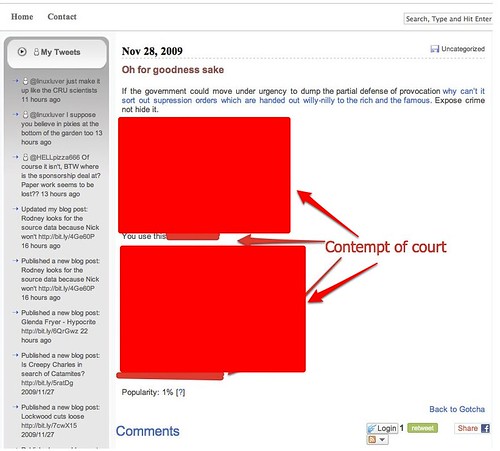
Contempt watch: Whaleoil and name suppression


<Picture changed after seeing this>

Whaleoil seems to think that he is above the law. One day he’ll find out that he is not. <Update That day has come>

But then It’s good to have people on the edge pushing the boundaries of New Zealand’s inoperable libel and suppression laws. Those laws need to change.

<UPDATE – an excellent post from Media Law Journal on name suppression matters. Apparently it is not ‘contempt of court’ to reveal a name – except in rare cases. It is an offense though. >

NZHerald’s shopping tab – it’s complicated

NZ Herald launched their new shopping tab yesterday, and as I dug into it the cast of players got larger and larger. It got so complicated that I decided that making a video would be the most efficient way to explain it all. After the experience all I can say is that Bernard Hickey is really good at this stuff.

The list of core and peripheral  players in this is huge – ranging from Air New Zealand, to  The Warehouse, KKR and Sella, and of course APN, owners of NZHerald.co.nz.

So was a  video a good idea or should I revert to type?

<update – in the video I refer to Finda being afiliated with NZHerald. Thanks to JX for the tip. My apologies – Finda is owned by Yellow Pages. I tried to check last night but for some reason Coys was down.>