A really great year at Pollenizer

For an example of a “really great” year, check out Pollenizer.

We at Lingopal started working with Phil Morle and then Mick Liubiskas as individuals early in 2008, and by the end of the calendar year they had formed a company, hired staff, found premises and helped 32+ companies on their path to and beyond launch.
It’s all in this Pollenizer Blog ost, and summarised by Mick in this video:

Vodpod videos no longer available.

What happened in 2008 (for Lance)

(Apologies for the “all about me” post. This sort of thing helps to motivate me for the year.)

Early last year I posted a plan for 2008 – daring to call it a manifesto. I’d just  turned down some very good corporate career options and dared to invest more time into smaller opportunities.

How did I do? Frankly I hadn’t looked at the post since January, and with some trepidation let’s launch into it. (Don’t worry – there is no personal stuff)

First – There were no New Year predictions. Good one. What a year to destroy predictions.

Next – there was the plan to go crazy – completing the Norwegian Berkiebeiner ski marathon. Sadly I just could not make this work logistically, and I feel pretty bad about it. My friend Hans, who I now owe some substantial karma, managed, after some adventure, to complete the Birkie on a perfect day. Great stuff. 

The professional goal was to spend more time starting and nurturing businesses, while continuing to consult, in both NZ and Australia.

Consulting

Continue reading “What happened in 2008 (for Lance)”

The top one thing to change at eBay

A while back I posted a list of the top 10 things eBay could do to improve: Top 10 things to change at eBay

I now believe I missed the most important one: 

0: Introduce auto-extend on auctions. 

Auto-extend makes the auction last for, say, 30 seconds longer each time a new bid is received. Trade Me does this. It will kill the practise of sniping and make the auction site a level  playing ground again. Right now the advantage is to those that use sniping tools and the auction experience is lousy.

My current next three are from the previous list. 

1: Sell PayPal (and allow Google Checkout)

–> greater velocity of sales, greater trust, money in the bank

2: Charge for Skype use

–> immediate revenue lift from a captured market

3: Simplify and reduce all marketplace fees

–>increase in Gross Merchandise Volume, particularly from smaller sellers

eBay’s horror year

It’s not farewell yet, but eBay’s descent in 2008 has been staggeringly complete. I was intending to write about it, but Dinah Balk has done that already.

Here it is – 2008 – the year eBay lost its mojo. I’d also call it “How not to run an auction site” or “Compulsory reading if work at Trade Me or Fairfax corporate”

They would have been much better off to move all marketing, development and management staff to customer service, but.. oh well. 

What a disaster year. Here are a few random quotes:

  1. Fees were raised and sales plummeted.
  2. Shipping rates were set below actual costs.
  3. Listings were hidden if they were indexed at all.
  4. PayPal was made mandatory and checks and money orders banned.

Sellers were banned from leaving negative feedback.

Site instability. … went from bad to worse. 

Best Match was officially named the worst sort/search engine on the internet. Search results were linked to everything but the kitchen sink and it took divine intervention to find anything. Entire categories of search results are still missing and many sellers reported over a 70% drop in sales which explains the pitiful sell thru rates.

I’ve never seen an e-commerce site nearly destroyed in such a short period of time.

I’m strangely still long eBay – simply because I think they they do have a compelling business. It’s just that they are doing everything to destroy it that makes me sick. I’d love to buy them and turn them around, but I am short a few billion sadly. I’m long in the hope that someone else with deeper pockets will snap them up. How about it Yahoo? Microsoft? Google??

Internet now ahead of newspapers for US news

From Pew Research comes the unsurprising, err, news, that the internet is preferred over newspapers as a US source of national and international news.
Pew

It’s amazing to me how high TV is on that question – especially after the appalling US network and cable news reporting over the last 10 years. I’ve essentially switched TV news off for over 10 years. Ok – over 20 years.

Indeed right now, for under 30’s, 59% say they get most of their news online, and only 59% say they use TV as a news source at all.
pew
Look at the internet jump from 2007 to 2008 – amazing, but look at the TV slide. I wonder how much of that was due to the US election, and the appalling network coverage versus the internet, radio and newspapers.

Can we say goodbye to AdultFriendfinder?

Adult Friendfinder’s ads habituate the seamy side of the web. They are the dating site for the adult internet, offering sex instead of love, and delivering (probably) neither.

adultfriendfinder
They take dodgy dating sites to an entirely new level, with ads that promise a naked beauty in your postcode is just waiting for you to turn up. They must pay a fortune for those ads, and no doubt help support a large number of adult oriented sites. Even Google gets in on the act.
google
Never mind that the same woman is also waiting in every other postcode and country in the world, and never mind that the sign up process guarantees that you will be advertising to the world that you have one of several sexual deviances. If you do happen to be stupid enough to post a naked picture of yourself, then you just might be the next naked beauty offered to countless surfers worldwide.

So it seems that AdultFriendFinder is in big trouble – not with the law, but with debt holders.

Somehow they have managed to raise $436m in debt, most of it short term, and with just $43m in the bank, and an unforgiving financial climate, they need money fast.

So they are doing an IPO (prospectus). Yup – an appalling climate and as AllThingsD’s Kafka puts it:

Here’s The Tech IPO You’ve Been Looking For: A Debt-Ridden Collection of Porn Sites And Social Networks”

Amazingly they made $262m in revenue for the nine months to September 2008, and $17.6m in operating income before interest costs – which were $60m.

I guess the borrow lots of money to increase revenue approach worked, but sadly the EBIT didn’t cover the interest payments.

They had 59m unique visitors in the same 9 month period, believing, apparently, that those visitors came for:

our focus on continuously enhancing the user experience and expanding the breadth of our services.

Yeah right. They came for the naked women.

As did the one million paying members per month (off 4m new members a month – that’s a pretty low sell through rate). The number of subscribers has not really changed from year to year, and churn is 18%-ish.

Those AdultFriendFinder ads were placed in 110,000 marketing affiliates, an amazing number, and they paid $46m to those sites as a result – that’s $418 each on average, and that’s a heck of a lot of sex sites.

AdultFriendFinder’s prospectus reckons that they can increase advertising revenue from 1% of sales to much higher. But who would want to advertise there?

Indeed the list of caveats on the prospectus is entertainingly long, ranging from “We have a history of significant operating losses and we may incur additional losses in the future.” to “Privacy concerns could increase our costs, damage our reputation…..” and “Because of our adult content, companies providing products and services on which we rely may refuse to do business with us.

There is more –  “Our liability to tax authorities in the European Union for the failure of Various and its subsidiaries to pay VAT on purchases made by subscribers in the European Union could adversely affect our financial condition and results of operations” and the kicker is “You may find it difficult to sell our common stock.

The IPO is looking for $460m, and it will be used to pay down that debt. That’s not exactly an interesting proposition, and like AdultFriendFinder’s other propositions I’m going to give it a wide berth.

If the IPO fails then it’s most likely goodbye to a company that frankly should never have been able to raise that much debt, and one that demonstrates that communities must be built organically not bought through advertisements.

How to do great web usability – iinet example

iinet have a fantastic new website for new customers. Try it –  go through the process to sign up for a service (use 6160 for Fremantle’s postcode).

The front page is simplicity itself.
iinet

Then it’s straight into questions that you can relate to:
iinet

The guy’s statements change with each screen – and they are actually helpful.

You can also go down a business route, and the questions are quite different. (do try it)

iinet

After 4 steps (which are actually fun, aside from the postcode/phone number bit) you get presented with three options. The consumer version came up with the option that I eventually selected for myself – that would have saved me a bit of time. Here is the business version
iinet

all in all a wonderful demonstration of how excellent usability can drive customer acquisition.

Or does it?

Sadly clicking on one of those business links led to this rather unseemly page.
iinet

Not only is the design ugly, the promised product didn’t show, and wehen I followed my nose I got asked for a phone number. I wanted naked ADSL, so no phone number should be required. Besides, I had already given my postcode earlier.
I figured out that I had to click the Naked DSL box on the far right (lucky I have a big screen), and I did so and faced another failure of a page. Sad.

I will guess that iiNet sees a mass exodus of potential customers from the process at this point. Some more work to do then, but a really promising start.

The death of cricket

After seeing the empty shops in Fremantle yesterday I wondered whether it was just that everyone was at the cricket.

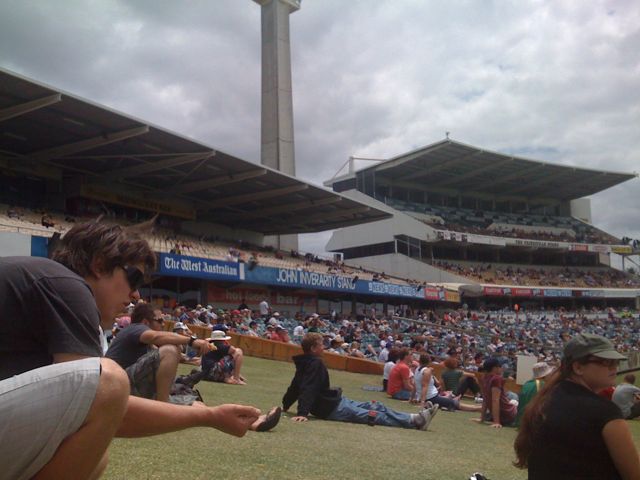
So here I am today at the WACA, on, the final day of a poised South Africa vs Australia test. All in the interests of research of course.

But this place is also strangely quiet, with empty seats everywhere.

Sadly the reasons why are all too apparent.

First is the $30 ticket price. That will help keep the crowds down.

Next is the bag search. I am not sure what they were looking for but I certainly got the impression that “bringing your own” wasn’t going to work.

And leave the camera behind too- a chap behind us was getting the 3rd degree over the length of his lens.

Finally a chap over there on the grassy bank got asked to take his bag to be checked at the gate after a remote security guard apparently saw him take a drink from something inside his bag. The remote guard was on radio to a local guard who clearly didn’t think that the action was warranted, but went ahead and followed orders.

The collective effect is a sterile experience at the ground. It’s a nice day in the sun, but passionless and bloody expensive.

And it’s reminiscent of the West Indian debacle of a world cup, where the passion was perverted by Western event organizers and sponsors.

Sports stadiums are like airplanes- if the seats are not used then they are lost forever. So organisers should price them so that they all sell. You’ll make more money on concessions as well.

But there is an even bigger impact- people that come to matches will contribute to the overall success of the sport versus other pastimes. Empty seats mean those potential fans are off doing other things- probably reading blogs.

It’s not like it used to be, and that is cricket’s loss.

An update. No cricket bats or balls allowed inside, and certainly no hordes of kids playing in the outfield. So so lame.

What is happening to Christmas?

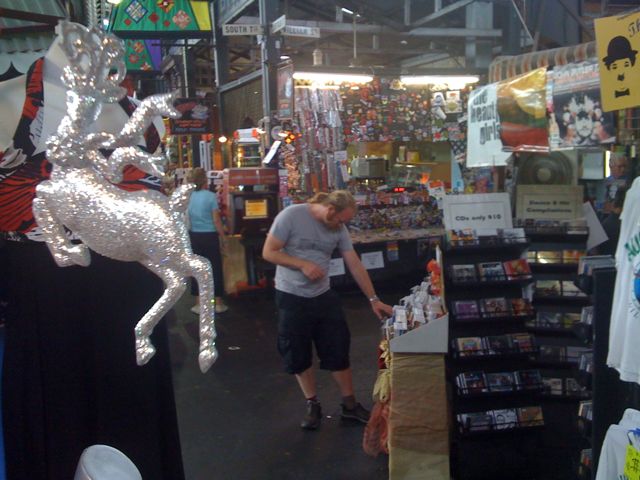
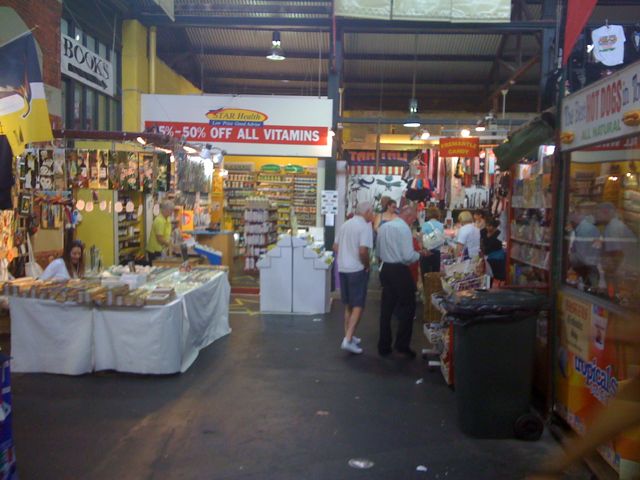
This is Fremantle’s great market, on the weekend before Christmas. Like the rest of Fremantle the market is almost empty versus normal weekends.
It was similar in Auckland, Wellington and Sydney, but I didn’t have much time in Sydney.

Either everyone is coming to shop tomorrow, everyone is unusually organized or there are going to be a lot of disappointed kids this Christmas.

Can it be true? Does this gell with what you are seeing?

The mainsteam starts to hear about web 2.0

Bugger – now they are letting the CEO’s know about the Web 2.0 marketing techniques. The WSJ has published The Secrets of Marketing in a Web 2.0 World,  which has the not so SEO friendly url of http://online.wsj.com/article/SB122884677205091919.html, but contains plenty of Web 2.0 buzzwords in it’s  text.

The article is from MT Sloan review, which the WSJ appears to publish in their Business Insight section. They have plenty of other articles of interest, as well as  discussions for each.

It’s yet another sign of the changes the WSJ is making – becoming more and more useful every time I go there. It is certainly gaining on the NYTimes. Do red the article, or if you are lazy, then the headlines below. Read it and think Vodafone & Telecom:

For marketers, Web 2.0 offers a remarkable new opportunity to engage consumers.

If only they knew how to do it

Don’t just talk at consumers
work with them throughout the marketing process.
The conversations consumers have with each other, he adds, result in “some of the most interesting insights,” including gift ideas for specific occasions, such as a college graduation, and the prices consumers are willing to pay for different gifts.

Give consumers a reason to participate.
The moderator can also see to it that consumer input is seen and responded to by the right people within the company.

Listen to — and join — the conversation outside your site.
In one case, a company found a popular blogger who had spoken highly of the company’s brand. Just prior to launching a new product, the company sent the blogger a free sample, inviting him to review it with no strings attached. The end result: The blogger wrote a favourable review and generated a flood of comments

Resist the temptation to sell, sell, sell.
“not to do anything about marketing, because we weren’t about selling; we were about conversing.”

Don’t control, let it go.
“You have to let the members drive. When community members feel controlled, told how to respond and how to act, the community shuts down.”

Find a ‘marketing technopologist.’
“I’d want to see someone with the usual M.B.A. consultant’s background, strong interest in psychology and sociology, and good social-networking skills throughout the organisation.”

Embrace experimentation.
One Web 2.0 strategy does not fit all, and sometimes the best way to find out what’s best for a given company is to try some things out and see what happens.

I wrote a response in the forum.

Great article

However  don’t keep it within the marketing department, but unleash all of your weapons – your employees. Let them  blog, twitter, talk on facebook, myspace, orkut and bebo about what they do, the company they work for and the products they sell. And as the article says, take the negative stuff on the chin and use all of the feedback, positive and negative, to improve your products.

Your newer employees are used to exposing their lives online for all to see – winning friends as a result. The web 2.0 challenge is how to open up your company in the same way.

Oh – and the technology moves so fast that you won’t keep up with it. Are you Twittering yet? Your employees are, and if you let them they’ll do the twittering or you

Organic Torpedo7 beats inept inorganic Ferrit

A mentioned, we’ve covered Torpedo7 before on this blog. That was the surprising finding after Ferrit had been beaten by Torpedo7 in domestic unique browsers for the week to July 20, 2008.

Organic versus Inorganic growth

It turns out that comparing Ferrit and Torpedo7 is an excellent way to compare organic (Torpedo7) and inorganic (Ferrit) growth. Organic growth is growth that is based on word of mouth, supported by a growing community and perhaps light advertising. Inorganic growth (and I am making this up) is growth that is generated by spending big amounts of money on advertising campaigns.

My theory is that inorganic growth is actually a fallacy – while you can buy traffic,  you cannot buy growth. Moreover, I also believe that purchasing inorganic traffic suffers from the law of diminishing returns – the more you do, the more it costs.

Let’s have a look at our case study traffic numbers.

Ferrit and Torpedo7 attract about the same amount of Domestic (NZ Sourced) traffic. Here’s the total time spent on each site over the last year, courtesy of Net Ratings. Note that December is a partial month.

NetRatings

Those red spikes are clearly advertising campaigns that Ferrit has used to boost traffic and hopefully sales.  If you ignore the spikes then there is a trend, and that trend is even more noticeable in the Unique Browser chart below. The arrows are mine:
NetRatings

Torpedo7 is showing consistent growth in Unique Browsers over time, while Ferrit’s core traffic is actually decreasing. Notice also that the spikes for Ferrit are also falling, though Dec08 should beat out at least Nov 08, and the height should be a function of ad spend, which I don’t have.

The amount of time spent on each site is telling –  roughly the same amount of total time come from a much smaller number of UB’s on the Torpedo7 site than the Ferrit site.

So what are the lessons?

Spend for traffic now, not later

The first is that if you are going to drive traffic to your site using massive advertising campaigns, then you should base the financial decisions about how much money to spend on the immediate results from that campaign, and not on any supposed future benefit.

Inorganic beats organic

The second is that, although big corporates struggle to believe it, an organic growth path creates a far more value in the short, medium and long runs.

In the short term the inorganic sites spend huge amounts of money on advertising to launch the sites, and this dwarfs any margins that the companies are making as a result of sales. Meanwhile the organic sites keep things small and lean, not selling much but spending very little as well.

In the medium term the inorganic sites need to continue to spend to show growth  (I’d classify Ferrit as at this stage right now), and probably still do not make money. Meanwhile the organic sites start to make solid revenues and profits, and the owners are making money – much like Torpedo7.

In the long run the inorganic sites are very low margin or do not exist, while the organic growth companies make strong revenues, have good margins versus their peers and make extraordinary profits for their owners. Trade Me is NZ’s finest example of organic growth, while Ferrit and Flying Pig (which I was not here for) are perhaps the worst.

Target a community or a category, not everyone

Torpedo7 targeted a small community/category – bicycle fans – and built their success from there. (Miki commented about this on the previous post) Many bike fans are also fans of other sports, and so they are able to move across. Nike, Adidas and Icebreaker started in the same way – target a niche and then expand out. Ferrit tried to target all New Zealanders and all categories, and so didn’t generate or appeal to a small group of fervent fans. Trade Me’s community built itself on the site, and grew as the site grew, to the extent that the community is now essentially all New Zealanders.

It’s usability, and it’s products

This could all be completely wrong, as the sites are actually quite different. I’ve commented about this before plenty of times, but the devil is in the results.

As part of the research for this post I browsed to both Ferrit and Torpedo7. (Torpedo7 has no google ads that I could find, whereas Ferrit has ads everywhere) On Ferrit I moved the mouse around, saw massive complicated menus pop up, didn’t see any products that I can recall and quickly left.

On Torpedo7 I purchased something within 1 minute of arriving on site. That’s found, added to cart and paid for. And that just about sums it up.

What do you think?

Torpedo7 NZ’s fastest tech grower

Congratulations to eCommerce sensation Torpedo7, the 87th fastest growing tech company in the Deloitte Technology Fast 500 Asia Pacific this year. We’ve covered Torpedo7 before on this blog, and it’s great to see their traffic numbers are being converted into dollars -at a growth rate of 571% over 3 years. It’s even better that they are doing this without pouring millions into a nation-wide ad campaign.

Congratulations also to Trade Me for growing at 134 percent, and making the list for six years straight.

And congratulations to Deloitte for owning the “fastest 5x…” space

No Black backgrounds please

Its always food to see new blogs. However if you are going to launch a new blog, like aotearoarenamemovement and newmasses did this week, then please make it easy to read.

I don’t mean the content, but the design. White words on black background simply isn’t that easy to read.

And for the Aotearoa Movement people,  if you want to start a movement, then here are some ideas to get the basics right:

  • Create a conversation. You’ve made a statement which leaves little else. The single post seems to have exhausted your rhetoric, and leads the reader to wonder whether there is anything else there. Perhaps if you frame the site differently so it isn’t just a “support this or not” decision
  • Use a better system than “email us” to ask people to make comments or contributions. Start with the comments on the blog, or make some new pages on the blog and ask for comments there. (It’s all probably easier on WordPress.) Ask for other contributors if you like, and get a good debate going.
  • Say who you are. This is a movement right? But behind a movement should be people, and a movement with nobody behind it  isn’t going to keep me interested for long. It’s saying the backers don’t actually want to put their reputations on the line. Say who you are, why you are passionate about this and what else you are pushing.
  • Use the right medium. A Facebook group might be smarter so that people can join, and it is a whole lot more viral. Try twittering, Beboing and everything else like that as well.