Tuesday Three: 3 ways to improve your business

Think like you think for yourself

  1. Switch to Gmail
  2. Get a ‘best friends’ telephone deal for your work. Don’t use a business deal if the personal ones are better
  3. Get rid of almost all of your printers – and make the ones you have harder to get to, and track printing by person/cost center. It’s amazing how often you don’t really need to print.

Why I don’t read Public Address

Via Not PC I see that there is a top NZ political blog ranking system.

That’s interesting.

Well not really – but I do like to read a range of views, and follow No Right Turn (#6, blogspot), Kiwiblog (#1), not PC (a rabble rousing #3 – also on blogspot) and The Visible Hand in Economics (#13). I also occasionally read Whale Oil (#8),  Roarprawn (#13 – blogspot) and rising star Offsetting Behaviour (#23 – blogspot)

I’m amazed at the number of blogspot hosted sites. I just don’t get it. WordPress is not only a far simpler platform to use, but it doesn’t show the blogspot toolbar on the top, and it makes it trivial to buy and host the site on a personal domain name.

Surely it is time for the better sites to move from something like norightturn.blogspot.com to norightturn.com?

I don’t read number 2: The standard, 4: Public Address or 5: No Minister. The Standard and No Minister have never compelled me to stay (especially versus No Right Turn and Kiwiblog – who really are excellent) while I have issues with  Public Address.

Let’s work through those personal issues I have with Public Address, because it is a much read and loved site by others, and people get really engaged there. Here are the top ten issues

  1. The front page has snippets of articles only. Reading shouldn’t be an active sport – but on Public Address I have to click multiple times to read the posts on the front page
  2. The articles are, well, articles. They are far too long for the internet media – seeming more suited to magazines.
  3. The articles often contain more than one topic – this one contains about 4 different thought streams. That may work for an email newsletter, but in a blog (or indeed a newspaper) the expectation is one story per story.
  4. Actually that link isn’t to one post – but to a series of posts (I was referring to the one on 7 July) on the same topic. That’s just weird.
  5. The link buttons and so forth under each post don’t look quite right – they are not standard and so I am not sure how they function.
  6. The comments are somewhere else – so you can’t read the article and see the comments straight underneath without clicking yet again
  7. Once you are in the comments section you can’t get back to the main Public Address site – there is no home link.
  8. It’s http://publicaddress.net – that’s weird. I still think of .net sites as being technical ones to do with running the internet. What is wrong with .com or .co.nz?
  9. The RSS feed is clipped. This is important as everything above is forgivable if I can read entire articles in my RSS reader. However like the homepage you can only see a few lines of the hundreds in each article.
  10. Overall it’s just too hard – the site makes me think too much about how it functions, and not enough about whatever it is they are talking about.

The solution is easy – move the site over to WordPress. There are plenty of people in NZ to help with the transition and even a WordPress camp coming up in Wellington.

None of these issues are to do with the actual content of the site – which is apparently very good. It’s a classic case of the usability getting in the way of the product.

I often wonder just how much traffic Public Address would get if they adopted standard usability and technology.

So is this just me – or do others have the same issues?

What’s wrong with Telco pricing and how to fix it

Via the tidbits newsgroup an Aussie (amacbell) succinctly points out the problem with Telco pricing:

I know of no other industry where you need to prepurchase on the basis of a best guestimate of the volume of units required for the month ahead.

If you guess wrong and don’t use all the units you bought then you lose your money. Tough.

Can you imagine the uproar that would ensue if petrol stations started selling fuel for your car ‘on a plan’. You would need to prepurchase say 150 litres a month, and if you use less you still have to pay the full price.

Let’s repeat that.

If you buy 100 minutes and use 50, then you have overpaid – by 50%.
If you buy 100 minutes and use 500 then you will be billed at the much higher 100 minute rate.
Either way you have overpaid.

Some telcos will even charge penal rates. (Telecom’s XT price plan does not – well done)

So let’s use Telecom’s XT network’s pricing plan, which is a big improvement, to look at how we can get better.

Telephone calls

Right now you need to select a plan based on your guestimate of what you will do.

But why not have one rate – and provide discounts for use based on what I actually use that month? Why not offer the ‘best price’ each month.

So if one month I use 500 minutes I pay 30 cents a minute, and the next month when I use just  30 minutes I pay 60 cents a call. Make it the same deal for everyone, and that way we don’t have to think – and not making your customers think is a great way to sell them more stuff.

Texts
Same with SMS – XT’s rates vary from 20 cents on prepay, and 4 cents to 1.2 cents on contract, but you need to predict what you will do. Why not just charge at the best rate for the use that month?

Data
Let’s turn to the real problem – data. Oh data.

Data ranges on XT’s pricing scheme from $300 per GB to $75 per GB. These are insane compared with regular broadband – and I mean it’s insane.

Meanwhile I have no idea how much data I use via XT’s network (I don’t see any warning texts – should I?), which makes this next bit scary.

The penalty rates for going over your data limit are criminal, and I use that word with purpose. There isn’t anyone that would deliberately go over their data limit (or extended data limit) and choose to pay, wait for it, $1,000 per gigabyte of data.

Go check – it’s on that same XT pricing plan, though they quote in megabytes. Megabytes – remember them? They were big back in the days of black floppy disks in 1995, but trivial in the days of 16 GB thumb drives and memory sticks, 5 Mb photos and a >1 Mb Stuff.co.nz home page.

Please Telecom (and Vodafone), and I say this with urgency – please fix your data rates so that using data is fun and not liable to end in penury.

There is plenty of room for improvement. Are you out there 2degrees?

Fixing the Berl report – some progress made

Some good progress on the saga of the Berl report on Costs of Harmful Alcohol and Other Drug Use.

Berl have posted a response to criticism, including a letter of apology from Treasury.

They note that the request for tender stated “You shall complete a cost analysis using an accepted framework and deliver a report on the costs of alcohol and other drug abuse to New Zealand.” Further, the WHO International Guidelines was provided as an example of an “accepted framework”.

Berl used those WHO guidelines, however given the subsequent dismantling of the method this points the finger at the tenderers – the Ministry of Health and ACC.

Berl also push back on some of the Crampton and Burgess study, both pointing out errors and challenging their assumptions.

It’s an aggressive piece (Read it: Berl rejects criticism of study), and they point out that they do in fact have 50 years of reputation which they do not want to lose by writing results on demand. I hope that means they will keep on this.

However I’m not sure  that they are that close to reconciling with Crampton and Burgess (and others).

Meanwhile as Eric Crampton writes in the comments in the previous post that he had a beer (love that) with David Slack from Berl and subsequently made some adjustments to the calculations – adding back $36m in costs. However this was more than outweighed by the new subtraction of $197m in excise duties that Treasury had pointed out. Net net that means rather than showing a small net cost of alcohol to New Zealand, they are now actually showing a benefit – though Eric contends both are essentially zero with the margin of error in these sorts of studies.

Let me repeat that – one study says that the Cost to New Zealand of harmful alcohol and drugs is $6.88 billion, while another study says that it is zero, or even a benefit. The policy implications are huge – so we need to get this right, and we need to make sure that the Law Commission and legislators understand this discussion.

Crampton and Burgess are also re-writing their paper, which is good, publishing within days.

It is excellent to see this discourse from both parties – and I trust that it will continue, as ultimately the policy of NZ will be governed by the agreed answer, the right answer.

It’s a far cry from the USA where we often see “black” and “white” presented and no attempt to bridge the gap, and lobbyists pushing their own barrow to the exclusion of all else. If we can continue the ‘beers’ and academic discourse then once again we can all be proud to be from New Zealand.

I  hope and trust that the Law Commission hold off on their policy paper until the academic dust settles – let’s not make laws based on faulty premises.

Tuesday Three: 3 ways to improve your business

Drinks are on the house, but only when in the house

  1. Buy staff beer and wine for Friday afternoons – but don’t put credit cards down at bars
  2. Cash in staff carparks – give them 50% share of the savings and encourage them to walk, use public transport, cycle or motorcycle
  3. Get everyone using IM – be it MSN, Skype or whatever. It’s far quicker than other methods and the new generation can’t functon without it. Oh – and it is free.

Fix the Berl report on alcohol and drugs

The Costs of Harmful Alcohol and Other Drug Use report commissioned by the Ministry of Health and ACC has been the subject of some controversy. It was written by five authors from Business and Economic Research Limited (BERL), and they got support from a range of people, including 9 people from ACC or Ministry of Health, three from Otago University and two external reviewers – Prof. David Collins and Prof Helen Lapsey from Australia. The external reviewers are authors of a report that used similar methodology for a report in Australia.

While the level of professionalism to produce a credible report should command the (apparently) $135,000 fee, I am disappointed that people inside both Berl and the Department of Health are not reacting to the responses – indeed it seems defensive. While there has been some good robust discourse, but it seems a bit tit for tat, and much as we like to see a good fight, I’d rather see a quest for an agreed answer.

On such an important topic I feel that the only thing that matters is that we get the facts straight – and I would dearly like to see a re-worked and perhaps expanded paper that can be acceptable to academics, media, the public and even bloggers.

There is abundant material – so let me share the results of my own random walk through the topic by looking at each of the players involved.

The ACC is apparently a co-funder of the research, though there is no press release on the ACC website, and no mention in any recent speeches. From a public point of view they are out of it.

The Ministry of Health, through subsidiary National Drug Policy New Zealand, seems to be driving the activity. The NPD, which I was vaguely aware of, has the goal to:

Prevent and reduce the health, social and economic harms that are linked to tobacco, alcohol, illegal and other drug use. It does this through a balance of measures that:

  • control or limit the availability of drugs (supply control)
  • limit the use of drugs by individuals, including abstinence (demand reduction)
  • reduce the harm from existing drug use (problem limitation)

The NDP website is a bit out of date – showing former Associate Minister of Health – Jim Anderton – as the chair and eight other former minsters from the last Labour government on the Ministerial Committee for the NDP. It doesn’t bode well.

However the Berl report is on the site (reflecting their priorities perhaps), along with their latest report Research into knowledge and attitudes to illegal drugs which is not bad but by no means  flawless. For example they selected their sample of drug users from contacts and friends of contacts provided through drug treatment agencies – which is only going to capture those that have gone too far in their drug taking and their friends – not a representative sample. It’s liked selecting people for a study on alcohol from the people in a hospital detox unit and their friends, rather than from a pub on a Friday night.

That report also avoids digging into just why people take drugs – but only looks at the dark side.

Credit where it is due – the drug report does uncover that “just don’t do it” campaigns will not work – as people will do it anyway. It’s pretty good when it comes to formulating campaigns to reduce harmful use, just lousy as a policy forming instrument.

Back to the Berl report. From what I’m seeing on the NPD site it appears that the Ministry of Health is biased strongly towards stronger regulation of alcohol and drugs, whereas I would hope for a more nuanced approach from our normally balanced civil servants.

BERL

Business and Economic Research Limited has been around since 1958, and does, obviously, economic research. They clearly care about their reputation, and are, from what I saw at the Economic Conference, very good at presenting their findings. (Including a very entertaining and insightful one on the global financial crisis in NZ)

This reputation and lagacy makes the report and resulting kerfuffle all the more disconcerting. I am guessing that Berl are feeling a bit blindsided by all the media and academic reaction.

Their paper was presented at the NZ Economists Association Conference last week, but sadly I only saw the last few minutes. (I was diverted by a macro economic discussion of the global financial crises). I did see the reply, given by Messers Crampton and Burgess (below) but sadly at this standing room only event, the question period was killed in favour of lunch.What I did observe from the back of the room where several covered smiles and quiet snickers – while the sheer number of people in the room made it feel like a veritable lynch mob.

More concerning to Berl is that my understanding is that Berl are not revising the report in light of the academic and media criticism. I could be wrong, and I hope so, but I had a very brief chat with one of the authors at the conference – but he wasn’t happy talking to “a blogger”.

The Law Commission has been part of the news on the Berl report – and I really didn’t know much about them. Turns out the Commission..

…is an independent crown entity funded by government. It is a central advisory body established by statute to undertake the systematic review, reform and development of the law of New Zealand.

They also cover alcohol and drugs, it seems. The Law Commission used the Berl report in a speech in Nelson and another in Wellington by President Sir Geoffry Palmer SC.

While Sir Geoffrey says, in the second speech:

I do not believe it is the Law Commission’s job to advise New Zealanders about how much they should drink.

He later says that

The Law Commission will need to make recommendation about the legal framework for the sale and supply of alcohol.

The publicity arising from the first of these speeches is perhaps the reason that some, including the NBR, (and myself) initially thought that the Law Commission had paid for the report.

The Law Commission is publishing a “Review of the regulatory framework around the sale and supply of liquor” this month (July 2009). This is the policy response to the Berl report – and an important document as it feeds recommended law to the Government.

I’m a bit concerned that the Commission may be exhibiting a bit of anti-alcohol/drug bias, as evidenced by the paper published in May recommending that parliament does not use conscience votes for alcohol related laws – as they see that this makes it harder to pass strong anti-alcohol laws. This seems to be a disturbingly strong and one-sided recommendation that will help to ensure the next round of laws are passed. It may not matter too much, as the Government Whips managed, it seems, to have every National MP vote against a recent (albeit very poorly written) attempt at legalising medical marijuana.

Eric Crampton and Matt Burgess

Eric is from the Department of Economics and Finance at Canterbury University and Matt from iPredict [edited – I said both were from Canterbury earlier], and they wrote a compelling rebuttal to the Berl report, backing it up live at the NZAEC conference.

We find substantial flaws in BERL’s method that together account for well over 90% of BERL’s calculated costs of alcohol use. Corrected external costs of alcohol use amount to $662 million [Berl recorded $4,791.5m lw] and are roughly matched by the $516 million collected in alcohol excise taxes. The BERL report is wholly inadequate for use in assisting policy development.

Their three main issues with the report are:

  1. It uses a threshold for health costs to define a cutoff for economic costs
  2. It assumes anybody who drinks enough to cross an epidemiological threshold is
    irrational
  3. It assumes anyone who is irrational enjoys zero gross (not net) economic benefits
    from drinking

They are particularly concerned that the Berl report does not match any benefits with the costs, and point the finger at the Law Commission for referring to the Berl report’s ‘dramatic findings’, which, when you add the benefits back, are not a big deal.

They are also concerned (as am I) at the line by line calculations of the costs (and they apparently don’t reference well.) In the hope that people will actually read this I’ll leave out the details – they cover it well. Once systematic error is that they attribute 100% to alcohol costs from people that are already costing society through another condition, like mental illness.

Finally Dr Peter Bushnell – Deputy Secretary of the Treasury was pretty scathing in an NBR article:

the onus should be on the Law Commission to be rigorous ….”

“..What we’re saying is it’s your reputation that’s at risk here. It doesn’t reflect well on the Law Commission if it … backs [work], that doesn’t have a sound basis.”

doesn’t look like it meets the “normal standards you would expect”

Where to next?
We are now waiting for the Law Commission’s policy document – and the reaction to that will be interesting. Indeed the Berl report has probably had the effect of increasing awareness of the forthcoming policy and thus activated many people whom otherwise would not have been engaged. Like me.

<update – see the later post>

Tuesday Three: 3 ways to improve your business

Spend like you spend, not like a corporate

  1. Stop buying refundable air fares – get the cheapest ones for 1/4 the price and throw them away when unused. It ends up being much cheaper
  2. Set your printers to print default black and white, double sided.
  3. Open up the internet – get rid of the expensive censorship tools that slow everything down and annoy everybody, and replace it with a policy that says “don’t be stupid”. Manage the person not the pipe.

So you’ve got a good idea – now what?

I’ve been getting an increasing number of ideas over the transom over the last few weeks. It started before the radio interview last week, accelerated because of that, and tomorrow it seems I’m in the latest issue of Idealog.

It’s really good to receive them, and I enjoy helping out and even starting some businesses. However last week I’ve been a bit slow to reply to some of those messages – and I apologize for that. Some of them I’ve been checking out, others I’ve been thinking through and still others I have just left. I will get back to everyone eventually though.

But there is one problematic category of ideas, and it’s one where I want to give some very strong advice. The note or call I receive will go something like this:

I’ve got a great idea, I’m not going to tell you what it is (at least not without an NDA), but I am going to invest or have already invested a bunch of money into it.

I’ve seen everything from $5000 to close to half a million invested in or required for companies and products that you have never heard of or are not even described. I’m always willing to help people in these situations but they need to be more honest with themselves about the value of the idea. Holding it too close to your chest means the idea won’t be as good, the speed of execution will be much slower and the amount of money invested will be much higher.

Instead here is my take on what to do once you have that wonderful idea for the next big thing.

Before you start

  • Check the competition – If it is a great idea then it may well be done already. Get online and search for the product – and be very persistent. Check different channels to make sure it isn’t being sold already, and make sure also that there isn’t a close substitute. Be very thorough in this and, importantly, keep doing it forever.
  • Share and improve the idea – Shop it around your friends and family, talk to potential customers, experts in the field and determine that it is a good idea. Along the way you’ll hopefully find some people that you respect and that are energised by the concept. Ask them to help. Your idea may be good, but with the assistance of others you can make it great.
    Be flexible with the idea and tweak it as you learn new things. Write it down in a structured manner – and have very crisp and consistent descriptions for the product or business, why it is better and will sell and your path to develop it.
  • Estimate the size of the opportunity, and be tough. This means numbers – how many widgets will you sell, at what price and what margin. It’s important to test your projections against the real world – what does 1000 sales per day really mean per sales outlet, will people actually pay the retail price, what are the wholesale margins in the channel you are using and and so on. Track your business against these numbers.

Starting up

  • Focus on the few. What few things do you need to believe, what do you need to do and and what results do you need to see before you can truly prove that the business will succeed. Write them down. Then spend your time focusing on those things, trying to get to them in the cheapest, fastest way. If you cannot prove something then you may need a leap of faith, but if you disprove something then change tack or move to the next idea.
  • Pay with equity – have some partners and pay them with equity. It’s the best way to save on start-up costs, it means better results as people have genuine interest in seeing the business succeed and it’s a heck of a lot more fun. Stay well away from large suppliers that deal mainly with corporate customers – their fees are far too high and you are a low priority for them. If you are struggling to find the right partners that will work for equity then perhaps there is a hint there, and your idea isn’t The One. Note that you generally need to pay for actual purchases (like raw materials) but work performed in the early stages should be for equity.
  • Don’t spend anything material until you know you will get a return. Great entrepreneurship has very little financial risk, so be miserly until you know it will succeed. Put very little money down at the start, investing only in the critical raw materials or services that you need, and focus on investing your and your partners’ time. Wait for revenues – if the idea and execution is good then there will be plenty of money later.

Growing

  • Be prepared to stop, and stop fast if at any stage it is clear the business will not succeed. You are passionate about your idea, but you also need to be dispassionate enough to exit before you waste too much money. An informal or formal board can help a lot here. If you have already sunk money into a business that isn’t proven, then treat it as such – sunk money that is gone forever. Don’t fool yourself into thinking your new venture is valued at the amount of total investment – look instead at what the profits are and will be.
  • Go full time – a full time CEO is the only way to really drive a business forward. Once you know the idea has legs then quit your other pursuits and focus on growing this business. Or perhaps you are not the right person to be the CEO, so find someone who is and cut them in. Don’t be distracted by the next business idea – that’s pointless until you’ve either made this one work or killed it.
  • Spend as little as possible – don’t pay your self (or anybody for that matter) any more than you need to live – and live frugally. Wait until the business is sustainably making money and then start increasing the salaries of the contributors, eventually to market rates.

Better culture, better people, better economy

It’s the most commented article on The Economist right now, and it’s a fractious topic.

Indian students have recently taken to the streets in protest against some of the worst ethnic-based attacks Australia has seen

The violence sprang to public notice when two Indian men were attacked with screwdrivers in Melbourne last month. One was robbed. Both ended up in hospital.

I don’t want to get into the wheres and wherefores of the topic, but do want to draw comparison between New Zealand and Australia.

Australian society has a pretty strong racist streak compared with New Zealand. It’s a combination of a number of things, but I let’s  it down to the following three.

  • Horrific indigenous population conditions and policies
  • Lack of exposure to non-white cultures – e.g. Aboriginal Australians make up 2.6% of the population
  • Lack of non White Australian (and male) leaders

In New Zealand we are continuously addressing these issues and as a result are far less inclined to have racially oriented violence. That’s not to say we don’t have it, nor that we don’t have racists, but it’s on a scale far below that of Australia. Even PM Kevin Rudd was in denial about the reasons behind the attacks as he:

..dismissed race as a motive, and called the violence “just a regrettable fact of urban life”

For a former diplomat Rudd has really miss-stepped. India is a growing market and power, and Australia isn’t doing their chances of a closer relationship any good:

It has also become a diplomatic embarrassment for Australia, at a time when it has been seeking to boost relations with India to what Stephen Smith, Australia’s foreign minister, calls “the front rank of our international partnerships”. Kumari Selja, India’s tourism minister, has cancelled a planned visit to Australia in July. And Manmohan Singh, the prime minister, has said he is “appalled” at the violence, calling some of it racially motivated.

New Zealand has steadily and deliberately moved over past 25 years to become a fairer, integrated multi-ethnic multi-cultural society. We’ve worked hard –  from the Te Reo programs, to treaty settlements, Maori seats in parliament, Maori broadcasting and so forth. Meanwhile we’ve experienced increased immigration from the Pacific, Africa and several countries in Asia.

As a result we, as a people, are better able to quickly understand, respect and work with foreign cultures. That helps make us even better global travelers and, along with our honest approach, good people to do business with.

Indeed a decent diplomatic corps may market a country as one thing, but just like a branded product, if there is a disconnect between rhetoric and reality then the reality will eventually shine through. New Zealand has always punched above our weight in global politics, and one reason is because our well-raised people are scattered throughout the world demonstrating every day what it is we stand for.

This helps our export driven economy. We are ever-increasing our reach into new markets, especially to the near 2 billion population inside countries that we have or are negotiating Free Trade agreements with. We are thus set up well to successfully do business within these very different societies and cultures.

Australia, in reality, is not that far behind, and this isn’t a win-lose game, but we’ll take any advantage we can get over the West Island.

Snow job in Greenland

Whitewash

“A West Coast man has lost his feet and a hand to frostbite after surviving three days in an Arctic whiteout.”

Let’s look at the facts here. He had

  1. No EPIRB to locate him if all failed
  2. No Food
  3. No GPS
  4. Not enough fuel
  5. No tent
  6. No other survivial gear

Karamea’s Joseph Gibbons is a lucky man to survive three days near the highest point in Greenland during a storm. He lost some bits of his limbs in the process, but is eager to get back to work in the extreme cold.

Only luck prevented this from becoming a fatal accident. The real question is how the heck did he get into this situation, and more importantly, how the hell did his employer let him get into his situation?

“I went out for what I thought would be a 20 to 30-minute excursion, so I didn’t have any survival gear per se.”

One of the first lessons in extreme conditions is surely never to go out without the right gear. So why wasn’t the gear on the snowmobiles at all times? Why was Joe allowed off base without the minimum equipment? How can you be a contractor to do this sort of work if these basics are not part of the way you operate? Who are these shonky people? Who employed them?

Turns out his employer was an unnamed contractor working for the US Government, and the work was, amazingly,  “researching how camps could be put together to better survive the harsh conditions.”

That mission just makes it even worse. What the hell were the US Government thinking? I sincerely hope that this contractor has been stood down until the reasons behind this debacle are cleared up.

Joseph may be able to claim some compensation from his contractor employer, and by extension, the US Government. He can probably do this regardless of whether he broke the rules or not.

However if he did break the rules for his excursion, then he should never be employed in a safety environment again – and certainly not by that employer (unless he reforms and teaches HSE.)

So whether this was something only he did (his fault) or was systemic (contractor’s fault) or wasn’t against the rules at all (Government fault) it should never happen again. All parties need to do some soul searching here – Joe for going out without the right kit, the contractor for providing a working environment that allowed him to do so and the US Government for employing contractors that allow this sort of thing to happen.

Shame on all of them, and you are a lucky man Joseph Gibbons.

Tuesday Three: 3 ways to improve your business

<I pulled this post after posting as I wanted to expand it, but it was already commented on externally – so here it is again.>

Get out there

  1. Use OpenOffice.org as the default office application. Give Microsoft Office only to those that really need extra bells, whistles and TLC.
  2. Meet your customers every day – stand in the supermarket, visit their factory, man the telemarketing lines, blog and tweet with them online.
  3. Keep it safe – take responsibility for the safety of yourself and everyone around you  and work to continuously improve it. Give each other the right to stop work if you see a potentially unsafe act. Accidents can kill people. They can also destroy your business and put you behind bars.

Radio NZ interview – How to survive and prosper this recession

I’m just back from an entertaining interview with Kathryn Ryan on the Nine to Noon program.

You can listen to it at Radio NZ: How Businesses Can Survive The Recession (and more)

Links to some things we talked about:

Social Innovation Camp NZ

Electricity microgeneration

  • Refit educating New Zealanders about Feed-in Tariffs (FITs)
  • Micro Generation – Wikipedia entry on what it is all about
  • Powershop – buy your power online now

Gardening
Great opinion piece from influential NYTimes columnist Nicholas Kristoff

5 Recent posts that I like – and a new page

I’ll be on Kathryn Ryan’s Nine to Noon program on Radio NZ at about 9:20am Monday 22nd.

There are a few potential topics to cover – including why NZ is a good place to be right now, what businesses can do to manage through the recession and the Social Innovation camp next steps. We’ll see what happens on the day.

For new and newer readers I’ve just put up a page of posts that I like from the last couple of years.

Posts I like.

Here are some good recent ones

Blame directors for failure, CEOs for success

2 shots were fired Self restraint is good

Let’s stop MPs drinking and lawmaking Seriously

Two McKinsey pieces on education – do read them

Well done Green cabs – now how about that website Great comments

Brass Monkey 2009 – a photolog The annual winter bike rally

Bribes, jobs and wine – not a good mix

There are two  jobs sites in NZ with critical mass – Seek and Trade Me Jobs. It’s a tough road to get to the top, and when Seek and Trade Me themselves have lost thousands of listings it’s even tougher to make things pay.

During these recession days  employers are realising that they don’t need to try hard to attract quality candidates, which means an advertisement on Seek and Trade Me is all they need to do.

New entrant MyJobSpace is doing the tough yards, and is tiny compared to everyone else. Here’s the market share of visitors – as measured by Netratings and charted in Trade Me’s newsletter to job advertisers.

So they need to go hard to get anywhere, but I feel that their latest attempt to woo customers is sailing a bit close to the wind.

I’ve copied below the text from a remarkable email that myjobspace is sending to contacts. The deal is that by committing your employer to a $365 annual fee you’ll receive a case of 12 bottles of wine. The first choice retails for $11 per bottle, so let’s call it $130 of wine.

Now most employers have rules against this sort of thing, and it creates a disconnect between what is best for your employeer in these cost cutting times, and what is best for the employee.

Imagine if we upped the ante – and added two zeros to each side. I’ll give you $12,000 worth of stuff if you sign a contract worth $36,500. New Zealanders, as inhabitants of the least corrupt country in the world,  would react pretty negatively to that offer. Companies and individuals should also do so to the wine offer.

I would be looking pretty hard at any money paid to this crowd if I were in a corporation. Sole traders are a different story – it’s their own money and wine to play with, but then I’m not a tax lawyer either.

So while myJobSpace needs to be aggressive, I feel they have gone too far with this. Shame.

an unashamable bribe!

A little while ago we spoke to you about your recruitment needs, you decided it wasn’t the best time for you to be using our site.

However in these times, more than ever, it’s critical to have the best people. There’s an old saying – “It’s easier to change people than to change people.” Anyone who’s not being positive, innovative, committed, or is under-performing must go.

Talking about being innovative and committed….. we came up with this unbelievable offer (well bribe really) that is an absolute first for NZ

If you decide to make the right choice and start advertising for the right person here’s what we’ll do;

We’ll send you a case of 12 bottles of wine when you join, you can chose from the following:

1. Wyndham Estate Bin 555 Shiraz 2006

2. Redwood Pass Marlborough Sauvignon Blanc 2008 – rated by Cuisine Magazine

3. Twin Islands Marlborough Chardonnay 2007 – rated by Cuisine Magazine

Tell us where to send it, and we’ll courier it as soon as we receive your one off payment of $365.00+gst for 12 months unlimited advertising.

Here’s the best part: the best guarantee you’ll hear all year! At the end of the 12 months of unlimited advertising, if you’re not completely satisfied with our service and jobsite, we’ll refund you in full, and of course the wine will be a distant hangover, which is all yours. If you hear of a better guarantee anywhere please let me know.

So if you’re looking for real value and ways to cut costs, our site is said to be the most cost effective recruitment tool available in NZ. We were also voted one the best sites in NZ at the NetGuide Awards.

This offer is strictly available until the end of June, with payment of $365+gst not required until 20 July. This can even be split over 3 payments of $135+gst. (July, Aug and Sept)

If you have any queries please call or if you’d like to go ahead please email: contactus@myjobspace.co.nz with JUNE WINE OFFER in the title, tell us the wine you’d like, the address for delivery of the wine, and a daytime contact phone number. We’ll do the rest.

Yours faithfully

Gary Collins
Managing Director
http://www.myjobspace.co.nz

PS. The first 15 to reply will also get a free priority listing which keeps your ad at the top of the page. Did you know that 82% of people don’t look at the second page of results. Valued at $95+gst †

Today’s news is fluffy

The front pages of both Stuff and NZHerald today are a sad indictment of both media in NZ and of what readers want to read.

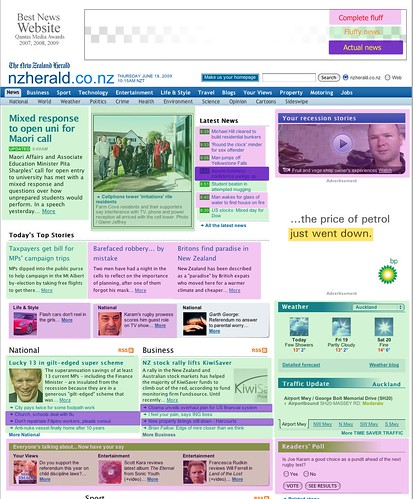
Let’s look at them article by article – and to do so I’ve helpfully colour coded the homepages for each. I’ve sampled each page this morning above the fold on my big screen, and categorised the articles. Your interpretation may vary, but overall I feel the ratio is sadly skewed towards fluff.

Let’s start with the NZHerald. Real news included Aussie business confidence, churches and schools dealing with flu, Obama’s new plan for the US financial system (arguably the most important piece – certain for business/economy) and new property listings down.

However they also had “Man jumps off Yellowstone falls”, “Is Joe Karam a good pundit choice?” and “Flash cars don’t reel in the girls”.

Pink is “fluff”, green is “fluffy – but still news” and dark purple is “real news”. Click on the picture to see a zoomed up version.

Stuff’s (and I blame them for starting me on this post) real news included “Swine flu hits prison”, “bodies suggest jet broke up in air”, Jetstar’s bad first week, Dows (pathetic) offer to clean up their chemicals and the postponing of the eviction of gang members from their house.
However they also had “Poolside photos with the Allblacks”, Michael Hill’s new house and “World’s most handsome man named”. (I didn’t click through, but I am guessing it wasn’t me)

Neither had anything on Iran’s post election story – which is the biggest geo-politial thing happening in the world right now.

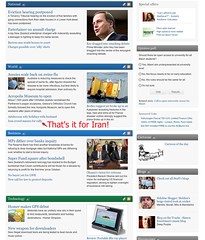
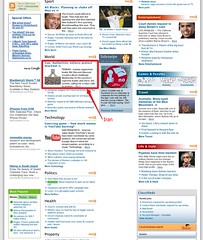
However if you want to read world news, then you can scroll down on each site- which I did, searching for the Iran coverage:

Stuff had a 5 word link to an article:

NZHerald had a short paragraph link to an article, and a small photo – better, but sad for what are critical moments for Iran, the region and the global economy and politics. (Iran has oil, issues with Israel and so on).

I’m not an editor – in fact the only time I ever made an editorial decision at Fairfax resulted in Stuff inadvertently breaking a budget lockup embargo. Editorial decisions are best left to journalism professionals and I stayed well clear.

But yet – can the editorial teams at Fairfax and NZHerald be happy with the content of those home pages? How do they compare to the newspapers? Are both Stuff and NZHerald worrying too much about pageviews and not about content? The end of that particular path is well trodden by Rupert Murdoch, and it’s not pretty.

Surely we can do better.

NBR is doing better – their home page has a much lower fluff quotient, and is a remarkable effort for a group that was late to the party.

However these days I’m doing what many others are doing, and getting my news via twitter alerts from WSJ, NYTimes and fellow twitters, via RSS reader for blogs and sites like interest.co.nz and the very occasional visit to a news home page.