Air New Zealand is the best – here are some reasons

A selection of reasons why Air New Zealand won the Airline of the Year in the Air Transport World magazine awards. Most of these refer to posts made here over the past three years, and the overarching reason is simply that Air New Zealand is a very well run business.

They have kept their fares low, and use a very simple fare structure. That means reducing some food services, but the lollies remain and, it seems, always will.

They have steadily got the details right – from the economy seats, to the check-in and seat back entertainment. The business class seats still rate, for me, as the best around, offering so much more than the competition.

They grasped the power of Twitter early – taking off with the Airpoints Fairy and several other Twitter identities. The Airpoints Fairy really is an exceptionally good move. You’ll find out a lot more, and a lot faster, by following the twitter accounts than by reading the media section of the Air New Zealand website, which, as of writing, still had no announcement.

While they use Zillion, SellmeFree and Sella instead of Trade Me for their annual charity auction – the point is that they have one, and it is not only a good thing to do but a fun and entertaining promotion of AirNZ services. By the way – Trade Me you really need to suck up to Air New Zealand, starting now, and make sure you land this for 2010.

They have, in post Ansett merger and Qantas code share proposal years, consistently understood that they are there for the greater good, not just corporate profits. This means lower airfares and more travellers. They also focused on improving the business across the board, rather than on government lobbying to maintain a quasi monopoly. They have stopped looking (it seems) for stupid tie-ins with Qantas and purchases of other, poorly run, airlines.

They are blessed with incompetent competition – with Qantas exiting and replacing themselves with the hapless Jetstar. Qantas are a good airline, especially when compared with ones from the USA, but Australian experience shows how much they still have to learn.

They reward their best customers by providing extra legroom at the front of the plane. They did this by adding another row, but taking the inches from the seats at the rear only. While this is not as egalitarian as the Jet Blue practice of rewarding people in the back with more room, it means that as a Gold (or Gold Elite now) status holder I can always get a seat near the front with plenty of legroom. Given that most of the profits would tend to come for the top few customers, this is placing the better service where the profits are.

They continue to innovate, and may even transform international travel (Jan07) with economy class sleeping seats. It will be a little while yet before the new planes arrive, but this has big implications for long haul tourism.

The innovation also applies to operations – not only testing biofuels recently, but also having some planes glide into Auckland airport to save on fuel – back in 2007.

They have delivered a series of great promotions – from the Pink plane to the Sydney Mardi Gras to the Pimp my Plane MTV promotion back in 2007.

Grabaseat – it’s a great idea, quickly executed and continuously improved. It’s a tool to sort of those that care about price from the others, and also to sell excess capacity. Well done.

The naked campaign is stunning, making the foreign press and providing for an entertaining safety briefing. It’s really great when one of the stars is serving on the flight – I’m sure they get a much easier time from passengers.

Their website is very good (not perfect though) and it is New Zealand’s biggest eCommerce website, delivering over $1 billion in sales back in 2007/7.

They launched the brilliant mPass application for the iPhone, and supply premium customers with an RFID tag. Each of these means customers can go directly to the gate, bypassing check-in. The implications for me is zero waiting time for most flights out of Wellington, and much tighter margins on my travel from other airports. Just one of several ways that they have reduced the pain of flying.

And lastly – the staff. The quality of a business shows up in the quality of the front line staff, and without exception Air New Zealand staff have been simply outstanding for me.

Whether it’s the gentle chiding I received recently as I arrived at the gate moments after they had closed the flight, while they quietly did the work required to let me on, or the folks who dealt (not perfectly, but well enough) with my booking a return flight for a year minus a day later than I had wished. It could be the phone number I received from the Perth Koru lounge to let them know next time I was late (it was next time), or the unflappable and always friendly staff on board.

Front line staff this good mean that the environment they work in is good, that their bosses also get it, and that ultimately the leadership team, CEO and board are all get it as well. Everyone I have met that works inside Air New Zealand corporate seems to get it, and seem to really enjoy what they do and who they work for. It’s been a while, it seems, since one of AirNZ’s panicky restructures, and while the current regime cannot last forever, I hope that they have good succession plans for all of the critical roles.

To top it all of, Air New Zealand awarded all staff an extra day’s leave as a reward for winning. There’s a lot in that announcement – not only the fact that the reward exists, but that it happened (embargo notwithstanding) so quickly, and that the large cost of doing so was absorbed, but also that it was aimed at the right recipients – the staff.

Well done Air New Zealand – you have made us proud.

Tour of New Zealand – 2009/2010

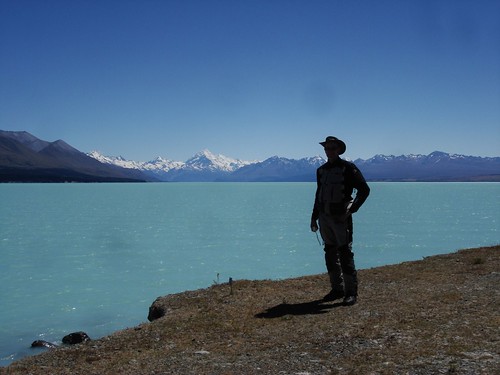
I spent 2 weeks or so riding around New Zealand over the Christmas New Year break. What glorious fun. (There is a more complete set of photos over at Flickr.)

It reaffirmed what a wonderful place this is. Even during the height of the summer break it was easy to get away from it all.

My friend April, ex USA, was great company, and meant that I really got to see NZ from a foreign tourist perspective. We we often both treated as being from offshore, and almost universally we had positive experiences.

New Zealand is increasingly a great place to travel to – it’s not only beautiful and so forth, but  people in and out of the tourism industry really appreciate visitors and it shows.

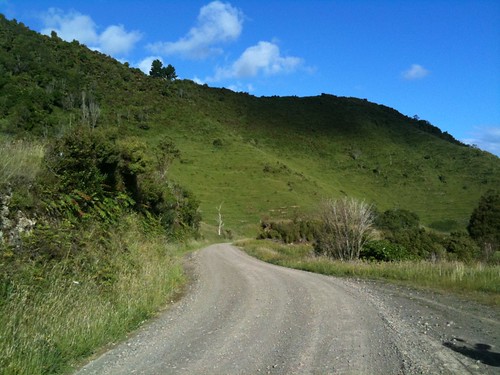
We rode from Wellington, down the Molesworth track to Hamner, then to Christchurch.The Molesworth Track is only open over summer, and is an excellent excursion. We briefly met several people from Wellington cycling the track – a wonderful idea.

The next day saw us go to Haast via a windy and then very wet Arthurs Pass. New Years Eve was to Te Anau (Queenstown was a traffic jam) and we spent New Years Day spent at Milford Sound. It really is one of the most spectacular places in the world.

The next day was a very big one – from Te Anau back to Wellington. That wasn’t the plan, but there was a big front behind us encouraging us to keep going. It simply meant steady riding at the speed limit all day. The nice thing about being on the motorbike is that our hold-ups by slow traffic in the hills was minimal.

Best shopping town award, and April was a very experienced judge, went to Napier, which we got to via the Wairarapa. Here she is perusing some mops.

We went through Gisborne, then the Motu track 9top two photos) to Whakatane, and then to Auckland via the back roads.

After dropping April off it was up to Waipu, then through to Raglan (highway 22 is very worthy) and then back to Wellington via the Wanganui river road. Be sure to go down that road son as it is increasingly devoid of gravel. Here’s the very pretty Jerusalem church.

2009 was a good domestic travel year for me – for example I managed to ride or drive through the Haast Pass three times in 2009, once on the Brass Monkey, once on the way back from skiing in Wanaka, and this time. Similarly it’s been a great start to 2010, with the visit to Milford on New Year’s Day.

New Zealand really is motorcycling paradise, and despite there being two tragic motorcycle fatalities during my trip (both relatively near to where I was that day), it remains one of the safest places to ride in the world. You certainly don’t need to go fast in New Zealand to experience great riding, and those tempting straights simply make you tired, wear your tires out and are fully policed.

Speaking of which, there was a checkpoint on the road into Wanaka on New Year’s Eve. The stop was the usual efficient affair, but what was interesting was April’s comment afterwards – “That was the friendliest Policeman I have ever met.” We tend to forget just how good interactions with the Police are here in New Zealand, and for his part the officer left us feeling even happier about the day and the country. Well done.

Do you feel assured?

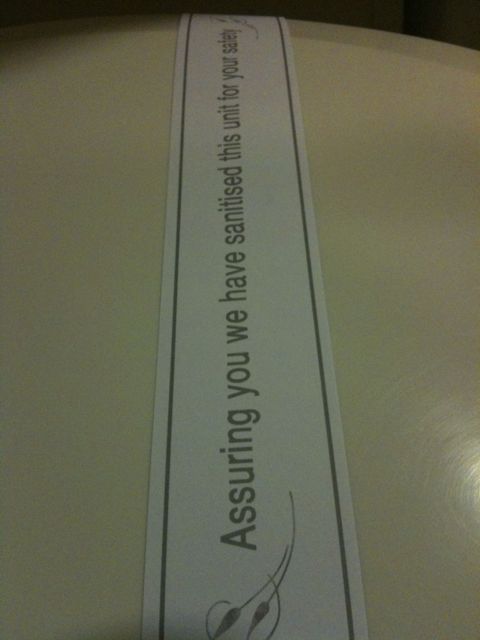
I imagine there is some ancient research backing up the use of the “be assured” strips across toilets in a certain class of accomodation. I for one feel it really is a waste of money, as not only is it obvious when a bathroom has been cleaned, it’s also hard to catch anything nasty from a toilet.

Be afraid, however of unwashed bedspreads, blankets and pillows.

These can harbour nasties and are washed far less frequently. Ever had a cough or flu in a hotel? Wondered what happened to the bedspread after you left? I try not to, and I do know people that use towels to insulate themselves from the less clean bedding. Some are very frequent travellers.

So instead of the toilet strip, how about a checklist at the door – giving the dates when each item in the room was washed (those pillows seem to sit there forever), or better yet the number of guests that have used the item before you? Also why not ask guests to tell you (or quietly record) when they are a bit ill, so you can wash the full range of bedding?

Neither of these are palatable options of course as they cue the guests to start thinking uncomforting thoughts.

I’m not sure what the right answer is. At the moment it’s a trade off between health and cost – and one that even the best hotels call in favour of cost.

Meanwhile there’s a lot to be said for camping. And towels.

No more Mojo for motorcyclers

I’m angry.

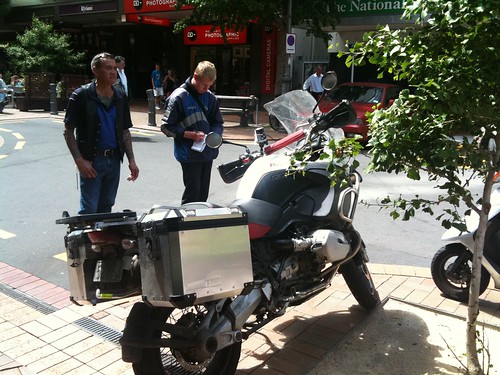
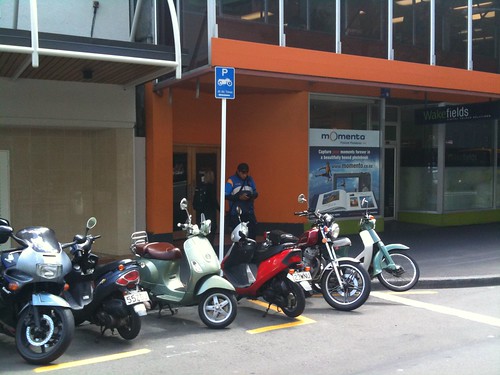
On three consecutive visits to Wellington city for coffee meetings I received 4 tickets on my motorcycle. Here’s the chap that gave me the third one – he is drawing a diagram of the location of the bike. Note that the bike is off the main footpath area, and between a tree and a driveway, not somewhere where people walk and does not impede car or other traffic.

The first ticket I received was a warning. I’d had a quick chat to the the ticket giver as I rushed to a meeting, trying to understand why policy had changed.

The next ticket was a $40 fine and another $200 fine for having no registration displayed. Registrations fall off motorcycles. The last one, that’s the photo above, was another $40 fine. I have not bothered to go back to the CBD since, and did a bunch of Christmas shopping in Auckland instead. Merry bloody Christmas, and don’t forget the ACC levy has gone up a bunch as well.

I have received only one other motorcycle parking ticket from the over 70 countries that I have ridden in (London, outside the AA while getting the fundamentally useless international driving license), and in almost all of them I have parked on the footpath or on other unofficial parking spaces.

There was a good reason why I parked on the footpath:

All of the official motorcycle parks were full – I know because I spent time looking around (and thus was later than normal to meetings)

The enforcement of motorcycle parking rules has no room for logic from the enforcers. Here are two scooters receiving warnings:

They are smaller bikes, and so are not poking out into the street, nor on the footpath. Their crime as to be on a dotted yellow line.

Their crime was also to be be part of a massive shift to motorcycles as a result of a recession, rising fuel prices and increasing realisation that bikes are better than cars for commuting and traveling.

This, according to Jon Visser, the WCC person in charge of the shift in policy, resulted in hundreds more bikes coming in to town each day. While this may have freed up car parks in parking buildings, it also jammed the motorcycle parks.

As he explained, the problem was commuters – people riding to work, parking their bike all day in a bike park, and then riding home.

So entered a policy change to push motorcycles into car parking buildings. That’s paid car parking buildings.  I used to park my motorcycle for free in a variety of car parking buildings, and it seems that now, thanks to the efforts of Mr Visser, I’m going to have to pay. That sucks, and it changes the incentives for having a bike in the first place.

But wait – I’m not a commuter, and the car parking buildings only have a $50-$100 (in the examples I heard) monthly deal for riders. There is, it seems, no casual parking deal for occasional visitors, or those like me that pop into town for meetings. So now I am locked out of parking in all but two, still free, car parking buildings.

It gets worse. Let’s run through the economic incentives to show how this is failing for me:

Economic incentives

1: Commuters that arrive early will find empty free motorcycle parks, and park there all day.

2: Commuters that arrive late to work, that previously parked on the footpath or in street niches, will choose either to arrive earlier, pay for a car park building, or to park further away.

2.1 If they arrive earlier then the other early arrivers will confront the same choices – the problem is simply moved to even earlier. This makes for earlier starts for everyone, and I guess as a result higher coffee sales, but worsened family situations as Dad or Mum has to abandon home earlier.

2.2 If they pay for a car park they are now out of pocket by $50. This is economic loss.

2.3 If they move to another bike park then they are transferring the problem to a new set of riders, and they are also subjecting themselves to a longer total commute, and to the pain of traipsing for long distances in full protective gear.

2.3.1 Riders can choose to reduce the inconvenience of traipsing by either wearing less protective gear – which increases their chance of injury or death while riding

2.3.2 or they can acquire luggage for their bike to place their gear into. This makes the bike bigger when parked and also harder to ride, especially for learners in Wellington’s wind,  increasing both the parking and the injury/death problems

3: Once a commuter has a motorcycle park, then they will not move for the day, because they know they will  unlikely be able to get a bike park anywhere else.This means that the bike parks will not churn, meaning that places will not become available throughout the day. I’ve noticed this.

4: Day trippers, or casual riders (such as myself) are thus unable to get bike parks through the day as the free parks are full of commuters and the paid parks are only available on a monthly basis. As someone that can ride to the city several times each day this is a big problem. The choices confronting the casual rider are not pretty:

4.1 Park illegally – find a safe place to park and put the bike there. Wear any ticket cost – which you are quite likely to get given the large number of ticket givers in the CBD. I’m told that towing is not going to happen under current policy, so consider it a $40 price to park. Oh – and since you are going to get a ticket anyway, don’t worry too much about parking the bike out of the way of pedestrians and motorists.

4.2 Park and walk – in Oriental Bay or Thorndon somewhere else that far away. This makes a mockery of the purpose of riding a motorcycle, which is to increase convenience. You also have the problem of shifting the parking problem elsewhere, all of that gear and the extra time for the visit to town, the bike being in position for longer, walking in inclement weather and a higher chance of theft.

4.3: Choose to go elsewhere or not to go. I’ve found myself reconsidering the “quick coffee” concept in the CBD after these draconian measures were bought into place. That’s sad. I’ve yet to get a ticket for parking on the footpath in The Hutt recently. Sorry Mojo, instead of using one of your venues, tomorrow morning I’ve having a meeting in Roseneath. How convenient.

4.4 Park in a car park on the street or in a loading zone. The first will cost you money, and both will have a negative external cost on car drivers, who are going to get justifiably annoyed at the single motorcycle taking up all of their space.

4.5 Choose another mode of transport. There is a clear policy by the local and national governments, to shift people away from motorcycles. They are doing this because of the differential between serious injury rates between cars and bikes. This is a sad argument, as it results in part from the lower experience of the new riders that have recently been forced on to bikes, on roads and car drivers that are relatively unfriendly to riders and most of all on not including the substantial societal benefits of having more people on bikes and less in cars. Those benefits include less emissions, greater capacity for a given road, more parking per square meter and better riders and drivers. That’s right – motorcycle riders have a steep learning curve, but I contend that they end up being, on balance, far superior and safer road users in all vehicles.

I was also encouraged by Mr. Visser to take public transport or to ride a bicycle. Public transport may be OK for regular commuting, but is too slow, irregular and unpredictable to use for dashes into meetings. Meanwhile bicycling is great, but you also have a much higher risk of injury, and once in town a higher risk of getting your bike stolen. Then for me there is that ride back to the top of Mt Vic. I have no desire to do that more than once a day. I’m also lucky I live so close – what about those that live further afield?

Solving all of this

Timed based parking

Jon says that the one thing they are trying to change is commuters using bike parks all day. The solution to this the above is actually in progress and may be ready to go in 6 months, and that’s to impose time limits on some, but not all, of the free motorcycle parks. That will push many day-long commuters off the parks and into longer all-day carparks.

That’s not going to make them happy, so I propose also:

Large, free bike parks

I’d like to see a few larger free bike parks introduced, ones that can take 1-200 bikes if necessary, on the outskirts of the inner-city.  Te Papa, one or two areas on the wharf area and somewhere around the Terrace all work. That way bikers will know where they are virtually guaranteed a park, and there will be security in numbers. Give riders a simple decision for their destination where they are guaranteed a park, and the inner city parks will also become more free.

Sensible sentencing and parking

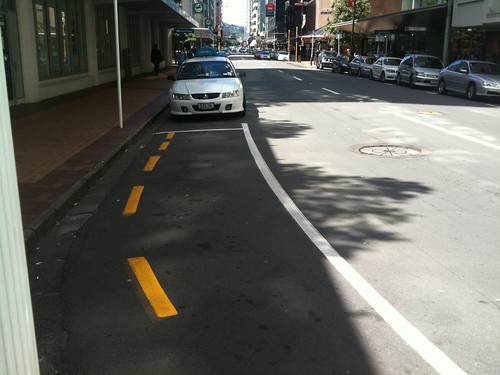
It is maddening when confronted with draconian laws and this:

That is a dotted yellow line and a lane divider. It also seems like a perfect place to park a motorcycle, or a car, or several of each. The WCC should give parking officials authority to dish out tickets only when a bike is egregiously in the way, when there is an easy alternative park in the area and when a ticket is a last resort. There are plenty of nooks and crannies around Wellington – let us use them sensibly.

Biker Hell
Finally there is the philosophy of the matter. Wellington has chosen to be unfriendly to motorcycles. It’s joining a mere handful nasty law enforcement regime cities around the world when it does so. I’ve motorcycled in hundreds of towns and cities throughout over 70 countries, and have had parking problems in only one: London.

That’s it.and now Wellington.

Jon tells me that Sydney is also pretty rough on bikers, and San Francisco too. I’ve motorbiked in Sydney before and not had a problem, and though I have not motorbiked in San Francisco, I’ve had very little problem in any of the 40 or so US States that I have motorbiked in. Across Northern Europe, a richer, more organised and rule-based society than here, I can park my bikes virtually anywhere, while in Latin Europe and Latin America for that matter, bikes take priority over everything. Actually – Monaco was an exception – a place so unfriendly to bike parking that I did the sensible thing, and left without dismounting. I hear that Monaco is used as a comparator to Wellington – something which made me ill when I think about what a horrible place it was to visit on bike.

I think the pertinent example to follow is the rest of Western Europe, which somehow manages to mix great public transport with superb services for cards, bikes, motorbikes and walkers. There are plenty of cities with similar geographical problems to Wellington, and plenty with larger populations. Why would we want to copy London and Monaco with their nightmarish motorcycle regimes?

And why are we not asking instead:  What can we do to promote Motorcycling?

The Jon Visser Factor

There is another part to this story, and that is the professionalism and engagement by its architect, Jon Visser. Hailing from Holland, a place with great laws for cyclists of all types, Jon has been very active in engaging with bikers. There is even a great 28 page thread on Kiwibiker where he has answered questions from all-comers.

I spent a decent amount of time on the phone with Jon, and he was unfailingly polite, reasonable and logical, but there was no moving his opinion, nor that of his masters. The fix is in, and the council signed off on it.

So perhaps it is time to vote them out, and perhaps I’d even vote for Bob Jone’s crowd if they campaign on bring back the bikes. How about it?

Kiwibiker

Anyway – I’ve pulled out a few choice quotes from the 28 pages below. Credit to those authors.

“Bugger. We went all out to be as bloody minded as possible to car drivers, so as to force them onto to public transport, despite its vileness. But, lo, the contrary sods are coming in on motorcycles instead. So we’re going to have to turn the clobbering machine on motorcycles also. Once there are no other transport options available , they’ll *have* to use public transport whether they want to or not , which is the only way we’ll ever force people to use it”
Ixion

the Council would rather see a reduction in the number of motorcycle riders getting hurt or hurting/affecting others. Jon Visser, WCC

From what I’ve read of your comments here, Jon. this has as much to do with the social engineering of commuters onto public transport as it does with the saftey of footpath users. Despite acknowledging that there is a problem with lack of parking around Grey st, rather than address the shortage of spaces for bikes and scooters (in the problem area) the only action it seems the council are prepared to take is “chase ’em off the road”. Clockwork

“there is no way I would park my bike in a Wilson carpark, given the number of bikes that have disappeared from them in the back of vans..”
James Deuce
provides reason enough never to park your bike inside a car park. Others pointed out that the car parks are making more money from the bike parks than car parks.

“I switched to motorcycle commuting because of the shortened time and reliability. The train is cheaper from Johnsonville than riding a bike (once you factor in buying a bike, gear, rego, insurance, servicing etc…) but takes me 25 mins all up (gear off / on, traffic slowness) compared to 45mins on a good day walking to / from the train at either end and assuming the J’ville train is running to time (which it usually is weather permitting).

I actually enjoy commuting on my bike and look forward to beginning my workday with a smile (nice ride in during sunny days) and can cheer up before I get home if I’ve had a bad day. I think that makes me a happier CBD citizen.” Dave Bullet says why biking to work is good for the soul

In January 08 I was in Wellington CBD for a day.. …I settled for a bit of space on the end of a couple of angle parked cars, between car and start of a driveway. I was pleasantly surprised to come back at the end of the day to find the bike unmolested, with no tickets as a welcome. Gremlin explains that tourism demand free parks

“Read Mr Visser’s posts closely Bob. He isn’t after opinions. He’s telling us that WCC are about to start charging for bike parking and is making up figures about how much space is needed to park bikes to justify not providing parking. It is disingenuous to try to put any other interpretation on the matter.” James Deuce says it’s driven by revenue 

“Those prices are going to penalise biker’s wallets, especially if they have moved from $0.00 yearly parking cost for their bike. Suddenly finding $600- $1200- for a years parking.” Swoop responds to Jon Visser’s reporting of $50-$100 per month pricing for bike parking.

Dare I mention it’s free in all the Auckland city carpark buildings?” Sayeth Devil

easily remedied by a change in the wording of the law, ie. ‘Parking on the footpath without due care and attention’. Magic Monkey has a sensible wording change to the parking law

1) there is a lot of unauthorised parking but most are in unused space which is not required by pedestrians.
2) Riders do help lessen congestion – the council needs to take this into account.
3) Commuters make up the vast majority of weekday retailer customers.
Wild_Weston sums it up

As I have stated earlier. It costs me 3x more to take public transport that is unreliable, crowded, germ-fested and inconvenient,
Str8_jacket discounts public transport. I agree.

Proud to be a Kiwi. Shame on you Australia

Today I’m proud of our Government in New Zealand, and horrified at the one they have in Canberra.

After the concerted #blackout campaign earlier this year the NZ government halted the implementation of the Section 92A bill that dealt very harshly with alleged copyright infringement.

Today they came back with a proposed changed Section 92A, which removed much of the problematic language.

David Farrar sums it up well, but the biggest wins for me are:

  1. Copyright holders will pay a fee for each accusation. This will stop the USA based RIAA and MPAA spamming accusations at domestic ISPs.
  2. Temporary Internet Termination can only happen when ordered by a court, not by the Copyright Tribunal or an ISP (unless you don’t pay your bills of course)
  3. Users can stay anonymous until the court stage

All in all it’s a pretty balanced outcome, though David has identified a few flaws. Do read his post.

Meanwhile the Australian Government announced yesterday, that in spite of a concerted consumer campaign against it, they will be mandating an Australian Firewall. Do read this article to understand more on why it is bad, and how it is purely politically driven. It’s an appalling move – reminiscent of totalitarian regimes.

Here’s what the public think – it’s a biased poll but, well 95% is pretty compelling:

I’m glad I live here. Well done to everyone in the government – and to the opposition.

Kiwibank’s Heaps – personal banking as it should be

I have no idea why it is called heaps, but Kiwibank’s new offering to personal customers looks superb. It really throws down the gauntlet to the other banks. The product lets you semi-automatically categorise your spending, and then track your spending against a budget. It’s the sort of thing previously only available with an aftermarket product, or on some high end credit cards.

Right now it is, apparently, in very limited release. I’d be clamoring for this if I were a Kiwibank customer.

BNZ has partnered with Xero, and are apparently launching Xero Personal in the new year, which I imagine and hope will have a similar set of features.

Congratulations to Kiwibank and to developers Made from NZ and @nzkoz – it looks like a great product.

The need for sub editing still remains

An article on Stuff with an AAP byline (but not writer’s name) reveals a little about the state of news reporting today. The original article was published in Fairfax’s Melbourne newspaper The Age yesterday – and has an author (Nicole Low). That brings us to the first finding:

  • Big media companies share content amongst their publications, and I am a fan. In these tough times it’s a great way to ensure we keep getting a mix of high quality articles. Fairfax, for example, has a business news team based in a smart new facility in Auckland that provides content to all Fairfax media in New Zealand. This means they can afford to hire and give time to specialist journalists, which the provincial newspapers would struggle to do based on current economics. Those local publications still need local journalists though – as local news is the critical part of the newspaper content.

However the article was also in the rival News.com website, back on November 5th, and I thus am sure in many other newspapers:

  • All media companies share articles. This has been going on for decades with NZPA, AAP and others writing and sharing articles to everyone. It’s a great model for general news – only one needs to be there, and we just want the facts.
  • In the past it was a good model as newspapers were separated by distance, but with online content available to all it’s increasingly hard to differentiate between news sources.  In this case I was quite disappointed in the quality of the article, and it caused me to reassess downwards slightly my impressions of the quality of the content on The Age and Stuff – while it’s just the sort of thing I’d expect from News.co.au.

On Stuff there was no byline:

A week before my departure for the United States, I went into a total meltdown.

There was in The Age and News.com, and it seems to be a pretty basic rule that  articles published in the first person should have the author’s name. But the biggest issue for me is that none of the articles had any way to give feedback  either through comments or (and this should always be the case) through an email address for the writer. Which leads us to:

  • Reader interaction is the standard these days, and publishers need to provide the basic tools.

Another quote gives two more findings:

TSA stands for Transportation Security Administration, otherwise known as customs officers in Australia.

Ignoring the incorrect information on the TSA for a moment, let’s focus on the perils of copying content from another place. In this case New Zealand readers are given an Australian reference. Which leads us to:

  • The need for sub editing still remains. Articles should be selected and relevant for their intended audience and should be written and edited with their point of reference in mind.

and now let’s look at the writer’s lack of understanding of what exactly the TSA is. It’s reflected also in this quote from further in the article:

…Wherever you land first in the US, that’s where you clear Customs. It doesn’t matter how bad the TSA in Dulles is. If you land in San Francisco, you clear immigration there. At Dulles, all you need to do is collect your bags.

The TSA (Transportation Security Agency) is nothing to do with US Customs and Immigration. The TSA are the people that are responsible for security, mainly on the way into the airport, while the Customs and Immigration folks are responsible for letting you and your things into the country. And thus:

  • The need for sub editing still remains. Yes – let’s reiterate the point. Articles that have been published before should not be blithely republished, but still need to have the at least a quick check to ensure they are up to scratch.

As news content increasingly becomes a commodity publishers need to ensure that they differentiate themselves so that they can capture a distinct readership and advertising revenue stream. That means, for a start, clearly defining and agreeing on who they are publishing for, how they are doing so, what content they are providing and how they interact with their readers. There is plenty of work to do in the industry, and answers to these questions will change rapidly over the next months and years.

Stop the spam Sky

Dear Sky Sports

Please famililarise yourselves with New Zealand’s Unsolicited Electronic Messages Act 2007. There is also a handy guide for businesses.

Then

  • include a way for me to unsubscribe from your puerile badly photoshopped spam.
  • include the name and address of the sender – who is the sending entity?
  • get my express consent to receive your spam
  • tell me where you got my email address from

many thanks

Bye.

P.S. Please stop with the Tiger nonsense.

<Update. Sky Sports called me and apologised. Thanks.

They didn’t, it seems, realise that they needed the unsubscribe option. They are now putting in on to all future mail-outs. So that’s a good result -well done for responding so fast Sky Sports.

Apparently I would have received emails from Sky Sports before, and in the terms and conditions is embedding the “we can send you spam” clause. That’s not something I know anything about – I certainly do not recall opting in to this sort of spam.

Also looking back at my Sky emails received I see one email from “Sky Marketing” – a survey in June this year and one from Sky Television – a promo back in April, and that’s it. Both had unsubscribe options – and both were sent by other companies on behalf of Sky. Here, for reference, is how the bottom of any spam email should look – from the April newsletter. I’m guessing I hit the unsubscribe button, but I cannot honestly recall whether I did or not>

Telecom XT Outage: Unacceptable

The other day I noted that Telecom seemed to be ramping up data use sources on the XT network, asking “Is Telecom really doing this?

Commenters said I was being unfair (and perhaps I was) as the XT network is much better than AT&T’s, there is fiber to each cell site and we have data limits in New Zealand that will prevent overload.

The promotion is going well : Telecom on Friday tweeted “We are currently giving away 3 T-Sticks a minute”

3: This morning all hell broke lose and the network died South of Taupo.

Credit to @TelecomNZ for responding on Twitter.

I’m pretty sure that despite the quantity of T-Sticks sold that there is another reason for this, but regardless, the timing is lousy for Telecom and the incident is terrible for all of us. What’s the use of a free T-Stick (or a phone for that matter) on a network that does not work?

As we become more and more dependent on mobile devices, both for voice and data, it’s incredible that a company like Telecom can fail in this way. Their response will be telling.

A quote such as this:

Customers’ ability to contact emergency services during the outage had not been affected, Ms Murphy said.

is simply wrong. I am one of the incraesing number of people with no home phone, and while I do have Skype as a backup I can say that my ability to call 111 from home is affected. Meanwhile we cannot just ignore any 111 call requirements for those that are not at home.

Unacceptable.

Despite the Stuff article saying “Telecom’s website is being regularly updated” this is what you get to see a few hours later, while the network is still down (10:58):

Unacceptable

No updates on news page (11:03)

Corruption and restrictive regulation

An interesting finding by the World Bank’s Investment Climate Department – the less procedures required to start a business, the less likely a country is corrupt. Note that New Zealand is way to the left and bottom of this chart:

There is more on the World Bank Private Sector Development blog, (article) but I tend to disagree with the finding;

Preliminary estimates by CIC staff suggest that a 25 day reduction in the number of days to start a business improves the control of corruption ranking by about 1 point. If the number of days to import and export is reduced by 25, the control of corruption ranking increases by 4.4 points.

That implies that reducing the number of days required to start a business reduces corruption – which cannot be true alone. The next paragraph is subtly different:

Further analysis shows that controlling for country specific effects, changes in the level of doing business indicators are positive and significantly correlated with changes in corruption rankings within a country.

That’s better, but regardless my take is somewhat different. I contend that a corrupt society may be better off with multiple bureaucratic steps, as it spreads the corruption out over a number of officials rather than concentrating it all in the hands of a few. That means lots of little payments and a process to follow rather than one huge payment to a single person. To be sure any society should seek to reduce the number of steps to do various things, but ensuring as they do that there is no room for corrupt practices.

Persistent offenders will be prosecuted

Whaleoil does it again – making it clear who someone is when their name is suppressed. He is defending his actions:

“I will not remove the series of images in question. The way I have acted has been entirely consistent with the public interest.

“I intend to vigorously fight any charges or allegations to the contrary,”

He should know about Solicitor General David Collins comments at R vs Internet two weeks ago. The Solicitor General admitted that while the Government has prosecuted only 3 name suppression cases recently they will target those who are persistent offenders and clearly acting as if they are above the law. He seemed very passionate about it, angry even, and I for one was under no doubt that Whaleoil was in his sights.

He should also be aware of Judge Harvey’s comments to me after I challenged his presumption that you could really block someone’s content online when we have so much content now on Twitter and Facebook (you can’t – not without blocking the entire sites). He eventually replied that no matter what the technology, I would still be sitting in New Zealand, and thus exposing myself to legal action. He was also very passionate about the subject – and I admit that I would not want to face that passion on the wrong side in a court room.

I do agree with both the SG and Judge Harvey – willful disobedience of a judge’s ruling is simply asking for trouble, and that targeting the person rather than the technology is the right thing to do.

It will only take a handful (at most) of cases to turn the tide, and my take is that Whale Oil is clearly going to be dragged before the court soon as an example, and most certainly if he keeps offending.

My suggestion to anyone that would listen at R vs Internet is that the Justice department and judges should be making phone calls and sending emails to key offenders very soon after the offending material is written. A quick phone call letting a blogger know about the seriousness and potential consequences of breaching a suppression order will see most of them fall in line.

However I am afraid Cameron Slater at Whale Oil feels he is beyond the reach of the law – here’s a short article from NewsTalk ZB: My apologies to ZB as I copied the entire article.

The blogger who has published clues to the identity of an Olympian facing rape charges says he would do it again.(1)

The man used pictures and symbols to reveal the name of the athlete who faces 13 charges including one of raping his wife. The blogger, who does not want to be identified (2) believes the accused should not have his name suppressed.

“I think the suppression laws we have in New Zealand are silly. I don’t believe in permanent name suppression except in exceedingly rare cases (3).”

The blogger says he will vigorously fight any charges or allegations and will not remove the images in question. He says he also identified the entertainer (4) who gained permanent name suppression after being convicted and discharged last month of an indecent act.

Let’s go through the highlighted phrases:

  1. Slater shows no contrition, shows that it was deliberate and that he did it and is demonstrating that he believes he is above the law
  2. It’s pretty obvious that the blog is Whaleoil, and that it is written by Cameron Slater. His own press release on Scoop makes that even more obvious. <Update from WhaleOil in comments below: “In their radio news they said correctly they they wouldn’t name me for fear of prosecution themselves.“>
  3. Again Slater shows that he believes he is above the law. That’s really going to annoy the SG,  judges and QCs and he is asking to be bought to account.
  4. Slater confesses to another breach of the suppression law. That’s going to make it really easy to place charges and win in court

Last word to Philip Morgan QC:

“This is a particularly deliberate contempt of court and any particularly deliberate contempt of court is punished severely.”

<Update: WhaleOil provides and update (and asks for a lawyer). Cameron Slater was issued, om the 22nd of December, with a summons to appear on 5 January to respond to four charges – 3 separate ones for “breaching an order of the district court of Auckland” on 3 dates and one for “Publishing a name or particulars likely to lead to the identification of a person upon whom an offense was committed”.  By placing the four offenses in one summons it seems clear that they want to shut down the persistent offending.

I note that Cameron has followed the recommendation in the Police letter to him and taken down at least one post, and so will avoid the potential for the laying of further charges.

It’s a tough time of year to find a lawyer.>

Increasing interconnectiveness of the mediasphere

WordPress.com has just added another link to the increasingly interconnected mediasphere. They’ve added the ability to login, read and post to WordPress blogs using the Twitter API.

What that specifically means is that we can now post blog entries using apps like Tweetie 2.0 for the iPhone, which I am doing for this. *

However the wider implication is that this is merely another step in the continued blurring of the boundaries between the Media – blogs, Twitter, Facebook, Linked In, general media sites, business sites and whatever is coming next.

We are also seeing the lines blurring between the quality and type of Content writing we see in professional media, high end bloggers, businesses and the various types of personal content.

I believe that The end game is a soup – where we are each surrounded by and interacting with a vast array of streams that themselves interact with each other. We choose the primary ways that we interact but feed in and out to other streams.

The hardest part is figuring out where the revenue streams will be. While we accept that we pay for little online we still demand quality writing and news.

These are big themes, and a short blog post cannot really do them justice. What do you think – is this where it is all going?

* Actually this is what the post originally looked like:

WordPress.com has just added another link to the increasingly interconnected mediasphere.
They have added the abi (cont) http://tl.gd/1835p

The API would only post the standard number of Twitter characters, and truncated the rest. So there is some work to do. Meanwhile there is a very good WordPress Application for the iPhone which is far better for creating posts.

Is Telecom really doing this?

Combine three recent pieces of news:

1: Telecom got fined $500,000 by the Commerce Commission for offering “unlimited data usage and all the internet you can handle”, paying another $8.4m in compensation to customers. The offering was less than unlimited in speed after everybody jumped on board – oh and they were shaping as well.

2: Telecom is currently giving away (essentially) T-Sticks, which offer data for your laptop over the XT network, to any existing Telecom broadband customer. Pay $30 in pre-pay credits and walk away with one. It’s “while stocks last” – so be quick.

3: AT&T is saying that heavy data use is overloading cell-sites. It seems that 3% of  iPhone users account for 40% of traffic, so they are going to start charging for heavy data use.

With a question:

4: When will Telecom become an official supplier of iPhone? Surely it has to be soon – it has been over 6 months since launch of XT and it’s the only network that provides true 3G access throughout NZ for the iPhone.

And then ask:

If the iPhone is made official soon, and given all of the above, then how much data and how many devices can Telecom’s XT network really cope with?

Will we be starting to see clogging of the virtual pipes?

Will Telecom look red-faced once again?

What is Vodafone doing in response to all of this?

Time will tell, but in the meantime go get yourself a free T-Stick if you have Telecom broadband.

<update. It’s Monday morning and XT is down “south of Taupo”. That’s got to be a coincidence but it does make you wonder>

51 in the top 500 – what does it mean?

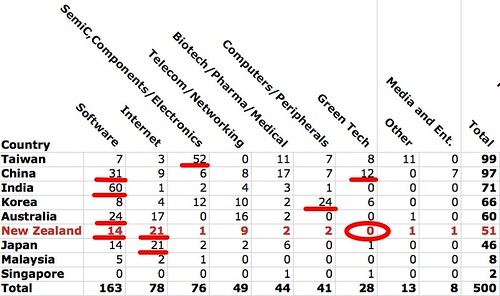
The latest Asia Pacific Deloitte Technology 500 results are out, New Zealand looks pretty good, with 51 companies making the list.

It looks even better on a per-head of population basis – with New Zealand demonstrating real strength.

I’d hasten to add that I do not really believe this result – as the sample is all companies that entered into the Deloitte 50 in their respective country. The bar to make the top 50 in say Taiwan is much higher than in NZ, which means that many companies that would otherwise make the top 500 may not bother applying.

Meanwhile I do not know how relevant the list is in the other Asia Pacific countries, and nobody would really know just what percentage of otherwsie qualifying companies never bother applying.

Regardless – there are some interesting facts to be gleaned. We are strong in internet companies – equal to Japan fgor goodness sake, and beating Australia.

But we have had no fast growing green tech start-ups. That’s a shame, and probably points to lack of market and tough laws, and is really something you’d hope that New Zealand could get serious about.

We are also under-represented (or perhaps fairly represented given our GDP) at the top of the table. Our businesses seem to be for lower annual revenues, and our average rank well down. I wanted to present that number, but the actual list does not copy and paste from the pdf at all well. I’ll ask Deloitte for a better version.