I received several copies of this email from Apple, and clearly there is a disconnect between my idea of appropriate Valentines day gifting behaviour and Apple’s:
I understand flowers, I understand dinner, and even a small gift, but isn’t a $349 iPod Touch raising the bar just a little too far?
It’s also not going to do a lot for your romantic life to see your partner buried in an iPod touch downloading and playing apps.
Is this is another sign that the Apple team need to get a few more women involved in their branding and advertising processes?
But then – what would I know – I’ve nobody to give one of these to this year anyway.
Rowan’s put a few photos up as well – we spent a great day on the Whanganui river yesterday. I’ve enjoyed the river road for years, but this was the first time on the river itself. For me one it is now one of the iconic New Zealand destinations.
Click on the pictures for larger versions.
On the Whanganui River road Looking towards JerusalemRowan taking in the viewdown a dark alleywaylooking back Relax - he's been doing it since he was 5The bridge to (and in) nowherePlenty of people were enjoying the riverLooking forward
It’s time for an update to the Telecom XT network map. From the communications I can glean that the latest map looks something like this:
Spotty means you can’t guarantee that you’ll be able to hold on to a call for very long, or that your phone will even work. <update – Chris Quin tells business users that they are getting 90% to mid nineties success in calls being made and mid nineties in calls being retained until hang-up. That’s not that great – 1/10 calls fails to go through and a bit less than 1/10 calls fails during the call.>
No coverage – well don’t even try.
Telecom CEO Paul Reynolds has called for an independent inquiry into what went wrong.
3 suggestions for that inquiry
1: Independent means get someone who is “outside of Telecom or any of its suppliers” to lead the team. The only inside person that would make sense is a direct report to the CEO that is not in a responsible department. Chris Quin, head of Gen-i, may be a starter. <update @chriskeall asked Chris Quin Who will be engaged to do the independent review – and the response was an international professional company that is as yet unnamed is being retained>
2: Focus on identifying what the systemic failures were, and not on a blame game. What were the cultural, system, design, technical, individual and other issues that caused this to happen?
3: Fix the problem, and more importantly, fix the underlying causes. e.g. If one answer is redundancy, then over do it and triple up – you cannot afford to ever have this happen again. There will be a number of underlying causes, and you need to fix them all, starting with the culture that allowed this mediocrity to happen, and having very very good look at the way technology competence has been outsourced and managed. <I asked a question to Chris Quin “Will the independent inquiry cover structure and cultural issues as well as technical issues” and he replied to my question – “Yes” – the review will cover structural and cultural issues. He said that the cultural side has been amazing to watch, that people internally are passionate about making it world class. They will need to look at processes, technology, discipline.>
I struggle with NZEdge. They mean well for New Zealand, but I often feel they are disconnected from reality.
It’s owned/run by Brian Sweeney and Kevin Roberts, but it seems to be operated as a one man band by Brian. Both Brian and Kevin are in the advertising and communications game, and this effort is a very poor advertisement for their services.
The NZEdge emails are unreadable – basically a long list of stuff we either already know or don’t care about. It’s a late laundry list of news that we all follow online or offline, and it is formatted soo poorly that it is painful to read or parse.
I forget how I ever subscribed, but I just unsubscribed (and easily – thanks).
Actually I wanted to link through to the email on the website, but all I got when clicking the “Having trouble reading this email? click here” link was this:
So the emails are sent using some sort of marketing tool (constant contact), and the unsubscribe page allows to to subscribe or unsubscribe to both the NZEdge and some newsletter from Kevin Roberts.
Let’s turn to the website. Turn your volume down before clicking that link – there is a very loud loop track “Come to the place you know is home” that does not appear to have any off button. That’s poor etiquette and pretty much going to make sure I never return. I guess it does encourage to to click on something, anything, to stop the music, but that something is going to be whatever it is you need to close the window.
Then there is the explanation about what NZEdge Aims to do. It’s clearly not aimed at geeks:
Introduce metaphors and contemporary frameworks for NZers to articulate who we are (positively hammer some boundary poles of the self into the whenua).
Articulate and leverage our difference through the edge proposal (landscape, location, attitude, history, Maori, Pacific, character, fringe innovation).
Increase the prosperity of the country, in spirit and in pocket, by spreading the edge DNA thickly over the culture.
..
Whatever. There is plenty more of that sort of guff on their about page, under the headings of, wait for it, Story Telling Compatriation (sic), and Index.
There’s a blog – but it’s over at blogspot and not integrated into the site.
The last update was on the 4th of December, the previous one a month before and the text of the posts is identical to that of the emails. So why does the link to “Having trouble viewing this email? Click here” not point to the blog? Well – the last post in fact is several weeks before the last email – so they are not even in sync. So basically the blog is not a blog, but an out of date repository for the old emails. Of course there are no comments on the blog.
They advertise a Twitter account on the blog – “Follow the nzedge.com headlines twice a day on Twitter. Register for updates at http://twitter.com/nzedge” but the last update was on December 28th and the writer is not following people back and engaging in conversations.
No comments on the blog, a handful (relatively) of Twitter followers and no facebook presence. There is no community associated with NZEdge – it is just an email list, and I would guess that very very few people actually read those emails.
Overall
NZEdge feels dead – an initiative started by a couple of guys with a “good idea” back in the day, but one that never moved beyond basic marketing sloganism and email spam. There is zero evidence of community involvement, and it is all one way traffic.
I would even question whether it is having a positive or negative effect on New Zealand.
But that’s me – what do you think? Does anyone find NZEdge useful? Is there a point?
Everybody seems to have written about the iPad. So here is my take:
1: I will get one.
2: I’m not sure whether to get the wifi model when it comes out in March in the USA or to wait for the 3G model. Or both.
3: I have an iPhone, and iPod touch, a MacBook Air and a Kindle. The iPad fits in there somewhere – it will be very interesting to see how I use it and what other devices suffer as a result.
and that’t it.
Oh – and yes – this was an important release. Apple transformed the music industry with iTunes, the application and telephony industries with the iPhone, and with this device and its successors and derivatives they will transform the software, OS, movie, written media and book industries.
It seems to be an emerging meme – comments in the post about Kiwibank’s Heaps and BNZ’s Xero Personal are worried that banks will create lock-in using personal financial management products. This comment is typical:
I really hope banks aren’t going to start using tools like Xero Personal to lock us in, because I can already see we’re heading down that route with Kiwibank and ASB offering their own.
Let’s get this straight – banks would be foolish to do anything else. The reason to offer these products is to increase the value proposition to the customer and to reduce churn. It’s a lot cheaper than acquiring new customers.
But with that said, there are at least three options for banks to consider:
1: Offer the enhanced services using internal client transactions details only. Charge either nothing or very little for this. I am guessing that some banks will try to charge for it, either at launch or down the track. They will learn about adoption rates, whether paid or unpaid, and make a decision one way or the other. I am picking that while some people will want this service regardless of cost, that providing personal financial management tools will rapidly become a price to play and be free.
2: Offer the enhanced services allowing you to draw in records from other financial institutions. There are three interesting impacts of this:
– Privacy – do you really trust your bank with all of your financial information? Are you comfortable with your bank knowing just how much debt you have?
– Price – banks could feel that they are able to charge for this service, and so price discriminate between those customers willing to pay and those who are not. That will help fund development for the entire suite of tools.
– Information – the reverse of privacy– banks can use the information contained in your other accounts to make better assessments of your risk profile and to offer you tailored products or services. Imagine getting an email “transfer your $1000 loan with Y Bank to us and lower your interest rate costs.” The downside of this is that for some the bank may decide to not offer your products and services, and even degrade the ones you have given their enhanced understanding of your risk profile.
While privacy advocates are noisily defending our rights (and I support them), when it comes down to it we will surrender those rights if it is in our benefit.
3: Offer to upgrade to an external provider that aggregates data from several financial institutions. Thus I start using Xero Personal in BNZ, and I have the option of upgrading to XeroPersonal.com -which is independent of BNZ. This gives confidence that customers will maintain privacy when getting records from other institutions, and also allows Xero (or whomever) to charge for the service. Xero for business fees are pretty high, but hopefully retail prices will be accessible to the masses – say $20-40 per year.
Hi
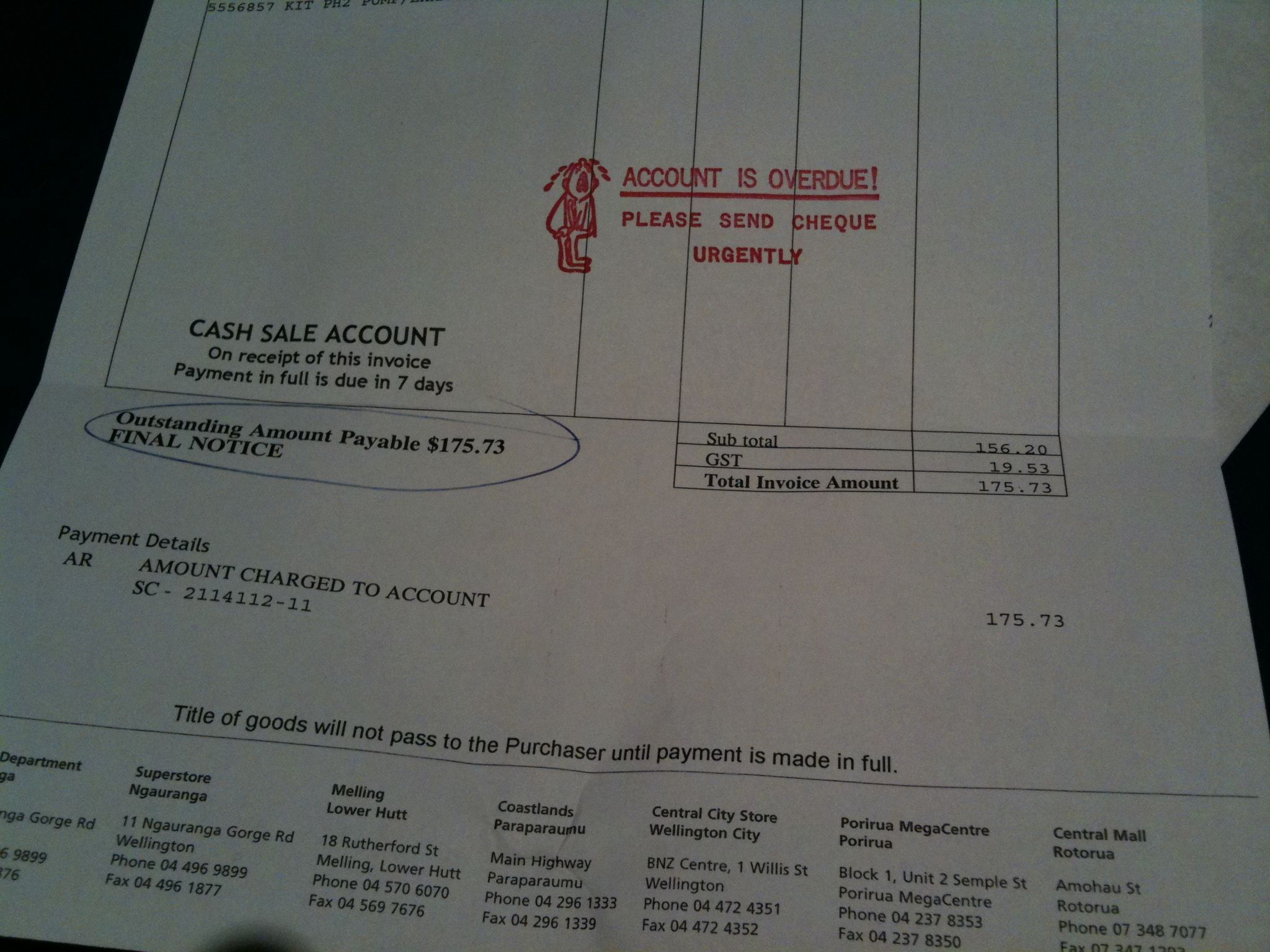
I’d really like to pay your invoice. Unfortunately I don’t have a cheque book – not for years now. Please put on your invoice at least one alternative method of payment.
Many thanks
Frustrated of Wellington
P.S. It would have been better if you’d actually fixed my dish drawer in one of your two visits.
How long does it take to bring back a customer that has had a series of bad experiences? And what do you need to do to get them back?
In Simon Grigg‘s case – about 8 years, and a heck of a lot. Let’s look at the lessons learned, and I’m also going to draw on my own experiences with three lousy (to me) companies – Telecom, McDonalds and Microsoft.
Simon’s experiences with Air New Zealand started going south in 1999, and he last flew with them in early 2002. Since then it seems he has actively worked to avoid Air New Zealand, flying on a number of other international airlines, and experiencing a range of horrific experiences. His blog post has more, but in a comment to the post here on Air NZ winning the Airline of the Year award he said of his last trip in 2002:
“To be honest the last time I flew them (from NZ to Melbourne), I swore I’d not ever fly them again. The plane was over-crowded, dirty, the inflight entertainment system was almost non-existent and the service utterly shocking”
Meanwhile after years of giving in I finally snapped and said “enough” of McDonalds “food.” The epiphany was when, after weeks of eating street food in Mexico, I and a friend saw our first McDonalds for a while and stopped to eat. We both felt ill almost immediately afterward – and this indeed was the worst food experience in Mexico. Meanwhile in Bolivia everyone seemed slim and fit – except for those people I saw in the McDonalds store in La Paz. It all makes me feel sick, and have not been back for years.
If you mess up with customers they will go to extraordinary lengths to avoid your products, even to the extent of making things much worse for themselves.
After Air New Zealand were bailed out from the Ansett debacle they embarked on a remarkable turnaround – one that now sees them at the top. It took a lot – several restructures, a great management team, plenty of hard work and time.
Meanwhile Telecom recently begun their own climb out of their own deep hole with the launch of the XT network. It’s a far superior product not only versus their old one, but also, for those with iPhones, to all of their competitors. I’ve switched, but I’ve run out of fingers and toes trying to count the number of iPhone owners that have stayed with Vodafone, mostly because of a passionate anti-Telecom feeling after years of being abused.
Step 1: Improve the business, the products, the service: Improving the service levels is the first and critical step – that means a complete transformation of the business, and it starts at the top. This takes years, but even then it is not sufficient to bring back everyone.
So although Simon had seen the press, read the blog posts and tweets, he still actively avoided flying with our flag carrier. I would also posit that he actively avoided the Ar New Zealand marketing itself – he had made his mind up. Eventually it took a big price difference between a Thai and an Air New Zealand flight from Asia for him to give Air New Zealand another go. Even then it was with some trepidation.
Telecom were for years the masters of advertising something that bore no relationship to their actual products and services. We all, eventually, could see through that, and simply learned not to trust them. For me it took a hopeless experience with Vodafone’s network when motorcycling around the South Island to try XT. It’s the same with the people I’ve been evangelizing XT to – yes, even word of mouth doesn’t work. It usually takes a trip away from the main centers for them to wake up, but by then they are often locked into a contract.
I’ve not only trained myself not to walk into McDonalds stores – the smell makes me feel ill now – but also to react the same way to any marketing by them. I don’t care if they say their food is healthy – I “know” is is not. I’d only go into a store if there were absolutely no alternative.
Step 2: Use a wide range of marketing and pricing tools to spread the message that things are better. However while many will return, for others it will come down to luck or desperation.
Once Simon got on board his flight things got interesting. I’ll let Simon explain (more goodness there), with apologies for grabbing the long excerpt:
We sat in our seats (63D & E if anyone cares) and asked the steward if they had eyepads as sleep was a necessity and usually highly unlikely on a full, as it was, 777. Of course, he said and returned with not only the afore requested pads but earplugs (these are both supplied as standard kit to every passenger on many airlines so no extra points for that aside from the big smile that went with it), but also with business class headsets (extra points earned) and the offer of a glass each of French champagne from the front of the plane (extra points being ladled on now). Yes.
He returned and said “here you go, Mr. Grigg”. Bemused, the woman in 63F asked if we’d just got married or something. We returned the bemusement.
After we took off another member of the cabin staff came past and stopped to ask us …just us … if all was fine. Uh, yes. Fine.
Would we like some more wine? Uh, yes? (no-one else was asked).
A few minutes later a woman called Ruth came to us (and I paraphrase, so I’m sorry Ruth ..my memory is not that good). I’m the crew manager. Is all ok? Yes. I bet you’re wondering why all the attention. Yes. Its because of a comment on a blog and a tweet. Uhh. We were contacted by three different people in the organisation and told you were about to fly with the airline and to look after you. Uhhh. We just want to say thank you for giving us another go and welcome back.
Nice.
Nice indeed. Chalk that one up to, I suspect, to the outstanding Concierge program who have a mission to “making every customer journey before, during and after an Air New Zealand service a special event.” Well done also also to the other folks inside AirNZ that passed on the message, and of course to the crew on that day. While it may have helped that Simon Grigg is a big flyer, I suspect that this is how Air New Zealand would like to operate its Concierge service and its flights. The results were good:
“it was a very pleasant flight. Without reservation.
No, make that a really bloody good flight. It worked. I’m happily sold and, all things as they should be, will probably make the BKK-HK-NZ route the default route when re-nesting, using Air New Zealand. Is that humble pie enough”
It’s the same whether you are landing new customers or bringing back old ones – it’s just that bringing back old ones is often harder, but perhaps more lucrative if you know who they are.
For websites this is often much easier – you know when old customers have returned and can offer them deals and incentives to get back on board. For airlines – well they can use everything from using historic records of lapsed frequent flyers to social media monitoring to being smart and attentive at check-in.
Step 3: Identify Returning Customers and fight to win them back: Before you can win back old customers, you need to know that they are coming back, so use whatever you can to identify them. Once they return to try your service or product then overwhelm them with great product, service and do it with integrity.
What sticks out to me in Simon’s story is how hard it was for him to admit that Air New Zealand had changed. He needed to basically say that he was wrong, and that others, including and airline he didn’t like, were right.
I felt the same way when I signed up to Telecom’s XT (month to month), and on the seldom occasions that I try out Bing. I suspect we all feel this way – a little dirty – like we am compromising my values. We feel like we are losing face, we feel cognitive dissonance.
That dissonance is only dissipated after an unbroken series of positive customer experiences. For me air New Zealand just keeps delivering the positive stories, while poor Telecom seemed to have under-specified their XT network, and we have had two major outages within a few months of launch.
Step 4: Help former customers feel good about returning returning – admit your mistakes and give them plenty of reasons to like you again. Monitor their use of your products and services and make sure that they are having good experiences. Aim to make every experience a positive one, and react quickly when it doesn’t work out.
In the end it comes back to Step 1 – the first step to get customers to return is stop selling lousy products and start selling good ones. This means listening (not preaching to) the customers and taking the painful feedback. Then is the difficult work of turning around the company, and producing a series of great products and services.
I’ve written before about Apple’s poor attention to international people – those that travel and live in multiple countries. It’s one of the reasons that I am trying not to get too excited about the forthcoming tablet.
The tablet appears to be aiming at bringing media to your knees – meaning books, movies and games – along with music of course. If it is a typical Apple product, then they will finally make this whole thing work, and I’ll fail in quenching my desire to have one.
I do wonder though whether we’ll even be able to buy one. The first iPhone was restricted to the USA, and let’s look at a recent and very frustrating example – The Kindle.
I own a US Kindle – unable to receive wireless support anywhere but there, but it is an absolutely astonishing device that I heartily recommend to anyone that asks – and plenty have.
The story of how I got it is worth telling.
I arranged for the Kindle to be shipped to me from Amazon while I was in San Francisco, late last year, just before attending @timoreilly’s foo camp a couple of hours North in Sebastopol. @nzkoz and I were privileged to be invited, thanks to the efforts of @gnat. Thanks Nat.
Koz and I were already driving North when I got the call – the Kindle DX had arrived. I really wanted to get it working while at foo as I was about to go to Mozambique for 7 weeks – and wanted (needed) enough books to read without breaking luggage limits or my back. So we returned to pick it up, and the unboxing was performed in the car. (P.S. Unboxing a Kindle and driving is worse than texting and driving.)
in a car. while driving. and unboxing a kindle DX
Somehow we did get to foo safely.
Koz arriving at foo
foo camp was great – a lot bigger in feel to the Kiwi-foo, or baacamp version, although a lot less alcohol was consumed. We were quietly drinking with a few new-found friends that night, when I pulled out the Kindle.
It was beautiful. Gorgeous edges, a lovely screen – and yet – it didn’t work. To make it work my Amazon account needed to be associated with a US credit card – as US accounts only could buy books. It was frustrating – such a wonderful device was lead in my hands and it was useless. Now I may have vented a little about this and other sorts of situations, and there may or may not have been an Amazon person nearby, and maybe they de-prioritized New Zealand. I digress.
I eventually, through some magic and kindness, managed to get the Kindle working, and immediately started asking for book recommendations. I got quite a few, and quickly set about downloading them as I heard them. (Blindsight, The Match King, Heroes Die, The City and the City, The Law of Nines – all excellent)
It was beautiful to use – the books were easy to find and downloaded almost instantly. I was fulsome in my praise – the kid with a new toy, and excited that my time offline in Mozambique would now be rendered sane.
The larger, DX, version of the Kindle that I had was relatively new, and so several people were very interested in checking it out – so it did the rounds a little, and then ended up on the table in front of someone.
And then it happened – in slow motion. A full water bottle was accidentally upended and a Kindle DX-sized wave of water swept across the top of the Kindle. It was beautiful. It was terrifying. But most of all it was as funny as hell, and I joined in with the laughter.
Perversely the spiller had not been drinking – well only water. But then he was Jesse Robbins, the “master of disaster” who used to go around pulling plugs out of servers – and server rooms – while working for Amazon. (It’s the only way they could really test disaster preparedness). So while Jesse had moved on to Opscode, his Amazon destruction skills were still very much intact.
But unlike the data centers that survived Jesse’s attacks, sadly it seems that Kindles are not immune to the hazards of water. While the device was mostly ok, two of the buttons were sporadically firing, and the cursor was moving down the screen until interrupted by a series of v’s were entered in the comments. Not to worry – this was Friday night, and there were two full days for it to dry out before I went to Mozambique.
It didn’t. And while Jesse had immediately, and continuously through the weekend, very graciously offered to replace the Kindle, the issue was not one of money, but one of whether I could get a Kindle in my hands before the Sunday evening flight to Africa.
By the the last hour of the weekend at foo I was resigned (although somewhat looking forward) to taking the Kindle to pieces in Mozambique to see whether some further drying would work.
and then a miracle. Jesse walked into the room with another Kindle DX, complete with cover, and handed it to me.
He’d got it from one of his investors, who was partially (at least) responsible for the development of the Kindle in the first place. We did a straight swap and my time in Mozambique was saved. Good people these Americans. Very good people.
So, if you’d excuse the long story, it was quite a journey to get my hands on a working Kindle. I have to repeat though, that the Kindle itself revolutionized travel for me. I’ve motorcycled and flown to too many places and carted around far too many heavy books while I have done so. The eternal search for the latest Economist, or anything decent in English, is now over. All I need is a Kindle and occasional access to the internet. I buy lots of books, download them books to my computer and then transfer them via USB to the Kindle.
The Kindle was restricted to America, but soon after it became available world-wide. Isn’t that great?
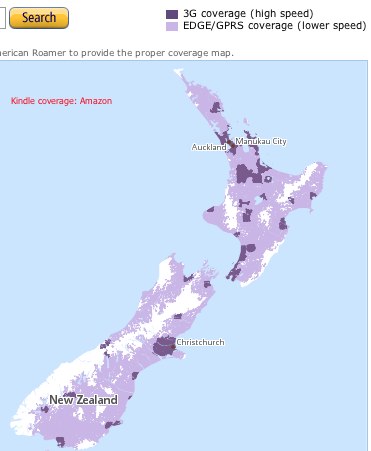
The Kindle and its bigger brethren the Kindle DX are now in GSM versions, and you can use it as intended – to wirelessly receive books, magazines and newspapers all over the place – even in New Zealand, with a map that is suspiciously like the Vodafone coverage map. My one is a CDMA USA version, so I can only look at this map and grimace.
But then I could always sell it on Trade Me or eBay, and upgrade to a localised one. So I went to the Kindle page, and saw this:
Let’s try Australia
While you don’t get the power plug, you can get the Kindle. So where else can we buy it from? Let’s continue with the beginning of the alphabet:
Albania:
American Samoa:
That’s interesting – what about the Samoa we are more familiar with?
Excellent! Now Canada should have it of course:
But who would have expected Turks and Caicos (where-ever they are)
and SVG (lovely place, but poor. Ask me about their coast guard)
and even East Timor (a brand new country with plenty of issues)
Palau has it – also very new, and its 20,000 people can now read on the Kindle:
and from the heights of Nepal
to the vast steppes of Russia – there are plenty in Asia and Europe that can buy the Kindle.
But who would have expected Rwanda?
and Vanuwatu gets in as well
But the real kicker – is that you can buy the Kindle in Zimbabwe.
But yes, as you know or have guessed, the Kindle is not available to us in New Zealand – perceived as the least corrupt place in the world, and measured as the 2nd easiest to do business.
That’s very difficult for us to understand. Very difficult.
So why – why is the Kindle not sold here? Does anyone know?
Making people print out a PDF and mail it back to you to register is no longer acceptable. It has not been acceptable for years.
Avis does a bit better, as does Hertz. However although it appears online sign-up to their programs is possible, they each have intimidatingly long forms to fill out.
Avis presents you with a long form in step two of four after selecting your country
and Hertz also presents you with a long form – but as the first of an amazing six steps.
Both sites have a USA feel, and I worried about my privacy given the rabid nature of customer information sharing in that country. So I checked a bit more and that worry was confirmed – here is how you opt-out of receiving email for Hertz:
To request to be removed from our e-mail list, please submit your request in writing and mail to: The Hertz Corporation, P.O. Box 25991, Oklahoma City, OK 73126, U.S.A. Please include your name, your #1 Club number and address.
And I thought printing out a PDF was bad. This is really sinister, and a terrible sign that a multi-national just simply does not understand the local market.
Then there is the disingenuous answer to this question:
Q: Has my personal data been shared with any other companies?
A: Unless you have previously provided consent, your personal data has not been shared with any companies other than Hertz, its affiliates and licensees for marketing purposes.
Of course consent is most likely given automatically during sign-up. I didn’t bother to go through the sign-up process to find out.
Instead let’s check Avis to see how they do it, as we can read their T&Cs in the first sign-up step. They say:
21. Avis shall hold information from the hirer … and the provision of related customer services, including direct marketing and assessing customer satisfaction with products and services of Avis. Avis may use the information for any of these purposes. The hirer is entitled to request access to and correction of these details at any time by contacting Avis.
There seems to be no opt-out from that at all. I’m not even sure that this is legal, as I understand, under New Zealand law. But then if you sign the contract, you sign up to receive the spam.
In the end I signed up to nobody’s program – the big three agencies had a chance to get my loyalty, and they all failed.
How to do it right?
Register first: A better approach could be to as me to “Register” or “Join” their program, requiring just an email address and password. Once registered then give me a better experience, (e.g. MyRentalco page) and ask me to “complete my profile to get your card” or similar. Once I am joined, I will feel more obliged and safe enough to add the extra information required so that I can get access to all my rental car transactions, and see my points rise.
Fix the Privacy
Let me opt-in and opt-out easily from the various marketing offers. Deliver your messages to people that want them, and they won’t be delivered straight to the spam folder. It’s also compliant with the law around here. This stuff is so basic – why am I even bothering?
Give it to me
I rent cars every two to four weeks. I use the same name, address, credit card and drivers license. Ask me whether you’d like to store my details for next time, track how much I spend and mail me my new platinum card for special frequent drivers.
Localise
It’s great to have one system, but it appears that the locals have little say in how it is presented here. Make a mix of economies of scale and genuine local engagement. As an example I have not seen @AvisNZ, @HertzNZ or @BudgetNZ (or any variations thereof) on Twitter. All of those IDs are available from Twitter, but for a measure of how pointless this all is check out @Avis. I don’t expect they read blog posts either.
Meanwhile my loyalty for now appears to be with Budget. The reason is simple – when you complete booking an Air New Zealand flight they make it easy to book a car with Avis or Budget by pre-populating a form and showing the options. While Budget and Avis have the same owner, their systems are different and Budget’s prices are always cheaper. So there you have it – Air New Zealand is doing Budget’s job for them.
Perhaps Air New Zealand should just start a rental car company?
Cool – here is a really simple way to write scripts – for OSX, Windows or Linux. (Download.) From MIT comes Sikuli script, where you just take screenshots of the buttons that you want the script to click. The picture above is of the resulting script – with those little graphics are screenshots of the buttons to click. Those clicks of course could be on websites, other applications or inside the operating system.
Each week I read The Independent, and each week some articles in it make me mad. This week I’m writing about it. Sadly none of the articles are online yet.
Air New Zealand and the Commerce Commisson
The News
The Commerce Commission is bringing criminal charges against Air New Zealand for price fixing. It all started with a raid on Air New Zealand in 2006, and a case in 2008. and the new news is that some information was released in a recent judgement by Justice Judith Potter.
What made me mad
Air NZ CEO Rob Fyfe has a great point – the ComCom has “always refused to provide Air New Zealand with details of the charges.” That’s shonky – to be accused of something without evidence being presented, especially for that long. Meanwhile Air New Zealand’s internal investigations turned up nothing, and they have been dragged through the press. The good news is that Justice Potter has ordered the ComCom to give that detailed information to Air New Zealand by February 9th. In the meantime this sordid exercise has dragged on for years, and Air New Zealand is not bothering to provision for any liability relating to the case. A good article by Denise McNabb.
Power Companies and their margins
The News
Power companies are “redoubling efforts to recoup lost margins.” Whatever
What made me mad
Contact’s year on year tariffs dropped 0.5% in 2009-10 financial year writer Pattrick Smellie found. (Good – remember that electricity company tariffs have been increasing sharply for years.) However “the additional costs of defending its customer base from competitors has added costs equivalent to 1.5 to 2% drop in average net retail tariffs”
It’s unclear whether those costs of defending the customer base were increased sales activities or discounts or bonuses applied to retain customers. I can say that I’ve heard many stories about people being offered incredibly sweet deals, and that the best way to get a retention phone call is to switch to Powershop. (You can do so and get $20 of free power by clicking on the flower above.)
But what makes me upset is that the 1.5 to 2% could have been used to drop tariffs, rather than on marketing activities. People are switching because they can get a better deal elsewhere – so why not offer them the best deal in the first place? If a business can afford to offer these sorts of incentives to stay, then clearly they are making fat margins, and customers are right to switch.
Auckland International Airport bought stakes in 2 other airports
The News
AIA purchased 25% of NQA – operators of Cairns and Mackay airports in Queensland, spending $166m to do so.
What made me mad
The pointlessness of this purchase – there is no synergy between the airports and a lack of control means that this is a financial investment not a strategic one. Airlines chose to fly to particular airports for the customers not the airport ownership. The AIA board would be far better off giving the money back to the shareholders and letting them make their own investment decisions. This smacks of agency cost – where the people that run AIA want to expand their empire for no worthy reason. So if you own AIA shares then sell them, they are not making good decisions.
Is it any surprise that the chap running AIA was the COO of Telecom when they made ill advised investments in Sky and INL in 2001? A well spotted coincidence by writer Jenny Ruth.
Amazing. Could any institution in New Zealand dream of doing something like this? They walk the line between sincere cheese and self deprecating irony beautifully.
Well done GMI. If you follow a recent advertisement for Gareth Morgan Investments and do the 10 Second test promo (five questions), click on “I’m not convinced – Tell me more” then you’ll get the screen above
“Leave me alone” is a wonderful way to acknowledge that this was a promotion, that we are all having fun here and most importantly although you are rejecting the product, it lets you walk away with a smile.
I can only assume that this is the influence of MOD.



















 Lance Wiggs